AI SDRs in 2026: Can AI Sales Reps Replace Your Team?
AI SDRs promise to automate prospecting, research, and outreach at scale. Here's how they actually work in 2026, what they cost, where they break, and when a human still wins.

TL;DR
- An AI SDR is software that handles the top-of-funnel sales development job — building lists, researching accounts, writing outreach, and booking meetings — with little human input.
- They are very good at volume, personalization at scale, and never-sleeping follow-up. They are bad at judgment, novel objections, and protecting your sender reputation when misconfigured.
- The category in 2026 splits into two camps: full "autonomous agent" platforms (11x, Artisan, AiSDR) and AI features bolted onto existing sequencers.
- The single biggest failure mode is not the AI — it's the data underneath it. Garbage contacts mean garbage outreach at machine speed.
- The realistic 2026 setup is a hybrid: AI SDR for research and drafting, a human for strategy and closing, and a clean data layer like a dedicated email finder feeding both.
What is an AI SDR?#
An AI SDR (Sales Development Representative) is an autonomous or semi-autonomous system that does the prospecting work a junior rep normally does: find the right accounts, identify the right people, research them, write tailored messages, send them across email and LinkedIn, and handle the back-and-forth until a meeting is booked.
Think of it like a self-driving car for the top of your funnel. A human still sets the destination — your ICP, your offer, your guardrails — but the system handles the lane-keeping: the repetitive list-building, the first-draft copy, the "did they reply yet?" follow-ups that eat a real rep's afternoon. Technically, it's a stack of LLMs for writing and reasoning, a data provider for contacts, and a sending engine wired into your inbox and CRM.
The promise is simple math. A human SDR sends maybe 50–100 quality touches a day. An AI SDR can run thousands, each one personalized against real signals, without lunch breaks or Monday-morning inertia. The catch is equally simple: speed multiplies whatever you point it at, including your mistakes.
How does an AI SDR actually work?#
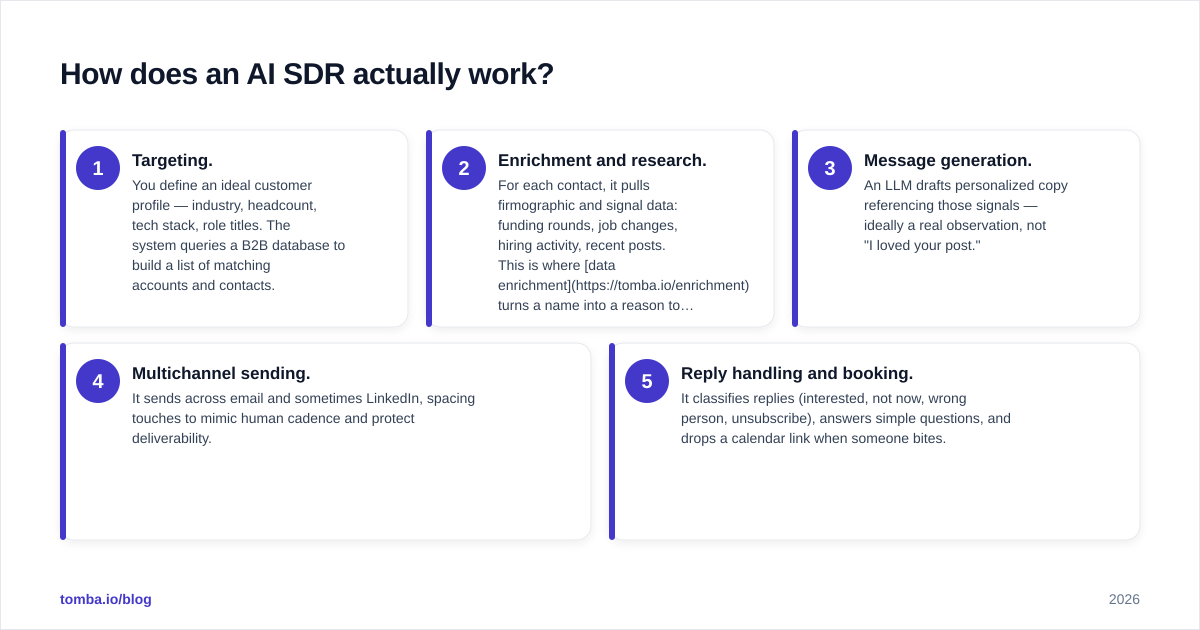
Most AI SDR platforms run the same five-stage loop, whether they brand it as an "agent" or not.
- Targeting. You define an ideal customer profile — industry, headcount, tech stack, role titles. The system queries a B2B database to build a list of matching accounts and contacts.
- Enrichment and research. For each contact, it pulls firmographic and signal data: funding rounds, job changes, hiring activity, recent posts. This is where data enrichment turns a name into a reason to reach out.
- Message generation. An LLM drafts personalized copy referencing those signals — ideally a real observation, not "I loved your post."
- Multichannel sending. It sends across email and sometimes LinkedIn, spacing touches to mimic human cadence and protect deliverability.
- Reply handling and booking. It classifies replies (interested, not now, wrong person, unsubscribe), answers simple questions, and drops a calendar link when someone bites.
The quality of stage 3 gets all the marketing attention, but stages 1 and 2 decide whether the whole thing works. An eloquent email to the wrong person at a dead address is worse than no email — it burns your domain. That's why teams running AI SDRs at scale obsess over verification, routing every address through an email verifier before a single message goes out.
Are AI SDRs better than human SDRs?#
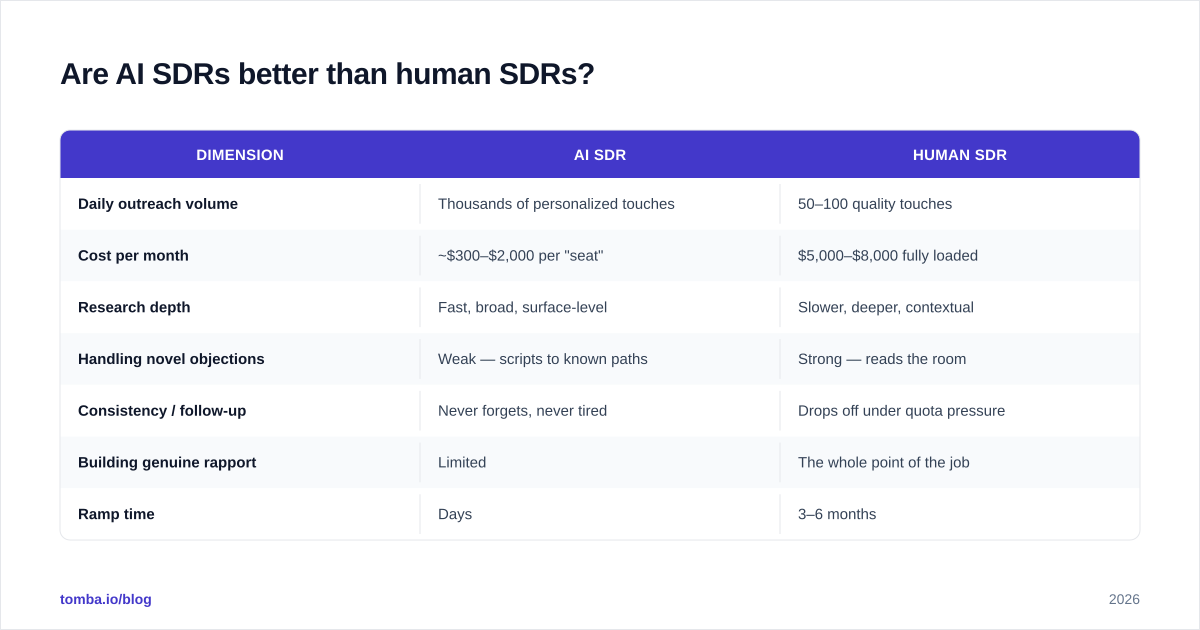
Short answer: not better, different. They win on volume and consistency; humans win on judgment and trust. The teams getting real results in 2026 stopped framing it as a replacement and started treating the AI SDR as a force multiplier for a smaller human team.
Here's the honest breakdown of where each side actually wins:
| Dimension | AI SDR | Human SDR |
|---|---|---|
| Daily outreach volume | Thousands of personalized touches | 50–100 quality touches |
| Cost per month | ~$300–$2,000 per "seat" | $5,000–$8,000 fully loaded |
| Research depth | Fast, broad, surface-level | Slower, deeper, contextual |
| Handling novel objections | Weak — scripts to known paths | Strong — reads the room |
| Consistency / follow-up | Never forgets, never tired | Drops off under quota pressure |
| Building genuine rapport | Limited | The whole point of the job |
| Ramp time | Days | 3–6 months |
| Risk if misconfigured | High — scales mistakes instantly | Contained to one person |
The pattern most playbooks converge on: let the AI handle the 80% of prospecting that is mechanical, and route the 20% that needs a human — the warm reply, the multi-threaded enterprise deal, the angry prospect — to a real person fast. According to HubSpot's research on sales AI adoption, reps increasingly spend their saved time on relationship-building and closing rather than list-building, which is exactly the division of labor that works.
What are the best AI SDR tools in 2026?#
The market has split into two distinct shapes, and picking the wrong shape for your team is the most common buying mistake.
Full autonomous platforms — 11x (Alice), Artisan (Ava), and AiSDR — sell a single "digital worker" that owns the whole loop end to end. You configure it, point it at an ICP, and it runs. These are powerful but opaque: when something goes wrong, you're debugging a black box, and you're locked into their data and sending stack.
AI-augmented sequencers — tools like Outreach, Salesloft, and newer entrants — keep a human in the driver's seat and layer AI into drafting, prioritization, and reply triage. You get more control and your existing data, but more manual setup.
A third path, increasingly popular with lean teams, is to assemble your own from best-of-breed parts: a top-tier data provider, a writing layer, and a sending tool. It's more work upfront but you own every component and your costs stay linear. If you go this route, the data layer is the part you should never cheap out on — feed it from a reliable domain search and bulk-enrich through a bulk email finder so the AI is always working from verified, current contacts.
Whatever you choose, evaluate it on G2 and against your own pilot data rather than the demo. The G2 sales engagement category is a reasonable place to compare verified user reviews before you commit budget.

How much do AI SDRs cost?#
Pricing in 2026 ranges from a few hundred to a few thousand dollars per month, and the headline number rarely tells the real story. The full autonomous platforms often price per "digital worker" plus usage, and many bundle data credits that run out faster than you expect — pushing you into overages or a forced upgrade.
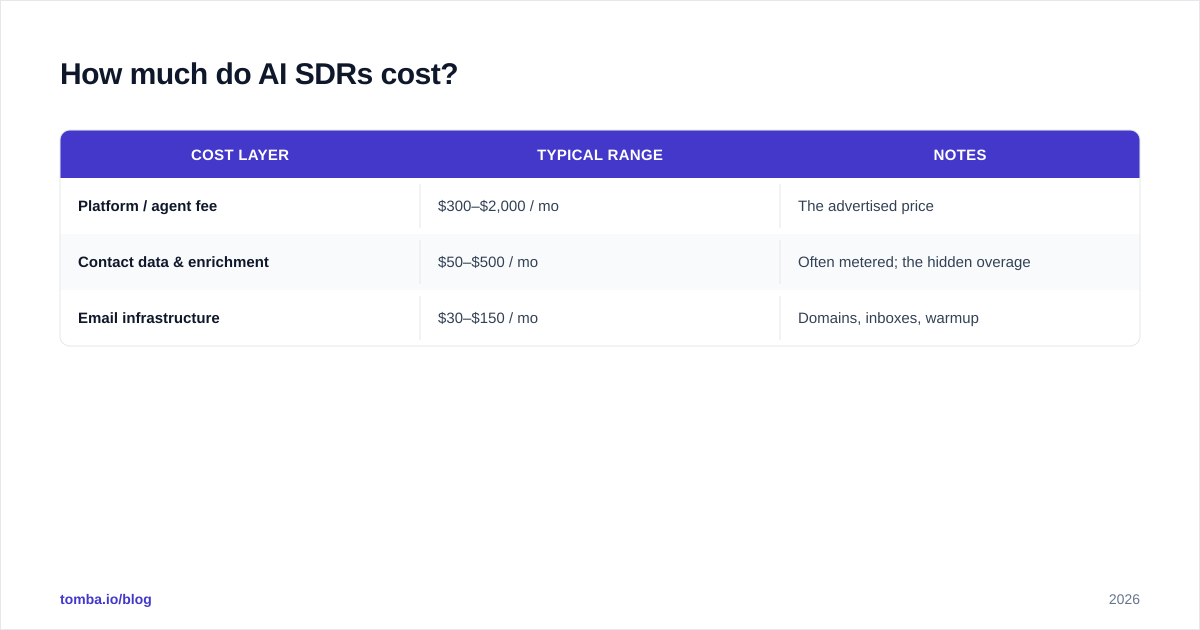
When you model cost, account for three layers, not one:
| Cost layer | Typical range | Notes |
|---|---|---|
| Platform / agent fee | $300–$2,000 / mo | The advertised price |
| Contact data & enrichment | $50–$500 / mo | Often metered; the hidden overage |
| Email infrastructure | $30–$150 / mo | Domains, inboxes, warmup |
That data layer is where many teams overpay through a bundled vendor. Running your contact discovery and verification through a standalone provider is usually cheaper and more accurate than the data baked into an all-in-one agent. Tomba's plans illustrate the gap: a Free tier covers 25 searches a month for testing, Starter is $49/mo, Growth $99/mo, and Pro $249/mo — predictable pricing you can actually forecast against, versus per-credit metering that spikes the month your campaign finally works.
What are the biggest risks of AI SDRs?#
The risks are real, and almost all of them trace back to scale: AI SDRs don't create new failure modes so much as they make old ones happen a thousand times faster.
Deliverability damage. The number-one way teams blow themselves up is volume without hygiene. Sending thousands of emails to unverified addresses spikes your bounce rate, trips spam filters, and tanks your domain reputation — sometimes permanently. Every address should pass verification first, and catch-all domains need special handling through a catch-all verifier so you're not guessing. Google's own Postmaster Tools guidance on bulk sending is the baseline every AI SDR config should respect.
Generic personalization. "AI personalization" that references a LinkedIn headline isn't personalization — prospects spot it instantly, and it makes you look worse than a plain template. The fix is feeding the AI real, structured signals, not letting it improvise from thin data.
Compliance exposure. Automated outreach at scale runs straight into GDPR, CAN-SPAM, and CCPA. The AI doesn't know your legal obligations unless you build them into the guardrails — suppression lists, opt-outs, and consent rules.
The black-box problem. When a fully autonomous agent starts underperforming, you often can't see why. Was it the list? The copy? The timing? Platforms that hide the mechanics make iteration slow.
The throughline: an AI SDR amplifies your inputs. Clean data, tight ICP, and real guardrails turn it into leverage. Skip those, and you've just automated the fastest way to ruin a domain.
When should you actually deploy an AI SDR?#
Deploy one when you have a proven, repeatable motion you want to scale — not when you're still figuring out who your customer is. AI SDRs are accelerators, and accelerating in the wrong direction just gets you lost faster.
You're ready if: your ICP is well-defined, you have messaging that already converts when a human sends it, your CRM and data are clean, and you have a human ready to take warm handoffs. You're not ready if you're hoping the AI will discover your market for you, or if your contact data is a stale spreadsheet from last year.
Start narrow. Pick one segment, run the AI SDR alongside a human control group, and compare reply and meeting rates over four to six weeks. Watch your bounce and spam metrics like a hawk. Scale only the plays that beat your human baseline on quality, not just volume.
The bottom line#
AI SDRs in 2026 are a genuine step-change in prospecting capacity — and a genuinely fast way to damage your reputation if the data underneath them is weak. The winning teams aren't choosing between AI and humans; they're pairing a lean human team with AI leverage, and they're investing in the data layer that makes both work.
That data layer is the highest-leverage decision you'll make. Before you point any AI SDR at your market, make sure every contact it touches is real and reachable. Tomba's Email Finder gives your AI SDR — or your own assembled stack — verified professional emails by name, company, or domain, with built-in verification so your sending stays clean and your reply rates stay honest. Start free with 25 searches and feed your outreach engine data it can trust.
// get started
Find, verify and enrich your first contacts today
Start on the free plan with 25 searches a month, then scale when your team is ready.
Free plan · No credit card required · GDPR & CCPA
// about the author