AI Skills for Sales Reps: The 2026 Upskilling Playbook
The AI skills for sales reps that actually move quota in 2026 — prompting, data hygiene, AI-assisted prospecting, and the workflows that separate top closers from the replaced.
TL;DR
- The AI skills for sales reps that matter in 2026 aren't "use ChatGPT" — they're prompting precision, data verification, AI-assisted research, and judgment about when to override the model.
- Reps who treat AI as a co-pilot (not an autopilot) book more meetings per hour because they compress research, personalization, and CRM admin into minutes.
- The biggest skill gap isn't technical: it's learning to feed AI clean, verified contact and account data so the output isn't confidently wrong.
- Use the four-layer skill framework below to self-assess, then close gaps in the order that compounds fastest.
- AI replaces tasks, not reps — but it does replace reps who refuse to learn the tasks.
Why are AI skills for sales reps suddenly non-negotiable?#
Because the baseline moved. A rep who manually researches every account, hand-writes every cold email, and logs every call by hand now competes against a rep who does the same volume in a third of the time with AI assistance. Same quota, very different effort curve.
This isn't hype. Gartner predicts that a large share of B2B seller tasks will be augmented or automated by generative AI within this cycle, and the reps who win are the ones who learned to direct the tools rather than fear them. The skill is no longer "knowing AI exists." Everyone knows. The skill is using it well enough that your pipeline shows it.
Here's the uncomfortable framing: AI is very good at the parts of selling that are repetitive and language-heavy — research summaries, first-draft emails, call notes, objection rebuttals. It is bad at the parts that require trust, timing, and reading a room. So the reps who thrive offload the first category aggressively and double down on the second. The ones who struggle do the opposite — they automate the human moments and grind manually through the busywork.
What does "AI skills for sales reps" actually mean in practice?#
It means four distinct competencies, and most reps are strong in one and blind in the others. Naming them is half the battle.
Layer 1 — Input quality (the data skill). AI output is only as good as the contact and account data you feed it. A perfectly prompted personalization engine writes a perfect email to the wrong person at a bounced address. This is the most underrated skill and the one with the highest ROI. It means knowing how to source, enrich, and verify contact data before a single token is generated.
Layer 2 — Prompting (the language skill). Writing instructions that produce usable output on the first or second try, not the seventh. Reps who prompt well give context, constraints, examples, and a clear job-to-be-done. Reps who prompt badly type "write a cold email" and paste whatever comes back.
Layer 3 — Judgment (the editing skill). Knowing when the model is wrong, bland, or hallucinating — and fixing it fast. AI drafts are a starting line, not a finish line. The rep's edge is taste: cutting the fluff, catching the fabricated stat, adding the one specific detail that makes a prospect reply.
Layer 4 — Workflow integration (the systems skill). Wiring AI into your CRM, your sequencing tool, and your daily routine so it saves time instead of adding a tab to babysit. This is where most "AI training" fails — reps learn a tool in a vacuum and never connect it to where work actually happens.
Which AI skills should a sales rep learn first?#
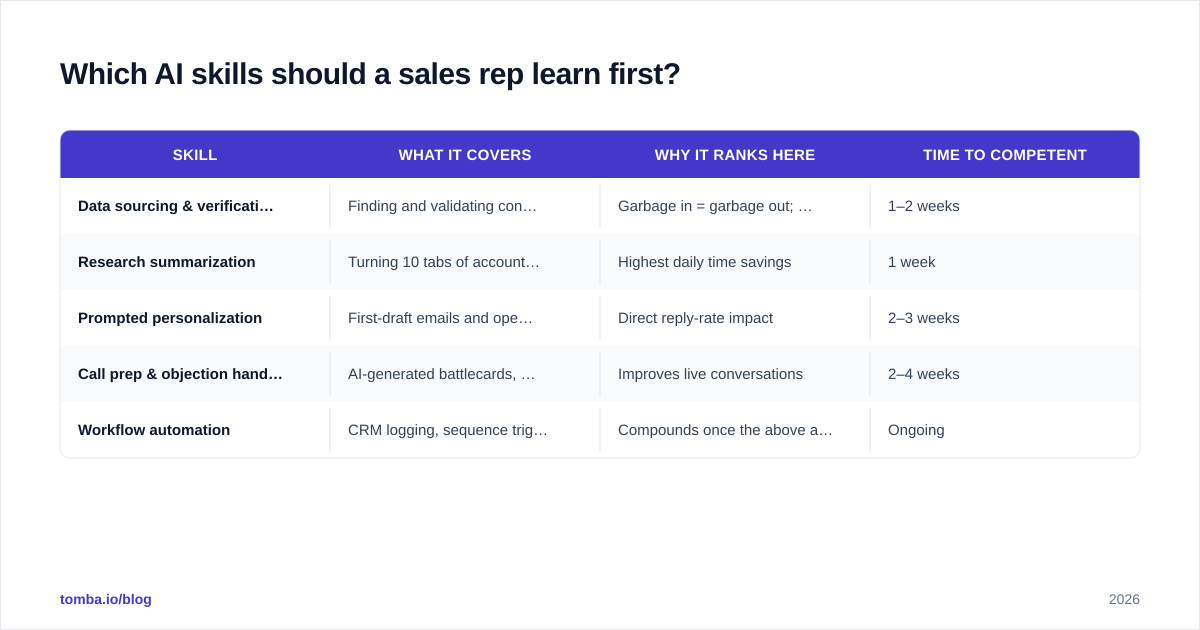
Learn them in the order that compounds. Don't start with prompt-engineering tricks — start with the data layer, because clean inputs make every other layer work better.
| Skill | What it covers | Why it ranks here | Time to competent |
|---|---|---|---|
| Data sourcing & verification | Finding and validating contact info, enriching accounts | Garbage in = garbage out; fixes the root cause | 1–2 weeks |
| Research summarization | Turning 10 tabs of account intel into a 5-line brief | Highest daily time savings | 1 week |
| Prompted personalization | First-draft emails and openers at scale | Direct reply-rate impact | 2–3 weeks |
| Call prep & objection handling | AI-generated battlecards, discovery questions | Improves live conversations | 2–4 weeks |
| Workflow automation | CRM logging, sequence triggers, follow-up drafts | Compounds once the above are solid | Ongoing |
Notice the pattern: the skills with the shortest ramp and the deepest root-cause impact come first. A rep who can verify data and summarize research is already faster than 80% of the floor, before touching a single "AI email writer."
How do you build the data skill (the one everyone skips)?#
Start by accepting a hard truth: AI will happily personalize an email to a person who left the company eight months ago. The model has no idea. It trusts your input completely, which means your input has to earn that trust.
The practical workflow looks like this. You identify a target account, pull the right contacts, and — critically — verify those contacts before they enter any AI sequence. That verification step is where a tool like a dedicated email finder earns its keep: you give it a name and a domain, it returns a deliverable address with a confidence score instead of a guess. Pair that with an email verifier to catch the addresses that will bounce, and your AI is now writing to real, reachable humans.
Then layer in data enrichment so the model has something to personalize with — role, company size, recent signals. The difference between "Hi {{first_name}}, I wanted to reach out" and a genuinely specific opener is entirely a data problem, not a writing problem. The AI can write either one; only good data lets it write the good one.
A rep who masters this layer stops blaming the AI for bland output. They realize bland output is usually starved output.
What does great AI prompting look like for a sales rep?#
Great prompting is specific, constrained, and seeded with examples. Here's the contrast.
Weak prompt: "Write a cold email to a VP of Sales about our software."
Strong prompt: "Write a 90-word cold email to a VP of Sales at a 200-person B2B SaaS company. Context: they recently posted three SDR job openings, which suggests they're scaling outbound. Our product helps teams find and verify B2B contact data. Tone: direct, no fluff, no 'I hope this finds you well.' One clear ask: a 15-minute call. End with a soft question, not a hard pitch. Here's an email of ours that worked: [paste]."
The second prompt produces something usable because it carries context (the job postings), constraints (90 words, tone rules), and a reference example. The model isn't guessing your taste — you told it.
A few prompting habits that separate strong reps:
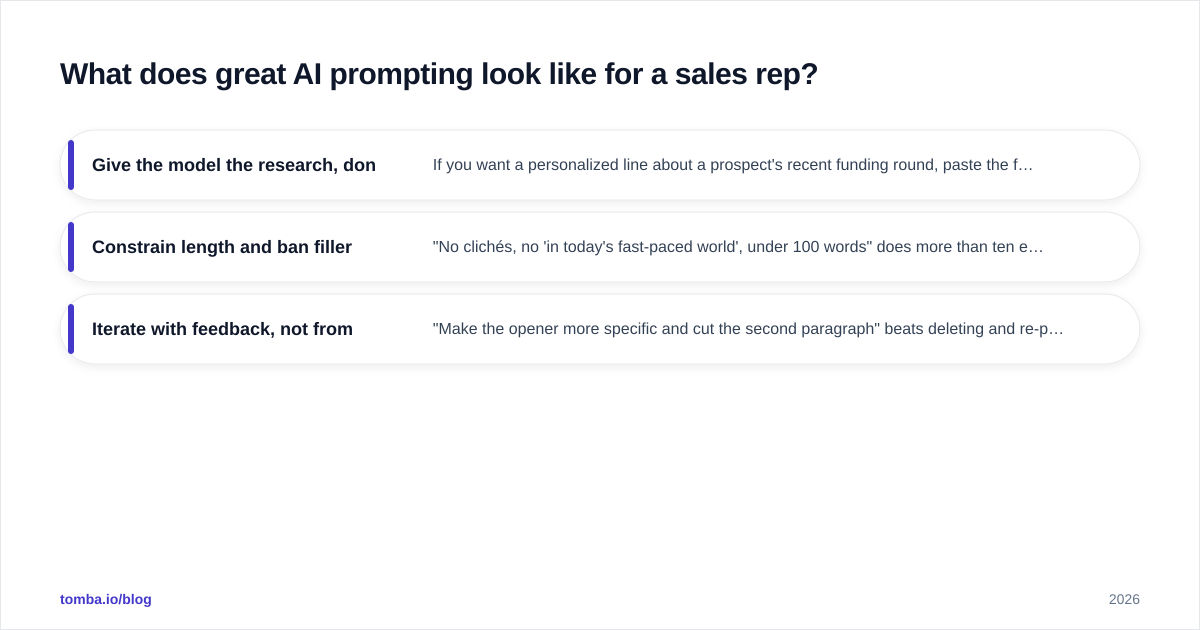
- Give the model the research, don't ask it to invent the research. If you want a personalized line about a prospect's recent funding round, paste the funding news in. Asking AI to "find" current facts about a specific small company invites hallucination.
- Constrain length and ban filler explicitly. "No clichés, no 'in today's fast-paced world', under 100 words" does more than ten edits later.
- Iterate with feedback, not from scratch. "Make the opener more specific and cut the second paragraph" beats deleting and re-prompting.
If you want a faster on-ramp, a purpose-built cold email AI bakes a lot of these constraints in so you're editing rather than architecting prompts from zero.
How is AI-assisted prospecting different from "spray and pray"?#
The fear is that AI just makes bad outreach faster — more volume, more spam, more burned domains. That fear is justified for reps who skip the judgment layer. It's wrong for reps who use it well.
AI-assisted prospecting done right is more targeted, not less. The workflow: AI summarizes the account so you understand it in 60 seconds, AI drafts a personalized opener grounded in verified data, and then you — the human — decide whether this prospect is even worth the touch. The model expands your research capacity; your judgment narrows the targeting. Volume goes up and relevance goes up at the same time, which is the only combination that survives modern spam filters and modern buyers.
Contrast that with spray-and-pray, where volume goes up and relevance collapses. Buyers can smell a mail-merge that an AI clearly wrote without supervision. The tell is always the same: generic specificity — a personalized-looking line that says nothing real. That's the signature of skipping the data and judgment layers.
HubSpot's research on sales trends keeps landing on the same point: personalization and relevance drive reply rates, and AI is a multiplier on whatever you already are. It makes a thoughtful prospector dramatically more efficient and a lazy one dramatically more annoying.
Will AI replace sales reps who don't learn these skills?#
It replaces the tasks first, then the reps who were only doing those tasks. The honest version: if your entire value was manually researching contacts, copy-pasting templates, and logging calls, AI does that now, and it does it cheaper. If your value is building trust, navigating complex deals, and exercising judgment, AI makes you faster at the busywork so you spend more time on the irreplaceable part.
The reps at risk aren't the ones who are "bad at technology." They're the ones who refuse to move tasks off their plate. There's a strange pride in doing things manually that quietly becomes a liability when the rep next to you closes more by working smarter. You can read more on how teams are restructuring around this in our coverage of sales automation.
Here's the reframe that helps: AI doesn't compete with you for the deal. It competes with the version of you that wastes two hours a day on tasks a machine handles in ten minutes. Beat that version of yourself and you're fine.
What's a realistic 30-day plan to build these skills?#
You don't need a bootcamp. You need a focused month and a willingness to be slightly slower for two weeks so you can be much faster forever.
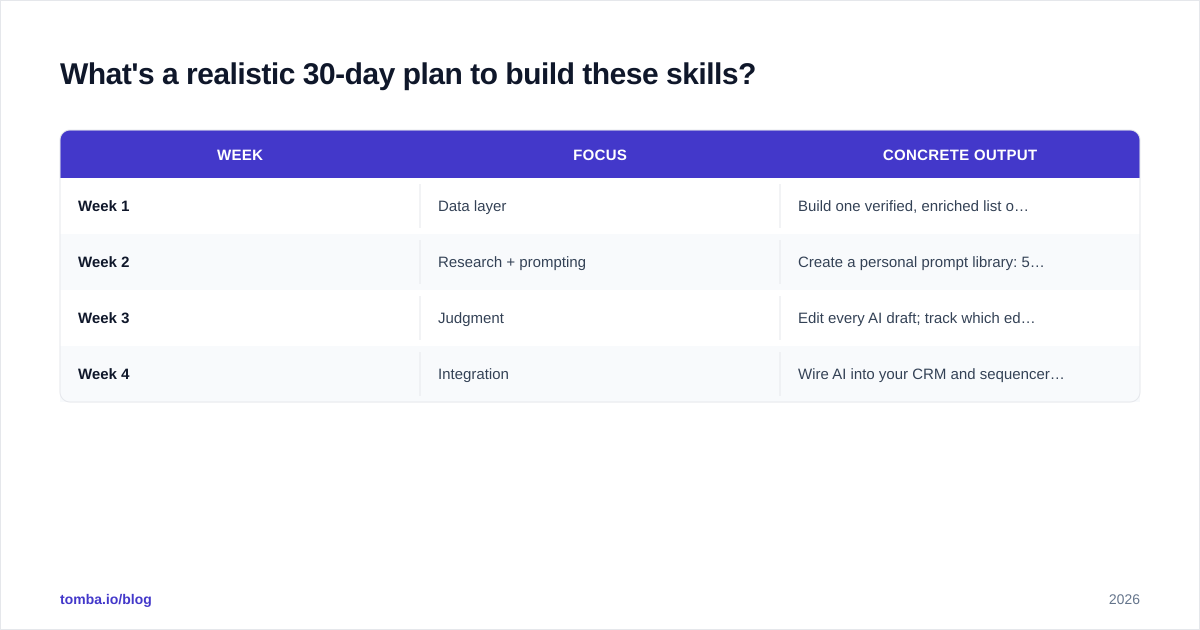
| Week | Focus | Concrete output |
|---|---|---|
| Week 1 | Data layer | Build one verified, enriched list of 50 target contacts; zero guessed emails |
| Week 2 | Research + prompting | Create a personal prompt library: 5 prompts you reuse daily |
| Week 3 | Judgment | Edit every AI draft; track which edits you make most, codify them |
| Week 4 | Integration | Wire AI into your CRM and sequencer; measure time-per-touch before/after |
A few notes on making it stick. Keep a running prompt doc — your best prompts are assets, not throwaways. Track one metric (meetings booked per hour worked) before and after, so you have proof the upskilling worked rather than a vibe. And lean on tools that meet you where you work: a Chrome extension that surfaces verified contact data inside LinkedIn removes the tab-switching tax that kills most new workflows.
If you operate at scale or you're technical, the same capabilities are available through the Tomba API and an MCP server, so AI agents you build can pull verified data directly instead of hallucinating it. That's the frontier skill: not just using AI tools, but feeding your own AI workflows trustworthy data.
How do you know if your AI skills are actually working?#
Measure outputs, not activity. "I used AI today" is not a result. These are:
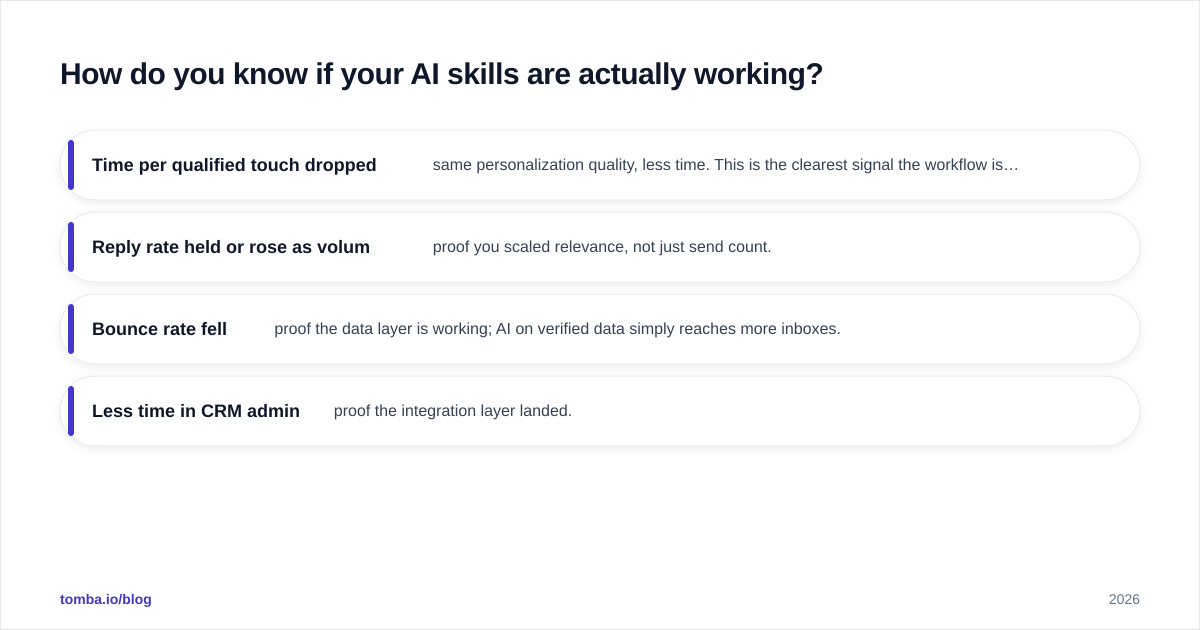
- Time per qualified touch dropped — same personalization quality, less time. This is the clearest signal the workflow is real.
- Reply rate held or rose as volume rose — proof you scaled relevance, not just send count.
- Bounce rate fell — proof the data layer is working; AI on verified data simply reaches more inboxes.
- Less time in CRM admin — proof the integration layer landed.
If you scaled volume and your reply rate cratered, you skipped the judgment and data layers — you're spraying faster. If your bounce rate is high, fix the data layer before anything else; no prompt rescues a dead address.
The bottom line#
The AI skills for sales reps that matter in 2026 are a stack: clean data at the bottom, sharp prompting and judgment in the middle, workflow integration on top. Reps who build the stack in that order win more meetings per hour and spend their saved time where humans still beat machines — building trust and closing complex deals. Reps who chase prompt tricks while feeding the model garbage data get faster at being wrong.
Start at the foundation. Before you automate a single email, make sure every contact in your sequence is a real, reachable person. Try the Tomba Email Finder to source and verify B2B contacts by name, company, or domain — the free tier gives you 25 searches a month to test it against your own list, and paid plans start at $49/mo (see Tomba pricing for the full breakdown). Get the data layer right, and every AI skill you build on top of it starts paying off immediately.
// get started
Find, verify and enrich your first contacts today
Start on the free plan with 25 searches a month, then scale when your team is ready.
Free plan · No credit card required · GDPR & CCPA
// about the author