AI Tools for Email Marketing in 2026: The Complete Guide
AI now writes subject lines, segments lists, predicts send times, and cleans your data. Here's how the best AI tools for email marketing actually stack up in 2026 — and where they quietly fail.
TL;DR
- AI tools for email marketing now cover four distinct jobs: writing copy, segmenting audiences, optimizing send timing/deliverability, and enriching the underlying contact data. No single tool does all four well.
- The biggest 2026 shift is generative subject lines and body copy baked directly into ESPs like Mailchimp and HubSpot — but they only work if your list data is clean and your sender reputation is healthy.
- "AI" on a vendor's homepage usually means one of three things: a GPT wrapper for copy, a predictive send-time model, or list hygiene scoring. Ask which one before you pay.
- Garbage in, garbage out still rules. The fanciest AI personalization fails if 20% of your emails bounce. Data quality and verification are the unglamorous foundation.
- Below: a feature-by-feature comparison table, a buyer's framework, and a realistic view of where each category of tool earns its price.
What counts as an "AI tool for email marketing" in 2026?#
Short answer: four separate categories wearing one label. When a vendor says "AI-powered email marketing," they almost always mean one of these jobs — rarely all of them.
Think of email marketing like running a restaurant. You need someone to write the menu (copy), seat the right guests at the right tables (segmentation), time the courses (send optimization), and make sure the reservation list isn't full of fake names (data quality). "AI" might be helping in the kitchen or at the front desk — but a vendor rarely tells you which.
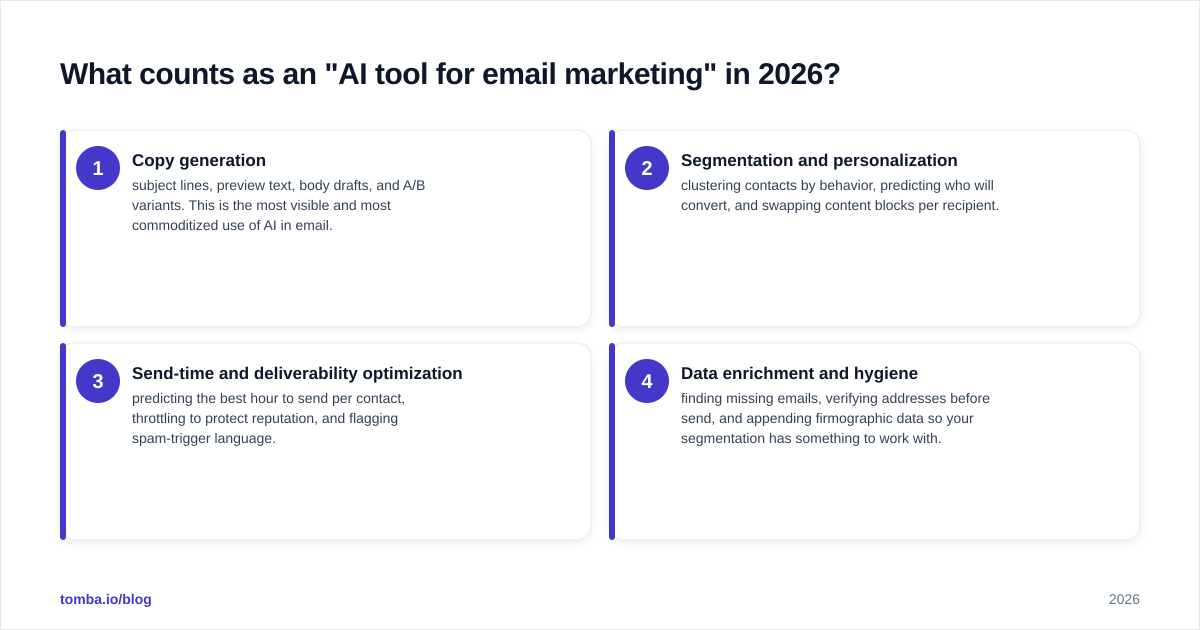
Here are the four jobs AI actually does today:
- Copy generation — subject lines, preview text, body drafts, and A/B variants. This is the most visible and most commoditized use of AI in email.
- Segmentation and personalization — clustering contacts by behavior, predicting who will convert, and swapping content blocks per recipient.
- Send-time and deliverability optimization — predicting the best hour to send per contact, throttling to protect reputation, and flagging spam-trigger language.
- Data enrichment and hygiene — finding missing emails, verifying addresses before send, and appending firmographic data so your segmentation has something to work with.
Most "AI email marketing platforms" are strong in one or two of these and thin in the rest. The trap is assuming a tool that writes great subject lines also keeps your list clean. It usually doesn't.
Which AI tools for email marketing are worth comparing?#
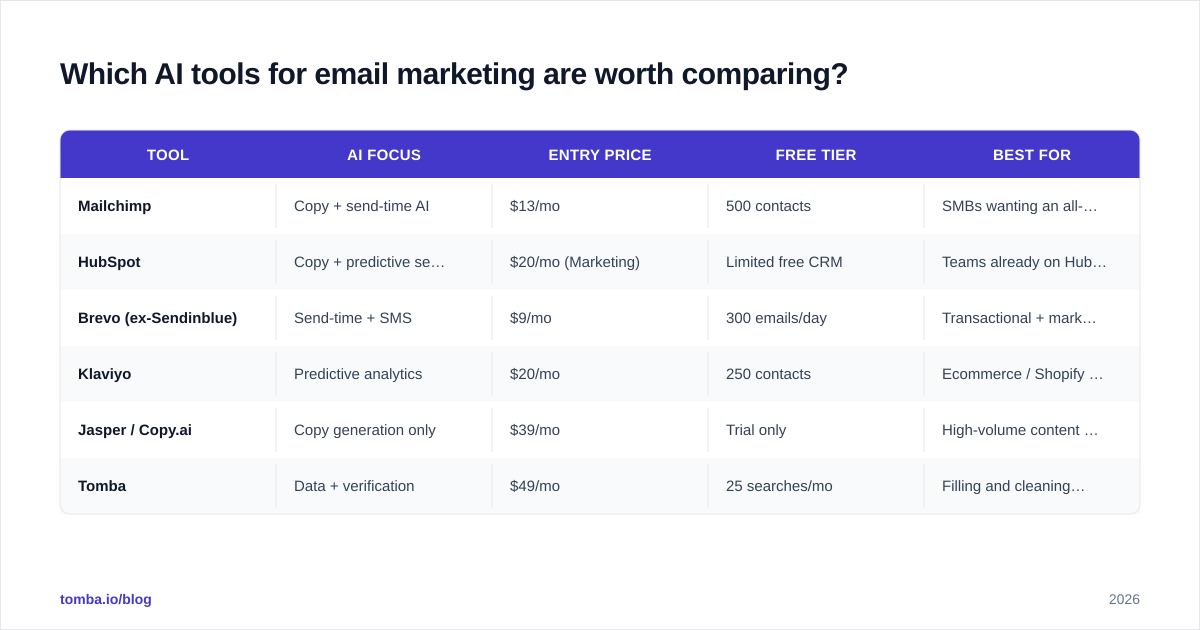
Below is a head-to-head across the tools marketers actually shortlist in 2026. Pricing reflects published entry tiers; "AI focus" is the job the tool genuinely does well, not its marketing claim.
| Tool | AI focus | Entry price | Free tier | Best for |
|---|---|---|---|---|
| Mailchimp | Copy + send-time AI | $13/mo | 500 contacts | SMBs wanting an all-in-one ESP |
| HubSpot | Copy + predictive segmentation | $20/mo (Marketing) | Limited free CRM | Teams already on HubSpot CRM |
| Brevo (ex-Sendinblue) | Send-time + SMS | $9/mo | 300 emails/day | Transactional + marketing mix |
| Klaviyo | Predictive analytics | $20/mo | 250 contacts | Ecommerce / Shopify stores |
| Jasper / Copy.ai | Copy generation only | $39/mo | Trial only | High-volume content teams |
| Tomba | Data + verification | $49/mo | 25 searches/mo | Filling and cleaning the list itself |
A few honest notes on this table. Jasper and Copy.ai are pure copy engines — they don't send anything, so you're paying a second subscription on top of your ESP. Klaviyo's predictive AI is genuinely strong but only shines with ecommerce purchase data behind it. And the cheapest entry prices hide the real cost: every one of these scales with contact count, so a 50,000-contact list lands you in the hundreds-per-month range fast.
Tomba sits in a different column on purpose. It isn't an ESP — it's the layer that makes the others work, by supplying verified addresses and enrichment data. More on why that matters below.

Is AI-written email copy actually better?#
Conclusion first: AI copy is faster and rarely worse than a rushed human draft — but it does not beat a marketer who knows the audience. It beats a blank page.
Generative subject lines are the clearest win. Tools that produce 10 variants in two seconds let you A/B test breadth you'd never write by hand. If you want to try this without committing to a platform, a focused subject line generator gets you most of the value for free, and a cold email AI writer can rough out body copy for outbound sequences.
Where AI copy breaks down:
- Brand voice drift. Default model output is polished and generic. Without a tuned prompt or a style guide fed in, every email reads like every other AI email — and recipients have started to notice.
- Hallucinated specifics. AI will confidently invent a stat, a case study, or a product feature. Every claim in an AI draft needs a human check before it ships.
- Deliverability blind spots. A model optimizing for "engaging" language will happily write spam-trigger phrases ("FREE!!!", "act now") that tank your inbox placement.
The realistic workflow in 2026: let AI draft, then have a human edit for voice, accuracy, and spam-safety. Treat the model as a fast intern, not a copy chief. Run drafts through a spam checker before they go anywhere near your list.
According to HubSpot's research on AI in marketing, the marketers seeing real lift aren't the ones who automate copy end-to-end — they're the ones using AI to produce more variants and then testing harder.
Can AI fix email deliverability and send timing?#
Partially. AI is good at predicting when to send and who is likely to engage. It cannot rescue a damaged sender reputation or a dirty list — those are physics, not prediction problems.
Predictive send-time optimization, offered by Mailchimp, HubSpot, and Brevo, learns each contact's open patterns and schedules accordingly. In practice it's worth a few percentage points of open rate — real, but not transformative.
The deliverability features that matter more are unglamorous and increasingly AI-assisted:
- Spam-language scoring before send, flagging phrases likely to trip filters.
- Engagement-based list pruning, where AI identifies chronically unengaged contacts you should suppress to protect your domain reputation.
- Send throttling that ramps volume gradually instead of blasting, protecting your sender reputation.
But here's the part vendors gloss over: AI send-time optimization assumes your email arrives. If your domain authentication is broken or your bounce rate is high, no amount of timing AI helps. Get your email deliverability fundamentals — SPF, DKIM, DMARC, warmup — in place first. The AI layer is a multiplier on a healthy foundation, not a substitute for one.
A practical sequence: verify the list, warm the domain, then turn on predictive sending. Do it in the other order and you're optimizing the timing of emails that land in spam.
Why does data quality decide whether any AI tool works?#
Because every AI feature above runs on your contact data — and most lists are dirtier than marketers think. This is the single biggest reason expensive AI email stacks underperform.
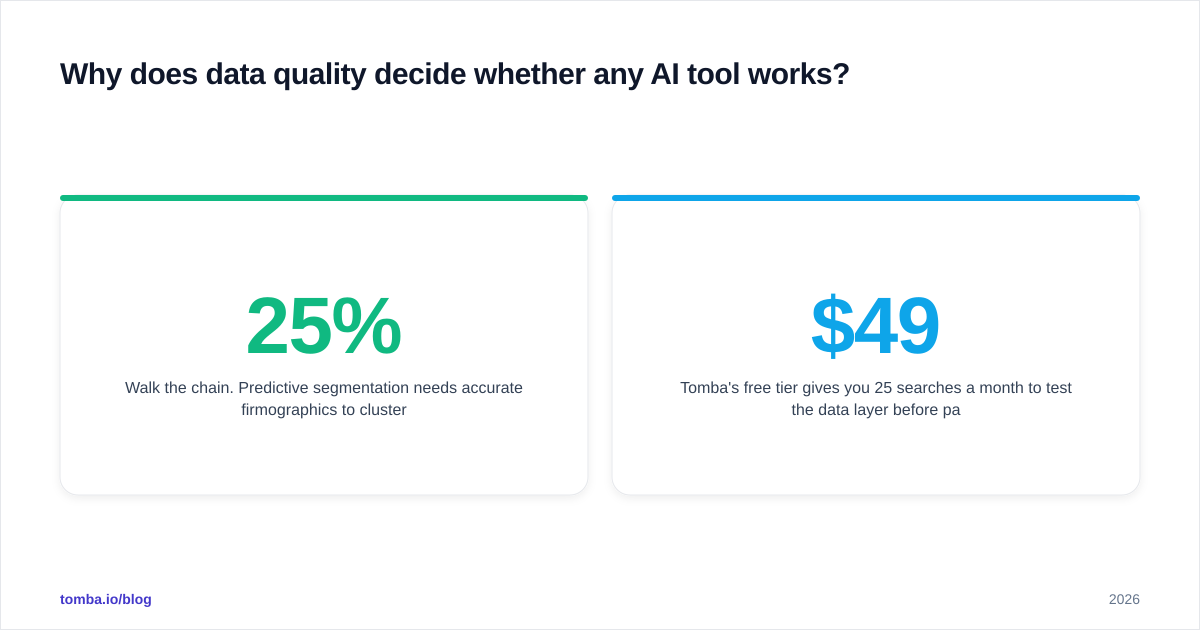
Walk the chain. Predictive segmentation needs accurate firmographics to cluster contacts. Personalization needs correct names and companies to merge into copy. Send-time AI needs real, deliverable addresses to learn from. If 15–25% of your list is invalid, decayed, or missing fields, every downstream AI model is training on noise.
This is where the "AI tools for email marketing" conversation usually skips the foundation. The fix isn't more AI on the marketing side — it's clean inputs:
- Verify before you send. Run new and existing contacts through an email verifier to strip invalid and risky addresses. This alone protects deliverability and saves send credits.
- Fill the gaps. When you have a name and company but no address, an email finder recovers the contact instead of dropping the lead.
- Enrich for segmentation. Data enrichment appends job title, company size, and industry so your AI segmentation has real attributes to work with.

Tomba's free tier gives you 25 searches a month to test the data layer before paying. Paid plans start at $49/mo on Starter, $99/mo on Growth, and $249/mo on Pro — full Tomba pricing is public. Compared to the per-contact billing of most ESPs, the data layer is a flat, predictable cost that makes everything above it perform better.
How do you choose the right AI email stack?#
Don't buy a single "AI email platform" and assume it covers everything. Assemble a stack across the four jobs, and weight your spend toward whichever job is currently your bottleneck.
Use this framework to diagnose where AI actually helps you:
- If your problem is "I can't write fast enough" → invest in copy AI (your ESP's built-in tool first; Jasper/Copy.ai only if you need volume beyond it).
- If your problem is "my sends are generic" → invest in segmentation/personalization AI (Klaviyo for ecommerce, HubSpot for B2B).
- If your problem is "my open rates are dropping" → audit deliverability before buying send-time AI. Check authentication and list hygiene first.
- If your problem is "my list is small, stale, or bouncing" → fix the data layer with finding, verification, and enrichment. This is the most common hidden bottleneck.
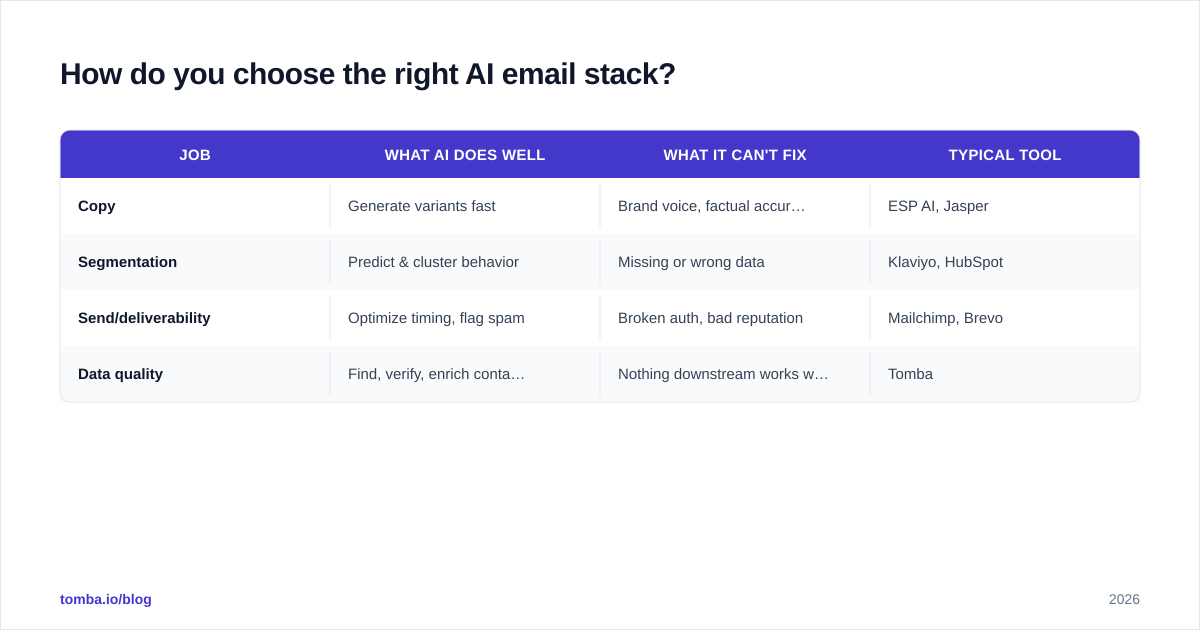
Here's a side-by-side of the four jobs so you can see where your budget should go:
| Job | What AI does well | What it can't fix | Typical tool |
|---|---|---|---|
| Copy | Generate variants fast | Brand voice, factual accuracy | ESP AI, Jasper |
| Segmentation | Predict & cluster behavior | Missing or wrong data | Klaviyo, HubSpot |
| Send/deliverability | Optimize timing, flag spam | Broken auth, bad reputation | Mailchimp, Brevo |
| Data quality | Find, verify, enrich contacts | Nothing downstream works without it | Tomba |
Most teams over-invest in the top two rows and ignore the bottom one. Then they wonder why their "AI personalization" produces "Hi {FirstName}" emails to addresses that bounce. Independent review sites like G2's email marketing category are useful for shortlisting within each row — just read the reviews for the specific job, not the overall star rating.
What's the realistic 2026 verdict?#
AI tools for email marketing are no longer optional, but they're also not magic. The category has matured into clear lanes:
- Copy AI is good enough to draft and should be standard in your workflow — with human editing.
- Segmentation AI earns its price when you have rich, clean data feeding it.
- Send-time and deliverability AI is a modest multiplier on a healthy sending foundation.
- Data quality tooling is the quiet determinant of whether any of the above works at all.
The marketers winning in 2026 aren't the ones with the most AI subscriptions. They're the ones who fixed their data first, then layered AI on top. The order matters more than the tool count.
If your email program is underperforming, start by auditing the input — not the output. Run your list through verification, recover missing contacts, and enrich what's thin. Then turn on the AI features your ESP already includes and measure the lift on a clean foundation.
Ready to fix the layer everything else depends on? Start with the Tomba Email Finder to recover and verify the contacts your AI marketing stack is starving for. The free tier gives you 25 searches to prove it works before you pay — clean data in, real results out. Your subject-line AI can wait; your list quality can't.
// get started
Find, verify and enrich your first contacts today
Start on the free plan with 25 searches a month, then scale when your team is ready.
Free plan · No credit card required · GDPR & CCPA
// about the author