Best AI Tools for Prospecting in 2026: A Practical Guide
AI prospecting tools promise to fill your pipeline on autopilot. Here's what actually works in 2026, where AI helps, and how to build a stack that converts.
AI tools for prospecting have gone from novelty to table stakes. The question in 2026 is no longer "should we use AI to find buyers?" — it's "which parts of prospecting should AI own, and which should stay human?" This guide answers both, with a stack you can build this quarter.
TL;DR#
- AI is strongest at the boring middle of prospecting: list building, enrichment, signal monitoring, and first-draft personalization. It is weakest at judgment — qualifying, multithreading, and handling objections.
- A working 2026 stack has three layers: a data layer (find and verify contacts), a signal layer (know when to reach out), and an execution layer (sequence and personalize at scale).
- Accuracy beats volume. A tool that sends 10,000 emails to stale addresses will torch your domain faster than it books meetings.
- Don't buy one mega-suite expecting it to do everything well. The best-performing teams combine a precise email-finder with a lightweight outreach engine and a CRM of record.
- Tomba anchors the data layer: verified B2B emails by name, domain, or company, starting free.
What are AI tools for prospecting?#
AI tools for prospecting are software that uses machine learning to identify potential buyers, gather their contact and company data, score their likelihood to buy, and help you reach out at the right moment with the right message. Think of them as a research assistant who never sleeps: they read thousands of public signals — job changes, funding rounds, hiring spikes, tech-stack changes — and surface the handful that matter to you today.
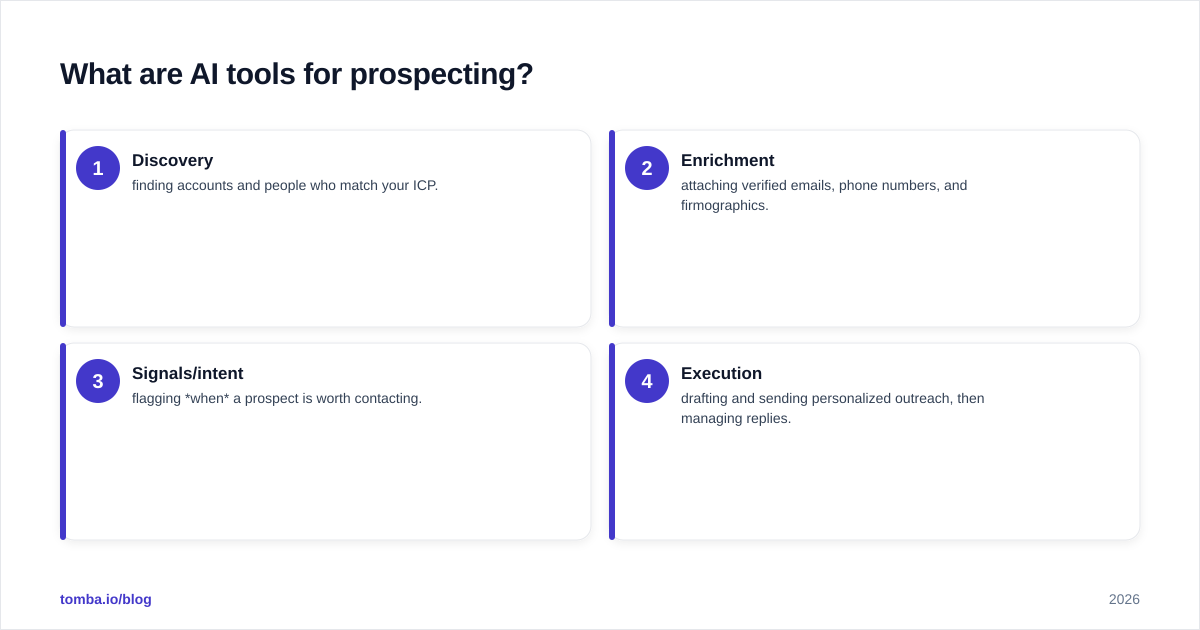
The category spans four jobs:
- Discovery — finding accounts and people who match your ICP.
- Enrichment — attaching verified emails, phone numbers, and firmographics.
- Signals/intent — flagging when a prospect is worth contacting.
- Execution — drafting and sending personalized outreach, then managing replies.
No single tool does all four exceptionally. The mistake most teams make is buying a "platform" that does four things at a B-minus instead of stitching together three tools that each earn an A.
Where does AI actually help in prospecting?#
AI earns its keep in the repetitive, pattern-heavy parts of the funnel. Here's the honest split.
AI wins:
- List building from messy inputs. Give it a domain or a LinkedIn page and it returns structured contacts. Manually, this is hours; with a tool, seconds.
- Enrichment and verification at scale. Matching a name to a deliverable email across millions of records is a math problem, and machines are good at math.
- Intent and signal monitoring. Watching 500 target accounts for a trigger event is impossible by hand and trivial for software.
- First-draft personalization. AI can scan a prospect's recent post or press release and propose an opener. You still edit it.
Humans win:
- Qualification judgment. Is this a real buyer or a curious tire-kicker? Context beats keywords.
- Multithreading a complex deal. Knowing who to loop in and when is relationship work.
- The actual conversation. Reply handling, objection navigation, and timing nuance still convert better human-led.
The teams that win treat AI as leverage on the front half of prospecting so reps spend their hours on the back half — live conversations — where deals are actually won.
What should a 2026 AI prospecting stack include?#
Build in three layers. Each layer has a clear job, and you can swap vendors within a layer without ripping out the others.
Layer 1 — Data (find and verify)#
This is the foundation. Bad data poisons everything downstream: your sequences bounce, your sender reputation drops, and your reps stop trusting the system. You want a tool with high match rates and real-time verification, not a static database that was scraped two years ago.
A precise email finder plus an email verifier covers this layer. For account-based work, domain search pulls every known address at a company in one call, and a catch-all verifier keeps you from guessing on risky domains.
Layer 2 — Signal (know when)#
Timing is the single biggest lever in outbound. A perfect message to a prospect who just renewed a competitor's contract goes nowhere; a mediocre message the week they post a job req for your category gets a reply. Signal tools watch for funding, hiring, leadership changes, and tech adoption, then push you a ranked list of "reach out now" accounts.
Layer 3 — Execution (sequence and personalize)#
This is where outreach goes out the door. Modern execution tools handle multichannel sequencing (email, LinkedIn, phone), inbox rotation to protect deliverability, and AI-assisted personalization. The trap here is volume worship — sending more without protecting your domain. Pair execution with disciplined email deliverability practices or the whole machine stalls.
Which AI tools for prospecting are best in 2026?#
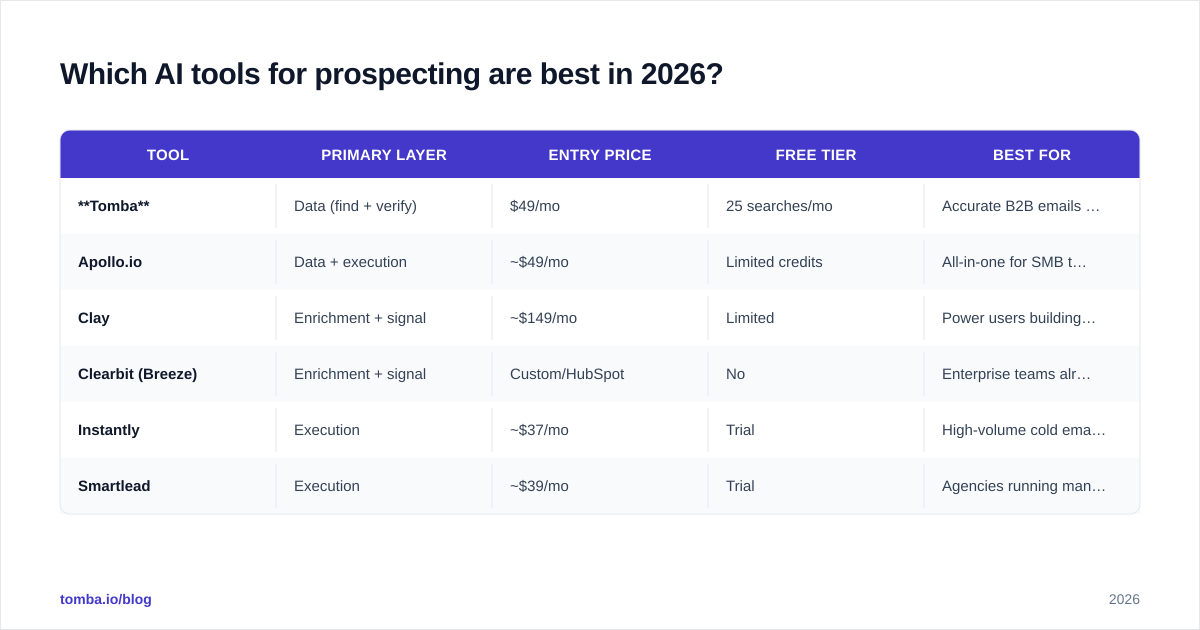
Below is a comparison across the layers. Pricing is the publicly listed entry tier as of mid-2026; always confirm on the vendor's site, since plans shift.
| Tool | Primary layer | Entry price | Free tier | Best for |
|---|---|---|---|---|
| Tomba | Data (find + verify) | $49/mo | 25 searches/mo | Accurate B2B emails by name, domain, or company |
| Apollo.io | Data + execution | ~$49/mo | Limited credits | All-in-one for SMB teams that want one login |
| Clay | Enrichment + signal | ~$149/mo | Limited | Power users building custom enrichment waterfalls |
| Clearbit (Breeze) | Enrichment + signal | Custom/HubSpot | No | Enterprise teams already in the HubSpot ecosystem |
| Instantly | Execution | ~$37/mo | Trial | High-volume cold email with inbox rotation |
| Smartlead | Execution | ~$39/mo | Trial | Agencies running many sender accounts |
A few notes on reading this table. Tomba sits in the data layer because that is the job it does best — precise, verified contact discovery with a genuine free tier so you can test match rates before paying. The "all-in-one" options like Apollo look cheaper on paper because one subscription spans two layers, but teams routinely find the email accuracy on bundled suites trails a focused finder, which costs you more in bounces than you saved on the invoice. If you want to pressure-test that for yourself, run the same 100 prospects through a dedicated finder and a bundled suite and compare deliverable rates — the gap is usually obvious.
For a deeper price breakdown across plans, see the full Tomba pricing page; the Growth plan at $99/mo is the typical sweet spot for a small SDR team.
Is an all-in-one AI suite better than a best-of-breed stack?#
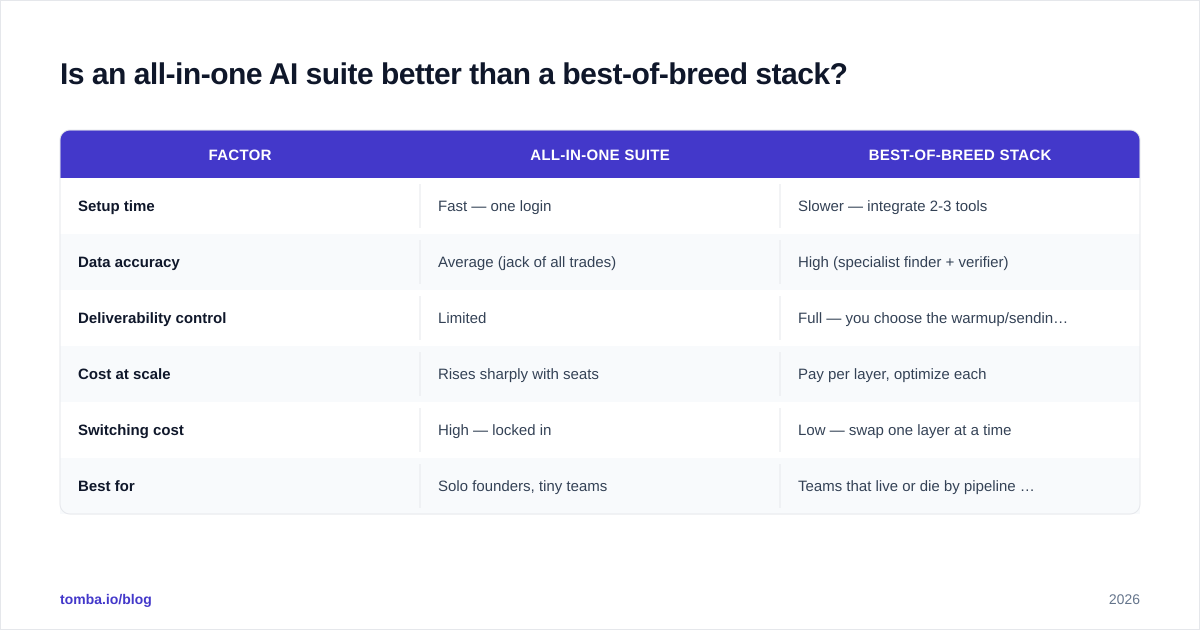
It depends on your team size and tolerance for trade-offs — but for most growing teams, best-of-breed wins on results, all-in-one wins on simplicity.
| Factor | All-in-one suite | Best-of-breed stack |
|---|---|---|
| Setup time | Fast — one login | Slower — integrate 2-3 tools |
| Data accuracy | Average (jack of all trades) | High (specialist finder + verifier) |
| Deliverability control | Limited | Full — you choose the warmup/sending layer |
| Cost at scale | Rises sharply with seats | Pay per layer, optimize each |
| Switching cost | High — locked in | Low — swap one layer at a time |
| Best for | Solo founders, tiny teams | Teams that live or die by pipeline quality |
The honest recommendation: if you're a solo founder doing 50 touches a week, buy the suite and move on. If prospecting is your growth engine and you're sending thousands of touches a month, invest in a specialist data layer and protect it with disciplined sending. You can connect the pieces with native integrations — push verified contacts straight into HubSpot or Salesforce — so the "stitching" is a one-time setup, not a daily chore.
How accurate is AI-driven prospecting data?#
Accuracy is the metric that quietly decides whether your whole program works. An AI tool that returns a plausible-looking email is worthless if that address bounces — bounces above roughly 3% start dragging your sender reputation down, and once that slides, even your good emails land in spam.
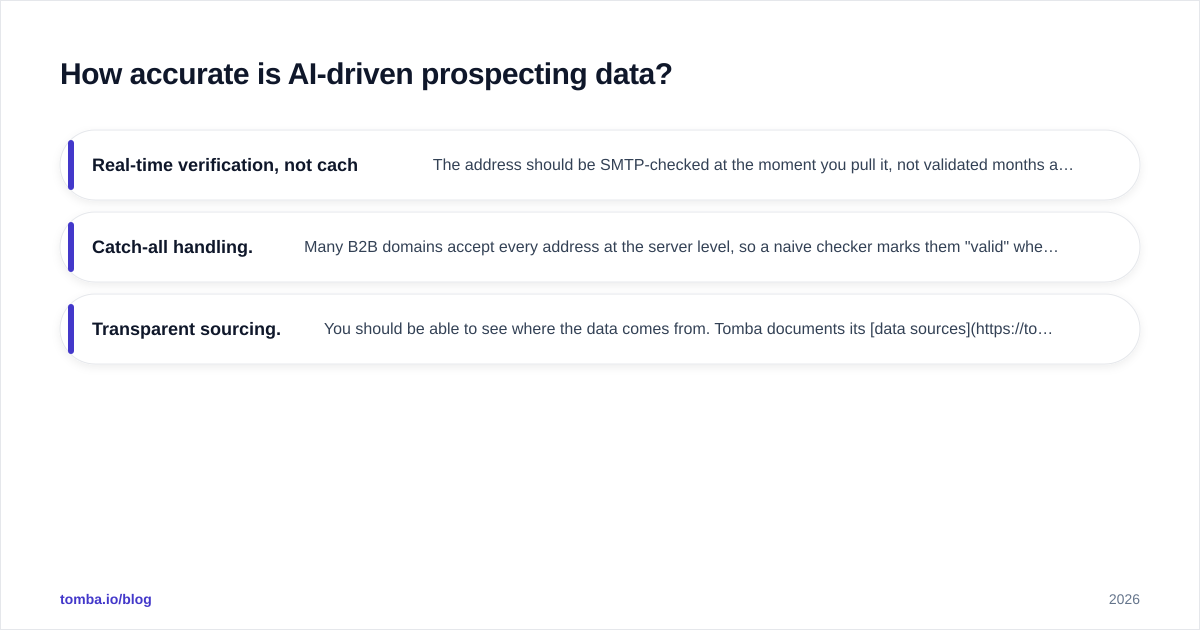
Three things separate accurate tools from confident-but-wrong ones:
- Real-time verification, not cached guesses. The address should be SMTP-checked at the moment you pull it, not validated months ago.
- Catch-all handling. Many B2B domains accept every address at the server level, so a naive checker marks them "valid" when they may not be. A proper catch-all verifier flags these as risky instead of falsely green.
- Transparent sourcing. You should be able to see where the data comes from. Tomba documents its data sources rather than treating the pipeline as a black box.
Independent review sites are a useful sanity check before you commit. Compare verified-customer ratings on G2 and read how vendors describe their own verification on their docs — for example, HubSpot's guidance on email deliverability is a solid neutral primer on why accuracy and reputation are linked.
A practical workflow: find in bulk, then verify before you ever load addresses into a sequence. Tomba's bulk email finder and verification handle thousands of records in one pass, and you can wire the same checks into your own product through the email finder API.
How do you measure if AI prospecting tools are working?#
Don't measure activity — measure outcomes, layer by layer. Vanity metrics like "emails sent" reward exactly the behavior that gets your domain blocked.
Track these instead:
- Data layer: match rate (% of inputs returning a contact) and bounce rate (keep it under 3%).
- Signal layer: reply rate on signal-triggered outreach vs. cold-list outreach. If signals aren't lifting replies, your triggers are wrong.
- Execution layer: positive response rate and meetings booked per 100 contacts.
- System health: sender reputation and spam-complaint rate, watched weekly.
If a tool can't move one of these numbers within a 30-day trial, it's not the right tool — regardless of how good the demo looked. The advantage of a layered stack is that you can pinpoint which layer is underperforming and swap just that one, instead of throwing out the whole system.
What mistakes should you avoid with AI prospecting tools?#
The failure patterns are predictable:
- Volume worship. Sending 5,000 unverified emails a day feels productive and quietly destroys your domain. Verify first, send less, send better.
- Set-and-forget personalization. AI openers that reference "your recent post" without naming it scream automation. Always have a human skim the first line.
- Skipping the verifier. Finders and verifiers are different jobs. Use both. A domain search gives you the contacts; verification keeps them clean.
- Ignoring deliverability fundamentals. SPF, DKIM, warmup, and reputation aren't optional add-ons; they're the road your messages drive on.
- Buying for features, not outcomes. The longest feature list rarely books the most meetings. Trial against your own data.
Avoid these and AI becomes a multiplier. Ignore them and it becomes an expensive way to get flagged as spam.
The bottom line#
AI tools for prospecting in 2026 are not about replacing reps — they're about removing the grunt work so reps spend their time where humans still win: live conversations. Build in three layers, anchor the foundation with accurate data, protect your sending reputation, and measure outcomes instead of activity. Do that, and AI stops being a buzzword and starts being pipeline.
Start with the layer everything else depends on. The Tomba Email Finder gives you verified professional emails by name, domain, or company, with a free tier of 25 searches a month so you can benchmark accuracy against whatever you use today before paying a cent. Find your next 100 buyers, verify them, and let your reps do what AI can't — close.
// get started
Find, verify and enrich your first contacts today
Start on the free plan with 25 searches a month, then scale when your team is ready.
Free plan · No credit card required · GDPR & CCPA
// about the author