Aidentified vs GrowMeOrganic: B2B Data Tools Compared 2026
Aidentified sells relationship intelligence; GrowMeOrganic sells volume lead extraction. Here's which B2B data tool actually fits your pipeline in 2026 — and where both fall short.
You're choosing between two B2B data tools that barely belong in the same sentence. Aidentified is a relationship-intelligence and wealth-data engine built for financial advisors and high-touch sales. GrowMeOrganic is a bulk lead-extraction and outreach suite built for volume prospecting. Both promise "more qualified leads," but they get there in opposite ways — and picking the wrong one wastes a quarter of pipeline.
This breakdown cuts through the marketing. You'll see exactly where each tool wins, where each leaks accuracy, and how a focused data layer fills the gaps neither covers well.
TL;DR#
- Aidentified is best when relationships, net-worth signals, and warm-intro paths matter more than raw volume — think wealth management, private banking, and high-ACV sales.
- GrowMeOrganic is best for volume outbound: scrape LinkedIn and company pages, extract emails, and fire sequences from one dashboard at a low flat price.
- Neither tool is a precision email source. Aidentified focuses on identity graphs; GrowMeOrganic relies on pattern-based extraction that often skips verification.
- If your bottleneck is email accuracy and deliverability, pair either platform with a dedicated email verifier and email finder.
- For most outbound teams, the real decision isn't "which one" — it's "which one, plus a verification layer that keeps bounce rates under 2%."
What is Aidentified?#
Aidentified is a relationship-intelligence platform that maps the connections between people and companies. Instead of handing you a flat list of contacts, it builds an identity graph: who knows whom, where they've worked, board seats, wealth indicators, and likelihood-to-transact scores.
Its core audience is financial services — advisors, wealth managers, and insurance teams who close on trust and referrals. The platform's standout feature is warm-path discovery: it tells you that your existing client sits two introductions away from a prospect worth pursuing. That's a different game than scraping a contact list.
The tradeoff is focus. Aidentified is deep on consumer-identity and wealth data but thinner on generic B2B firmographics and direct work-email coverage. If you sell SaaS to mid-market IT directors, much of its differentiation doesn't apply to you.
What is GrowMeOrganic?#
GrowMeOrganic is an all-in-one prospecting and outreach suite. You extract leads from LinkedIn, LinkedIn Sales Navigator, Google Maps, and company websites, then run email campaigns and drip sequences from the same tool. It bundles a B2B database, a Chrome extension, and a sending engine under one flat subscription.
The pitch is simplicity and price: unlimited-ish extraction and email sending without per-credit metering on higher tiers. For solo founders and small agencies running high-volume cold outbound, that bundling is genuinely attractive.
The catch is data quality. Pattern-based extraction guesses email formats and often returns role-based or unverified addresses. Without a verification step, you ship those straight into a sequence — and your sender reputation pays for it. GrowMeOrganic includes basic verification, but it's not a substitute for a dedicated, SMTP-level checker.
Aidentified vs GrowMeOrganic: how do they compare?#
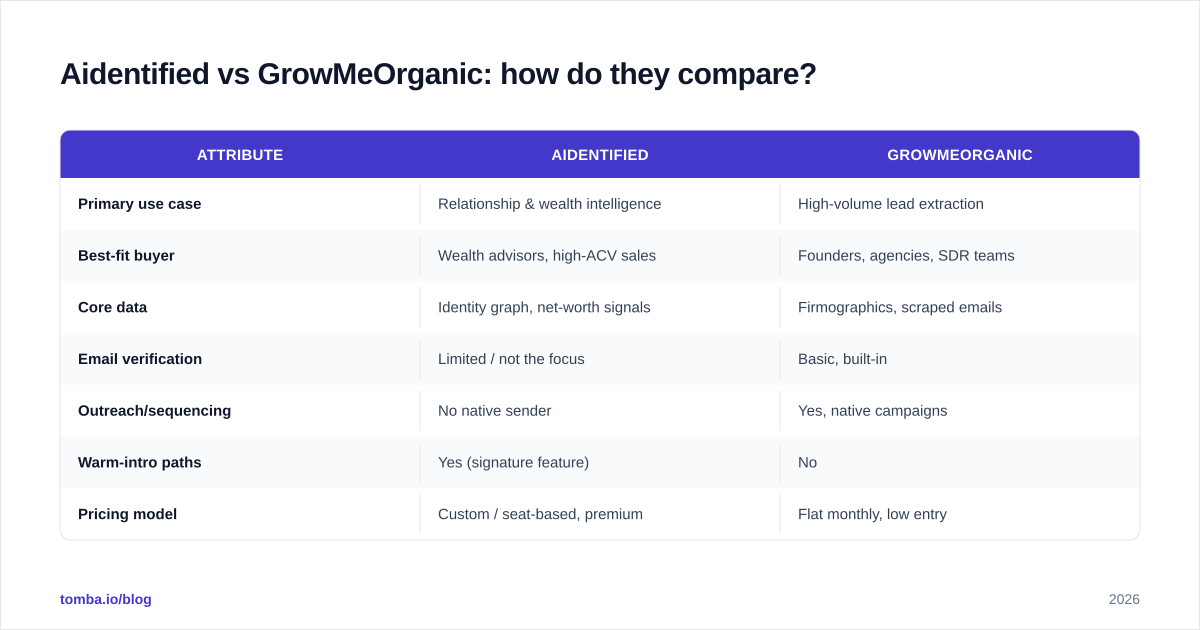
Here's the side-by-side on the attributes that actually change your buying decision.
| Attribute | Aidentified | GrowMeOrganic |
|---|---|---|
| Primary use case | Relationship & wealth intelligence | High-volume lead extraction |
| Best-fit buyer | Wealth advisors, high-ACV sales | Founders, agencies, SDR teams |
| Core data | Identity graph, net-worth signals | Firmographics, scraped emails |
| Email verification | Limited / not the focus | Basic, built-in |
| Outreach/sequencing | No native sender | Yes, native campaigns |
| Warm-intro paths | Yes (signature feature) | No |
| Pricing model | Custom / seat-based, premium | Flat monthly, low entry |
| Typical entry cost | High (quote-based) | Low ($mid-double-digits/mo) |
| Data freshness risk | Strong on identity, weak on B2B email | Volume over verified accuracy |
Read the table as two different jobs. Aidentified answers "who should I build a relationship with, and how do I get warm?" GrowMeOrganic answers "how do I contact 5,000 people this month cheaply?" Choosing means deciding which question is your actual bottleneck.
Which tool is more accurate for B2B email data?#
Neither is built to be your email accuracy backbone — and that's the most important sentence in this article.
Aidentified excels at identity resolution but doesn't position itself as a verified work-email source. GrowMeOrganic produces a lot of emails fast, but volume and accuracy are different metrics. Pattern guessing ("first.last@company.com") gets you in the door on common formats and silently fails on catch-all domains, sub-brands, and non-standard patterns.
The measurable consequence is bounce rate. Sending to unverified lists above a 3–4% bounce rate signals mailbox providers that you're a careless sender, and your inbox placement craters. That hurts every campaign afterward, not just the bad list. Strong email deliverability starts with clean inputs, not better copy.
This is exactly the gap a dedicated data layer closes. Run extracted lists through a real verifier, and handle the trickiest cases — catch-all domains — with a catch-all verifier instead of guessing.
How should you choose between them?#
Use a simple decision flow instead of a feature checklist. The right tool depends on your motion, not on which has more logos on its homepage.
Choose Aidentified if:
- You sell on relationships and referrals (wealth, insurance, private markets).
- Average deal size justifies a premium, seat-based data tool.
- Warm-intro discovery would change how your team prospects.
Choose GrowMeOrganic if:
- Your motion is high-volume cold outbound on a tight budget.
- You want extraction and sending bundled in one place.
- You're a solo founder or small agency, not an enterprise data team.
Choose neither as your sole source if:
- Email deliverability is your real constraint. In that case the priority is a verification and finding layer that plugs into whatever prospecting tool you keep.
Cross-check both vendors on independent review sites before you commit — G2 and Capterra surface recent, role-specific feedback that marketing pages won't.
What about pricing and value?#
Aidentified runs on quote-based, seat-oriented pricing aimed at financial-services teams — expect a premium that's justified only if relationship data drives your revenue. GrowMeOrganic plays the opposite end: a low flat monthly fee with generous extraction limits, which is why budget-conscious teams gravitate to it.
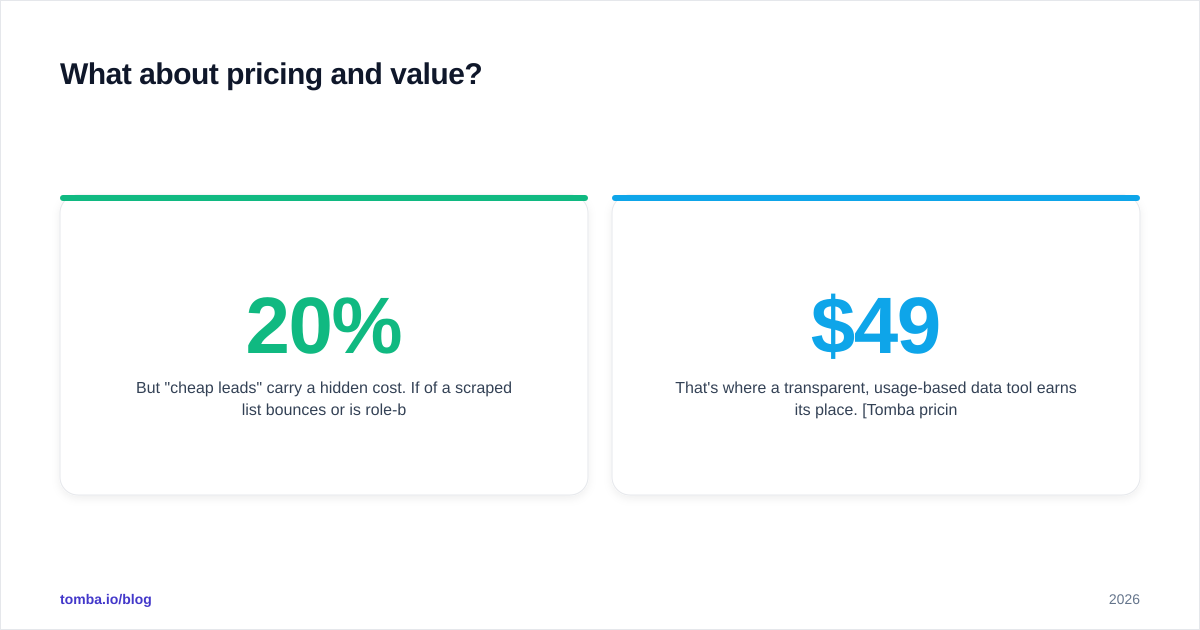
But "cheap leads" carry a hidden cost. If 20% of a scraped list bounces or is role-based, you didn't save money — you spent it on damaged sender reputation and wasted SDR hours. The honest total-cost-of-ownership comparison includes the verification you'll need to bolt on either way.
That's where a transparent, usage-based data tool earns its place. Tomba pricing starts with a free tier of 25 searches per month, then $49/mo (Starter), $99/mo (Growth), and $249/mo (Pro) — so you pay for verified accuracy as a precise line item instead of burying it inside a bundle. For teams processing large lists, the bulk email finder keeps cost-per-verified-contact predictable.
Can you use a data layer with either tool?#
Yes — and for most teams that's the smart architecture. Treat Aidentified or GrowMeOrganic as the prospecting front end, and add a dedicated finding-and-verification layer behind it.
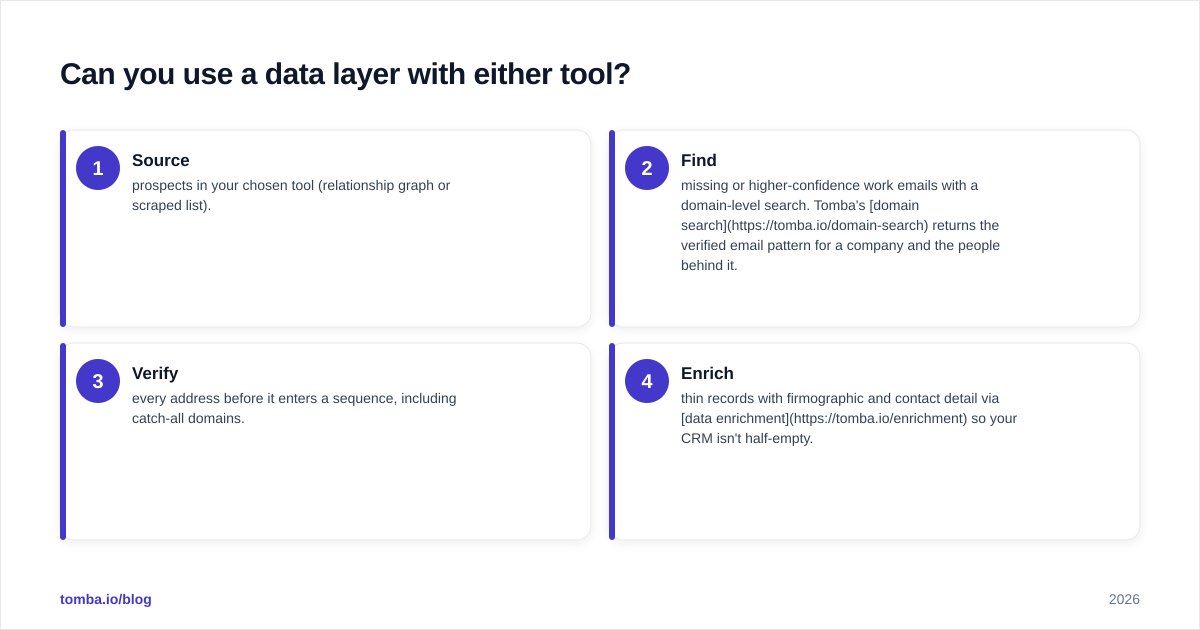
A practical stack looks like this:
- Source prospects in your chosen tool (relationship graph or scraped list).
- Find missing or higher-confidence work emails with a domain-level search. Tomba's domain search returns the verified email pattern for a company and the people behind it.
- Verify every address before it enters a sequence, including catch-all domains.
- Enrich thin records with firmographic and contact detail via data enrichment so your CRM isn't half-empty.
This separates two jobs that bundled tools blur together: finding people and confirming they're reachable. Vendors like HubSpot preach the same principle — clean data in, reliable outreach out. The verification layer is the difference between a list and a pipeline.
For developers, the same checks run programmatically through the Tomba API, so verification happens automatically as leads flow in from either platform — no manual export-import loop.
Aidentified vs GrowMeOrganic: the verdict#
There's no universal winner, because they're solving different problems. Aidentified wins for relationship-driven, high-ACV sales where warm intros and wealth signals move deals. GrowMeOrganic wins for cheap, high-volume cold outbound where bundling matters more than per-record precision.
What's consistent across both: email accuracy is the weak link, and it's the link that most directly controls whether your campaigns land in the inbox or the spam folder. Solve that, and either tool performs noticeably better.
Pick the prospecting front end that matches your motion — then make verified, deliverable data non-negotiable. Start free with the Tomba Email Finder: find professional emails by domain, name, or company, verify them before you send, and keep your bounce rate under 2% no matter which platform feeds your pipeline. Your sender reputation is the one asset you can't buy back, so protect it from the first email.
// get started
Find, verify and enrich your first contacts today
Start on the free plan with 25 searches a month, then scale when your team is ready.
Free plan · No credit card required · GDPR & CCPA
// about the author