Aidentified vs Kipplo: B2B Data Platforms Compared (2026)
Aidentified leans on relationship intelligence; Kipplo bets on affordable contact data. Here is an honest 2026 breakdown of which B2B platform fits your sales motion.
TL;DR
- Aidentified is a relationship-intelligence platform: it maps who on your team already knows your prospects, scores warm paths, and enriches contacts with wealth and life-event signals. Best for referral-driven, high-touch sales (wealth management, real estate, enterprise).
- Kipplo is a leaner, lower-cost B2B contact-data and prospecting tool: search by company or role, pull emails and phone numbers, and export lists. Best for volume outbound on a budget.
- They solve different problems. Aidentified answers "who can introduce me?" Kipplo answers "how do I reach more people cheaply?"
- Neither is a pure email-finder. If accurate, verified emails are your real bottleneck, a dedicated tool like Tomba usually beats both on cost-per-valid-email.
- Pick by sales motion: warm-intro selling → Aidentified; high-volume cold outbound → Kipplo; data accuracy first → a specialized finder/verifier stack.
What is Aidentified?#
Aidentified is a relationship-intelligence and contact-data platform built around the idea that your next deal is hiding in your team's existing network. Instead of treating every prospect as a cold name, it ingests your team's connections — email history, social graphs, CRM contacts — and tells you who already has a relationship with the person you want to reach.
On top of the relationship graph, Aidentified layers a large consumer-and-professional dataset: job changes, wealth indicators, life events (new role, relocation, liquidity events), and verified contact details. The pitch is that you stop buying cold lists and start working warm paths that convert at a far higher rate.
That focus shows in who buys it. Aidentified's core users are financial advisors, wealth managers, commercial real estate teams, and enterprise sellers — people whose deals are large, relationship-driven, and worth the effort of finding a mutual connection. If your average deal is $50 and you send 5,000 emails a week, that machinery is overkill.
What is Kipplo?#
Kipplo is a B2B prospecting and contact-data tool aimed at a more price-sensitive buyer. The promise is straightforward: search a database of companies and people, filter by role, industry, location, and company size, then pull work emails and phone numbers you can drop into a sequence or CRM.
Where Aidentified sells insight (who knows whom, who just came into money, who just changed jobs), Kipplo sells access — more contacts, fewer dollars. It positions itself against the Apollos and ZoomInfos of the world on cost, betting that small teams and solo founders will trade some data depth and graph intelligence for a bill they can actually justify.
That makes Kipplo a natural fit for early-stage startups, agencies running outbound for clients, and individual reps who need raw volume. It is not trying to find you a warm introduction; it is trying to hand you a workable list fast and cheap.
Aidentified vs Kipplo: how do they compare head to head?#
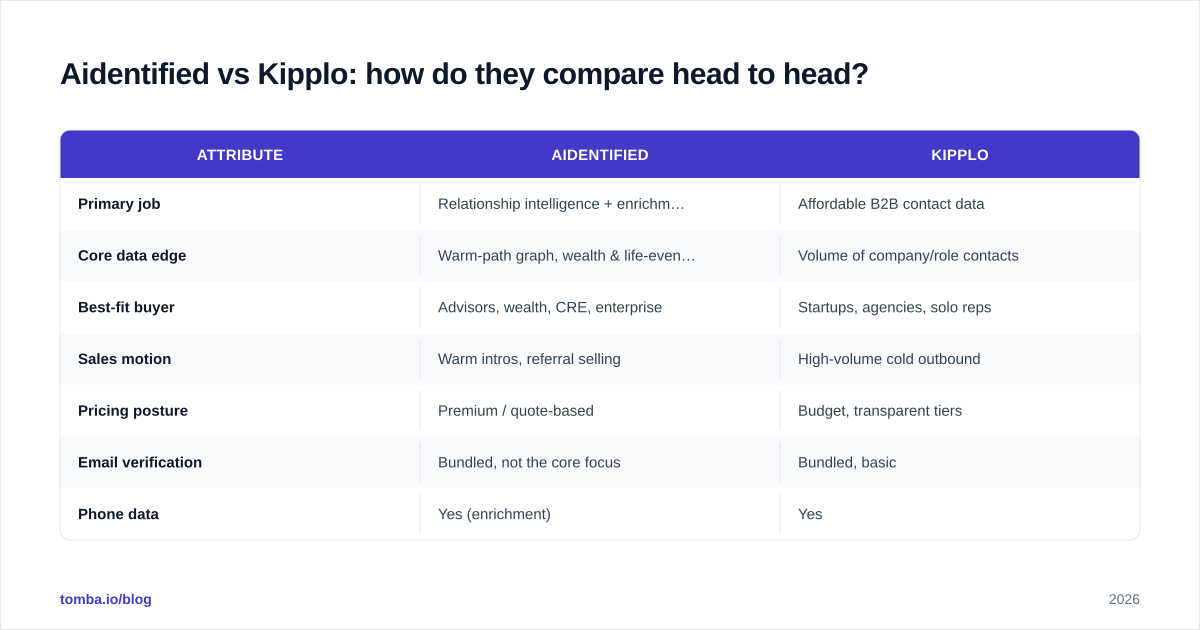
The two tools rarely land on the same shortlist by accident — they attract different buyers. But teams evaluating a "data platform" line item often weigh them together, so here is the direct comparison.
| Attribute | Aidentified | Kipplo |
|---|---|---|
| Primary job | Relationship intelligence + enrichment | Affordable B2B contact data |
| Core data edge | Warm-path graph, wealth & life-event signals | Volume of company/role contacts |
| Best-fit buyer | Advisors, wealth, CRE, enterprise | Startups, agencies, solo reps |
| Sales motion | Warm intros, referral selling | High-volume cold outbound |
| Pricing posture | Premium / quote-based | Budget, transparent tiers |
| Email verification | Bundled, not the core focus | Bundled, basic |
| Phone data | Yes (enrichment) | Yes |
| CRM fit | Salesforce, HubSpot enrichment | Export + lighter integrations |
| Learning curve | Higher (graph-driven) | Low (search-and-export) |
| Where it's weak | Cost, complexity for SMB | Data depth, no warm-path graph |
Read the table by your own constraint. If your win rate is bottlenecked by access to decision-makers, Aidentified's graph is the differentiator. If it's bottlenecked by how many qualified contacts you can afford, Kipplo's pricing wins. Treat vendor accuracy claims on both sides as marketing until you run your own sample — every B2B data vendor quotes a flattering number.

Which one is more accurate?#
Neither company is primarily an accuracy-first email tool, and that matters. Aidentified and Kipplo both bundle contact data and basic verification, but their reason for existing is relationship intelligence and cheap volume respectively — not squeezing the last false-positive out of an email list.
In practice, broad B2B databases drift. People change jobs, domains migrate, and catch-all servers accept everything so a "valid" result is anything but. If you push unverified data straight into a cold campaign, you pay for it in bounces, spam complaints, and a damaged sending domain. That is true of Aidentified, Kipplo, Apollo, ZoomInfo, and everyone else — the size of the database does not protect your deliverability.
The reliable pattern is to separate sourcing from verification. Use a data platform to find contacts, then run those addresses through a dedicated email verifier before anyone hits send. A real-time SMTP check and a catch-all verifier will catch the addresses that a bundled "verified" flag quietly let through. If your campaigns are bouncing above 3-4%, the fix is almost never a bigger database — it's a verification step you skipped. Independent review sites like G2 are useful for seeing how real users rate each vendor's data quality before you commit.
What about pricing — which is cheaper?#
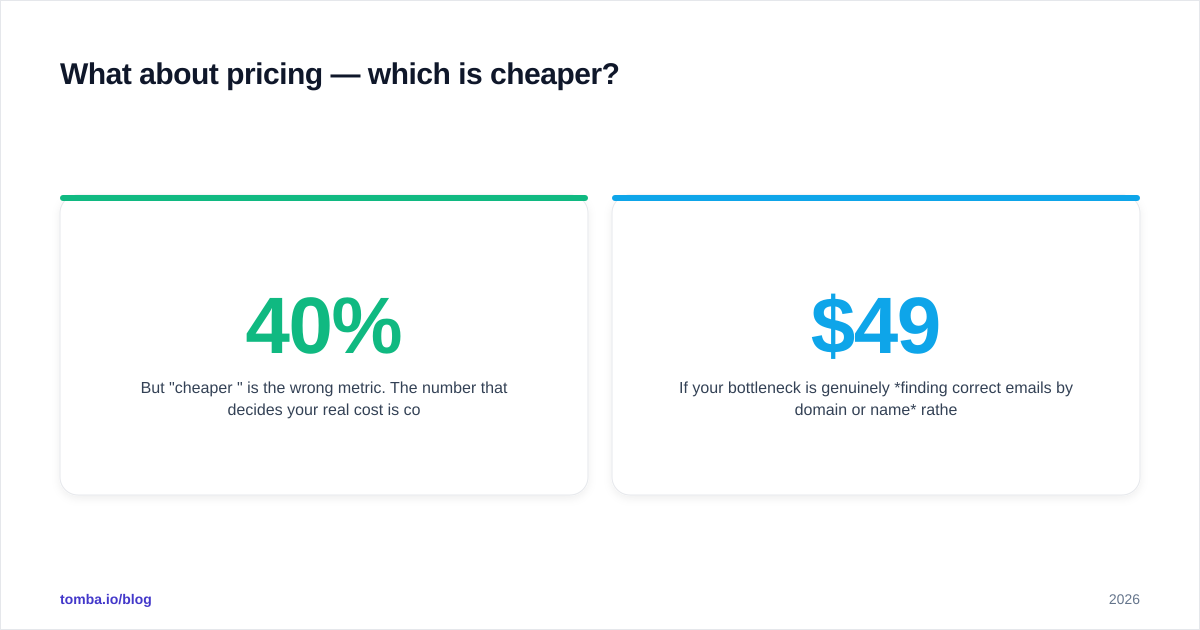
Kipplo is the cheaper sticker, plainly. It markets itself on affordable, transparent tiers aimed at solo operators and small teams, and it competes specifically against expensive enterprise data suites on price.
Aidentified sits at the premium, quote-based end. You're paying for the relationship graph and the wealth/life-event enrichment, and the buyers who need that — advisors managing books of business, CRE teams chasing eight-figure deals — can justify it on a single closed deal. For a two-person startup doing cold outbound, that math doesn't work.
But "cheaper per seat" is the wrong metric. The number that decides your real cost is cost per valid, verified contact you actually email. A cheap tool that hands you 40% stale data is more expensive than it looks once you count bounces and burned domain reputation. A premium tool you use for ten warm intros a month might be a bargain if those intros close.
If your bottleneck is genuinely finding correct emails by domain or name rather than relationship mapping, a focused tool changes the equation. Tomba's plans — Free (25 searches/mo), Starter $49/mo, Growth $99/mo, Pro $249/mo, Enterprise custom — are built around finding and verifying emails specifically, so you're not paying for graph intelligence you won't use. You can compare the full Tomba pricing against either platform's per-contact cost.

When should you choose Aidentified?#
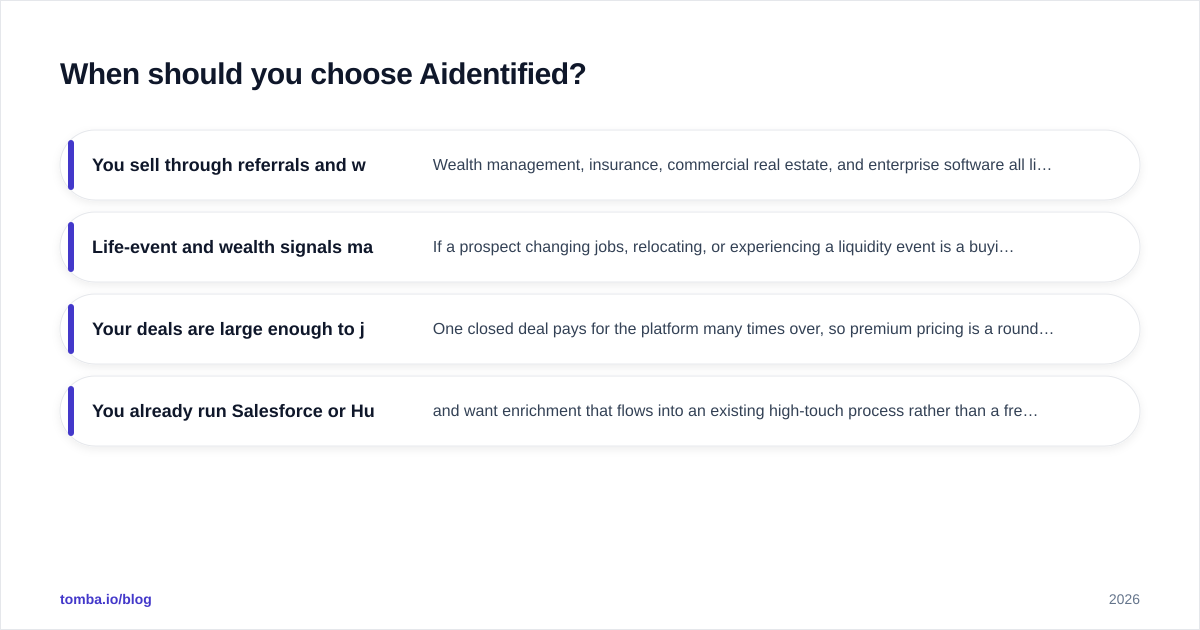
Choose Aidentified when relationships are your real currency. Specifically:
- You sell through referrals and warm intros. Wealth management, insurance, commercial real estate, and enterprise software all live and die on who-knows-whom. Aidentified's graph turns your team's collective network into a prospecting asset.
- Life-event and wealth signals matter. If a prospect changing jobs, relocating, or experiencing a liquidity event is a buying trigger for you, that enrichment is hard to replicate elsewhere.
- Your deals are large enough to justify the cost. One closed deal pays for the platform many times over, so premium pricing is a rounding error.
- You already run Salesforce or HubSpot and want enrichment that flows into an existing high-touch process rather than a fresh cold-outbound stack.
If most of those describe you, Aidentified's complexity and price are features, not bugs. You can read its positioning directly on the Aidentified site and weigh it against your average deal size.
When should you choose Kipplo?#
Choose Kipplo when volume and budget are the constraints:
- You run high-volume cold outbound and need a steady supply of company and role-based contacts without an enterprise contract.
- You're an agency or freelancer building lists for multiple clients and need predictable, low per-list cost.
- You're early-stage and can't justify ZoomInfo or Apollo pricing yet, but still need more than manual LinkedIn scraping.
- Speed beats depth. You want search-filter-export in minutes, not a graph you have to learn.
Just pair it with a verification step. Kipplo gets you the raw list; protecting your email deliverability is on you, and that means verifying before you send.
What if your real problem is just finding correct emails?#
Here's the honest framing most comparison posts skip: a lot of teams shopping for "a data platform" actually have a narrower problem — they need accurate, verified email addresses for people they've already identified. You know the company. You know the person. You just need the right address that won't bounce.
For that job, both Aidentified and Kipplo are heavier than necessary. A purpose-built email finder and domain search will find addresses by name or company and verify them in the same step, usually at a lower cost-per-valid-email than a broad platform you're only half-using. And when you need to enrich those contacts with firmographics or run a bigger list, data enrichment and a bulk email finder cover it without an enterprise contract.
A clean decision rule:
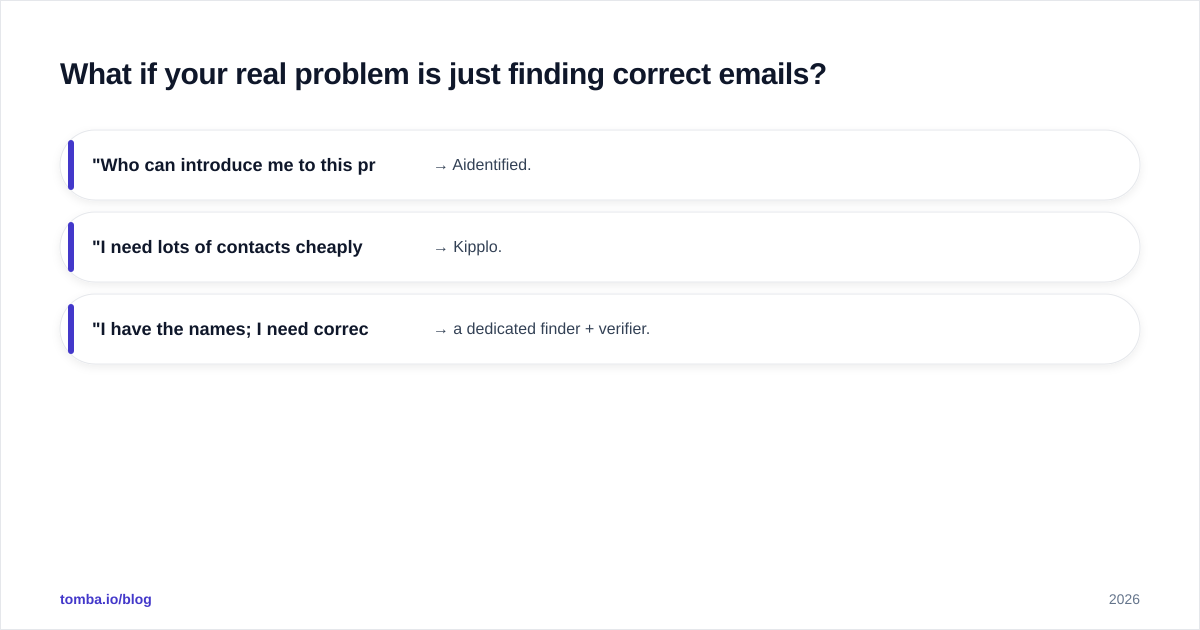
- "Who can introduce me to this prospect?" → Aidentified.
- "I need lots of contacts cheaply." → Kipplo.
- "I have the names; I need correct, verified emails." → a dedicated finder + verifier.
Map the question to the tool and you stop overpaying for capabilities you won't use. For teams building this into a workflow, the Tomba API lets you find and verify at scale inside your own systems, and integrates with the CRMs (HubSpot, Salesforce, Pipedrive) you're probably already running.
The bottom line on Aidentified vs Kipplo#
Aidentified and Kipplo aren't really rivals — they're answers to different questions. Aidentified is premium relationship intelligence for referral-driven, high-value selling. Kipplo is budget contact data for high-volume outbound. Choosing between them is mostly a question of whether warm paths or raw volume is your growth lever, and how large your deals are.
What both share is a weak spot: neither is built to guarantee that the emails you send actually land. That's a verification problem, and it's the one most likely to quietly tank your campaigns regardless of which platform you pick.
If your core need is finding and verifying professional email addresses — accurately, affordably, and at scale — start with the Tomba Email Finder. Use the free tier (25 searches a month) to benchmark Tomba's results against whatever Aidentified or Kipplo hands you, then verify the addresses before a single campaign goes out. Find the right contact, confirm the email is real, and protect your sender reputation — that's the foundation every data platform sits on top of.
// get started
Find, verify and enrich your first contacts today
Start on the free plan with 25 searches a month, then scale when your team is ready.
Free plan · No credit card required · GDPR & CCPA
// about the author