Aidentified vs SignalHire 2026: B2B Data Tool Comparison
Aidentified leans on relationship and wealth intelligence; SignalHire sells verified emails and phones at scale. Here's how the two B2B data tools actually compare in 2026 — and where a dedicated finder fits.
You are evaluating two very different B2B data tools that keep landing on the same shortlist. Aidentified and SignalHire both promise to turn names into reachable contacts, but they solve different problems. This guide breaks down what each does well, where each falls short, and how to decide in 2026.
TL;DR — Aidentified vs SignalHire at a glance#
- Aidentified is a relationship-intelligence and wealth-data platform. It maps who-knows-whom, scores propensity, and is strongest for financial advisors, fundraising, and warm-intro prospecting.
- SignalHire is a contact-finder. It pulls verified emails and phone numbers from profiles in bulk, with a Chrome extension and an API for outbound teams.
- They are not direct competitors. Aidentified answers "who should I talk to and how am I connected?" SignalHire answers "what's their email and phone number?"
- Pricing is opaque on Aidentified (custom, enterprise-tilted) and transparent on SignalHire (credit packs from roughly $39–$49/mo entry).
- If your only goal is accurate, verifiable contact data at a fair price, a dedicated email finder like Tomba often beats both on cost-per-valid-contact.
What is Aidentified?#
Aidentified is a relationship and consumer-intelligence platform built mostly for wealth management, financial services, and high-net-worth fundraising. Instead of just handing you a contact record, it builds a graph of relationships — who is connected to whom, through what company, board, alumni network, or life event — and layers on predictive wealth and propensity scores.
The product centers on a few ideas:
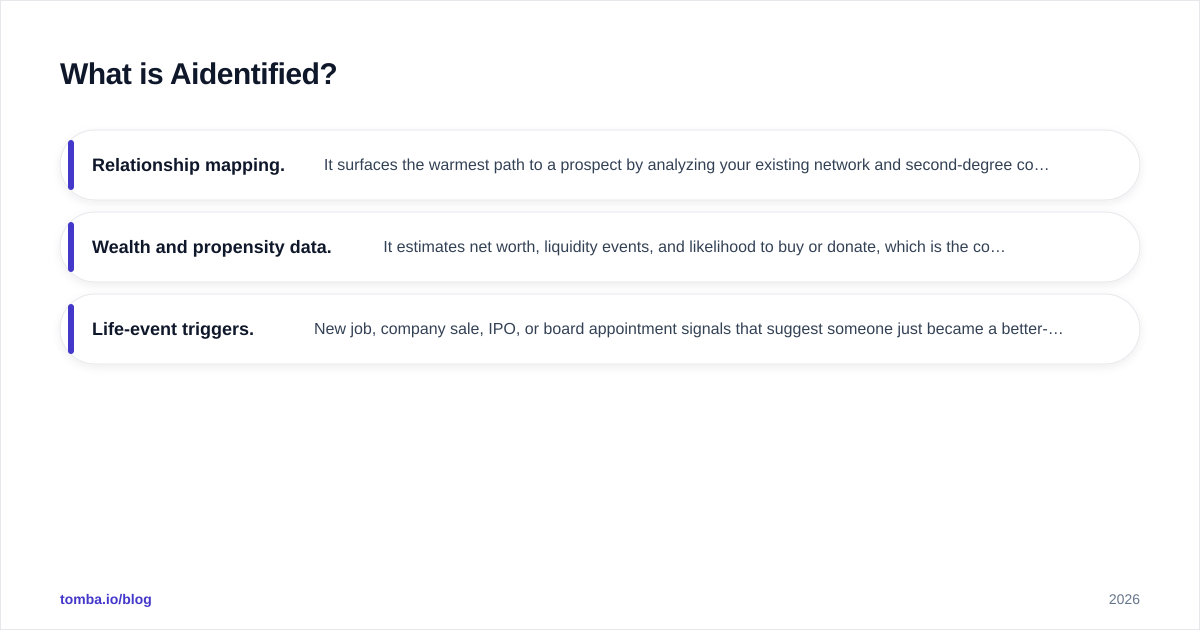
- Relationship mapping. It surfaces the warmest path to a prospect by analyzing your existing network and second-degree connections.
- Wealth and propensity data. It estimates net worth, liquidity events, and likelihood to buy or donate, which is the core draw for advisors and nonprofits.
- Life-event triggers. New job, company sale, IPO, or board appointment signals that suggest someone just became a better-timed prospect.
This makes Aidentified less of a "find an email" tool and more of a "find the right person and the right moment" tool. You can read more on the company's own site at aidentified.com.
What is SignalHire?#
SignalHire is a contact-finding platform focused on emails and phone numbers. Think of it as a vending machine for verified contact details: you give it a name, a LinkedIn profile, or a list, and it returns work and personal emails plus direct dials, checked against its real-time verification system.
Its main components:
- Browser extension. Reveal contact details directly on LinkedIn, company sites, and search results.
- Bulk search and lists. Upload or build lists and pull contacts in volume.
- ATS / CRM features. SignalHire also markets recruiting workflows, candidate tracking, and pipeline tools, since recruiters are a big slice of its user base.
- API. Programmatic lookups for teams that want to enrich records inside their own systems.
SignalHire's pitch is breadth of contact data and real-time verification at the moment of lookup, rather than relationship context. Their homepage is at signalhire.com, and you can sanity-check user sentiment on G2.
Aidentified vs SignalHire: how do they compare?#
The fastest way to see the gap is feature by feature. These two tools overlap only at the edges.
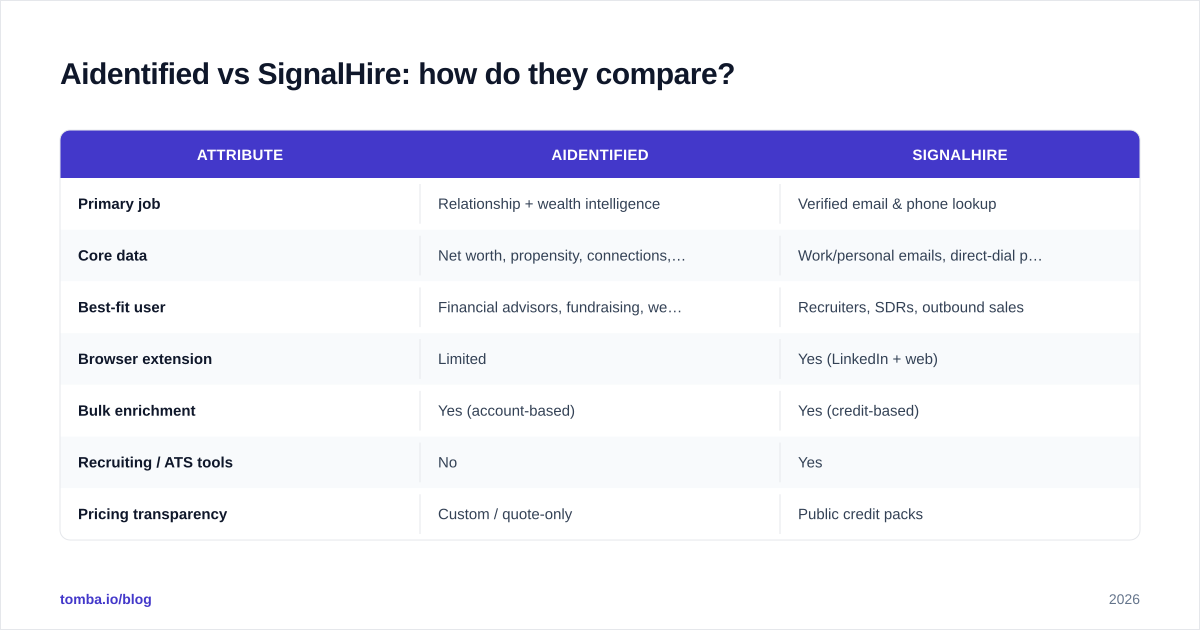
| Attribute | Aidentified | SignalHire |
|---|---|---|
| Primary job | Relationship + wealth intelligence | Verified email & phone lookup |
| Core data | Net worth, propensity, connections, life events | Work/personal emails, direct-dial phones |
| Best-fit user | Financial advisors, fundraising, wealth | Recruiters, SDRs, outbound sales |
| Browser extension | Limited | Yes (LinkedIn + web) |
| Bulk enrichment | Yes (account-based) | Yes (credit-based) |
| Recruiting / ATS tools | No | Yes |
| Pricing transparency | Custom / quote-only | Public credit packs |
| Typical entry cost | Enterprise (high) | ~$39–$49/mo range |
| API access | Enterprise tiers | Yes |
| Verification at lookup | Predictive scoring focus | Real-time email checks |
The pattern is clear: Aidentified sells context and targeting, SignalHire sells reachable contact details. Picking between them is really a question of which problem is blocking your pipeline.
Which one has better data accuracy?#
It depends on which kind of accuracy you mean, because they are measuring different things.
Aidentified's value is in predictive accuracy — how well its net-worth estimates and propensity scores line up with reality. That is genuinely hard to benchmark publicly, and results vary by segment. For a wealth advisor, a directionally correct net-worth band is often "accurate enough" to prioritize a call list.
SignalHire's value is in contact accuracy — does the email deliver, does the phone connect? Real-time verification at lookup helps, but no provider is perfect, and personal-email and direct-dial coverage always carries more bounce risk than corporate emails. If deliverability is your KPI, you should still re-check anything before a big send. A standalone email verifier catches stale or risky addresses that slip through any single-vendor check, and a quick catch-all verifier pass handles the domains that silently accept everything.
The honest takeaway: do not assume either tool's data is send-ready out of the box. Verification is a separate discipline from sourcing.

How does pricing compare in 2026?#
Pricing is where these two diverge most sharply, and it often decides the matter for smaller teams.
Aidentified runs on quote-based, enterprise-tilted pricing. You talk to sales, you get a custom number, and it is generally aimed at firms that will pay for relationship intelligence as a strategic capability. For a solo SDR or a lean startup, that is usually overkill and over-budget.
SignalHire publishes credit-based plans, with entry tiers in roughly the $39–$49/mo range depending on credit volume and whether you want emails only or emails plus phones. That transparency makes it far easier to start small and scale.
Here is the budgeting reality for most outbound teams:
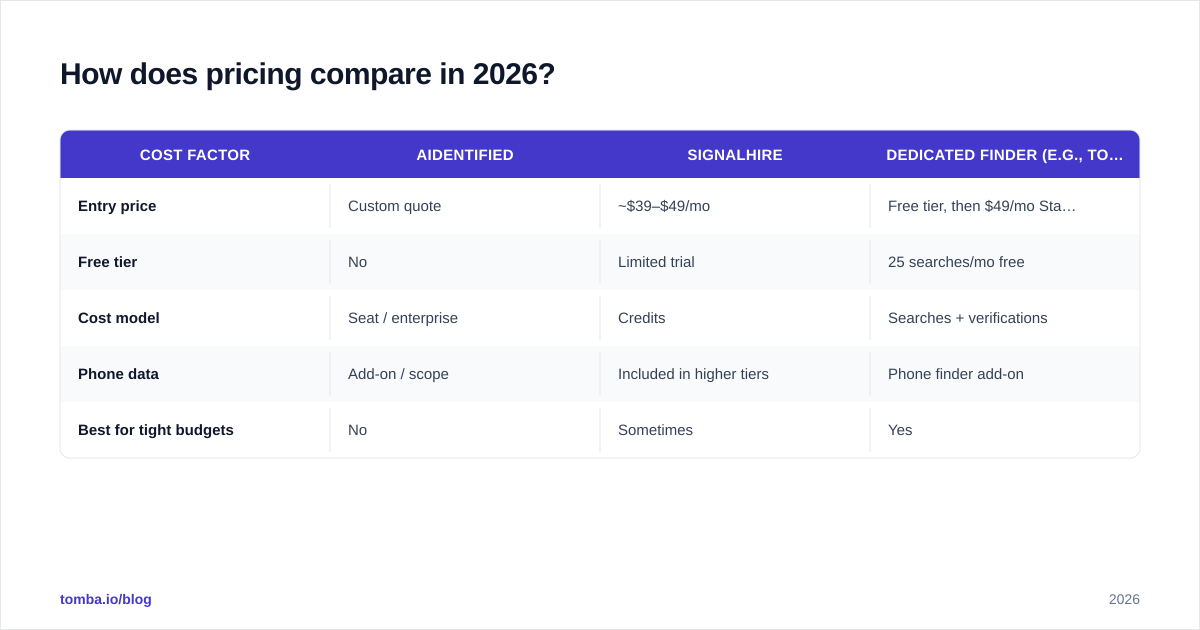
| Cost factor | Aidentified | SignalHire | Dedicated finder (e.g., Tomba) |
|---|---|---|---|
| Entry price | Custom quote | ~$39–$49/mo | Free tier, then $49/mo Starter |
| Free tier | No | Limited trial | 25 searches/mo free |
| Cost model | Seat / enterprise | Credits | Searches + verifications |
| Phone data | Add-on / scope | Included in higher tiers | Phone finder add-on |
| Best for tight budgets | No | Sometimes | Yes |
For context on how a transparent, usage-based plan looks, compare against Tomba pricing: a Free tier with 25 searches, Starter at $49/mo, Growth at $99/mo, and Pro at $249/mo. The point is not that one is "cheapest," but that you should know your cost-per-valid-contact before committing.
Which tool fits your use case?#
Match the tool to the job, not the hype.
Choose Aidentified if:
- You are a financial advisor, wealth manager, or nonprofit fundraiser.
- Warm introductions and relationship paths matter more than raw volume.
- You need propensity and net-worth signals to prioritize who to call.
- Budget is not the constraint, and you want strategic targeting.
Choose SignalHire if:
- You are a recruiter or SDR who needs emails and phones fast.
- You live in LinkedIn and want a reveal-on-profile extension.
- You want predictable credit pricing and an API.
- You value breadth of contact data over relationship context.
Choose a dedicated email finder if:
- Your bottleneck is simply getting accurate, verifiable contact data at the lowest cost-per-lead.
- You want domain search to map every reachable contact at a target company.
- You need clean enrichment that plugs into your CRM without enterprise lock-in.
Where does a dedicated email finder fit?#
Here is the part most comparison posts skip: for a large share of outbound and recruiting teams, neither Aidentified nor SignalHire is the most efficient choice for the contact-data layer of the stack.
Aidentified is priced and built for relationship strategy, which is a different budget line. SignalHire bundles contact data with recruiting workflows you may not need, and personal-email and phone coverage adds cost and bounce risk. If your real job is "turn a company or a name into a verified business email," a focused finder usually wins on price and precision.
That is the lane Tomba occupies. A purpose-built email finder with a transparent free tier, bulk email finder for list work, native HubSpot integration, and a documented email finder API covers the sourcing-and-verification step without forcing you into an enterprise contract or a recruiting suite you will not use.
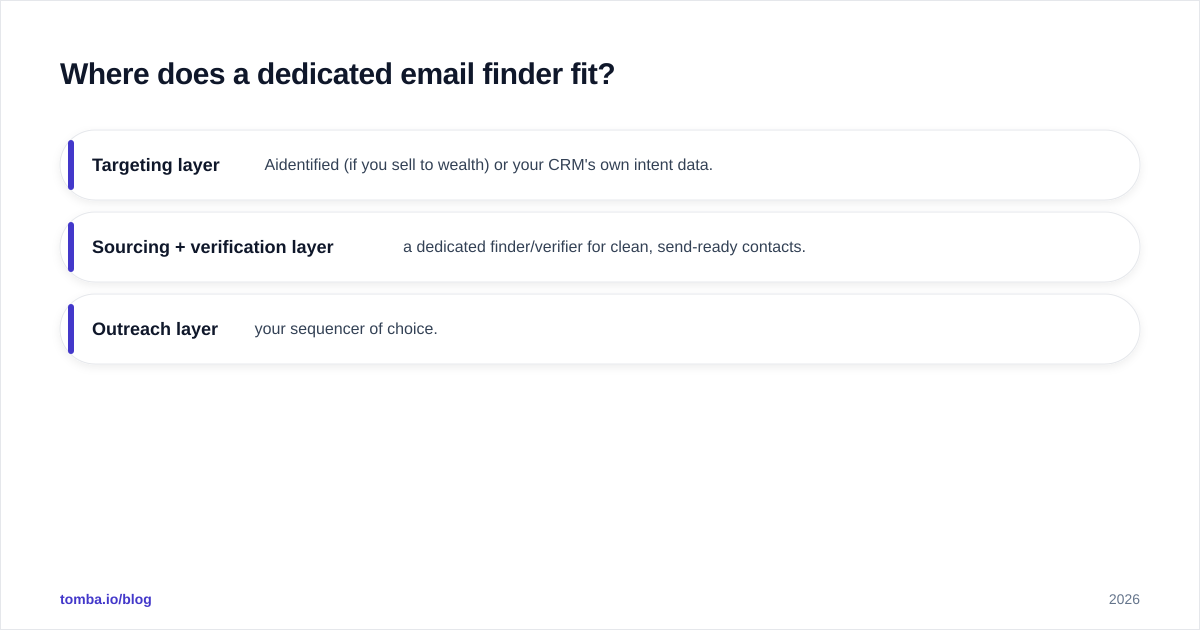
A pragmatic 2026 stack often looks like this:
- Targeting layer — Aidentified (if you sell to wealth) or your CRM's own intent data.
- Sourcing + verification layer — a dedicated finder/verifier for clean, send-ready contacts.
- Outreach layer — your sequencer of choice.
You do not have to pick one vendor to do everything. The teams with the best deliverability and cost control tend to use a specialist for each layer.
Quick FAQ#
Is Aidentified a SignalHire competitor? Not really. They overlap on "find people," but Aidentified is relationship and wealth intelligence while SignalHire is a contact (email and phone) finder. Many teams could use both for different jobs.
Which is cheaper, Aidentified or SignalHire? SignalHire, almost always. It has public credit-based pricing starting in the ~$39–$49/mo range, while Aidentified is custom, enterprise-tilted quote pricing.
Do I still need to verify contacts from these tools? Yes. Both source data, but you should verify emails before any meaningful send. Run lookups through an email verifier to protect sender reputation and reduce bounces.
What if I only need accurate business emails? Then a dedicated finder is usually the most cost-effective path. You skip the relationship-intelligence premium and the recruiting features and pay only for the contact-data step.
The bottom line#
Pick Aidentified when relationships and wealth signals drive your revenue, and you can fund a strategic data platform. Pick SignalHire when you need verified emails and phones with predictable credit pricing and a LinkedIn extension. But if the actual gap in your pipeline is accurate, affordable, verifiable contact data — not relationship graphs or recruiting workflows — start with a tool built for exactly that.
Try the Tomba Email Finder on the free tier (25 searches a month, no card), test the accuracy against your own list, and only scale up when the cost-per-valid-contact proves out. It is the simplest way to keep your contact-data layer cheap, clean, and CRM-ready while you reserve the bigger budgets for tools that truly need them.
// get started
Find, verify and enrich your first contacts today
Start on the free plan with 25 searches a month, then scale when your team is ready.
Free plan · No credit card required · GDPR & CCPA
// about the author