Aidentified vs SMARTe 2026: B2B Data Platforms Compared
Aidentified leans on relationship and wealth intelligence; SMARTe focuses on global B2B contact data. Here's how the two stack up in 2026 — and where a leaner stack wins.
You are choosing between two B2B data platforms that look similar on a feature grid but solve very different problems. Aidentified is built around relationship intelligence and wealth signals. SMARTe is built around global contact data and sales-ready phone numbers and emails. Picking the wrong one means paying for coverage you will never touch.
This breakdown compares Aidentified vs SMARTe on what actually moves pipeline: data type, coverage, accuracy, pricing model, integrations, and the use cases each one was designed for. No vendor spin — just where each tool earns its seat in your stack, and where a lighter, pay-as-you-go layer does the same job for less.
TL;DR#
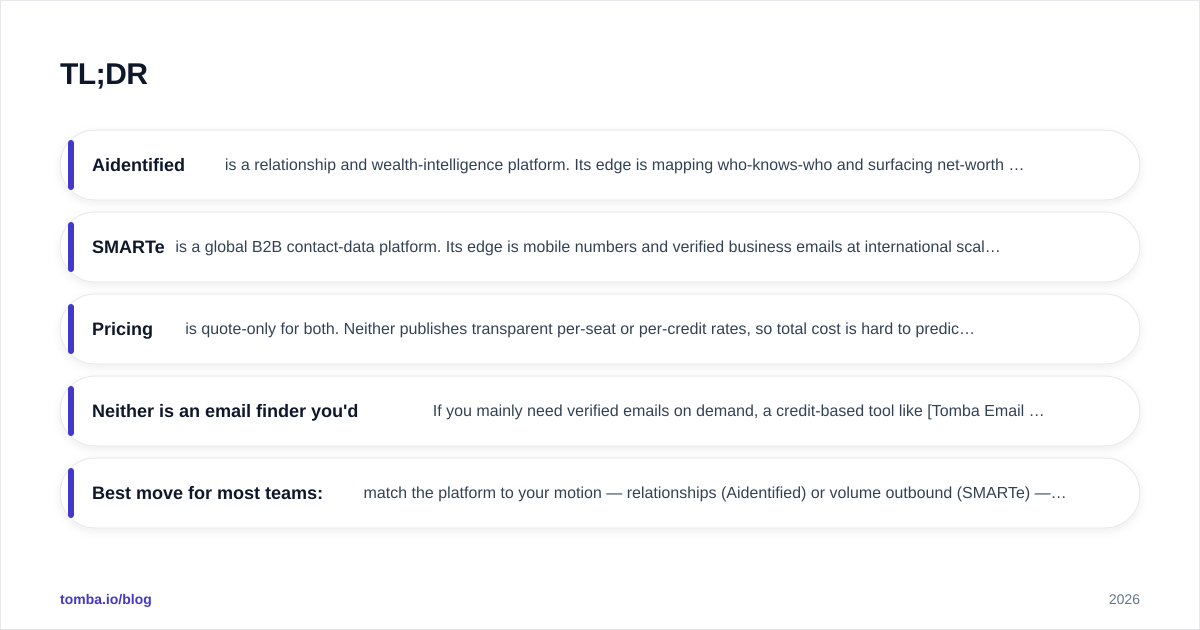
- Aidentified is a relationship and wealth-intelligence platform. Its edge is mapping who-knows-who and surfacing net-worth signals — ideal for financial advisors, wealth managers, and warm-intro-driven sales.
- SMARTe is a global B2B contact-data platform. Its edge is mobile numbers and verified business emails at international scale — ideal for outbound SDR teams working multiple regions.
- Pricing is quote-only for both. Neither publishes transparent per-seat or per-credit rates, so total cost is hard to predict before a sales call.
- Neither is an email finder you'd run ad hoc. If you mainly need verified emails on demand, a credit-based tool like Tomba Email Finder covers that job without an annual contract.
- Best move for most teams: match the platform to your motion — relationships (Aidentified) or volume outbound (SMARTe) — and bolt a cheap verification layer on top of either.
What is Aidentified?#
Aidentified is a relationship-intelligence platform. Think of it as a social graph for sales: instead of handing you a flat list of contacts, it maps the connections between people — shared employers, board seats, alumni ties, family links — and layers on demographic and wealth attributes like estimated net worth, income band, and liquidity events.
That focus tells you who it's for. Financial advisors, wealth managers, private bankers, and luxury-goods sellers use it to find warm paths into high-net-worth prospects. The pitch isn't "here are 10,000 emails" — it's "here are the three people in your existing network who can introduce you to this $5M household."
Aidentified pulls from public records, professional profiles, and proprietary wealth modeling. Its AI-driven "look-alike" modeling is a core feature: feed it your best clients and it finds statistically similar households. For a warm-intro motion, that's genuinely useful. For a cold SDR blasting 500 emails a day across EMEA, it's the wrong tool.
What is SMARTe?#
SMARTe is a B2B contact and sales-intelligence platform built for outbound at scale, with a strong emphasis on international coverage. Where many US-centric databases thin out fast past North America, SMARTe markets verified mobile numbers and business emails across EMEA and APAC as a differentiator.
Its core deliverables are direct dials, mobile numbers, verified emails, and firmographic data, delivered through a Chrome extension that overlays LinkedIn and through CRM integrations. The workflow target is clear: an SDR finds a prospect on LinkedIn, clicks the extension, and gets a phone number and email to drop into a sequence.
SMARTe leans on GDPR/CCPA-compliant sourcing and human-plus-machine verification for its contact records. The value proposition is reach and dial connect rates in regions where data is usually weakest — not relationship mapping or wealth signals. If your reps live in LinkedIn and need a number to call, SMARTe is aimed squarely at that.
Aidentified vs SMARTe: side-by-side comparison#
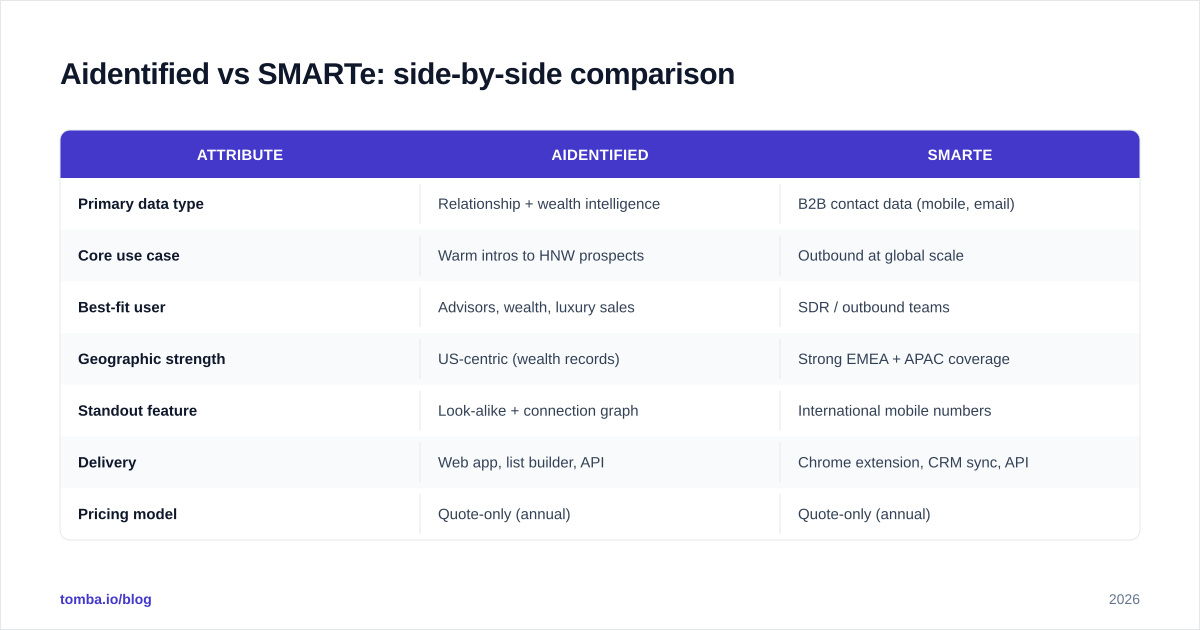
Here's the core differentiation in one view. Read it as "which problem are you solving," not "which has more checkmarks."
| Attribute | Aidentified | SMARTe |
|---|---|---|
| Primary data type | Relationship + wealth intelligence | B2B contact data (mobile, email) |
| Core use case | Warm intros to HNW prospects | Outbound at global scale |
| Best-fit user | Advisors, wealth, luxury sales | SDR / outbound teams |
| Geographic strength | US-centric (wealth records) | Strong EMEA + APAC coverage |
| Standout feature | Look-alike + connection graph | International mobile numbers |
| Delivery | Web app, list builder, API | Chrome extension, CRM sync, API |
| Pricing model | Quote-only (annual) | Quote-only (annual) |
| Free self-serve tier | No | No |
| Ad-hoc email lookup | Not the focus | Possible, contract-gated |
The pattern: Aidentified optimizes for depth on a person (who they know, what they're worth), SMARTe optimizes for breadth of reachable contacts across geographies. Almost no team needs both at full strength.
Which one has better data accuracy?#
Accuracy depends entirely on the data type, so a single "winner" is misleading. Aidentified's relationship and wealth attributes are modeled estimates — net worth is inferred, not confirmed — so treat them as probabilities, not facts. They're strong enough to prioritize outreach, weak enough that you should never quote them back to a prospect.
SMARTe's contact data is verification-driven, and its honest selling point is connect rates on international mobile numbers. But every B2B database decays — people change jobs, emails bounce, numbers get reassigned. Independent reviews on G2 for both platforms show the usual spread: great hits in core segments, staleness at the edges.
The practical takeaway is the same regardless of which you pick: verify before you send. Run any sourced email through an email verifier before it enters a sequence, and check risky domains with a catch-all verifier so you don't torch your sender reputation on addresses that silently accept everything. No vendor's "verified" label survives contact with your own bounce log — confirm it yourself.
How do Aidentified and SMARTe price?#
Both are quote-only. Neither publishes self-serve per-seat or per-credit pricing, which means you're committing to a sales call and, typically, an annual contract before you see a number. That's standard for enterprise data platforms, but it has two consequences worth naming.
First, you can't pilot cheaply. There's no $49 month to test data quality against your own territory before signing. You're often relying on a sample list the vendor curates — which is, predictably, their best data.
Second, cost scales with seats and volume in ways that surprise teams. Annual relationship-intelligence and global-contact platforms commonly land in the four-to-five-figure range per year depending on seats and credit allotment. For a two-person team that needs a few hundred verified contacts a month, that's heavy.
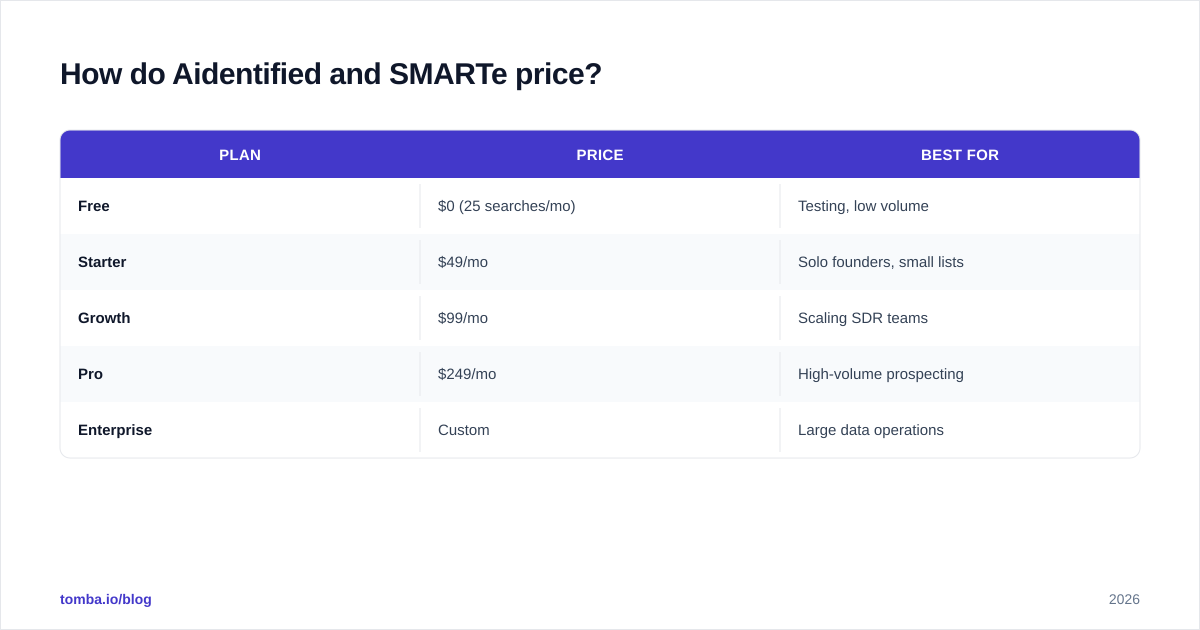
This is exactly where a transparent, credit-based layer changes the math. Tomba's pricing is public and predictable:
| Plan | Price | Best for |
|---|---|---|
| Free | $0 (25 searches/mo) | Testing, low volume |
| Starter | $49/mo | Solo founders, small lists |
| Growth | $99/mo | Scaling SDR teams |
| Pro | $249/mo | High-volume prospecting |
| Enterprise | Custom | Large data operations |
You won't replace Aidentified's wealth graph or SMARTe's international mobile coverage with a finder — those are genuinely differentiated assets. But for the bread-and-butter job of "find and verify a business email," a pay-as-you-go tool removes the annual-contract gamble entirely.

Which should you choose for your team?#
Match the tool to the motion. Here's the decision in plain terms.
Choose Aidentified if your revenue comes from relationships and high-net-worth individuals. Financial advisory, wealth management, private banking, commercial real estate, and luxury sales all benefit from connection mapping and wealth signals. If your reps win by getting a warm introduction rather than dialing 80 cold numbers, Aidentified's graph is the product built for you. The wealth and look-alike modeling has no real equivalent in a standard contact database.
Choose SMARTe if you run volume outbound across multiple regions and your bottleneck is reachable contacts — especially mobile numbers in EMEA and APAC. If your SDRs live in LinkedIn and need a dial-ready number plus a verified email to load into a sequence, SMARTe's international coverage is its reason to exist. A US-only database will leave your global reps stranded; this is where SMARTe pulls ahead.
Choose neither (yet) if your real need is "I just need verified emails for a campaign this week." Annual data platforms are overkill for that. Start with an on-demand email finder and data enrichment, prove out your motion, and graduate to a heavyweight platform only when relationship depth or global mobile coverage becomes the actual constraint.
Can you combine either platform with an email finder?#
Yes, and for many teams that's the smartest architecture. The two enterprise platforms and a lightweight finder solve non-overlapping problems, so they stack cleanly rather than compete.
A common setup: use Aidentified or SMARTe as your strategic data source — relationship intelligence or international contacts — then use a finder and verifier as your execution layer to fill gaps and confirm deliverability. When a record comes back without an email, or with one that's three years stale, you don't go back to the vendor and wait. You run a quick lookup.
This is where Tomba's surrounding tools earn their keep:
- Domain search to pull every reachable contact at a target account when your primary platform has only one.
- Bulk email finder to process a list export from either platform in one pass.
- Tomba API to wire verification directly into your enrichment flow so nothing enters the CRM unverified.
- Tomba Chrome extension for the same LinkedIn-overlay workflow SMARTe reps already use, at a fraction of a per-seat enterprise license.
The point isn't to rip out your strategic platform. It's to stop paying enterprise rates for the commodity part of the job — finding and verifying an email — when a credit-based tool does that better and cheaper.
What are the main trade-offs to weigh?#
Before you commit, weigh these against your actual workflow rather than the feature list.
Contract risk. Both Aidentified and SMARTe are annual, quote-only commitments. If your team's needs shift mid-year, you're locked in. A monthly, credit-based tool carries none of that risk — useful as a hedge while you evaluate.
Data-type fit. Wealth and relationship signals (Aidentified) are useless for a SaaS SDR. Global mobile numbers (SMARTe) are overkill for a US-only advisory practice. Buying the wrong type of data is more expensive than buying too little of the right type.
Verification ownership. No matter which you choose, deliverability is your problem, not the vendor's. Build verification into your process from day one. A simple rule — nothing enters a sequence without passing a fresh verification check — protects your domain reputation far more than any "verified" badge on a vendor's marketing page.
Coverage gaps. Every platform thins out somewhere. Aidentified outside US wealth records; SMARTe in niche verticals. Plan for a fallback finder so a gap doesn't stall a campaign.
The bottom line#
Aidentified and SMARTe aren't really competitors — they're specialists. Aidentified wins when relationships and wealth signals drive your deals. SMARTe wins when global reach and mobile connect rates are the constraint. Choose by motion, not by feature count, and you'll rarely regret it.
Whichever you pick, the commodity layer — finding and verifying business emails — shouldn't cost you an annual enterprise contract. Start free with Tomba Email Finder: 25 searches a month at no cost, transparent pricing as you scale, and a verifier built in so every address is sequence-ready before it hits your CRM. Use the heavyweight platform for what only it can do, and let a lean finder handle the rest.
// get started
Find, verify and enrich your first contacts today
Start on the free plan with 25 searches a month, then scale when your team is ready.
Free plan · No credit card required · GDPR & CCPA
// about the author