AiSDR Reviews 2026: Features, Pricing, and Honest Verdict
An honest look at AiSDR in 2026: what the AI SDR actually automates, real pricing, where it shines, where it stalls, and the data stack you still need behind it.
TL;DR
- AiSDR is an AI sales development rep that writes, sends, and replies to outbound email (and texts) on autopilot, aiming to replace the manual grind of a junior SDR.
- Pricing starts around $900/month for a fixed monthly email volume, which makes it a mid-market commitment, not a starter tool.
- The personalization and reply-handling are genuinely good; the weak spot is data quality and deliverability, which AiSDR does not fully own.
- It works best when you feed it clean, verified contact data. Garbage list in, bounced campaign out.
- If you want the autonomy without the data risk, pair an AI SDR with a dedicated email finder and email verifier so every send hits a real inbox.
If you are evaluating AiSDR in 2026, you have probably already watched the demo and seen the "book meetings while you sleep" promise. This review skips the pitch and looks at what the tool actually does, what it costs, where it breaks, and what you need around it to make it work.
What is AiSDR?#
AiSDR is an autonomous outbound platform. Think of it like hiring a junior sales rep who never sleeps: you give it an ideal customer profile and a goal, and it researches prospects, drafts personalized emails, sends them on a schedule, reads replies, and either books the meeting or routes the conversation to a human.
The technical reality is a layer of large language models sitting on top of a sending engine and a CRM connection. It pulls context from LinkedIn activity, company news, and your HubSpot or Salesforce records, then generates copy that references something specific about the prospect instead of a generic "I came across your profile."
That last part is the real selling point. Most cold email fails because it reads like a mail merge. AiSDR's pitch is that every message looks hand-written, at a volume no human team could sustain.
How does AiSDR actually work?#
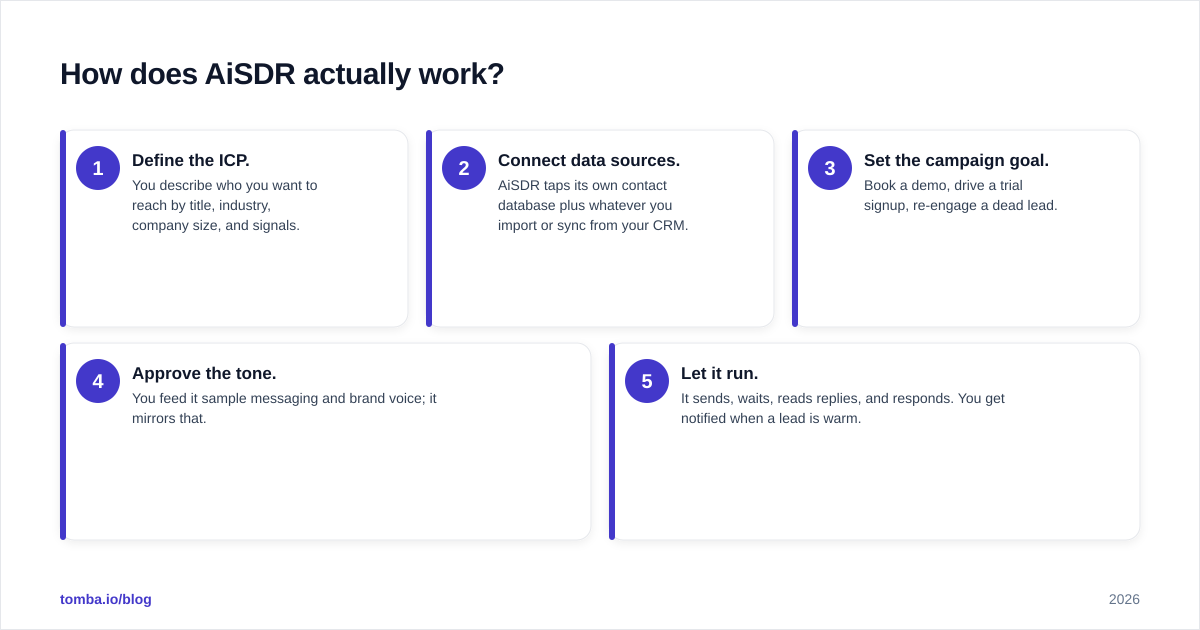
The flow is straightforward once you set it up:
- Define the ICP. You describe who you want to reach by title, industry, company size, and signals.
- Connect data sources. AiSDR taps its own contact database plus whatever you import or sync from your CRM.
- Set the campaign goal. Book a demo, drive a trial signup, re-engage a dead lead.
- Approve the tone. You feed it sample messaging and brand voice; it mirrors that.
- Let it run. It sends, waits, reads replies, and responds. You get notified when a lead is warm.
The piece people underrate is step five. Reply handling is where most automation tools fall apart, because a real prospect rarely answers with a clean "yes." They ask about pricing, push back on timing, or go quiet. AiSDR's reply engine handles objections and nurtures the thread, which is closer to a real SDR than a simple drip sequence.
What does AiSDR cost in 2026?#
This is where buyers get sticker shock. AiSDR is not a $49 tool. It is priced for teams that already have outbound budget.
Plans are built around a fixed monthly email volume, with the entry tier landing near $900/month for roughly a thousand emails, scaling up from there. Texting, additional volume, and higher tiers push the number well past that. Always confirm current numbers on the official AiSDR site, since vendor pricing in this category changes often.
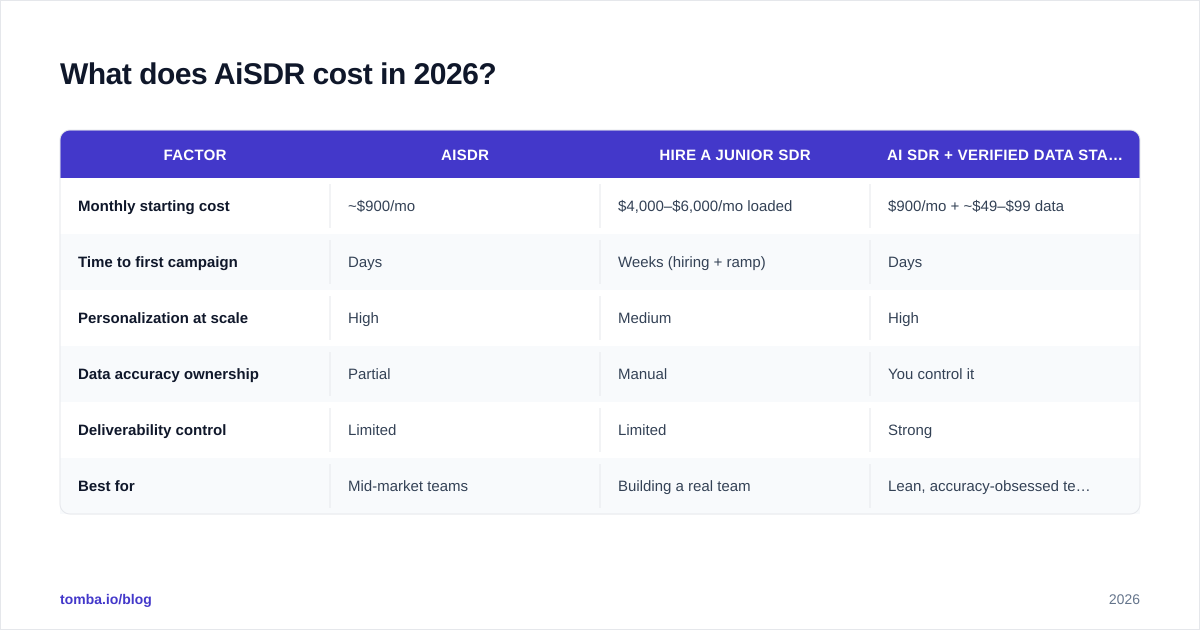
For comparison, here is how the commitment stacks up against the manual route and a data-first stack:
| Factor | AiSDR | Hire a junior SDR | AI SDR + verified data stack |
|---|---|---|---|
| Monthly starting cost | ~$900/mo | $4,000–$6,000/mo loaded | $900/mo + ~$49–$99 data |
| Time to first campaign | Days | Weeks (hiring + ramp) | Days |
| Personalization at scale | High | Medium | High |
| Data accuracy ownership | Partial | Manual | You control it |
| Deliverability control | Limited | Limited | Strong |
| Best for | Mid-market teams | Building a real team | Lean, accuracy-obsessed teams |
The honest read: AiSDR is cheaper than a headcount and faster to deploy, but the "partial" in the data accuracy row is the line item that quietly decides whether you get results.
Is AiSDR's personalization actually good?#
Yes, and this is the strongest part of the product. The copy does not read like a template. It references a recent funding round, a product launch, a podcast the prospect appeared on, or a shared connection, and it weaves that into a natural opener.
In side-by-side tests against generic sequencers, AiSDR's messages consistently feel more human. The model is tuned for sales context, so it avoids the worst AI tells like over-formal phrasing and three-adjective stacks. If you have read enough cold email, you know the difference between "Hope this finds you well" and a line that proves someone (or something) actually looked you up.
The caveat: personalization is only as good as the data underneath it. If the contact record is thin, the AI has nothing specific to reference and falls back to safe, generic lines. That brings us to the real weakness.
Where does AiSDR fall short?#
Data quality. AiSDR relies on a mix of its own database and your imports. Contact databases in this space go stale fast, and a wrong email address means a hard bounce. Stack up enough bounces and your sending domain reputation tanks. The tool does not deeply verify every address before it fires, so you can burn a domain without realizing it until your open rates collapse.
Deliverability is on you. AiSDR sends the email, but inbox placement depends on your domain warmup, SPF, DKIM, and sending volume. The platform helps, but it does not own the email deliverability stack end to end. Teams that skip warmup and list hygiene get mediocre results and blame the AI.
Cost floor. At ~$900/month, this is not for solo founders testing an idea. The math only works if a booked meeting is worth real money to you.
Less control over edge cases. The autonomy is the feature and the risk. When the AI misreads a reply or pushes too hard, it does so in your name. You need to monitor the early weeks closely.

AiSDR vs other AI SDR tools#
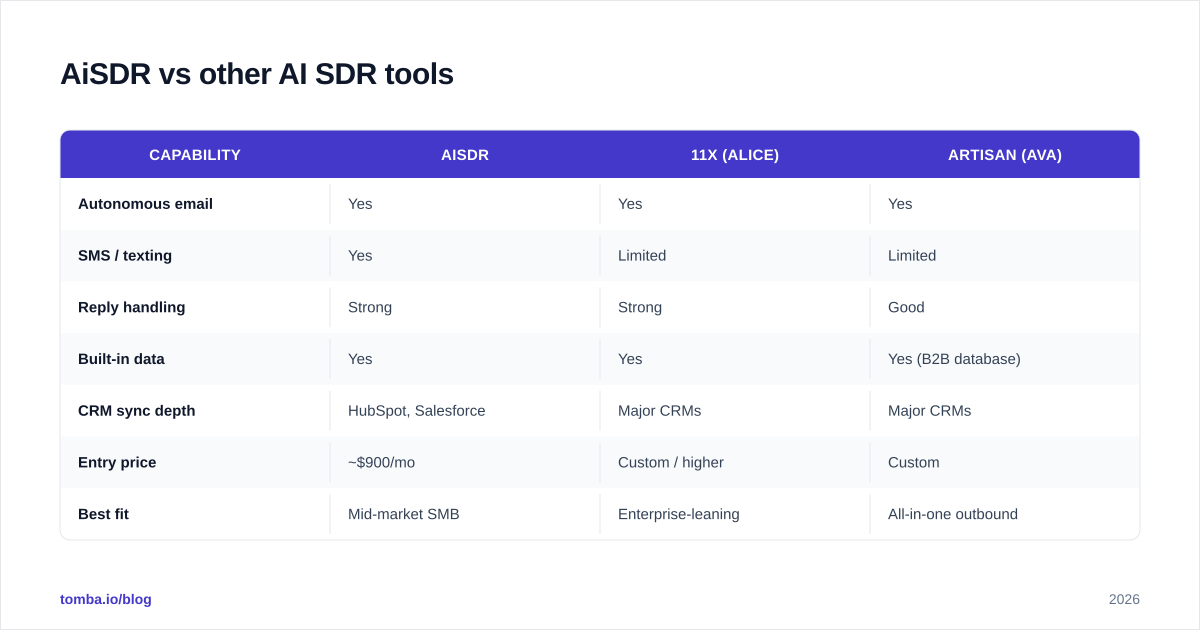
AiSDR is not alone. The AI SDR category got crowded fast, with 11x, Artisan, and others chasing the same buyer. Here is a practical comparison of what matters when you choose.
| Capability | AiSDR | 11x (Alice) | Artisan (Ava) |
|---|---|---|---|
| Autonomous email | Yes | Yes | Yes |
| SMS / texting | Yes | Limited | Limited |
| Reply handling | Strong | Strong | Good |
| Built-in data | Yes | Yes | Yes (B2B database) |
| CRM sync depth | HubSpot, Salesforce | Major CRMs | Major CRMs |
| Entry price | ~$900/mo | Custom / higher | Custom |
| Best fit | Mid-market SMB | Enterprise-leaning | All-in-one outbound |
The differences are smaller than the marketing suggests. They all generate personalized outbound and handle replies. What separates winners from money pits is the data feeding them and the deliverability discipline behind them. Read independent user feedback on G2 before you sign, because experiences vary wildly by team and list quality.
Who should buy AiSDR?#
AiSDR is a good fit if you are a mid-market B2B team with an outbound budget, a defined ICP, and no SDR headcount to spare. If you sell a product with a clear buyer and a deal size that justifies $900+ a month, the automation pays for itself quickly when it books even a handful of meetings.
It is a poor fit if you are pre-revenue, selling to a fuzzy audience, or hoping the tool will figure out your messaging for you. AI SDRs amplify a working motion. They do not invent one.
A useful framing borrowed from how teams structure revenue operations: the AI SDR is the execution layer. It needs a clean data layer beneath it and a strategy layer above it. Skip either and the execution layer just runs faster in the wrong direction.
How do you make AiSDR actually work?#
The teams that win with AiSDR, or any AI SDR, treat data as the foundation rather than an afterthought. Here is the practical checklist.
Verify before you send. Run every contact through verification so you are not firing into dead inboxes. Bounces above 3 percent put your domain at risk. A standalone email verifier catches the bad addresses the AI would otherwise blast.
Enrich thin records. When the AI has more accurate context, the personalization sharpens. Feed it real titles, company data, and current roles through data enrichment so messages reference something true.
Find the right contacts in the first place. A database that is 18 months stale is a liability. Sourcing fresh, accurate emails by domain with a dedicated email finder beats relying on a bundled database that everyone else is also blasting.
Warm the domain and protect reputation. Set up SPF, DKIM, and a warmup ramp before you scale volume. Monitor sender reputation weekly.
Watch the first 100 sends. Read what the AI actually sent and how it replied. Tune the tone and guardrails before you trust it at volume.
Do these five things and AiSDR can genuinely run like a tireless rep. Skip them and you are paying $900 a month to damage your domain.
What is the verdict on AiSDR?#
AiSDR is one of the better AI SDR platforms in 2026, with standout personalization and reply handling that feel close to a real human rep. The autonomy is real, the copy is good, and for the right mid-market team the cost beats a headcount.
The honest caveat: it is only as good as the data you feed it, and it does not fully protect you from bounces and deliverability damage. The tool is the engine, not the fuel. Buy it with eyes open, budget for the data layer, and monitor the early weeks.
If you are leaning toward an AI SDR but worried about list quality torpedoing your results, fix the foundation first. Tomba's Tomba Email Finder sources accurate, verified professional emails by domain, name, or company, and it plugs into your outbound stack through the Tomba API. Feed your AI SDR clean, verified contacts and you turn an expensive gamble into a predictable pipeline machine. Start free with 25 searches and see the accuracy difference before you commit a dollar to automation.
// get started
Find, verify and enrich your first contacts today
Start on the free plan with 25 searches a month, then scale when your team is ready.
Free plan · No credit card required · GDPR & CCPA
// about the author