Albacross vs Lead Forensics: Best Visitor ID Tool 2026
Albacross vs Lead Forensics, compared head-to-head: pricing, match rates, GDPR posture, and which website visitor identification tool actually fills your pipeline in 2026.
You have traffic. You do not have names. Albacross and Lead Forensics both promise to fix that — turning anonymous website visitors into company-level leads your sales team can actually work. The question is which one earns a slot in your stack in 2026, and where each quietly falls short.
This is a neutral, hands-on comparison. No winner is crowned by default; the right pick depends on your region, your deal size, and how much of the "identify, then enrich, then outreach" chain you want one vendor to own.
TL;DR#
- Albacross is the better fit for European, GDPR-sensitive teams that want self-serve setup, intent data, and a modern UI at a predictable price.
- Lead Forensics is the legacy heavyweight with a large IP-to-company database and white-glove onboarding, but pricing is opaque, sales-led, and often higher.
- Both stop at company-level identification. Neither reliably hands you the named decision-maker's verified email — that's a separate enrichment step.
- Match rates for both hover in the 30–60% range depending on traffic source and region; treat any "we identify 100%" claim as marketing.
- The highest-ROI setup pairs a visitor-ID tool with a contact-grade enrichment layer like Tomba's data enrichment so a company name becomes a real inbox.
What do Albacross and Lead Forensics actually do?#
Both are website visitor identification (sometimes called deanonymization) platforms. The mechanic is the same in principle: a tracking script on your site logs visitor IP addresses, the tool matches each IP against a database of business IP ranges, and it returns the company behind the visit — plus firmographics like size, industry, and location.
Think of it like a doorbell camera for your website. You can't always see the individual face, but you can tell which company knocked, how long they lingered, and which rooms (pages) they walked through.
What neither tool does well is hand you the person. IP-to-company matching identifies the org, not the buyer. That gap is the single most important thing to understand before you compare feature checklists.

How does Albacross work?#
Albacross (albacross.com) is a Stockholm-built platform that leans into self-serve. You install a script, and within a day you start seeing companies, the pages they viewed, and a lead score. Its differentiators in 2026:
- Intent data layered on top of identification — you see not just who visited, but signals suggesting they're in-market.
- Native integrations with HubSpot, Salesforce, Pipedrive, Slack, and
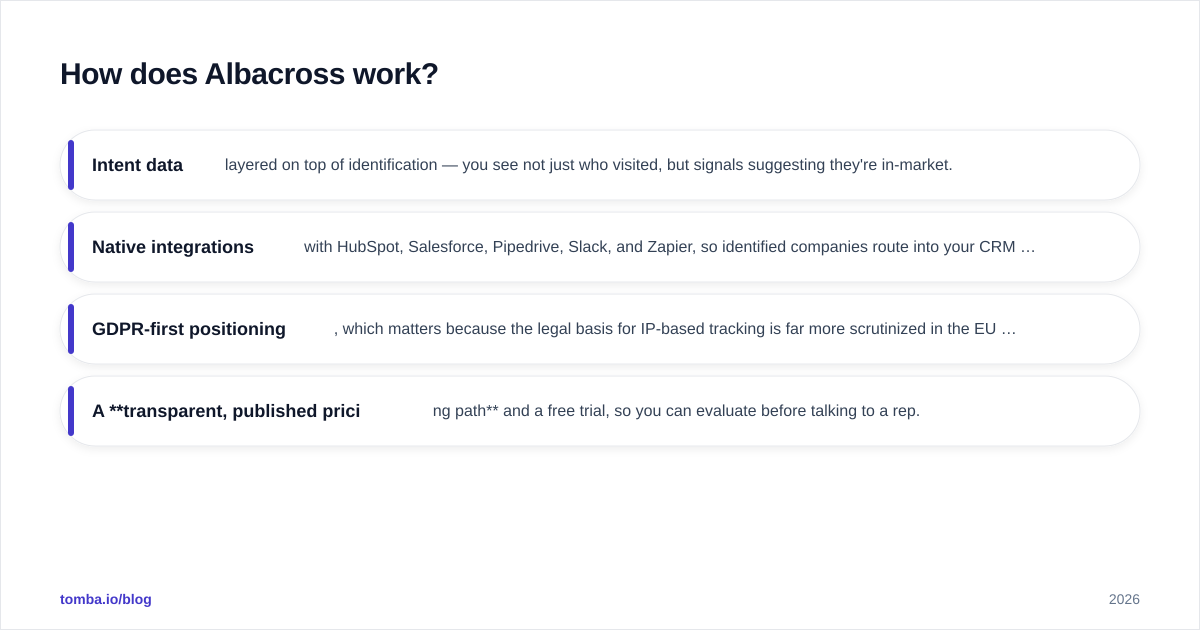
Zapier, so identified companies route into your CRM without manual export.
- GDPR-first positioning, which matters because the legal basis for IP-based tracking is far more scrutinized in the EU than the US.
- A transparent, published pricing path and a free trial, so you can evaluate before talking to a rep.
The trade-off: Albacross's database skews toward European business IPs. North American match rates are solid but not always best-in-class, and its enrichment of identified accounts is shallower than a dedicated B2B data vendor.
How does Lead Forensics work?#
Lead Forensics (leadforensics.com) is the older, larger incumbent, especially strong in the UK and US mid-market. Its pitch:
- A large proprietary IP-to-company database built over more than a decade.
- Dedicated onboarding and a customer success manager — this is white-glove, sales-led software, not self-serve.
- Built-in contact records for identified companies, so reps get a starting list of names (though contact accuracy varies, and emails are rarely verified).
- Strong reporting and lead-scoring dashboards aimed at sales managers.
The trade-offs are well-documented in user reviews on G2: pricing is not published, contracts are typically annual, and you generally must sit through a demo to get a quote. Teams that want to "try before they buy" find this friction frustrating.
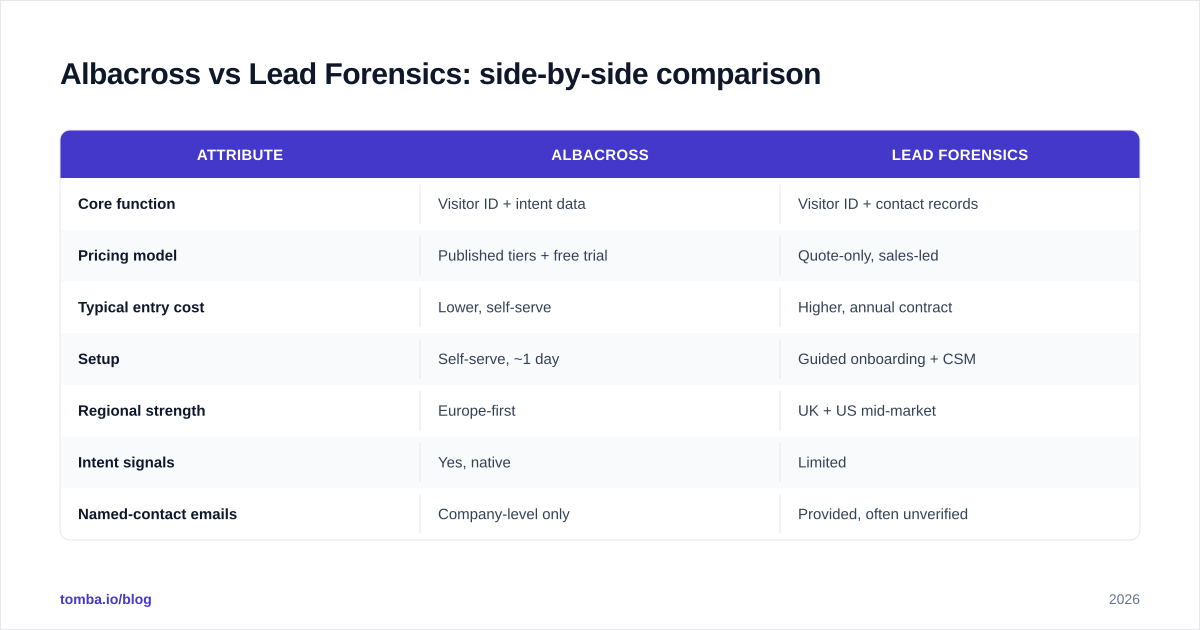
Albacross vs Lead Forensics: side-by-side comparison#
| Attribute | Albacross | Lead Forensics |
|---|---|---|
| Core function | Visitor ID + intent data | Visitor ID + contact records |
| Pricing model | Published tiers + free trial | Quote-only, sales-led |
| Typical entry cost | Lower, self-serve | Higher, annual contract |
| Setup | Self-serve, ~1 day | Guided onboarding + CSM |
| Regional strength | Europe-first | UK + US mid-market |
| Intent signals | Yes, native | Limited |
| Named-contact emails | Company-level only | Provided, often unverified |
| GDPR posture | Strong, EU-built | Compliant, US/UK focus |
| Best for | Lean, EU, self-serve teams | Enterprise wanting hand-holding |
The honest summary: Albacross wins on price transparency, modern UX, and intent. Lead Forensics wins on database depth in its core regions and on hands-on support. Neither closes the contact-data gap.
Which has better match rates and data quality?#
Neither vendor will give you a clean, audited number, so be skeptical. In practice, both land somewhere in the 30–60% company match rate depending on three factors:
- Traffic source. Direct and organic traffic from businesses on corporate networks matches well. Mobile, residential-IP, and VPN traffic matches poorly — and that share keeps growing.
- Region. Albacross is stronger across the Nordics, DACH, and broader EU; Lead Forensics is stronger in the UK and US.
- Company type. Large enterprises with registered IP ranges are easy. Remote-first startups on cloud VPNs are nearly invisible to both.
The reliability problem is structural, not vendor-specific: IP-based identification is degrading industry-wide as remote work, mobile browsing, and privacy networks erode the link between an IP and a physical office. That's why a B2B database and verified contact layer matters more every year — identification is step one, not the finish line.
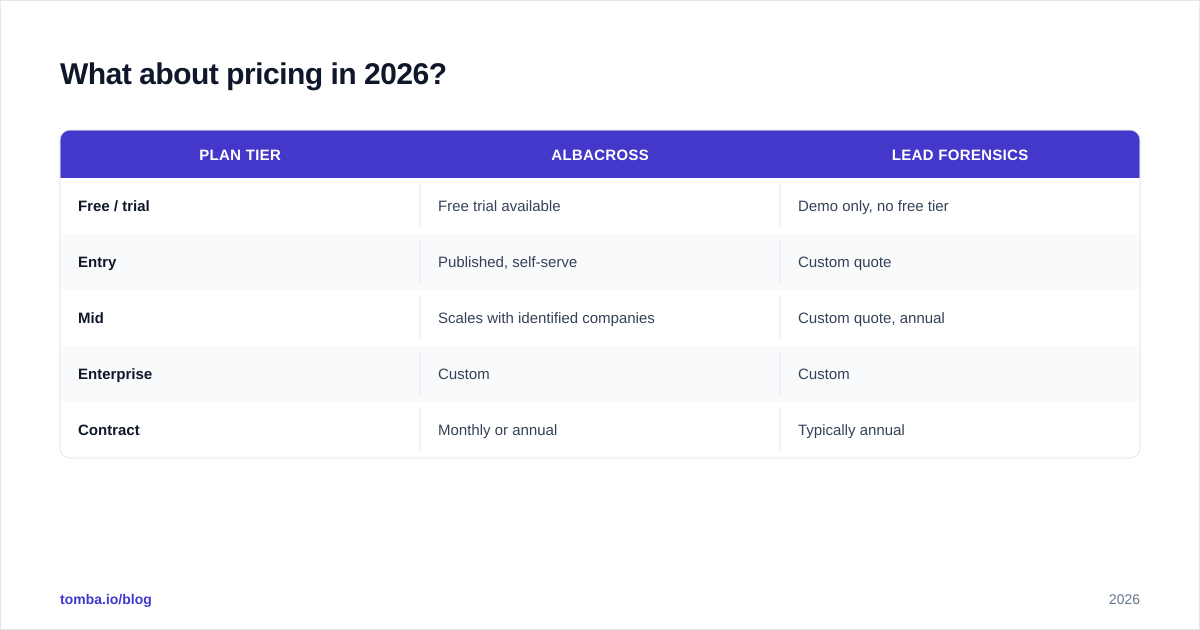
What about pricing in 2026?#
Pricing is where the two diverge most sharply.
| Plan tier | Albacross | Lead Forensics |
|---|---|---|
| Free / trial | Free trial available | Demo only, no free tier |
| Entry | Published, self-serve | Custom quote |
| Mid | Scales with identified companies | Custom quote, annual |
| Enterprise | Custom | Custom |
| Contract | Monthly or annual | Typically annual |
Albacross publishes enough to plan a budget and start without a sales call. Lead Forensics requires a conversation, and reported quotes frequently exceed comparable Albacross plans — you're partly paying for the database depth and the dedicated CSM.
If predictable, self-serve spend matters to you, Albacross has the structural edge. If you want a vendor to hold your hand through rollout and you have budget for it, Lead Forensics's model is built for that.
What's the gap both tools leave open?#
Here's the part vendors gloss over: a company name is not a sales contact. When Albacross or Lead Forensics tells you "Acme Corp visited your pricing page three times," you still don't have the email of the person who can sign. You have a logo and a guess.
Closing that gap takes a two-step chain:
- Identify the account — what visitor-ID tools do.
- Enrich to the person — find the right decision-maker and a verified email at that company.
This is where a contact-data platform earns its place. With a tool like Tomba's domain search, you take the company domain a visitor-ID tool surfaced and pull the actual people and email patterns behind it. Run those through an email verifier and you've converted an anonymous session into a deliverable, ready-to-contact lead — instead of a logo your reps can't reach.
You can even skip a standalone visitor-ID subscription for some use cases: Tomba's own website visitor reveal identifies anonymous traffic and feeds it straight into enrichment, collapsing the two steps into one workflow.
Albacross vs Lead Forensics: which should you choose?#
Match the tool to your situation rather than chasing a single "best."
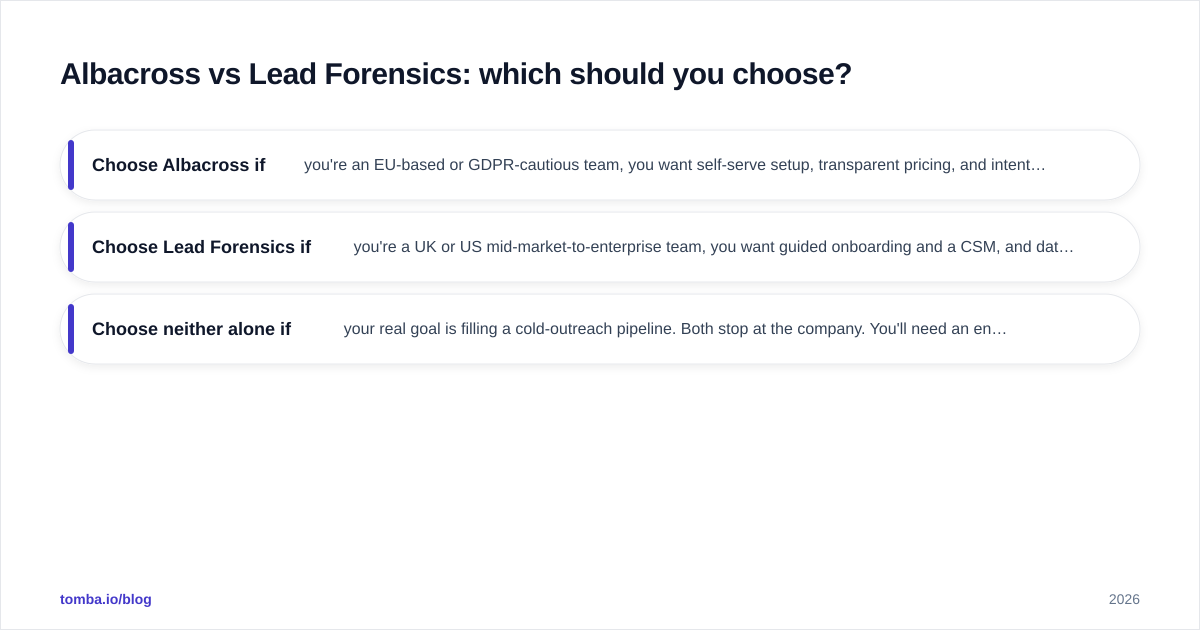
- Choose Albacross if you're an EU-based or GDPR-cautious team, you want self-serve setup, transparent pricing, and intent signals, and you value a modern UI over a dedicated rep.
- Choose Lead Forensics if you're a UK or US mid-market-to-enterprise team, you want guided onboarding and a CSM, and database depth in those regions outweighs pricing opacity for you.
- Choose neither alone if your real goal is filling a cold-outreach pipeline. Both stop at the company. You'll need an enrichment and verification layer regardless of which you pick — so budget for it from day one.
A pragmatic 2026 stack looks like this: one visitor-ID source (Albacross, Lead Forensics, or Tomba Reveal) feeding a contact-grade enrichment layer, with every address verified before it touches a sequence. The identification tool tells you who's interested; the enrichment layer tells you who to email and whether it'll land.
Turn anonymous traffic into reachable contacts#
Albacross and Lead Forensics are both legitimate ways to learn which companies browse your site — pick based on region, budget, and how much hand-holding you want. But identification is only half the job. The moment you have a domain, the bottleneck becomes finding the right person and a verified inbox.
That's exactly what Tomba's Email Finder does: feed it the company domain a visitor-ID tool surfaced, and get the decision-maker's professional email, validated and ready for outreach. Start free with 25 searches a month, then scale on a Tomba plan from $49/mo as your pipeline grows. Identify the account with Albacross or Lead Forensics — then let Tomba turn it into a contact you can actually close.
// get started
Find, verify and enrich your first contacts today
Start on the free plan with 25 searches a month, then scale when your team is ready.
Free plan · No credit card required · GDPR & CCPA
// about the author