Allegrow vs Bookyourdata 2026: Deliverability or B2B Data?
Allegrow optimizes inbox placement; Bookyourdata sells contact records. This 2026 breakdown shows which one your outbound stack actually needs — and why most teams need a third tool.
Most "Allegrow vs Bookyourdata" comparisons get one thing wrong: they treat these as competitors. They aren't. One fixes where your email lands. The other sells you the addresses to send to. Picking between them is like choosing between a faucet and the water — you probably need both, plus a filter in between.
This guide cuts through the marketing on each side, shows where each tool genuinely earns its price, and explains the gap neither one fills on its own.
TL;DR#
- Allegrow is a deliverability and inbox-placement platform. It monitors sender reputation, runs seed-list inbox tests, and automates warmup so your cold email lands in the primary inbox instead of spam.
- Bookyourdata is a pay-as-you-go B2B contact database. You filter by title, industry, and geography, then buy verified email and phone records on credits that never expire.
- They solve different problems: Allegrow protects how you send; Bookyourdata supplies who you send to.
- Bought lists — even "verified" ones — decay fast and inflate bounce rates, which is exactly what Allegrow then has to clean up. That feedback loop is the hidden cost.
- A finder-plus-verifier workflow (find the address you actually need, verify it before send) usually beats buying static lists. That's the Tomba Email Finder angle covered at the end.
What is Allegrow?#
Allegrow is an inbox-placement optimization platform. Instead of finding contacts, it works on the deliverability layer: the set of signals that decide whether your message hits the inbox, the Promotions tab, or the spam folder.
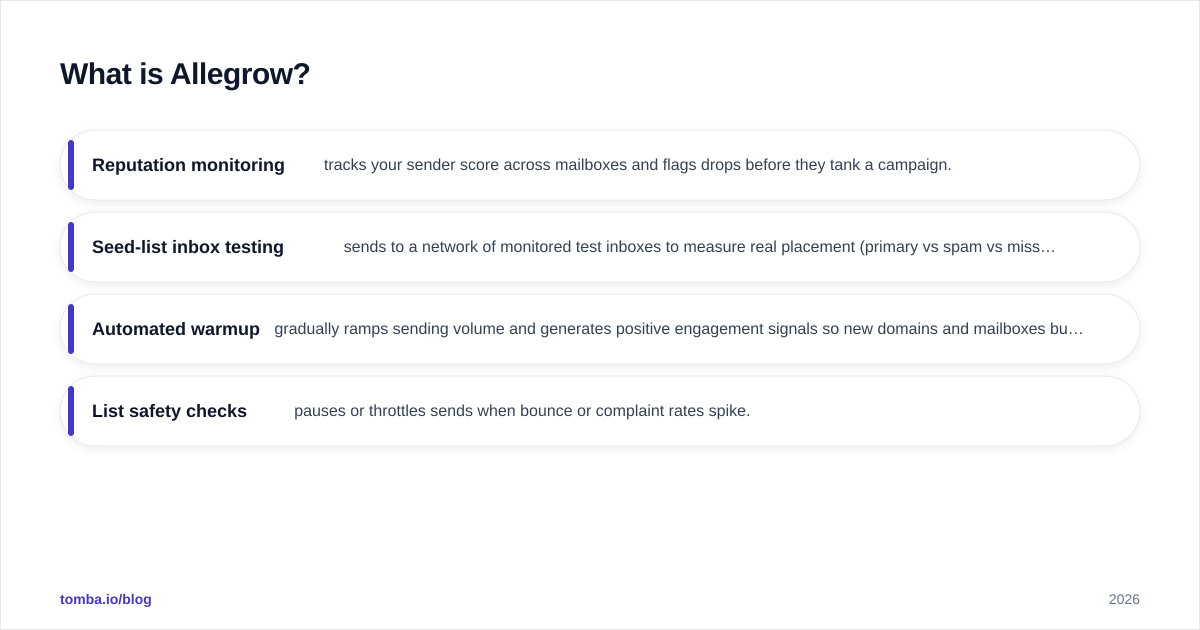
Its core jobs:
- Reputation monitoring — tracks your sender score across mailboxes and flags drops before they tank a campaign.
- Seed-list inbox testing — sends to a network of monitored test inboxes to measure real placement (primary vs spam vs missing) rather than guessing from open rates.
- Automated warmup — gradually ramps sending volume and generates positive engagement signals so new domains and mailboxes build trust.
- List safety checks — pauses or throttles sends when bounce or complaint rates spike.
If your open rates cratered overnight and you don't know why, Allegrow is the category of tool you reach for. It assumes you already have contacts — it just makes sure they receive you. For the fundamentals behind this, see Tomba's primer on email deliverability and sender reputation.
What is Bookyourdata?#
Bookyourdata is a self-service B2B data marketplace. You log in, filter a database of business contacts by job title, company size, industry, location, and technology, then purchase the matching records. Pricing is credit-based and — unusually for the category — credits don't expire, with a real-time verification step advertised at the point of export.
Its core jobs:
- Contact discovery by filter — build a list from attributes without knowing names in advance.
- Pay-as-you-go credits — buy what you need; no forced annual seat.
- Point-of-export verification — emails are checked as you download, which trims (but never eliminates) bounces.
- Direct dials and firmographics — phone numbers and company data alongside emails.
If you're entering a brand-new market segment and have zero names to start from, a database like Bookyourdata gives you raw volume fast. The tradeoff is that database records are a snapshot of a moving target — people change jobs, and B2B data decays at roughly 2–2.5% per month, or ~30% a year, according to widely cited Gartner and HubSpot figures.
Allegrow vs Bookyourdata: how do they actually compare?#
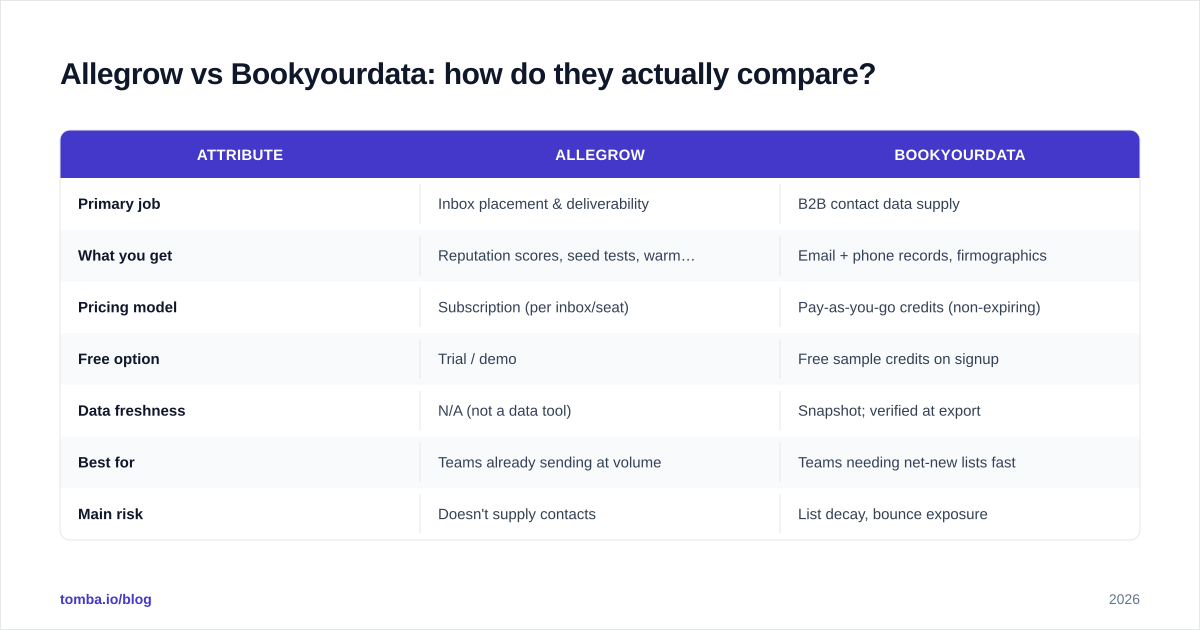
Because they sit at different stages of the outbound pipeline, a feature-by-feature table only makes sense if you read it as "what each one is for," not "which wins each row."
| Attribute | Allegrow | Bookyourdata |
|---|---|---|
| Primary job | Inbox placement & deliverability | B2B contact data supply |
| What you get | Reputation scores, seed tests, warmup | Email + phone records, firmographics |
| Pricing model | Subscription (per inbox/seat) | Pay-as-you-go credits (non-expiring) |
| Free option | Trial / demo | Free sample credits on signup |
| Data freshness | N/A (not a data tool) | Snapshot; verified at export |
| Best for | Teams already sending at volume | Teams needing net-new lists fast |
| Main risk | Doesn't supply contacts | List decay, bounce exposure |
| Replaces | A deliverability/warmup tool | A data vendor or scraper |
The honest read: Allegrow has no overlap with Bookyourdata. You could run both at once and they'd never step on each other. The real decision isn't "which one" — it's "which problem do I have right now, and is buying static lists the right way to feed the top of this funnel?"
Which problem do you actually have?#
Diagnose before you buy. Three quick scenarios:
"My emails get sent but nobody replies, and opens dropped." That's a deliverability problem. Allegrow (or a comparable inbox-placement tool) is the right category. Buying more contacts won't help if half your sends are landing in spam — you'll just burn a bigger list. Pair it with a sender-reputation routine: authenticate your domain with an SPF record, warm up gradually, and keep complaint rates low.
"I have a clean sending setup but no one to email in this new vertical." That's a data problem. Bookyourdata, or a targeted finder, fills the top of the funnel. The question becomes how you source — bulk-bought list vs found-and-verified contacts (more on that below).
"My bounce rate is climbing and I'm not sure if it's the list or the sending." This is the trap. A decayed bought list raises bounces, which damages reputation, which hurts placement — so a deliverability tool ends up firefighting a data-quality problem. The fix starts upstream: verify every address before it enters a sequence. Run lists through an email verifier and screen risky domains with a catch-all verifier.

Is buying a list the right way to source contacts?#
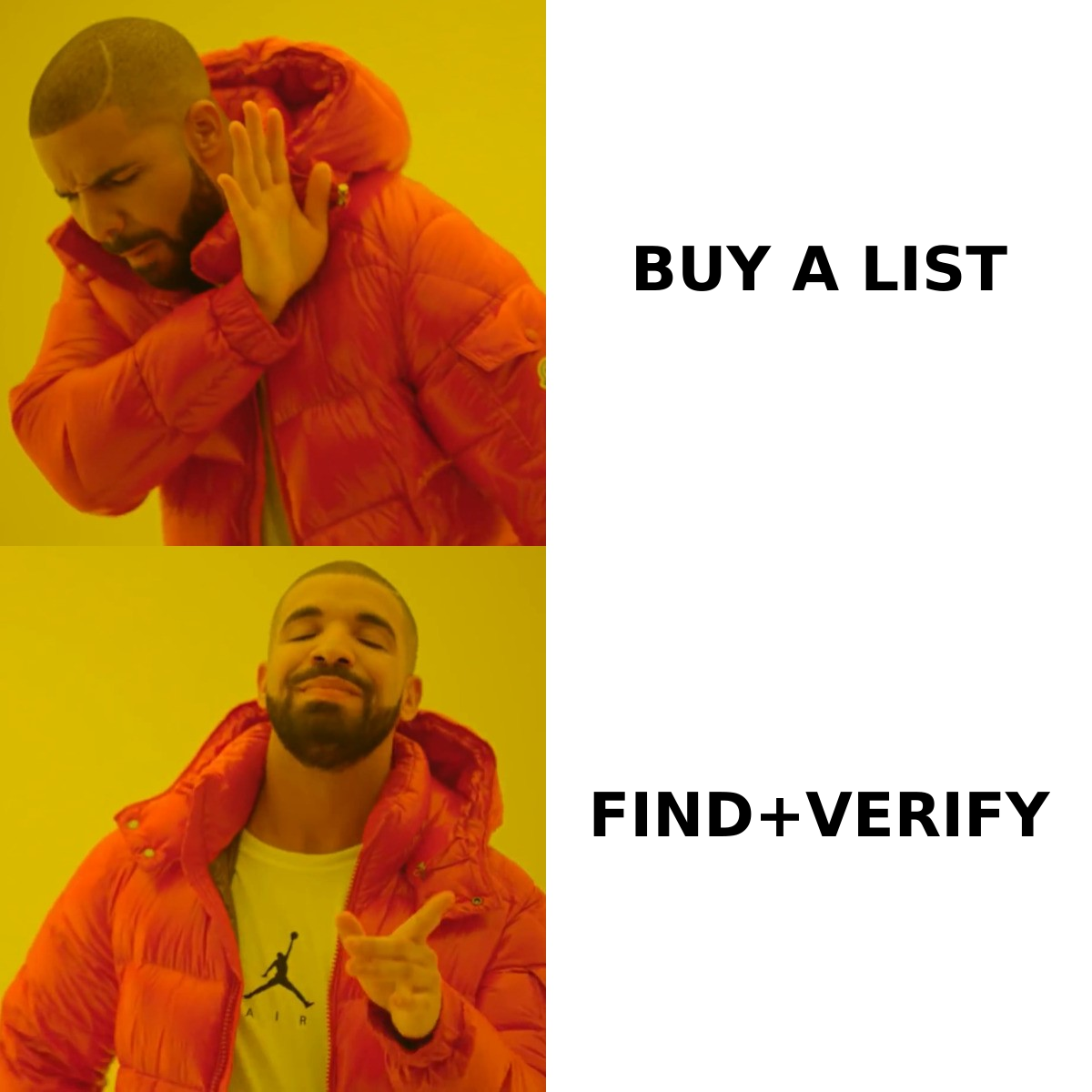
Short answer: it's the fastest way and rarely the best one. Bought B2B lists have three structural problems no vendor fully solves.
- Decay. Even a list verified today is wrong tomorrow when contacts switch jobs. You're buying a photograph of a crowd that keeps moving.
- Saturation. A purchasable list is, by definition, purchasable by your competitors too. The CMO on that list has heard from twelve other vendors this quarter.
- Deliverability drag. Stale or mistyped addresses bounce. High bounce rates are the single fastest way to wreck the sender reputation Allegrow exists to protect — so list-buying can actively work against your deliverability spend.
The alternative is targeted sourcing: identify the specific accounts and roles you want, then find and verify the exact contact at send-time. Instead of 50,000 cold records, you build 2,000 right ones. This is where a finder-first workflow beats a list marketplace for most teams. You can find emails by company with domain search, pull the decision-maker directly, and confirm the address is live before it ever hits a sequence.
For phone-led outbound, the same logic applies: validate numbers with a phone validator rather than dialing a stale list and burning rep with your carrier.
Where does Tomba fit between these two?#
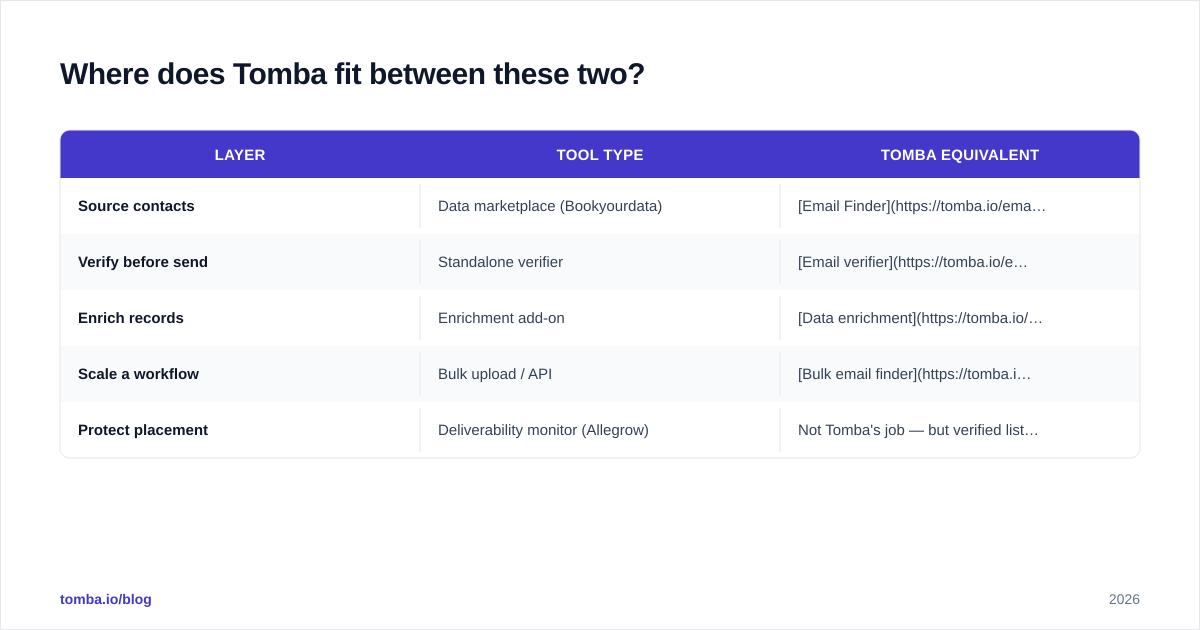
Tomba sits at the layer both tools assume you've already handled: producing accurate, send-ready contacts on demand. It isn't a deliverability monitor like Allegrow, and it isn't a buy-in-bulk marketplace like Bookyourdata. It's the find-and-verify engine in the middle.
How the pieces line up:
| Layer | Tool type | Tomba equivalent |
|---|---|---|
| Source contacts | Data marketplace (Bookyourdata) | Email Finder + domain search |
| Verify before send | Standalone verifier | Email verifier + catch-all verifier |
| Enrich records | Enrichment add-on | Data enrichment |
| Scale a workflow | Bulk upload / API | Bulk email finder + Tomba API |
| Protect placement | Deliverability monitor (Allegrow) | Not Tomba's job — but verified lists keep bounces low |
That last row is the connective tissue people miss: the cleanest way to help a deliverability tool is to never feed it dirty data. Tomba's verification step keeps bounce rates down, which keeps sender reputation high, which means a tool like Allegrow has far less firefighting to do. Sourcing quality and deliverability aren't separate budgets — they're the same problem at two ends of the pipe.
What does each one cost?#
Pricing models differ enough that direct dollar comparison misleads. Allegrow is a per-inbox subscription whose value scales with how many mailboxes you're protecting. Bookyourdata is credit-based — you pay per record, credits don't expire, and free sample credits seed the account. Always confirm current numbers on each vendor's own pricing page, since both change tiers periodically.
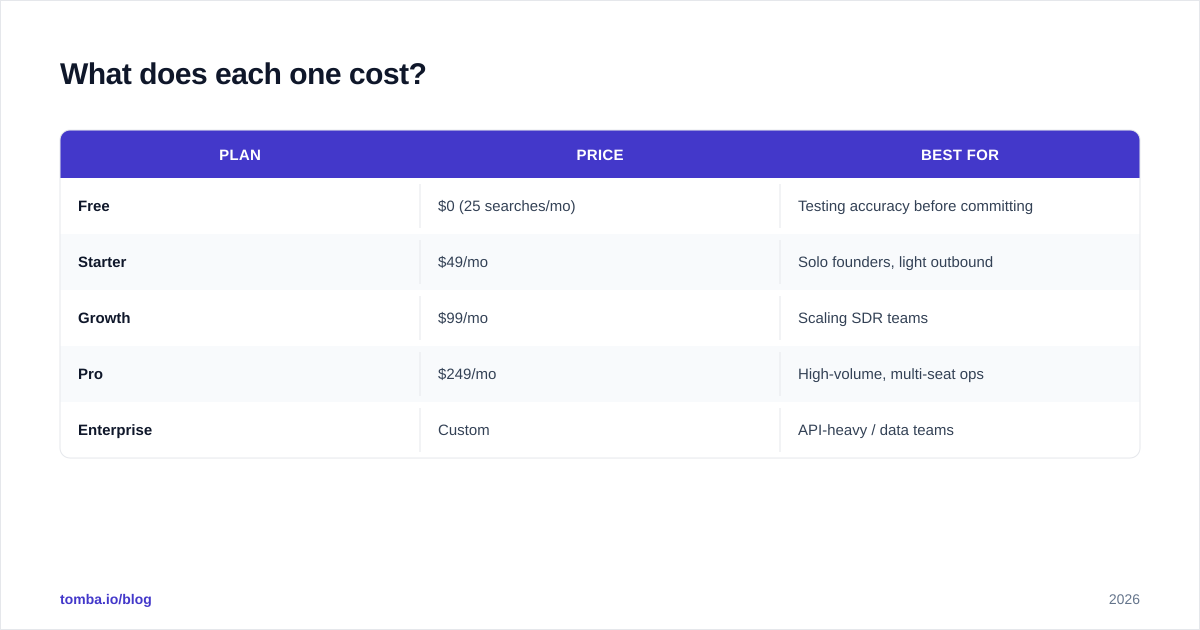
For reference, here's where Tomba's transparent tiers land, so you can model the find-and-verify layer against a list spend:
| Plan | Price | Best for |
|---|---|---|
| Free | $0 (25 searches/mo) | Testing accuracy before committing |
| Starter | $49/mo | Solo founders, light outbound |
| Growth | $99/mo | Scaling SDR teams |
| Pro | $249/mo | High-volume, multi-seat ops |
| Enterprise | Custom | API-heavy / data teams |
Full Tomba pricing is public, including API credit details. The strategic point: a verified-finder subscription is usually cheaper and lower-risk than buying volume lists you then have to clean — because you only pull the contacts you'll actually use.
Can you use Allegrow and Bookyourdata together?#
Yes, and some teams do. A typical stack: buy a starter list from Bookyourdata, run it through a verifier, load the survivors into a sequencer, and use Allegrow to monitor placement and warm the sending mailboxes. Nothing about that is wrong.
But notice the verifier in the middle — that's the unspoken requirement. Skip it, and the bought list's bounce rate undermines the deliverability tool you're paying for. The two products only play nicely with a verification step between them.
That's also the argument for collapsing the "buy list → verify → send" path into a "find verified → send" path. If you're going to verify anyway, sourcing already-targeted contacts removes the decay and saturation problems at the root rather than scrubbing them after the fact. Compare the workflow against established players on G2 — both Allegrow and Bookyourdata have category listings worth reading for unfiltered user reviews before you commit budget.
The verdict: which should you pick?#
There's no single winner because they aren't the same race.
- Pick Allegrow if your problem is placement — opens dropped, spam complaints rose, or you're scaling cold volume on fresh domains and need warmup plus monitoring. It does nothing to source contacts, so budget for data separately.
- Pick Bookyourdata if you need raw net-new volume today in a segment where you have no names, and you accept list decay as the cost of speed. Pair it with verification, always.
- Pick a finder-first workflow if you want to spend on the contacts you'll actually use, keep bounce rates low by design, and avoid the saturated-list problem entirely. For most outbound teams in 2026, this is the highest-ROI starting point.
The deeper takeaway: deliverability and data quality are the same problem viewed from two ends. Clean sourcing prevents the reputation damage that deliverability tools exist to repair. Get the front of the pipe right and the rest of the stack gets cheaper.
Start with accurate contacts, not a bought list#
If the goal is replies, start where they begin — with the right person's real, verified email. The Tomba Email Finder lets you find professional addresses by name, company, or domain, then confirm they're deliverable before a single message goes out. That keeps bounce rates low, protects your sender reputation, and means whatever deliverability tool you layer on top has far less to fix. Try it free with 25 searches a month — no list to buy, no credits to gamble on a snapshot that's already aging. Source clean, verify first, and let your outbound stack do the rest.
// get started
Find, verify and enrich your first contacts today
Start on the free plan with 25 searches a month, then scale when your team is ready.
Free plan · No credit card required · GDPR & CCPA
// about the author