Allegrow vs FindThatLead 2026: Deliverability or Finding?
Allegrow optimizes inbox placement; FindThatLead finds and verifies leads. Here's which one your outbound stack actually needs in 2026 — and why most teams need both.
Most "Allegrow vs FindThatLead" searches start from a false premise: that these two tools do the same job and you have to pick one. You don't. They sit on opposite ends of the outbound pipeline — one finds the people you email, the other makes sure those emails land in the inbox. This guide breaks down what each actually does, where they overlap, and how to decide where your budget goes first.
TL;DR#
- FindThatLead is a prospecting tool. It finds and verifies email addresses by domain, name, or LinkedIn, then helps you send cold campaigns. It feeds the top of your funnel.
- Allegrow is a deliverability tool. It monitors and improves inbox placement, sender reputation, and warmup. It protects the bottom of your funnel.
- They are not direct competitors. Comparing them is like comparing a list of phone numbers to a clearer phone line.
- If you must choose one first, choose based on your bottleneck: no leads → start with finding; leads but low reply rates and spam-folder problems → start with deliverability.
- The strongest stack pairs a high-accuracy finder with a deliverability layer. A precise finder like the Tomba Email Finder plus a placement monitor covers both ends without overpaying for overlap.
What is Allegrow?#
Allegrow is an email deliverability and sender-reputation platform. Its core promise is improving inbox placement — the percentage of your sent emails that actually reach the primary inbox instead of spam, Promotions, or the void.
It works by running automated reputation-building activity (a warmup network), monitoring placement across mailbox providers, and scoring your sender reputation over time. The dashboard surfaces where your messages are landing and flags reputation drops before they tank a campaign. Think of it as the smoke detector and the air filter for your sending domain: it doesn't write your emails or find your prospects, it keeps the channel healthy so the emails you do send get seen.
Allegrow is most relevant once you already have volume going out and you're seeing symptoms — low open rates that don't match your list quality, replies drying up, or messages confirmed landing in spam. If you've never struggled with email deliverability, you may not feel its value yet. If you have, you know exactly why a tool like this exists.
What is FindThatLead?#
FindThatLead is a lead-generation and prospecting platform. Its core job is the opposite end of the pipeline: finding the contacts you don't have yet. You give it a domain, a name plus company, or a LinkedIn profile, and it returns professional email addresses, then runs verification to cut bounces.
On top of finding, FindThatLead bundles a cold-email sender ("Scrap" and campaign tools) so you can go from discovery to outreach inside one product. That all-in-one framing is the appeal for small teams who don't want to stitch a finder, a verifier, and a sender together.
The trade-off with all-in-one prospecting suites is usually depth: the finder's accuracy and the verifier's strictness matter more than the number of features on the pricing page. A bloated list with a 30% bounce rate will wreck the very sender reputation that a tool like Allegrow then has to repair. This is why finding accuracy and deliverability are linked even though they're sold separately.
Allegrow vs FindThatLead: how are they different?#
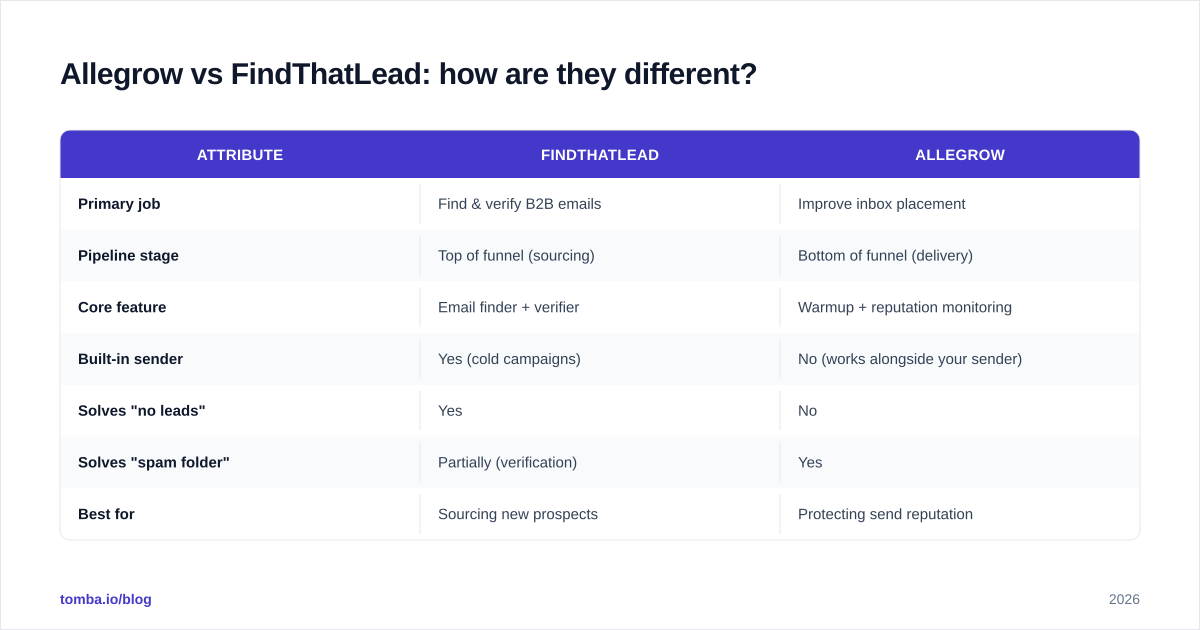
The fastest way to understand the difference is to map each tool to the stage of outbound it owns.

| Attribute | FindThatLead | Allegrow |
|---|---|---|
| Primary job | Find & verify B2B emails | Improve inbox placement |
| Pipeline stage | Top of funnel (sourcing) | Bottom of funnel (delivery) |
| Core feature | Email finder + verifier | Warmup + reputation monitoring |
| Built-in sender | Yes (cold campaigns) | No (works alongside your sender) |
| Solves "no leads" | Yes | No |
| Solves "spam folder" | Partially (verification) | Yes |
| Best for | Sourcing new prospects | Protecting send reputation |
| Typical buyer | SDRs, founders, agencies | Demand gen, ops, high-volume senders |
The overlap is thin and sits in one place: verification. FindThatLead verifies addresses to reduce bounces, and clean lists are a precondition for good deliverability. But verification is a feature inside a finder, not a deliverability program. Allegrow assumes your list is already clean and works on everything that happens after you hit send.
Which one should you buy first?#
Buy for your bottleneck, not for the feature list. Here's the decision in plain terms:
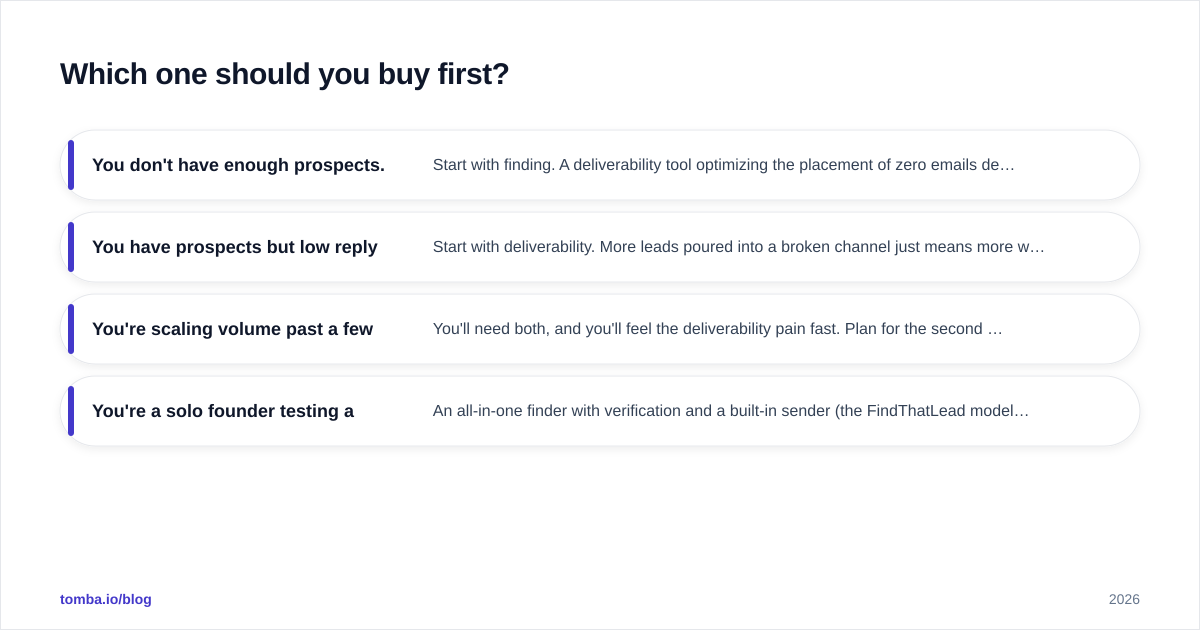
- You don't have enough prospects. Start with finding. A deliverability tool optimizing the placement of zero emails delivers zero value. Get a finder, build clean lists, then send.
- You have prospects but low reply rates and confirmed spam-folder issues. Start with deliverability. More leads poured into a broken channel just means more wasted contacts.
- You're scaling volume past a few hundred sends a day. You'll need both, and you'll feel the deliverability pain fast. Plan for the second tool within a quarter.
- You're a solo founder testing a motion. An all-in-one finder with verification and a built-in sender (the FindThatLead model) gets you to first results fastest, then you add a placement layer when volume justifies it.
The honest answer for most growing teams is "both, eventually." The sequence just depends on which end of the pipe is leaking today.
How do they compare on pricing and value?#
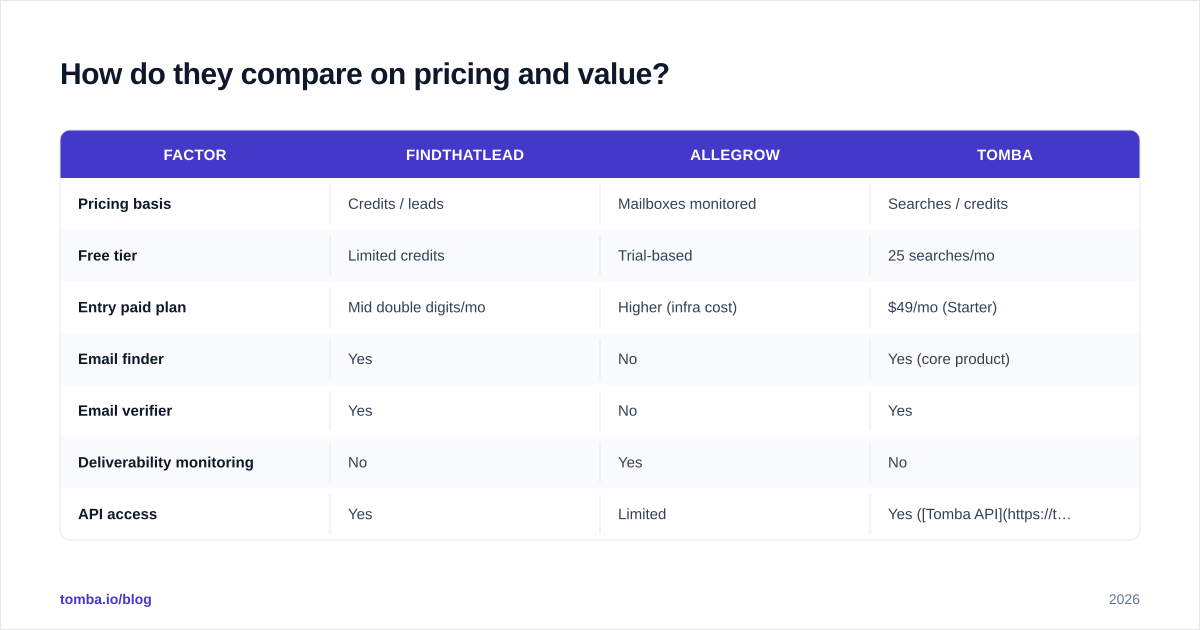
Pricing models differ because the products do. FindThatLead charges by credits and contacts (finding volume). Allegrow charges by sender seats and monitored mailboxes (delivery infrastructure). Always check each vendor's live pricing — plans change — but the structural difference is what matters for budgeting.
| Factor | FindThatLead | Allegrow | Tomba |
|---|---|---|---|
| Pricing basis | Credits / leads | Mailboxes monitored | Searches / credits |
| Free tier | Limited credits | Trial-based | 25 searches/mo |
| Entry paid plan | Mid double digits/mo | Higher (infra cost) | $49/mo (Starter) |
| Email finder | Yes | No | Yes (core product) |
| Email verifier | Yes | No | Yes |
| Deliverability monitoring | No | Yes | No |
| API access | Yes | Limited | Yes (Tomba API) |
A few takeaways. Deliverability tools tend to cost more per seat because they run live monitoring infrastructure. Finders are cheaper per unit but you pay for volume. And if accuracy is your priority on the finding side, it's worth comparing dedicated finders directly rather than defaulting to whatever's bundled — the Tomba pricing page lists a free tier of 25 searches and a $49/mo Starter plan, which is a useful reference point for what high-accuracy finding costs on its own.
For independent feature and review comparisons across all three categories, G2 and Capterra are the neutral sources worth checking before you commit.
Does verification quality actually affect deliverability?#
Yes — directly, and this is the link most buyers miss. Every hard bounce is a signal to mailbox providers that you're sending to bad addresses, which is classic spammer behavior. A few percent bounce rate is tolerable; double digits will degrade your reputation no matter how good your warmup tool is.
That means the cheapest deliverability improvement available to you is not sending to bad addresses in the first place. A strict email verifier catches invalid, role-based, and risky addresses before they ever hit your sequencer. Catch-all domains are the hard case — they accept everything at the SMTP layer, so a naive verifier marks them "valid" when they may not be. A dedicated catch-all verifier reduces that uncertainty.
In practice the workflow looks like this: find with a high-accuracy finder, verify hard (including catch-all handling), then let a deliverability tool optimize placement for the clean list that survives. Skip the verification step and you're asking Allegrow to repair damage that a better finder would have prevented.
What does the ideal outbound stack look like?#
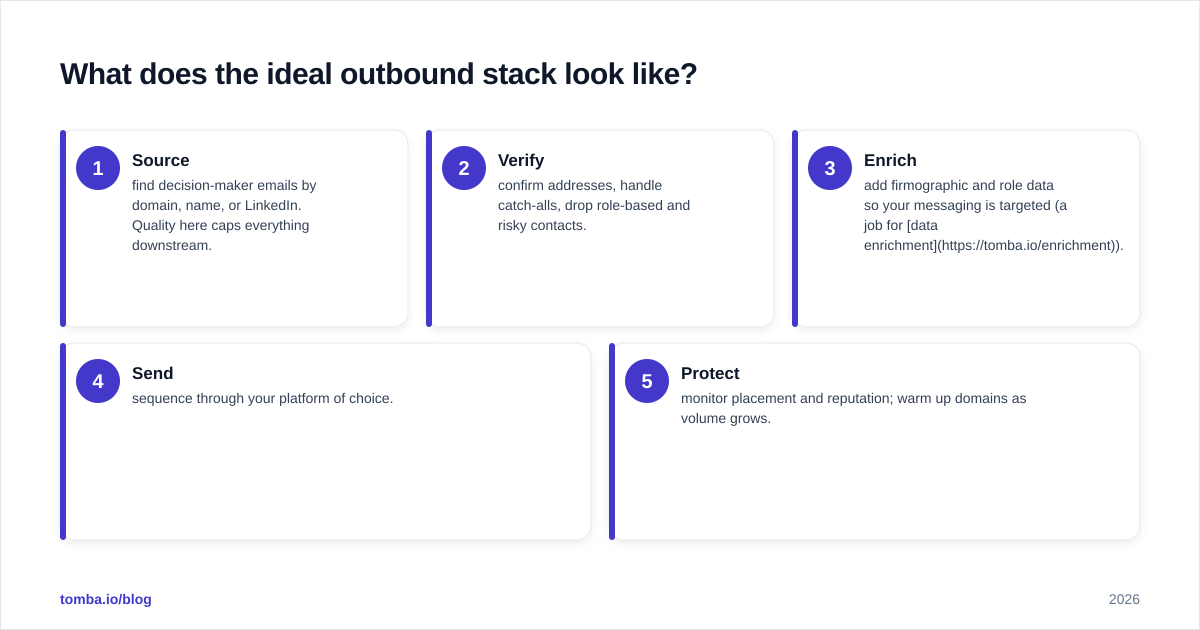
The mistake is treating finding, verifying, and deliverability as competing line items. They're sequential stages, and the output of each feeds the next:
- Source — find decision-maker emails by domain, name, or LinkedIn. Quality here caps everything downstream.
- Verify — confirm addresses, handle catch-alls, drop role-based and risky contacts.
- Enrich — add firmographic and role data so your messaging is targeted (a job for data enrichment).
- Send — sequence through your platform of choice.
- Protect — monitor placement and reputation; warm up domains as volume grows.
FindThatLead covers stages 1, 2, and 4. Allegrow covers stage 5. Neither covers all five, which is exactly why "vs" is the wrong frame. A team running serious outbound typically assembles a finder, a verifier, an enrichment source, a sender, and a deliverability monitor — sometimes consolidating a few of those into one vendor.
Where you can consolidate without losing quality, do. Where consolidation means a weaker finder or a soft verifier, don't — because those two stages set the ceiling on every campaign that follows. If you're sourcing at scale, a bulk email finder plus strict verification will protect the deliverability you're paying Allegrow to optimize.
Allegrow vs FindThatLead: the verdict#
There's no single winner because they're not in the same race. Choose FindThatLead (or a stronger standalone finder) when your problem is "I need more qualified contacts." Choose Allegrow when your problem is "my emails aren't reaching the inbox." Most scaling teams hit both problems within the same year and end up running a tool for each.
If you only remember one thing: deliverability tools optimize the placement of emails you've already decided to send. They can't fix a list full of guesses and bounces. The highest-leverage investment for most outbound teams is still accurate sourcing and strict verification at the top of the funnel — because clean inputs make every later stage, including deliverability, easier and cheaper.
That's the gap the Tomba Email Finder is built to close: find verified, professional email addresses by domain, name, or company, with catch-all handling and a verifier in the same workflow, so the list you hand to your sender — and to whatever deliverability layer you add next — is clean from the start. Start free with 25 searches a month and scale into the $49/mo Starter plan once the pipeline proves out. Get the finding right first, and the rest of the stack does less work.
Ready to find emails that actually work?
Join 150,000+ professionals who stopped guessing and started sending. Free credits on signup — no credit card required.
Get the Tomba newsletter
Practical outbound tactics and product updates — once every two weeks.
About the author