Allegrow vs RocketReach 2026: Which Tool Do You Need?
Allegrow optimizes inbox placement; RocketReach finds contact data. Here's how the two compare, why they solve different problems, and which one your outbound stack actually needs in 2026.
TL;DR
- Allegrow and RocketReach are not real competitors — Allegrow is a deliverability and inbox-placement optimizer, while RocketReach is a contact-data and email-finding database. They sit at opposite ends of the same outbound workflow.
- If your emails aren't landing in the inbox, you need Allegrow (or a deliverability tool like it). If you don't know who to email or lack verified addresses, you need RocketReach (or a cheaper, more accurate finder).
- RocketReach pricing starts around $39/user/mo billed annually and scales by lookups; Allegrow is quote-based and priced per seat/mailbox for teams.
- Most teams that "compare" these two actually need both functions — accurate data feeding a deliverability-safe sending setup — not one or the other.
- For the data half of the equation, a focused finder-and-verifier like Tomba is usually more accurate and far cheaper per credit than RocketReach.
What are Allegrow and RocketReach?#
Here's the short version: these tools do completely different jobs, and the only reason you'd compare them is that both show up in cold-email tool lists.
Allegrow is a deliverability optimization platform. It monitors where your emails land (inbox, spam, or promotions), runs seed-list placement tests, and automates sender-reputation work like warming, spam-word detection, and engagement signals. Its entire value is getting messages you've already written, to people you've already chosen, into the primary inbox. You can read more on the official Allegrow site.
RocketReach is a contact database and email finder. It helps you discover who works at a company, surfaces their professional email and phone number, and exports those contacts into your CRM or sequencer. Its value is the front of the funnel: building a list of the right people to contact. See the official RocketReach site for its current feature set.
So when someone searches "allegrow vs rocketreach," they're usually really asking one of two things: which problem do I have right now — finding people, or reaching them? Answer that and the choice makes itself.

Why are people comparing two tools that do different things?#
Because the symptoms feel identical. When an outbound campaign underperforms, the dashboard just shows low reply rates. That single number can come from at least three different failures:
- Bad data — you emailed the wrong people, or the addresses bounced. (A data problem → RocketReach territory.)
- Bad placement — your emails were technically delivered but landed in spam, so nobody saw them. (A deliverability problem → Allegrow territory.)
- Bad copy — the right people got it in the inbox and ignored it. (A messaging problem → neither tool fixes this.)
Reps often grab whichever tool a peer recommended without diagnosing which failure they actually have. That's why the comparison exists at all. The honest framing is not "Allegrow or RocketReach" but "where in my funnel is the leak?"
If you're unfamiliar with the underlying concept, our glossary entry on email deliverability explains why a "delivered" email is not the same as an email that reached the inbox.
How do Allegrow and RocketReach compare head-to-head?#
Even though they solve different problems, it helps to see them side by side so you can place each in your stack.
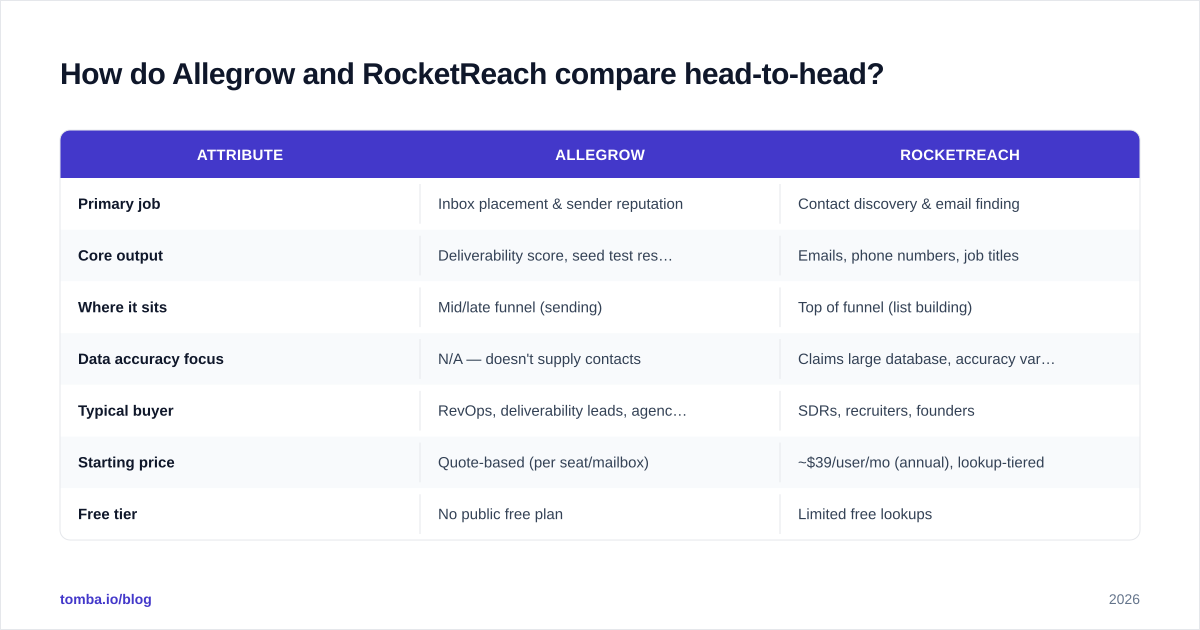
| Attribute | Allegrow | RocketReach |
|---|---|---|
| Primary job | Inbox placement & sender reputation | Contact discovery & email finding |
| Core output | Deliverability score, seed test results, warmup | Emails, phone numbers, job titles |
| Where it sits | Mid/late funnel (sending) | Top of funnel (list building) |
| Data accuracy focus | N/A — doesn't supply contacts | Claims large database, accuracy varies |
| Typical buyer | RevOps, deliverability leads, agencies | SDRs, recruiters, founders |
| Starting price | Quote-based (per seat/mailbox) | ~$39/user/mo (annual), lookup-tiered |
| Free tier | No public free plan | Limited free lookups |
| CRM/sequencer fit | Sits beside your sender (e.g. Instantly, Smartlead) | Exports into HubSpot, Salesforce, Outreach |
| Replaces | A manual deliverability audit | A manual prospecting/research process |
The takeaway: there's almost no feature overlap. Allegrow never tells you who to email, and RocketReach never tells you whether your email landed. A complete outbound motion needs both capabilities — but rarely from these two specific vendors at full price.
Which one should you choose first?#
Start with the bottleneck that's costing you the most pipeline right now.
Choose a deliverability tool (Allegrow-style) first if:
- Your bounce rate is low but reply rates cratered suddenly.
- Seed tests show your mail going to spam or the promotions tab.
- You're scaling volume across many mailboxes and reputation is fragile.
- You already have a clean, verified contact list and just can't get seen.
Choose a data tool (RocketReach-style) first if:
- You're staring at a blank spreadsheet with no target accounts.
- Your bounce rate is high (a classic sign of stale or guessed emails).
- You need phone numbers and job titles, not just addresses.
- Your problem is "I don't know who to contact," not "they didn't see it."
Here's the diagnostic most teams skip: check your bounce rate before you buy anything. A high bounce rate is a data problem and will also wreck your deliverability — so fixing data first often resolves what looks like an Allegrow-shaped problem. The cleanest way to do that is to run your list through an email verifier before you ever hit send.
Is RocketReach worth it for contact data?#
RocketReach is a capable, well-known database, and for some buyers the brand recognition and broad coverage are enough. But there are three recurring critiques worth weighing before you commit, and they show up consistently in reviews on G2:
- Accuracy is inconsistent. Like every large aggregator, RocketReach blends fresh and stale records. You'll get correct emails, but you'll also get outdated ones — which means you still need verification before sending, or your bounce rate climbs.
- Lookup-based pricing adds up. Costs scale with how many contacts you pull, and heavy prospecting months can get expensive fast compared to flat-credit finders.
- You pay for the database, not the deliverability. RocketReach hands you data and stops there. Anything about getting that email seen is on you.
This is exactly why many teams pair or replace it with a dedicated finder. A focused tool can match or beat RocketReach on accuracy at the addresses you actually care about, while costing less per credit. If you're evaluating that route, our breakdown of the best RocketReach alternative options walks through the trade-offs.
How do the two fit into a real outbound workflow?#
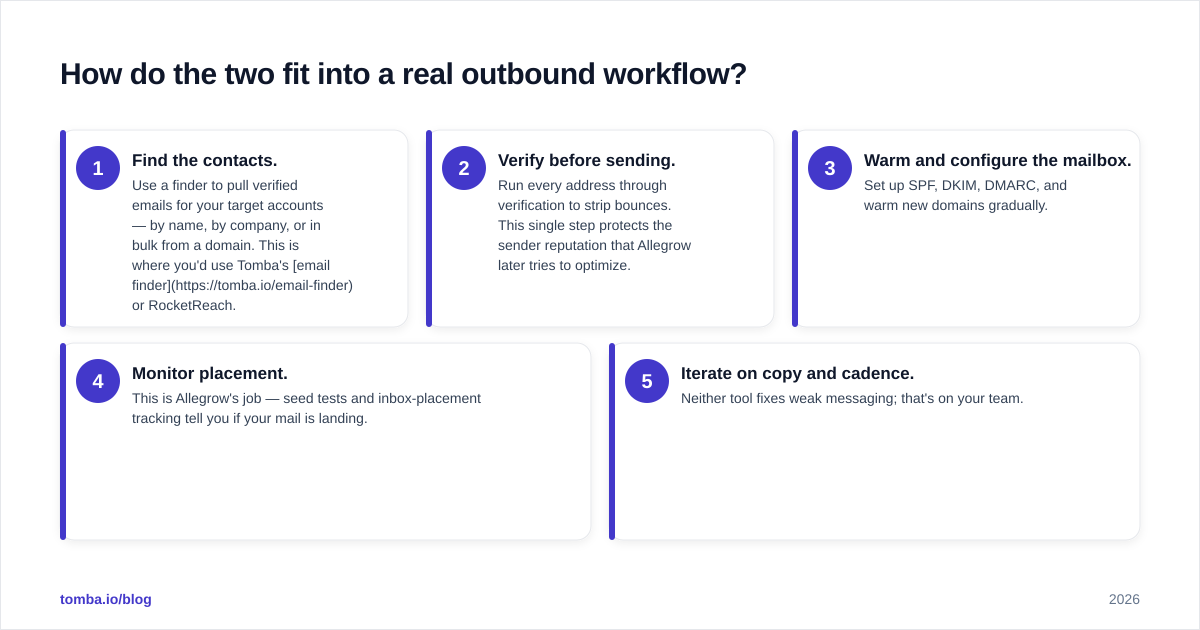
Think of outbound as a relay race. Data tools run the first leg; deliverability tools run the last. Drop either baton and the whole race is lost.
A realistic 2026 stack looks like this:
- Find the contacts. Use a finder to pull verified emails for your target accounts — by name, by company, or in bulk from a domain. This is where you'd use Tomba's email finder or RocketReach.
- Verify before sending. Run every address through verification to strip bounces. This single step protects the sender reputation that Allegrow later tries to optimize.
- Warm and configure the mailbox. Set up SPF, DKIM, DMARC, and warm new domains gradually.
- Monitor placement. This is Allegrow's job — seed tests and inbox-placement tracking tell you if your mail is landing.
- Iterate on copy and cadence. Neither tool fixes weak messaging; that's on your team.
Notice that RocketReach lives in step 1 and Allegrow lives in step 4. They're complementary, not competitive. The mistake is buying an expensive deliverability tool to compensate for dirty data from step 1 — fix the data and step 4 gets dramatically easier.
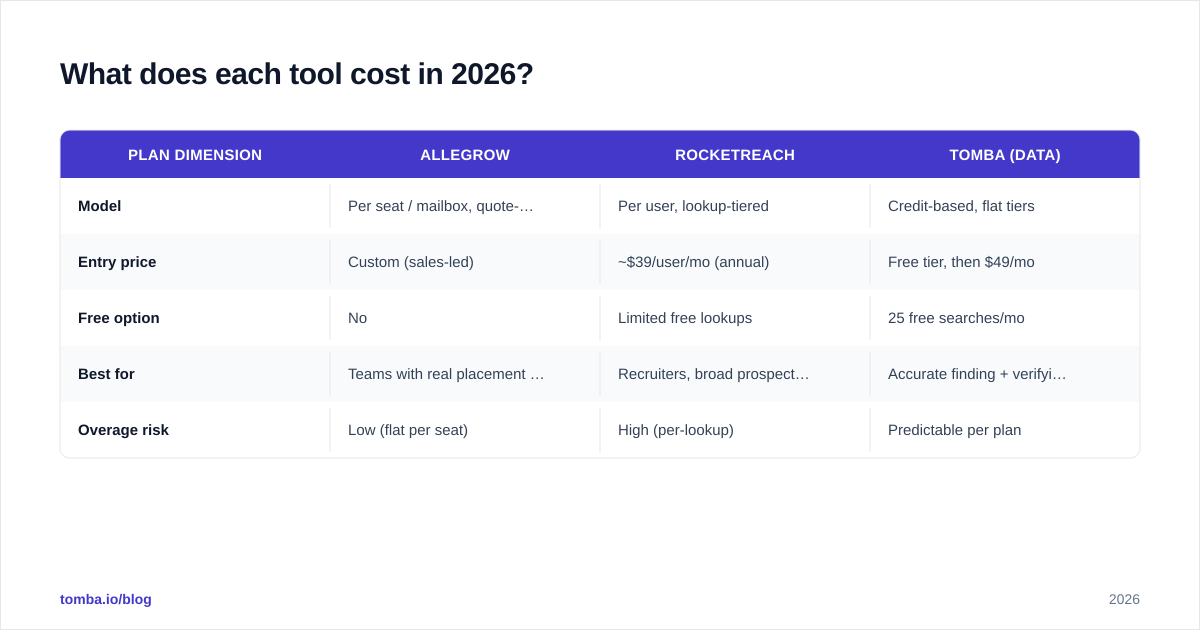
What does each tool cost in 2026?#
Pricing is where the "vs" framing gets confusing, because the two are billed on different logic.
| Plan dimension | Allegrow | RocketReach | Tomba (data) |
|---|---|---|---|
| Model | Per seat / mailbox, quote-based | Per user, lookup-tiered | Credit-based, flat tiers |
| Entry price | Custom (sales-led) | ~$39/user/mo (annual) | Free tier, then $49/mo |
| Free option | No | Limited free lookups | 25 free searches/mo |
| Best for | Teams with real placement issues | Recruiters, broad prospecting | Accurate finding + verifying |
| Overage risk | Low (flat per seat) | High (per-lookup) | Predictable per plan |
For the data side specifically, a flat-tier finder is easier to budget than a per-lookup model. Tomba's plans run a free tier (25 searches/mo), then Starter at $49/mo, Growth at $99/mo, and Pro at $249/mo — you can see the full breakdown on the Tomba pricing page. The point isn't that one number is universally lower; it's that lookup-metered pricing punishes the exact behavior — high-volume prospecting — that you bought the tool to do.
Do you actually need both?#
For most growing outbound teams, yes — but not necessarily these two brands.
You need one tool that supplies accurate contact data and one process that protects deliverability. Allegrow is one option for the second; basic sender hygiene plus your sequencer's built-in warmup covers it for many teams at lower volume. RocketReach is one option for the first; a more accurate, flat-priced finder often covers it better.
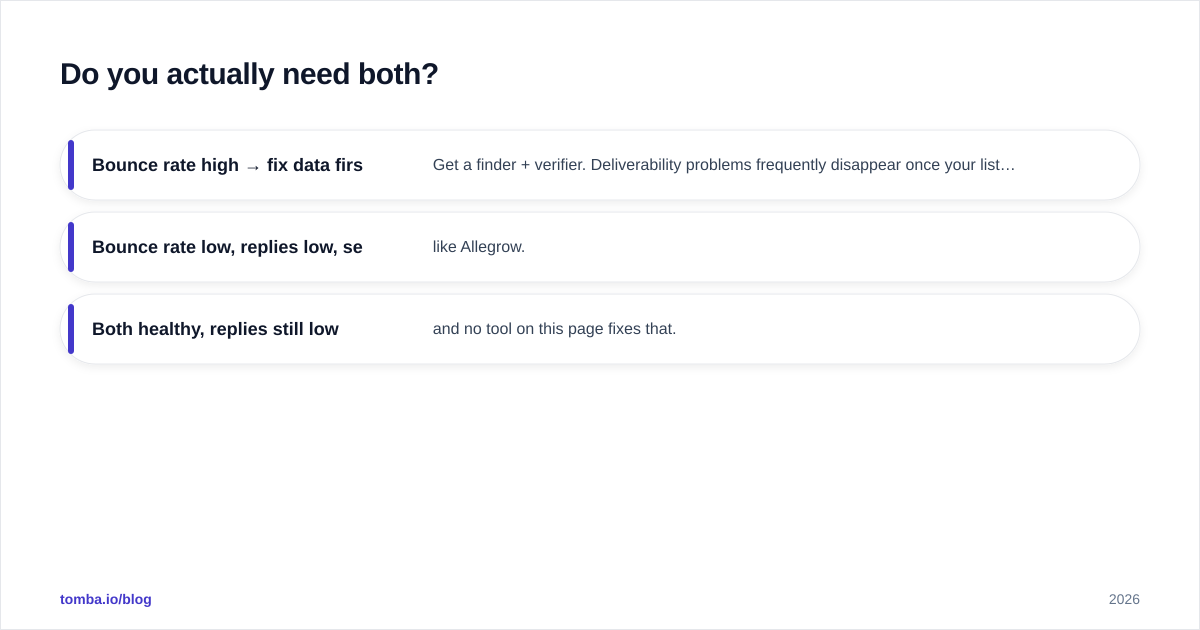
The decision tree is simple:
- Bounce rate high → fix data first. Get a finder + verifier. Deliverability problems frequently disappear once your list is clean.
- Bounce rate low, replies low, seed tests show spam → invest in deliverability monitoring like Allegrow.
- Both healthy, replies still low → it's your copy or targeting, and no tool on this page fixes that.
Spending on a deliverability platform while feeding it guessed email addresses is like installing a premium sound system in a car with no engine. Sequence matters.
The bottom line#
Allegrow and RocketReach aren't rivals — they're two stages of the same journey. Allegrow makes sure your message lands; RocketReach (or a better-priced alternative) makes sure you have someone real to send it to. Compare them only to figure out which gap you have, then fill that gap with the right tool.
If your real problem is the one most outbound teams actually have — unreliable contact data driving bounces and dragging down everything downstream — start there. Tomba's Email Finder pulls verified professional emails by name, company, or domain, with built-in verification so bad addresses never reach your sender in the first place. Start free with 25 searches a month, confirm the accuracy on your own target accounts, and only then worry about whether you need a dedicated deliverability layer on top. Clean data first; everything else gets easier.
Ready to find emails that actually work?
Join 150,000+ professionals who stopped guessing and started sending. Free credits on signup — no credit card required.
Get the Tomba newsletter
Practical outbound tactics and product updates — once every two weeks.
About the author