Allegrow vs Salesbot: Which Deliverability Tool Wins in 2026?
Allegrow optimizes inbox placement and sender reputation; Salesbot automates outreach replies. Here's which one actually protects your cold email in 2026 — and where they overlap.
You found two tools with similar promises and very different jobs. Allegrow wants to keep your emails out of spam. Salesbot wants to automate the conversation once they land. Picking between them — or deciding you need both — depends on where your cold email is actually leaking revenue.
This breakdown compares Allegrow vs Salesbot on what they do, what they cost, and which gaps in your outbound stack each one plugs.
TL;DR#
- Allegrow is a deliverability and inbox-placement tool: it monitors sender reputation, runs seed-list inbox tests, and auto-warms mailboxes so more messages reach the primary tab.
- Salesbot is an outreach-automation and reply layer: it sequences messages, qualifies responses, and routes warm leads — it does not fix a damaged sending reputation.
- They solve different problems. If your open rates cratered, you need Allegrow's category. If your inbox is healthy but follow-up is manual, you need Salesbot's category.
- Neither tool finds or verifies the contacts you send to — that data-quality step happens upstream, and it's the single biggest driver of bounce-rate-related blacklisting.
- For most teams in 2026, the winning stack is clean data → deliverability monitoring → reply automation, not one tool pretending to do all three.
What is Allegrow?#
Allegrow is an inbox-placement optimization platform. Think of it as a smoke detector wired into your email-sending: it constantly samples whether your messages land in the primary inbox, the promotions tab, or spam, then adjusts your sending behavior to push placement back toward the inbox.
Its core mechanics:
- Seed-list testing — sends to a network of monitored mailboxes across Gmail, Outlook, and others to measure where you actually land.
- Reputation scoring — tracks a sender score over time so you catch a decline before prospects stop replying.
- Automated warm-up — generates positive engagement signals (opens, replies, moves-to-inbox) to build mailbox trust.
- Spam-trigger alerts — flags content and behavior patterns that depress email deliverability.
Allegrow assumes you already have a list and a sequencing tool. It sits underneath both, protecting the channel.
What is Salesbot?#
"Salesbot" refers to AI-driven sales-conversation automation — the layer that handles outreach cadences and the back-and-forth after a prospect replies. Where Allegrow worries about whether the email arrives, Salesbot worries about what happens next: detecting intent in a reply, answering common questions, booking meetings, and handing genuinely hot leads to a human.
Its core mechanics:
- Sequencing — multi-step email (and sometimes LinkedIn/SMS) cadences with conditional logic.
- Reply classification — sorting responses into interested / not-now / objection / out-of-office.
- Auto-response drafting — AI-generated replies to keep conversations moving.
- Routing & handoff — pushing qualified leads into your CRM or to a rep.
A Salesbot improves throughput and response rate handling. It does nothing for your sender reputation — in fact, a high-volume bot sending to bad addresses will damage deliverability faster than manual sending.
Allegrow vs Salesbot: how do they actually differ?#
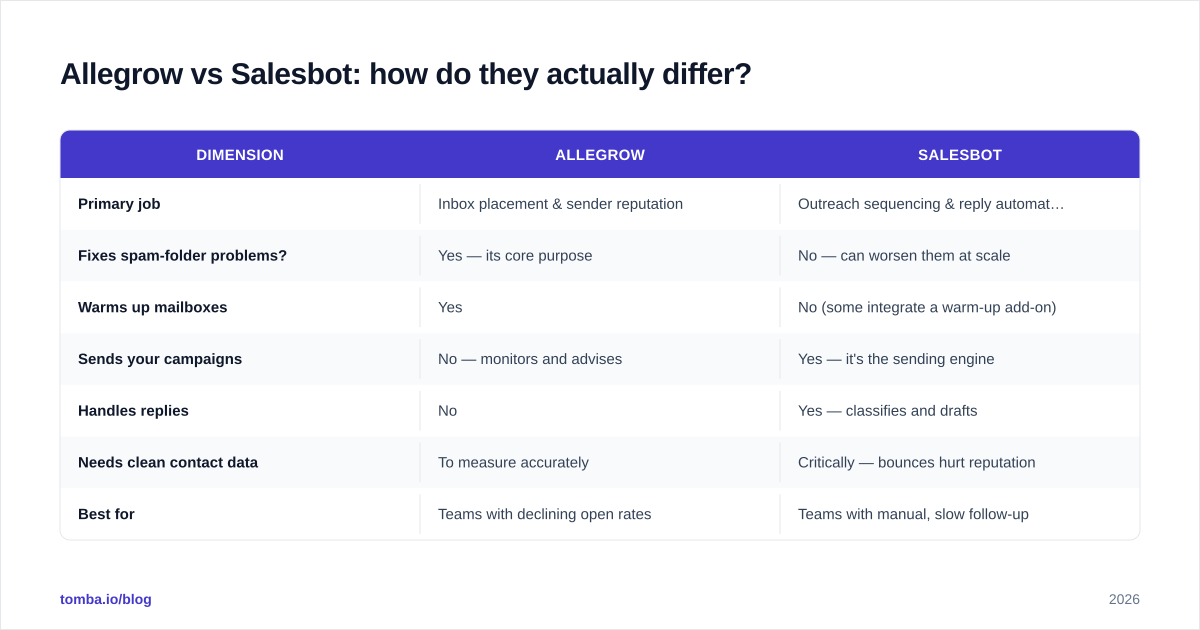
The cleanest way to see it: one tool guards the pipe, the other moves volume through it.
| Dimension | Allegrow | Salesbot |
|---|---|---|
| Primary job | Inbox placement & sender reputation | Outreach sequencing & reply automation |
| Fixes spam-folder problems? | Yes — its core purpose | No — can worsen them at scale |
| Warms up mailboxes | Yes | No (some integrate a warm-up add-on) |
| Sends your campaigns | No — monitors and advises | Yes — it's the sending engine |
| Handles replies | No | Yes — classifies and drafts |
| Needs clean contact data | To measure accurately | Critically — bounces hurt reputation |
| Best for | Teams with declining open rates | Teams with manual, slow follow-up |
| Typical buyer | RevOps / deliverability lead | SDR / outbound manager |
The mistake teams make is treating this as an either/or. A deliverability tool with nothing to send is idle; a sending bot with a trashed reputation just automates landing in spam.
Which one does your team actually need?#
Diagnose the symptom first, then pick the category.
Your open rates dropped 20%+ in a month. That's a deliverability signal, not a copy problem. You need Allegrow's category — seed testing and reputation monitoring — to find out whether you've been throttled or soft-blacklisted. Pair it with a sender reputation check and an SPF/DKIM audit.
Your inbox placement is fine but reps spend hours on follow-up. That's a throughput problem. Salesbot's category — sequencing plus AI reply handling — is the fix. Just don't crank volume until your data is clean.
You're scaling from 500 to 5,000 sends a month. You need both, in order: data hygiene, then deliverability monitoring, then automation. Skipping the first two means the third amplifies your mistakes.

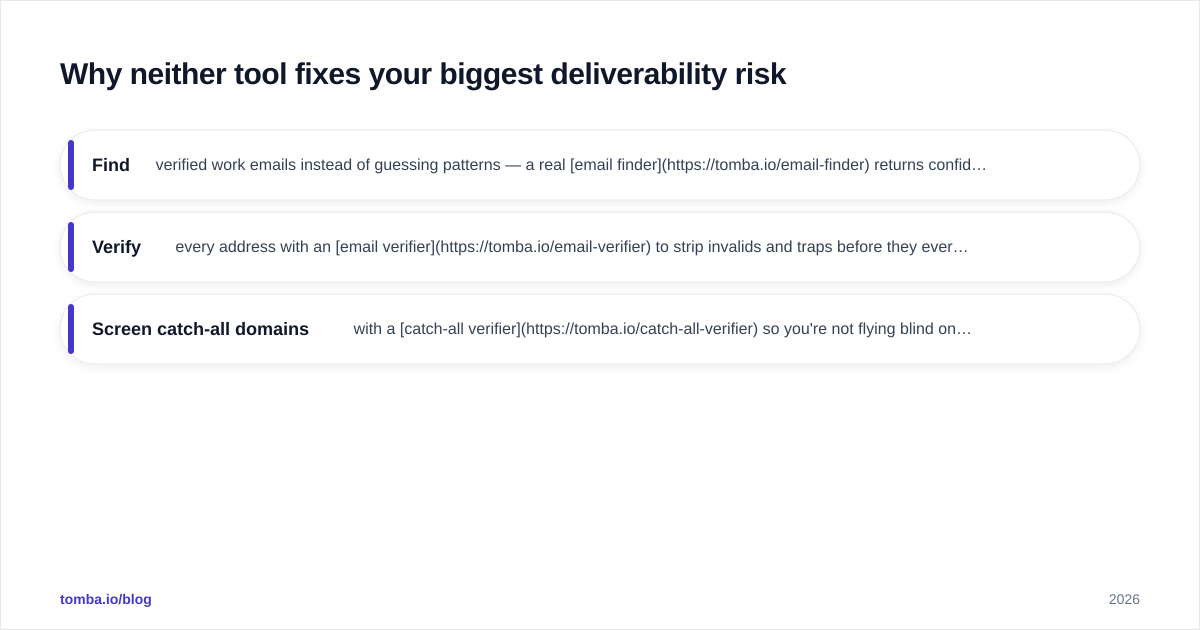
Why neither tool fixes your biggest deliverability risk#
Here's the part both categories quietly depend on: the quality of the list you send to.
Mailbox providers weigh bounce rate and spam complaints heavily. A 2026 cold campaign sent to a list with 8% invalid addresses will tank your reputation faster than any warm-up tool can repair it — and Salesbot's automation will hit those bad addresses at machine speed. Allegrow will dutifully report the resulting decline, but it can't un-send to a spam trap.
This is the upstream step neither tool owns. Before deliverability monitoring and before automation, you need accurate contacts:
- Find verified work emails instead of guessing patterns — a real email finder returns confidence-scored results.
- Verify every address with an email verifier to strip invalids and traps before they ever enter a sequence.
- Screen catch-all domains with a catch-all verifier so you're not flying blind on accept-all servers.
Get this right and both Allegrow and Salesbot perform better, because they're working on a list that won't get you blacklisted in the first place. According to Google's Postmaster Tools guidance, keeping spam complaint rates below 0.3% is non-negotiable for bulk senders — and that starts with who you send to, not how you warm up.
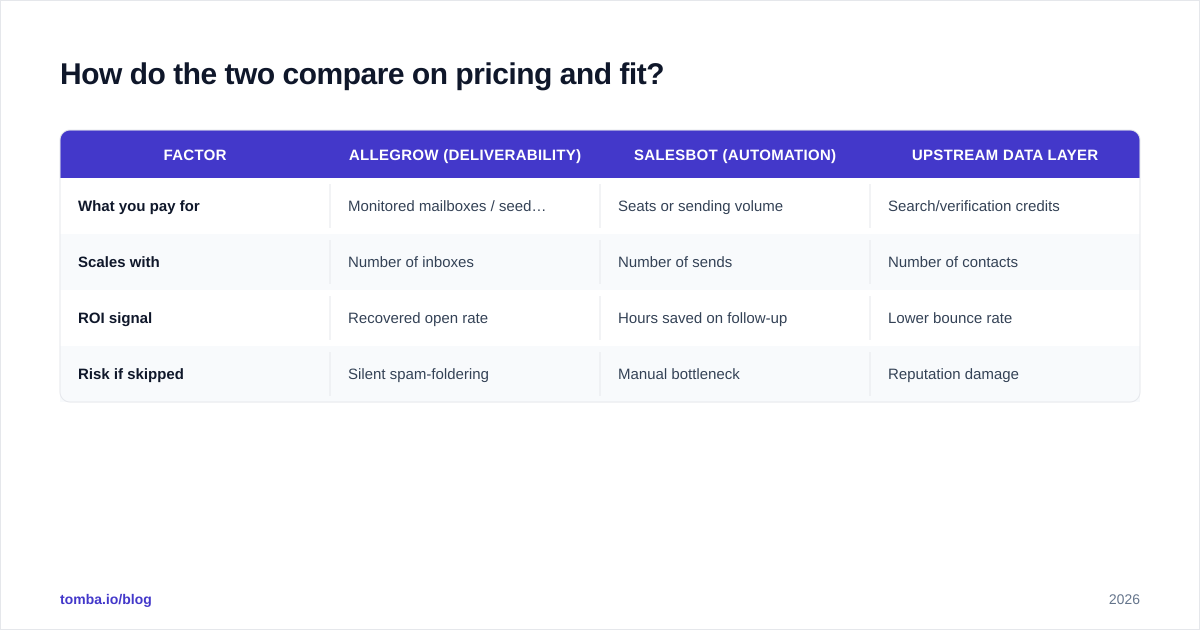
How do the two compare on pricing and fit?#
Exact pricing for both shifts by plan and volume, so confirm on each vendor's site before buying. The structural difference matters more than the dollar figure:
| Factor | Allegrow (deliverability) | Salesbot (automation) | Upstream data layer |
|---|---|---|---|
| What you pay for | Monitored mailboxes / seed tests | Seats or sending volume | Search/verification credits |
| Scales with | Number of inboxes | Number of sends | Number of contacts |
| ROI signal | Recovered open rate | Hours saved on follow-up | Lower bounce rate |
| Risk if skipped | Silent spam-foldering | Manual bottleneck | Reputation damage |
For independent user reviews of either category, G2's email deliverability software grid and the broader sales-engagement listings on HubSpot's ecosystem are reasonable neutral starting points. Read the one-star reviews — that's where the real limitations surface.
What's the right stack in 2026?#
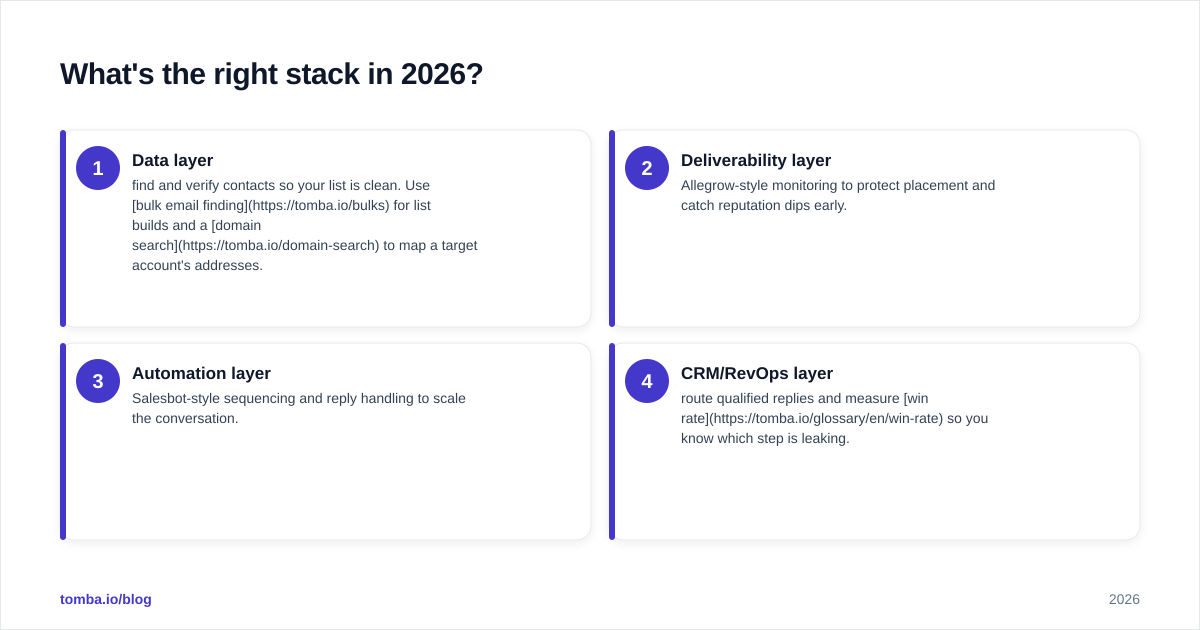
Stop looking for a single tool that does everything. The durable outbound setup is a chain, and each link has a specialist:
- Data layer — find and verify contacts so your list is clean. Use bulk email finding for list builds and a domain search to map a target account's addresses.
- Deliverability layer — Allegrow-style monitoring to protect placement and catch reputation dips early.
- Automation layer — Salesbot-style sequencing and reply handling to scale the conversation.
- CRM/RevOps layer — route qualified replies and measure win rate so you know which step is leaking.
Allegrow vs Salesbot was never the real question. The real question is whether each layer of your stack is owned by a tool built for it — or whether you're asking a reply bot to fix a reputation problem it can't see.
Frequently asked questions#
Can Salesbot replace Allegrow? No. A sequencing bot sends and replies; it doesn't run seed-list inbox tests or repair sender reputation. They're complementary, not substitutes.
Does Allegrow send my campaigns? No. It monitors placement and warms mailboxes underneath whatever sending tool you use.
What's the single biggest deliverability lever? List quality. Invalid addresses and spam traps cause bounces and complaints that no warm-up tool can fully undo — verify before you send.
Where Tomba fits#
Before you spend on either Allegrow or a Salesbot, fix the layer both depend on. The Tomba Email Finder returns verified, confidence-scored business emails by name, company, or domain — so the list feeding your deliverability and automation tools is clean from the start. Pair it with the built-in email verifier to keep bounce rates low and your sender reputation intact. Start on the free tier (25 searches/month), or check Tomba pricing — Starter is $49/mo — when you're ready to scale. Clean data first; everything downstream works better because of it.
Ready to find emails that actually work?
Join 150,000+ professionals who stopped guessing and started sending. Free credits on signup — no credit card required.
Get the Tomba newsletter
Practical outbound tactics and product updates — once every two weeks.
About the author