Best Aloware Alternatives in 2026: Top 7 Dialer Platforms
Aloware is a solid power dialer, but it isn't the only one. Here are 7 Aloware alternatives compared on pricing, dialing modes, CRM fit, and the data that actually feeds your calls.
Aloware built a name as a CRM-friendly power dialer that bolts onto HubSpot and Pipedrive without enterprise pricing. It's good software. But "good" and "right for your team" are different questions, and the dialer market in 2026 is crowded with tools that beat Aloware on price, AI features, compliance, or sheer call volume.
This guide breaks down seven real Aloware alternatives, what each one is actually for, and how to pick without burning a month of trials.
TL;DR#
- Aloware is a mid-market power/predictive dialer with native HubSpot and Pipedrive sync, priced around $40–$125 per user/month. The main complaints: dialer reliability under load and support response times.
- Best overall alternative: JustCall for teams that want dialer + SMS + AI in one tidy package.
- Best for high-volume outbound: PhoneBurner (power dialing) or Orum (parallel AI dialing) depending on your appetite for automation.
- Best for full sales engagement: Salesloft or Outreach if calling is one channel inside a bigger sequence.
- The part nobody fixes by switching dialers: your dialer is only as good as the phone numbers and emails you feed it. Clean contact data beats a faster dial button every time.
What does Aloware actually do, and why look for an alternative?#
Aloware is a cloud contact center built around outbound calling. It gives reps a power dialer, predictive dialer, two-way SMS, call recording, local presence, and native CRM sync. The pitch is "contact center features without the enterprise contract," and for a lot of SMB and mid-market teams that's accurate.
So why do people shop around? A few recurring reasons show up in G2 reviews and support threads:
- Dialer stability under heavy concurrent call volume.
- Support latency — slower than teams want when a dialer goes down mid-shift.
- Pricing creep once you add SMS bundles, extra numbers, and AI features.
- AI gaps versus newer tools built around conversation intelligence and parallel dialing.
None of these mean Aloware is bad. They mean your specific bottleneck — volume, budget, AI, or compliance — might be solved better elsewhere.
How should you evaluate an Aloware alternative?#
Before you look at logos, decide what you're actually optimizing for. Picking a dialer is like buying running shoes: the "best" one depends entirely on whether you're sprinting, marathoning, or just commuting. Five criteria do most of the work:
- Dialing mode. Manual click-to-dial, power (one line, auto-advance), predictive (multi-line, statistically paced), or parallel (AI dials many numbers, connects you only to humans). More automation means more conversations and more compliance risk.
- CRM fit. Native two-way sync with your CRM beats a
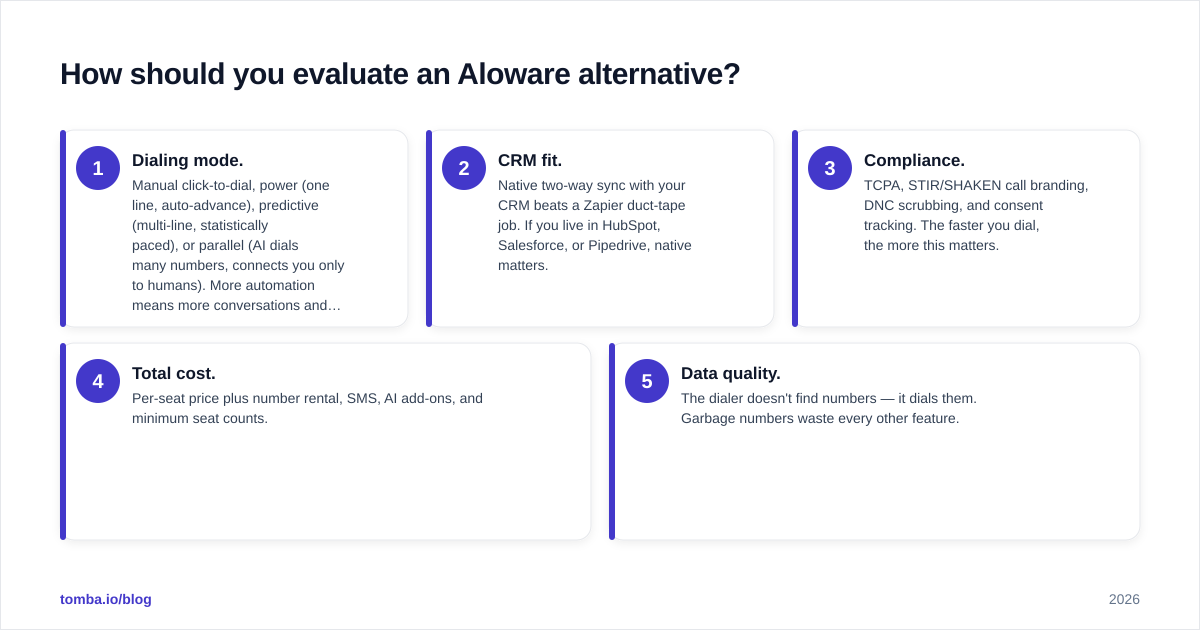
Zapier duct-tape job. If you live in HubSpot, Salesforce, or Pipedrive, native matters. 3. Compliance. TCPA, STIR/SHAKEN call branding, DNC scrubbing, and consent tracking. The faster you dial, the more this matters. 4. Total cost. Per-seat price plus number rental, SMS, AI add-ons, and minimum seat counts. 5. Data quality. The dialer doesn't find numbers — it dials them. Garbage numbers waste every other feature.
That last point is where most teams quietly lose money, and we'll come back to it.

Which are the best Aloware alternatives in 2026?#
Here's the shortlist, grouped by what each tool is genuinely best at.
1. JustCall — best all-rounder#
JustCall is the closest like-for-like swap. You get a power dialer, predictive dialer, two-way SMS, an AI copilot for live call coaching, and native integrations with HubSpot, Salesforce, and Pipedrive. Pricing starts lower than most contact-center suites and scales by feature tier. If you liked Aloware's concept but want steadier performance and a more mature AI layer, start here.
2. PhoneBurner — best for power-dialing SDRs#
PhoneBurner is laser-focused on one thing: getting reps through a call list fast without the awkward predictive-dialer pause. No telemarketer delay, built-in voicemail drop, email follow-up, and solid local presence. It's a power dialer, not a predictive one, so it's TCPA-friendlier and great for quality B2B conversations rather than spray-and-pray volume.
3. Orum — best for AI parallel dialing#
Orum dials multiple numbers in parallel, filters out voicemails, bad numbers, and IVR trees, and only patches a live human through to your rep. Teams report multiples more live conversations per hour. It's the most aggressive automation on this list, which means data hygiene and compliance discipline are non-negotiable.
4. Kixie — best for HubSpot/Pipedrive-native teams#
Kixie competes directly with Aloware on the "CRM-native dialer" positioning, with strong local presence, automated SMS, and click-to-call from inside the CRM. If your only real complaint about Aloware is reliability and support, Kixie is the most direct philosophical replacement.
5. Salesloft — best full sales-engagement platform#
If calling is one channel inside a broader cadence of emails, LinkedIn touches, and tasks, a standalone dialer is the wrong tool. Salesloft wraps dialing into multi-step sequences with analytics and conversation intelligence. You can read more about why teams move between these platforms in our Salesloft alternative breakdown.
6. Outreach — best for enterprise revenue teams#
Outreach is the heavyweight sales-engagement platform: sequencing, forecasting, deal management, and an embedded dialer. It's overkill for a 3-rep startup and exactly right for a 200-rep org that needs governance. See the Outreach alternative comparison if you're weighing the trade-offs.
7. CloudTalk — best for international calling#
CloudTalk offers local numbers in 160+ countries, intelligent routing, and a clean analytics dashboard. If your outbound motion crosses borders, its number coverage and call-quality routing outclass most US-centric dialers.
How do the top Aloware alternatives compare on price and features?#
| Tool | Starting price (per user/mo) | Dialing mode | Native CRM sync | Best for |
|---|---|---|---|---|
| Aloware | ~$40 | Power + predictive | HubSpot, Pipedrive | CRM-friendly SMB dialing |
| JustCall | ~$29 | Power + predictive | HubSpot, Salesforce, Pipedrive | All-round dialer + SMS + AI |
| PhoneBurner | ~$149 | Power (single-line) | Salesforce, HubSpot | High-quality SDR power dialing |
| Orum | Custom | Parallel AI | Salesforce, Outreach, Salesloft | Maximum live conversations |
| Kixie | ~$35 | Power | HubSpot, Pipedrive | CRM-native click-to-call |
| Salesloft | Custom | Power (in-sequence) | Salesforce, HubSpot | Full multichannel engagement |
| CloudTalk | ~$25 | Power + predictive | HubSpot, Pipedrive, |
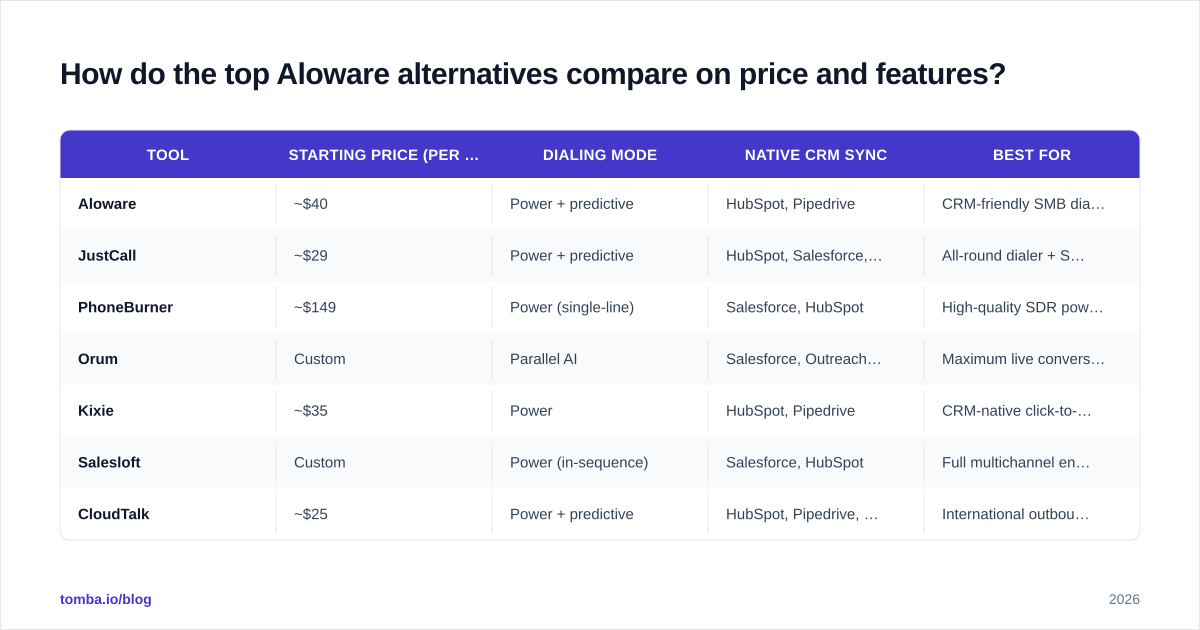
Zendesk | International outbound |
Prices are approximate list rates as of 2026 and shift with seat minimums and add-ons — always confirm on the vendor's own page. Note that the cheapest sticker price rarely wins once you add number rental, SMS, and AI tiers.
Is a power dialer or a predictive dialer better for your team?#
Short answer: power dialer for quality, predictive or parallel for raw volume.
A power dialer calls one number at a time and advances automatically when a call ends. No connection delay, low compliance risk, and the rep is mentally present for every conversation. This is the right default for considered B2B selling.
A predictive dialer calls several numbers at once and uses pacing algorithms to predict when a rep will be free. It maximizes talk time but introduces the dreaded "telemarketer pause" and more TCPA exposure. Parallel AI dialers like Orum push this further, screening out non-humans before connecting.
The faster you dial, the more your compliance and data quality have to be airtight. Which brings us to the thing every dialer comparison conveniently skips.

Why won't a faster dialer fix your outbound numbers?#
Because the dialer isn't your bottleneck — the list is.
Think of your dialer as a high-performance engine. It doesn't matter how many horsepower it has if you're pouring dirty fuel into the tank. If 25% of your numbers are wrong, disconnected, or pointed at the wrong person, no dialing mode saves you. You just hit voicemail and dead lines faster.
This is the uncomfortable math behind most "our dialer underperforms" complaints:
- Bad numbers burn rep hours and tank connect rates.
- Wrong-contact dials hurt your caller reputation and trip spam-likely flags.
- Mismatched data means even a connected call reaches the wrong person.
A dialer dials. It does not source, verify, or enrich the underlying contact data. That's a separate job — and it's the one that actually moves your connect rate. Pair whichever dialer you choose with a real data layer: accurate direct-dial numbers, verified emails for follow-up, and enrichment that tells you who you're actually calling.
That's where a phone finder and phone validator earn their keep — they give you direct-dial B2B numbers and confirm they're live before your dialer wastes a slot on them. Layer in data enrichment so reps open every call knowing the title, company, and context, and you've fixed the part that switching dialers never touches.
How do you migrate off Aloware without breaking outbound?#
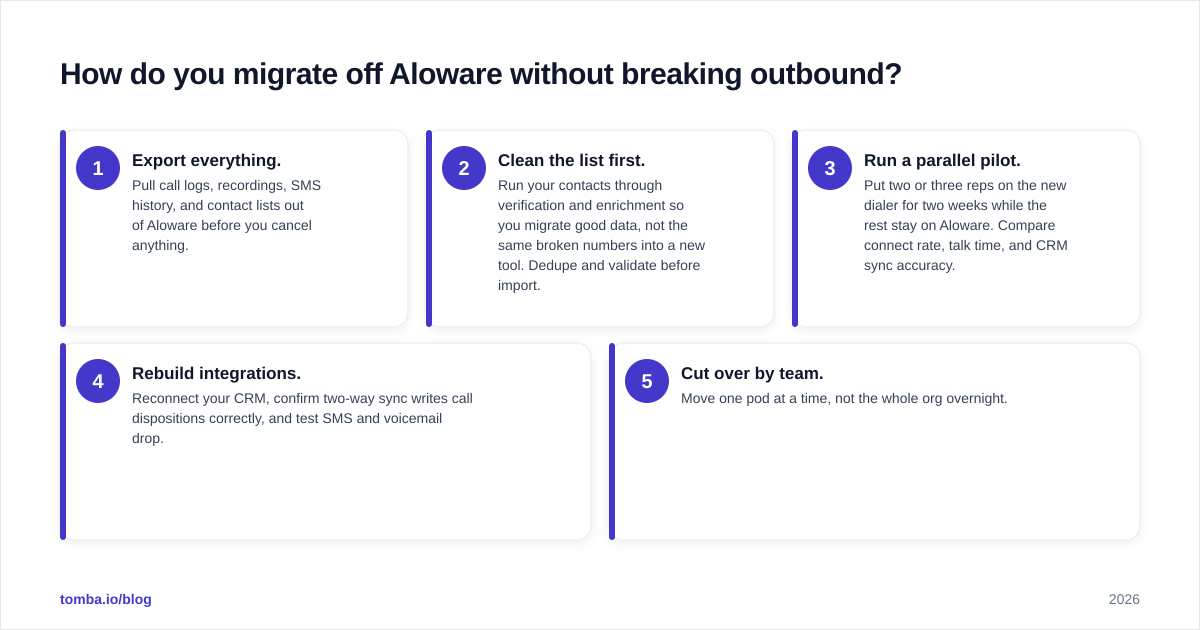
Switching dialers feels risky, but a staged move keeps your pipeline intact:
- Export everything. Pull call logs, recordings, SMS history, and contact lists out of Aloware before you cancel anything.
- Clean the list first. Run your contacts through verification and enrichment so you migrate good data, not the same broken numbers into a new tool. Dedupe and validate before import.
- Run a parallel pilot. Put two or three reps on the new dialer for two weeks while the rest stay on Aloware. Compare connect rate, talk time, and CRM sync accuracy.
- Rebuild integrations. Reconnect your CRM, confirm two-way sync writes call dispositions correctly, and test SMS and voicemail drop.
- Cut over by team. Move one pod at a time, not the whole org overnight.
The single highest-leverage step is #2. A clean, enriched list makes any dialer look like the right choice — and a dirty one makes all of them look broken.
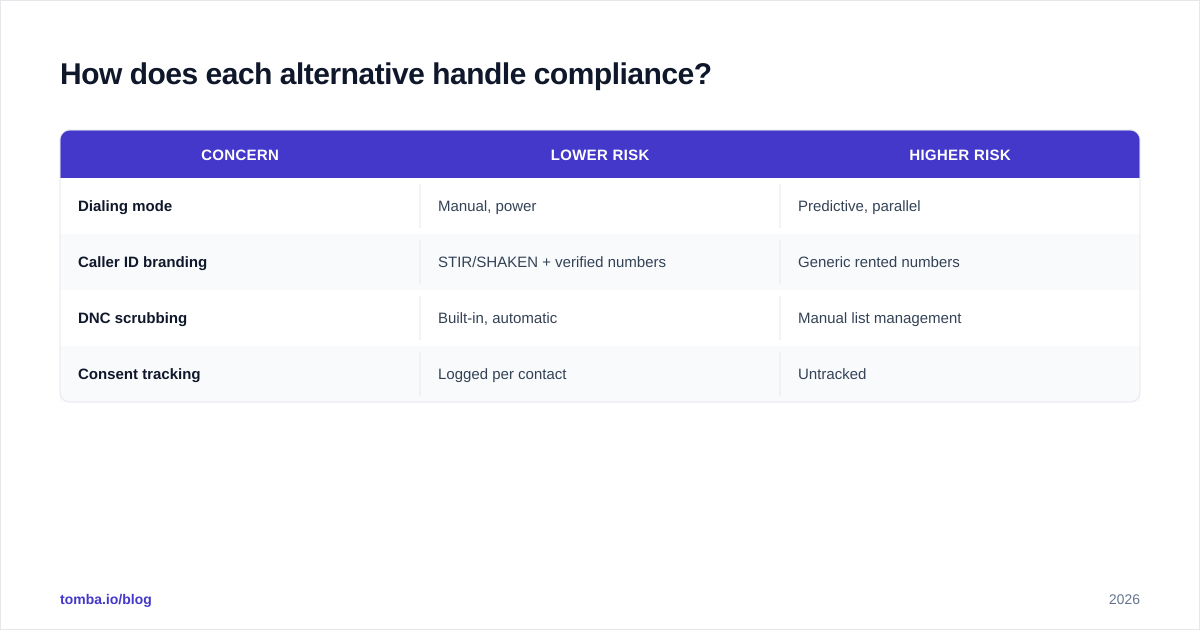
How does each alternative handle compliance?#
Compliance scales with dialing speed, so weigh it accordingly:
| Concern | Lower risk | Higher risk |
|---|---|---|
| Dialing mode | Manual, power | Predictive, parallel |
| Caller ID branding | STIR/SHAKEN + verified numbers | Generic rented numbers |
| DNC scrubbing | Built-in, automatic | Manual list management |
| Consent tracking | Logged per contact | Untracked |
PhoneBurner and Kixie lean toward lower-risk power dialing. Orum's parallel approach demands the strongest compliance hygiene. Whatever you pick, keep your number reputation clean — and that again comes back to dialing verified, correctly-matched contacts instead of stale lists. If reputation is already a worry, a sender reputation audit on the email side is a useful parallel habit, since the same list often powers both channels.
Which Aloware alternative should you choose?#
Match the tool to your actual constraint:
- Want a near-identical, more reliable swap? JustCall or Kixie.
- Reps need to power through quality B2B calls? PhoneBurner.
- Chasing maximum live conversations and you have clean data? Orum.
- Calling is one channel in a bigger cadence? Salesloft or Outreach.
- Selling across borders? CloudTalk.
But run this test first: pull 100 contacts from your current list and check how many phone numbers are actually correct and current. If it's below 80%, your next dollar belongs in data, not a new dialer.
Feed your dialer the data it deserves#
The fastest dialer on Earth still dials whatever number you give it. Before you sign a new contract, fix the fuel. Use the Tomba Email Finder to source verified professional emails for follow-up, pair it with the phone finder for direct-dial B2B numbers, and check Tomba pricing — the free tier gives you 25 searches a month to test the data quality before you commit, with paid plans starting at $49/mo. Get the list right, and whichever Aloware alternative you choose will finally perform the way the demo promised.
// get started
Find, verify and enrich your first contacts today
Start on the free plan with 25 searches a month, then scale when your team is ready.
Free plan · No credit card required · GDPR & CCPA
// about the author