Altss Pricing, Reviews, Pros and Cons: 2026 Buyer Guide
An honest, vendor-neutral breakdown of Altss pricing, reviews, pros and cons for 2026 — real costs, data accuracy, who it fits, and the alternatives worth testing first.
TL;DR
- Altss is an AI-native lead intelligence and contact-data platform that markets itself on real-time, hard-to-find B2B contacts rather than a static database.
- Pricing is quote-based and seat-oriented, which makes it hard to compare on a per-credit basis against transparent tools like Tomba ($49/mo Starter) or other email finders.
- The strongest reviews praise data freshness and niche coverage; the most common complaints are opaque pricing, annual lock-in, and inconsistent coverage outside its sweet-spot industries.
- For most teams that just need accurate work emails at a predictable price, a dedicated email finder plus an email verifier covers 80% of the job for a fraction of the cost.
- Run a side-by-side accuracy test on your own list before signing anything annual — sample data beats sales decks every time.
What is Altss?#
Altss is a B2B lead intelligence platform that positions itself as an AI-first alternative to legacy contact databases. Instead of selling access to a pre-scraped list that ages the moment it's compiled, Altss markets real-time enrichment — pulling and verifying contact details (work emails, direct dials, profile data) at query time, with a focus on niche or hard-to-reach personas like investors, founders, and senior operators.
That's the pitch. Whether it holds for your territory depends entirely on the industries and seniority levels you sell into, which is exactly why a structured evaluation matters before you commit budget.
This review is vendor-neutral. Tomba competes in the same space, and where Tomba is the honest better fit, I'll say so — but the goal here is to help you decide whether Altss pricing, reviews, pros and cons add up for your team in 2026, not to talk you out of a tool that might genuinely fit.
How much does Altss cost in 2026?#
Short answer: Altss does not publish flat per-seat pricing the way transparent finders do — plans are quote-based, typically annual, and scale by seats plus enrichment volume.
That's the single biggest friction point for buyers. When a vendor hides the number, you can't model cost-per-lead until you're already on a sales call, and you can't benchmark against the rest of the market without doing the math yourself. So here's the honest framing: treat any Altss quote as an annual commitment and divide the total by the verified contacts you actually expect to use. That cost-per-verified-contact is the only number that matters.
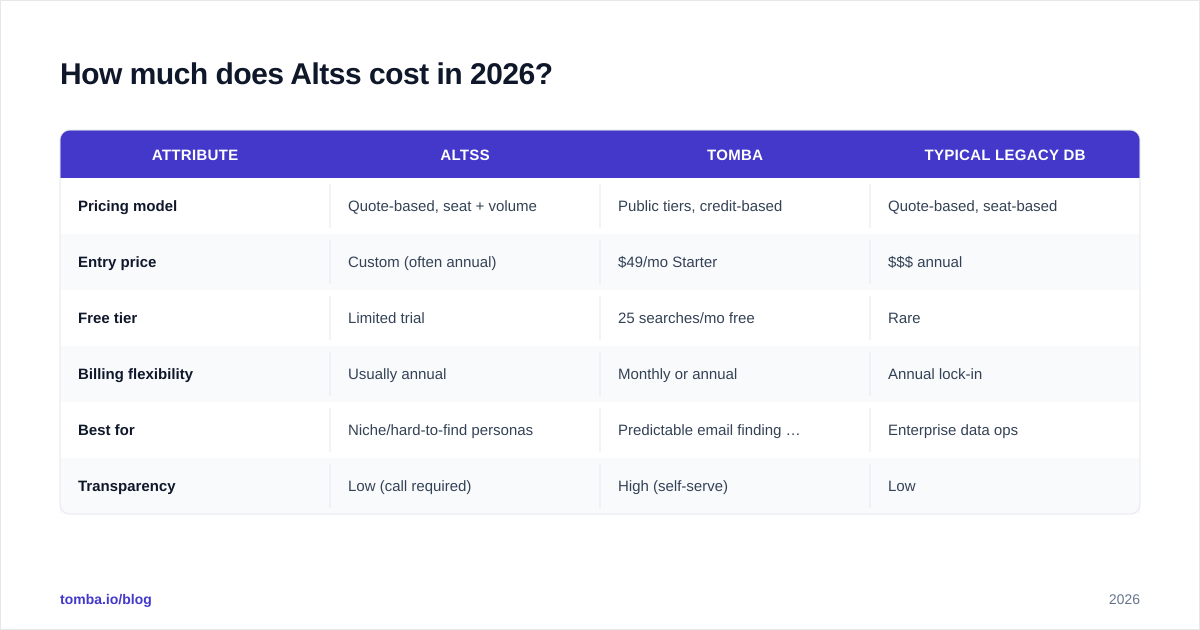
For contrast, here's how Altss's model stacks up against a transparent, credit-based tool:
| Attribute | Altss | Tomba | Typical legacy DB |
|---|---|---|---|
| Pricing model | Quote-based, seat + volume | Public tiers, credit-based | Quote-based, seat-based |
| Entry price | Custom (often annual) | $49/mo Starter | $$$ annual |
| Free tier | Limited trial | 25 searches/mo free | Rare |
| Billing flexibility | Usually annual | Monthly or annual | Annual lock-in |
| Best for | Niche/hard-to-find personas | Predictable email finding at scale | Enterprise data ops |
| Transparency | Low (call required) | High (self-serve) | Low |
The takeaway isn't "Altss is expensive" — it might price competitively for your use case. The takeaway is that you'll spend more time and negotiation to find out, and you'll likely sign annual. Compare that to checking Tomba pricing in ten seconds and starting on a free tier.
What do Altss reviews actually say?#
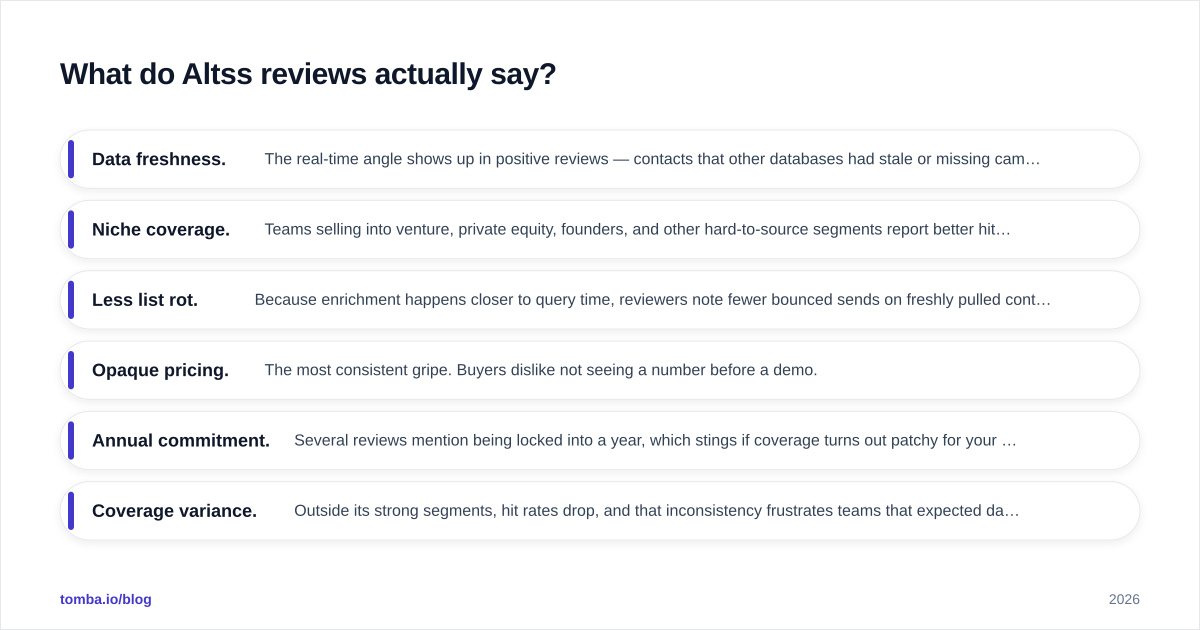
The review picture is genuinely mixed, and that's the useful signal — patterns repeat across G2 and Capterra style feedback regardless of which platform you read.
Recurring praise:
- Data freshness. The real-time angle shows up in positive reviews — contacts that other databases had stale or missing came back current.
- Niche coverage. Teams selling into venture, private equity, founders, and other hard-to-source segments report better hit rates than with generic databases.
- Less list rot. Because enrichment happens closer to query time, reviewers note fewer bounced sends on freshly pulled contacts.
Recurring complaints:
- Opaque pricing. The most consistent gripe. Buyers dislike not seeing a number before a demo.
- Annual commitment. Several reviews mention being locked into a year, which stings if coverage turns out patchy for your specific ICP.
- Coverage variance. Outside its strong segments, hit rates drop, and that inconsistency frustrates teams that expected database-wide depth.
- Onboarding/learning curve. AI-native workflows are powerful but not always intuitive for reps who just want a list.
Reviews are directional, not gospel — a reviewer selling into Altss's sweet spot will rave; one selling into a segment Altss covers thinly will pan it. Map the reviewer's ICP to yours before you weight their opinion.
How accurate is Altss data?#
Accuracy is the whole ballgame for any contact tool, and it's also where marketing claims and reality diverge most. Every vendor in this category claims high accuracy; the only number you can trust is the one you measure on your own list.

Altss's real-time model is a genuine architectural advantage for accuracy in theory: data validated at query time is fresher than data validated months ago and stored. But "fresh" and "complete" aren't the same thing. A tool can return a current, deliverable email for the 40% of your list it covers well and simply return nothing for the rest. That's often better than a stale wrong answer — but it means coverage rate and accuracy rate have to be judged together.
Here's a practical test protocol that works for Altss, Tomba, or anyone:
- Pull a sample of 100–200 real target contacts you can independently confirm.
- Run them through each tool and record: found vs. not found (coverage), and correct vs. wrong (accuracy).
- Verify every returned email with an independent email verifier — don't trust the source tool to grade its own homework.
- Calculate cost-per-verified-correct-contact. That's your real number.
Whatever the source, always run a verification pass before you send. Catch-all domains, role addresses, and recently-departed employees slip through every provider, and a clean email verification step protects your sender reputation more than any single vendor choice.
What are the pros and cons of Altss?#
Here's the honest balance sheet.
Pros
- Real-time enrichment means fresher data and fewer bounces on newly pulled contacts.
- Strong coverage for hard-to-find and senior personas that legacy databases miss.
- AI-native workflows reduce manual list-building for the right use cases.
- Compliance-conscious sourcing is part of the positioning (verify the specifics for your region).
Cons
- Opaque, quote-based pricing — no self-serve number, no quick benchmarking.
- Typically annual commitment, which raises the risk if coverage disappoints.
- Coverage varies sharply outside core segments.
- Learning curve for teams used to simple search-and-export tools.
- Overkill (and over-budget) if all you need is reliable work emails at volume.
Is Altss better than a dedicated email finder?#
It depends on what you're actually buying. Altss is a lead intelligence play; a dedicated email finder is a precision utility. Those solve overlapping but different problems.
If your core job is "I have a company and a name, get me the verified work email," a focused finder wins on price, speed, and transparency every time. You don't need an AI intelligence suite to resolve firstname.lastname@company.com and confirm it's deliverable — you need accuracy, a clean API, and predictable cost.
| Use case | Better fit |
|---|---|
| High-volume work-email finding | Dedicated email finder |
| Predictable, self-serve pricing | Dedicated email finder |
| Hard-to-find investor/founder personas | Lead intelligence platform (Altss) |
| Real-time enrichment in workflows | Lead intelligence platform |
| Tight budget / SMB / agency | Dedicated email finder |
| Direct dials + deep profile data | Lead intelligence platform |
This is where Tomba fits the conversation honestly. If you want the intelligence layer Altss offers, Altss may earn its quote. If you mostly need emails, domain search, and enrichment at a published price, a finder-first stack is leaner. Tomba's own data enrichment and bulk email finder cover the volume side without an annual contract.

What are the best Altss alternatives in 2026?#
If the opaque pricing or annual lock-in gives you pause, you have real options — and the smart move is to trial two or three against the same sample list rather than trust any single review (including this one).
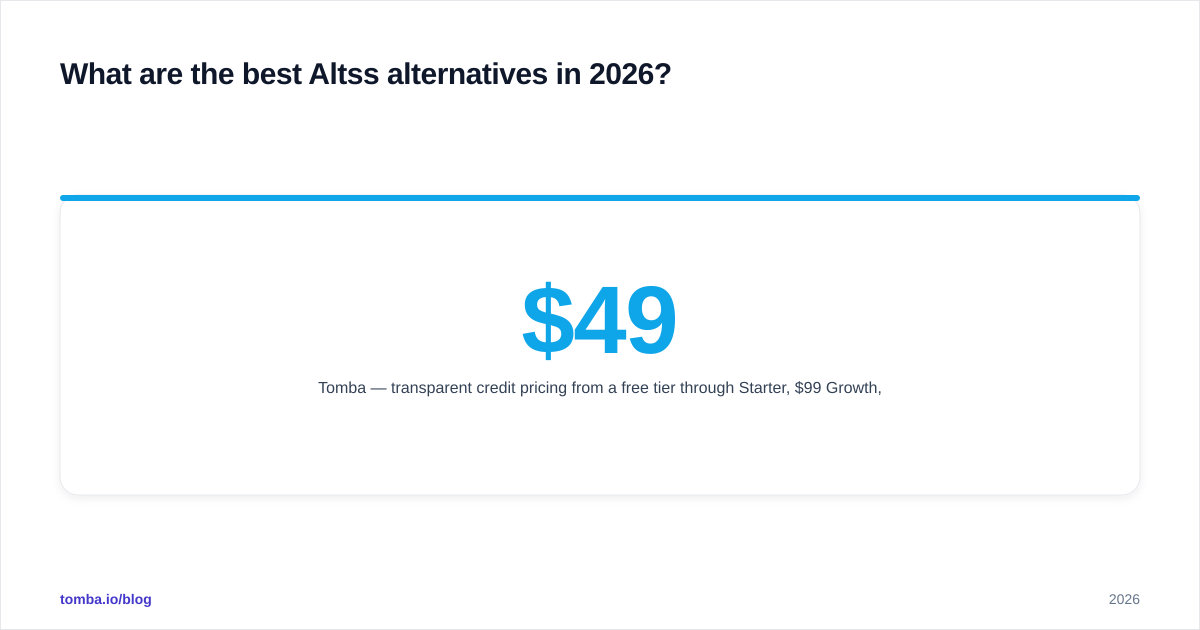
- Tomba — transparent credit pricing from a free tier through $49/mo Starter, $99/mo Growth, and $249/mo Pro. Strong for high-volume email finding, domain search, verification, and enrichment with a clean email finder API.
- **Legacy databases (
ZoomInfo, Apollo, Cognism class)** — deeper firmographic and intent layers, but the same opaque/annual pattern as Altss, usually at higher cost.
- Verification-first stacks — pair any finder with a dedicated verifier to push deliverability up regardless of source.
The point isn't that one tool wins universally. It's that "best" is defined by your ICP, your volume, and your tolerance for annual commitments. A team selling into VC-backed founders may rightly choose Altss; an agency running cold outbound at 5,000 contacts a month almost certainly shouldn't.
How should you evaluate Altss before buying?#
Run a structured pilot, not a vibes-based demo. Here's the decision framework:
- Define your ICP precisely — industries, seniority, geographies. This determines whether you're in Altss's strong zone or its thin zone.
- Build a 150-contact ground-truth list you can independently verify.
- Trial Altss and one or two alternatives on that identical list, same week.
- Score coverage and accuracy separately, then verify every result independently.
- Convert each quote to cost-per-verified-correct-contact — the only apples-to-apples metric.
- Check the contract terms — monthly vs. annual, overage pricing, seat minimums.
- Decide on data, not on the sales deck.
If Altss wins your ground-truth test for your ICP and the annual math works, buy it with confidence. If a transparent finder matches it on accuracy at a third of the cost, you have your answer too.
Final verdict: who should buy Altss?#
Buy Altss if you sell into hard-to-source, senior personas, you value real-time enrichment inside your workflow, and an annual commitment with quote-based pricing doesn't scare your finance team. For that specific buyer, the freshness advantage is real and the niche coverage can justify the premium.
Skip it if you primarily need accurate work emails at volume with predictable, self-serve pricing — that's a finder's job, not an intelligence suite's, and you'll save money and onboarding time going direct.
If that second description sounds like you, start with the Tomba Email Finder. You can find and verify professional emails by name, company, or domain on a free tier (25 searches/month), scale to $49/mo when you're ready, and never sign an annual contract to test it. Run your ground-truth list through it this afternoon, compare the cost-per-verified-contact against any Altss quote, and let the data — not the sales call — make the decision for you.
// get started
Find, verify and enrich your first contacts today
Start on the free plan with 25 searches a month, then scale when your team is ready.
Free plan · No credit card required · GDPR & CCPA
// about the author