Altss vs Clodura.ai 2026: Which Sales Data Tool Is Better?
Altss promises real-time lead intelligence; Clodura.ai bundles a B2B database with sequences. Here's how the two stack up on data, pricing, and fit.
Altss vs Clodura.ai comes down to one question: do you want a focused, real-time lead-intelligence engine, or an all-in-one prospecting suite that bundles a database with email sequences? This guide breaks down both so you can decide without a sales demo.
TL;DR#
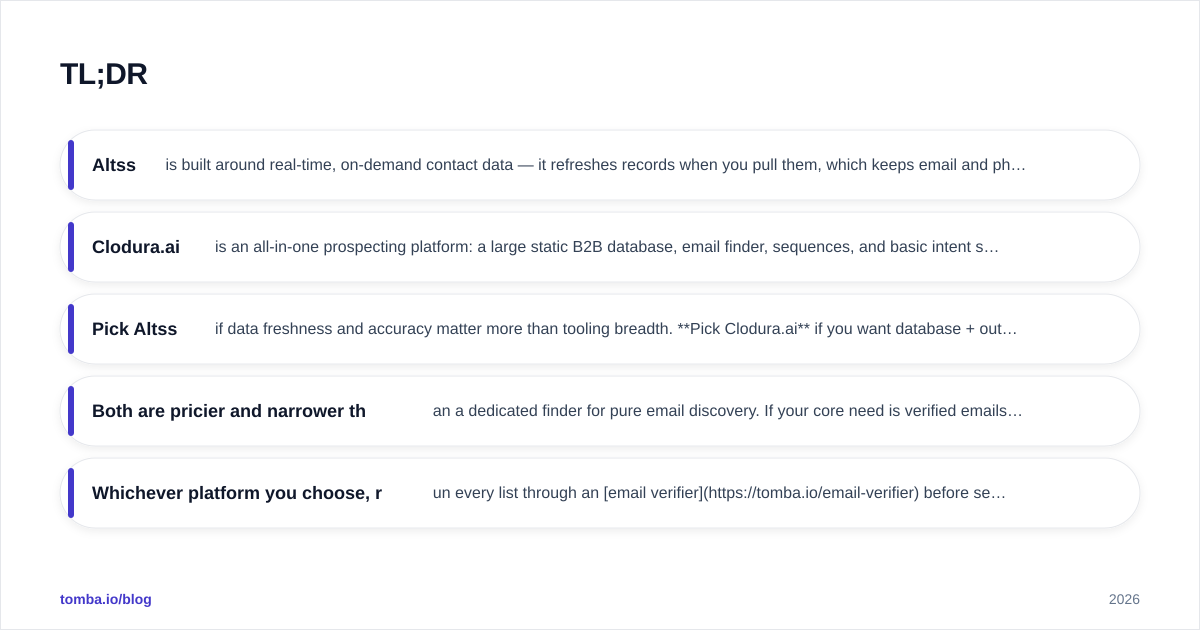
- Altss is built around real-time, on-demand contact data — it refreshes records when you pull them, which keeps email and phone accuracy high but ties cost to usage.
- Clodura.ai is an all-in-one prospecting platform: a large static B2B database, email finder, sequences, and basic intent signals in one subscription.
- Pick Altss if data freshness and accuracy matter more than tooling breadth. Pick Clodura.ai if you want database + outreach in a single tab and can tolerate older records.
- Both are pricier and narrower than a dedicated finder for pure email discovery. If your core need is verified emails by domain or name, a specialist like Tomba Email Finder is cheaper and more accurate.
- Whichever platform you choose, run every list through an email verifier before sending — neither tool guarantees deliverability.
What is Altss?#
Altss is a B2B sales-intelligence tool that emphasizes real-time data retrieval. Instead of serving a contact record from a months-old snapshot, it attempts to source and validate details — work email, direct dial, current role — at the moment you request them. That design targets the single biggest problem in prospecting data: decay. Roughly 30% of B2B contact data goes stale every year as people change jobs, so a record that was perfect in January can bounce by June.
The trade-off is that real-time enrichment is compute-heavy, so Altss leans toward usage-based or credit-style pricing rather than an unlimited flat fee. You pay closer to the marginal cost of fresh data.
What is Clodura.ai?#
Clodura.ai (official site: clodura.ai) is a broader sales-prospecting platform. It combines a large pre-built B2B contact database (tens of millions of records), an email finder and verifier, direct-dial numbers, basic buyer-intent and technographic signals, and built-in email sequencing. The pitch is consolidation: find a company, pull contacts, build a cadence, and send — all without leaving the app.
The cost of that breadth is freshness. Database-first tools store records and re-crawl on a schedule, so any single contact may be weeks or months old when you export it. Clodura.ai counters with verification steps, but verification only confirms an address is deliverable today — it does not resurrect a contact who already left the company.
How should you compare Altss vs Clodura.ai?#
Don't compare on feature-count alone — a longer feature list usually means you're paying for modules you won't touch. Score each tool on the four dimensions that actually move pipeline: data freshness, accuracy, workflow fit, and total cost.
The framework above is the lens for the rest of this post. Here's how the two platforms map onto it.
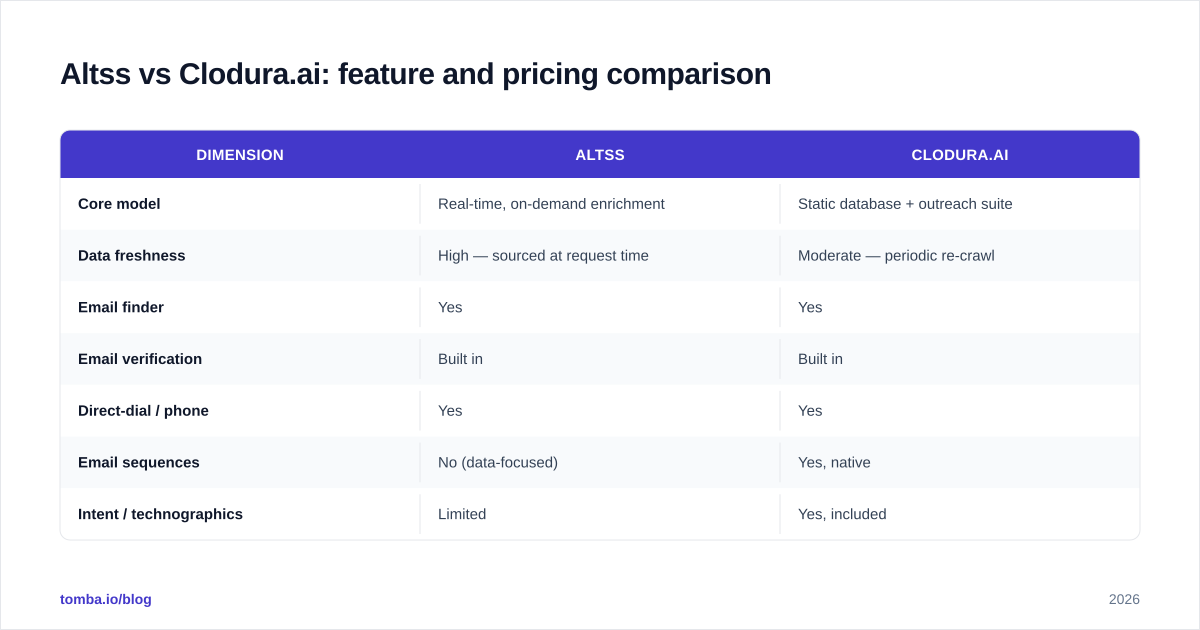
Altss vs Clodura.ai: feature and pricing comparison#
| Dimension | Altss | Clodura.ai |
|---|---|---|
| Core model | Real-time, on-demand enrichment | Static database + outreach suite |
| Data freshness | High — sourced at request time | Moderate — periodic re-crawl |
| Email finder | Yes | Yes |
| Email verification | Built in | Built in |
| Direct-dial / phone | Yes | Yes |
| Email sequences | No (data-focused) | Yes, native |
| Intent / technographics | Limited | Yes, included |
| Pricing model | Usage / credit-based | Flat subscription tiers |
| Best for | Accuracy-first teams | All-in-one prospecting on a budget |
| Weakest at | Breadth of tooling | Record freshness at scale |
A few things to read carefully. Clodura.ai wins on raw breadth — it does outreach, which Altss does not. Altss wins on the thing that quietly wrecks campaigns: bounce rate from decayed data. If your sequences are already in a tool you like, Clodura.ai's bundled sequencer is redundant, and you're effectively paying for a database you could buy more cheaply elsewhere.
Which has better data accuracy?#
Accuracy is where the two philosophies diverge most. Altss's real-time model structurally favors accuracy: a freshly sourced email is far less likely to bounce than one pulled from a six-month-old row. Clodura.ai's database model favors coverage and speed — you get instant results for almost any company, but a slice of those records will be stale no matter how recently they were "verified."
Neither vendor publishes an independently audited accuracy figure, so treat marketing claims like "95% accurate" with skepticism. The only number that matters is your bounce rate on your segment. Run a 200-contact pilot through each tool, send to a seed list, and measure hard bounces. That single test tells you more than any G2 star rating — though G2's category reviews are still a useful sanity check for support quality and billing complaints.
A practical habit regardless of vendor: re-verify before every send. Data that was valid when exported can decay between export and send date. A standalone email verification pass catches the contacts who changed jobs last week, and a catch-all verifier handles the domains that accept everything and tell you nothing.
Which is better for workflow and outreach?#
This is Clodura.ai's home turf. Because it ships sequences, intent signals, and a database in one login, a small team can run an entire outbound motion without stitching tools together. For a two-person SDR team that doesn't already own a sales-engagement platform, that consolidation is genuinely valuable.
Altss is deliberately narrower. It's a data layer, not a campaign tool. That's a feature if you already run outreach in your CRM or a dedicated sequencer — you plug Altss in for fresh contacts and keep your existing workflow. It's a drawback if you wanted one tool to do everything.
The diagram shows where each tool sits. Notice that the "verify" and "enrich" steps are tool-agnostic — you can slot in data enrichment from a third source even when your primary database is Clodura.ai or Altss. Vendor lock-in on the full pipeline is rarely worth it.
How much do Altss and Clodura.ai cost?#
Pricing for both is gated behind sign-up or sales, and tiers shift over time, so confirm current numbers on each vendor's pricing page and on Capterra before committing.
The structural difference is what matters for budgeting:
- Altss (usage-based): cost scales with how much fresh data you pull. Predictable if your volume is steady; spiky if your team prospects in bursts. You pay for accuracy at the margin.
- Clodura.ai (flat subscription): a fixed monthly or annual fee with credit caps per tier. Predictable, and cheap per-record at high volume — but you pay for the whole database whether you use 5% or 95% of it.
For teams doing high-volume, breadth-first prospecting, Clodura.ai's flat fee is usually cheaper per lead. For teams doing lower-volume, accuracy-critical outreach (think ABM into 200 named accounts), Altss's pay-for-fresh model often nets out lower because you waste fewer sends on bounces.
Where does a dedicated email finder fit?#
Here's the honest take: if your primary need is finding and verifying professional emails, neither Altss nor Clodura.ai is the most cost-efficient choice. Both bundle email discovery inside a heavier, pricier intelligence platform. You're paying for intent data, phone numbers, and sequencing you may not need.
A specialist finder is leaner on exactly that job. Tomba, for example, runs a focused domain search to pull every public email pattern for a company, a bulk email finder for list building, and an API for programmatic enrichment — at transparent, published Tomba pricing: a free tier (25 searches/mo), Starter at $49/mo, Growth at $99/mo, and Pro at $249/mo.
| Need | Best fit |
|---|---|
| Find + verify emails at low cost | Dedicated finder (e.g., Tomba) |
| All-in-one database + sequences | Clodura.ai |
| Accuracy-first real-time intel | Altss |
| Programmatic enrichment via API | Finder with an API |
The smartest stacks often combine layers: use a finder for cheap, accurate email discovery, and reserve a platform like Altss or Clodura.ai for the enrichment fields a pure finder doesn't cover. You're not obligated to pick one tool for the whole job.
Is Altss or Clodura.ai right for you?#
Match the tool to your constraint, not to the feature list:
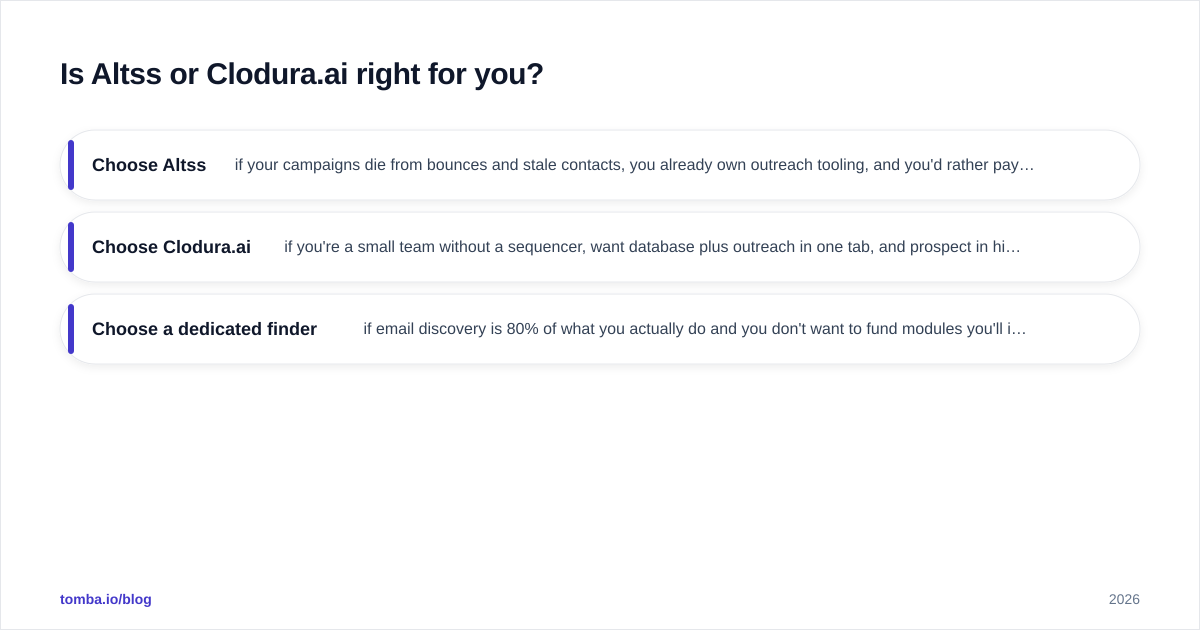
- Choose Altss if your campaigns die from bounces and stale contacts, you already own outreach tooling, and you'd rather pay for freshness than breadth.
- Choose Clodura.ai if you're a small team without a sequencer, want database plus outreach in one tab, and prospect in high volume where a flat fee wins on cost-per-lead.
- Choose a dedicated finder if email discovery is 80% of what you actually do and you don't want to fund modules you'll ignore.
Run the 200-contact bounce-rate pilot before you sign an annual contract with either. The vendor that wins on your data is the only benchmark that pays you back.
The bottom line#
Altss is the accuracy play; Clodura.ai is the consolidation play. Both are solid at what they're built for, and both are overkill if your real job is finding verified business emails fast and cheap.
If that's you, start with the tool built for exactly that. Tomba Email Finder finds professional email addresses by name, domain, or company, verifies them in the same pass, and plugs into your CRM, Sheets, or codebase via the Tomba API — without the all-in-one price tag. Try the free tier, run it against your next 25 prospects, and compare the bounce rate yourself.
// get started
Find, verify and enrich your first contacts today
Start on the free plan with 25 searches a month, then scale when your team is ready.
Free plan · No credit card required · GDPR & CCPA
// about the author