Altss vs Datanyze: Which B2B Data Tool Wins in 2026?
Altss vs Datanyze compared on data accuracy, coverage, pricing, and contact freshness — plus where each one fits your 2026 prospecting stack and when a dedicated email finder beats both.
Choosing between Altss and Datanyze usually comes down to one question: do you need fresh, hard-to-find contact data, or do you need technographic signals about the companies you already want to sell to? They look similar on a feature grid, but they were built to solve different halves of the prospecting problem.
This guide breaks down where each tool actually wins in 2026, what they cost, and where a dedicated email finder quietly outperforms both on the one metric that decides whether your outreach lands: deliverable contact accuracy.
TL;DR#
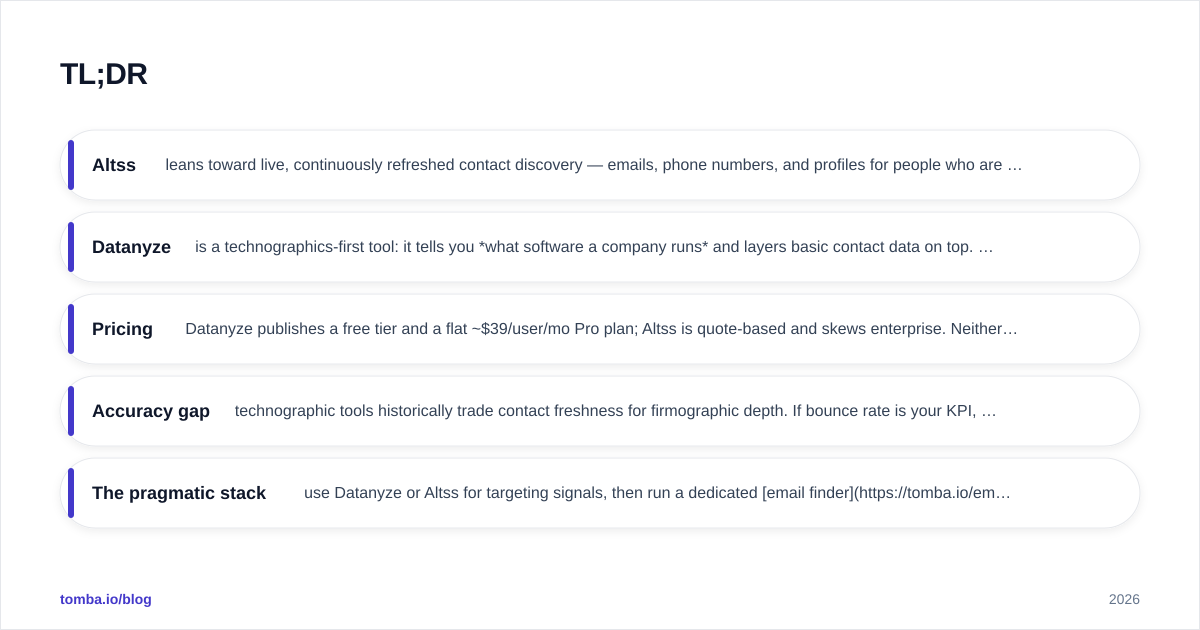
- Altss leans toward live, continuously refreshed contact discovery — emails, phone numbers, and profiles for people who are hard to find elsewhere. Best for outbound teams that live and die by connect rates.
- Datanyze is a technographics-first tool: it tells you what software a company runs and layers basic contact data on top. Best for ABM and competitive-displacement plays.
- Pricing: Datanyze publishes a free tier and a flat ~$39/user/mo Pro plan; Altss is quote-based and skews enterprise. Neither is cheap per verified contact at scale.
- Accuracy gap: technographic tools historically trade contact freshness for firmographic depth. If bounce rate is your KPI, verify everything before you send.
- The pragmatic stack: use Datanyze or Altss for targeting signals, then run a dedicated email finder and email verifier to get clean, deliverable addresses.
What is Altss?#
Altss is a B2B contact-intelligence platform built around finding people who don't show up cleanly in the big legacy databases. Its pitch is recency: instead of serving a contact record that was scraped 18 months ago, it focuses on continuously refreshed emails, direct dials, and profile data so reps can reach decision-makers before the data goes stale.
In practice, teams reach for Altss when their existing provider keeps returning role-changed contacts, dead direct dials, and catch-all addresses that bounce. The value proposition is narrow but real: higher connect rates on hard-to-reach personas — founders, niche technical buyers, and people at small companies that the big vendors under-index.
The tradeoff is that Altss is less of a "browse the whole market" database and more of a precision lookup tool. Pricing is quote-based, which makes it harder to evaluate quickly than a tool with a public price page.
What is Datanyze?#
Datanyze is a technographics company. Its original claim to fame was telling you which technologies a website runs — analytics, ecommerce platform, CDN, marketing stack — so you could target companies by the software they already use. Owned by ZoomInfo, it now bundles a Chrome extension that surfaces contact details (email and mobile) while you browse LinkedIn or company sites.
Datanyze is strongest when your targeting depends on a tech signal: "show me every Shopify store using a competing review app," or "find companies that just adopted a tool we integrate with." That's a different motion from "give me the verified email for this specific VP."
The contact-data layer in Datanyze is functional but secondary to the technographic engine. If you need a deep, reliable contact database first and signals second, that ordering matters.
Altss vs Datanyze: how do they compare head to head?#
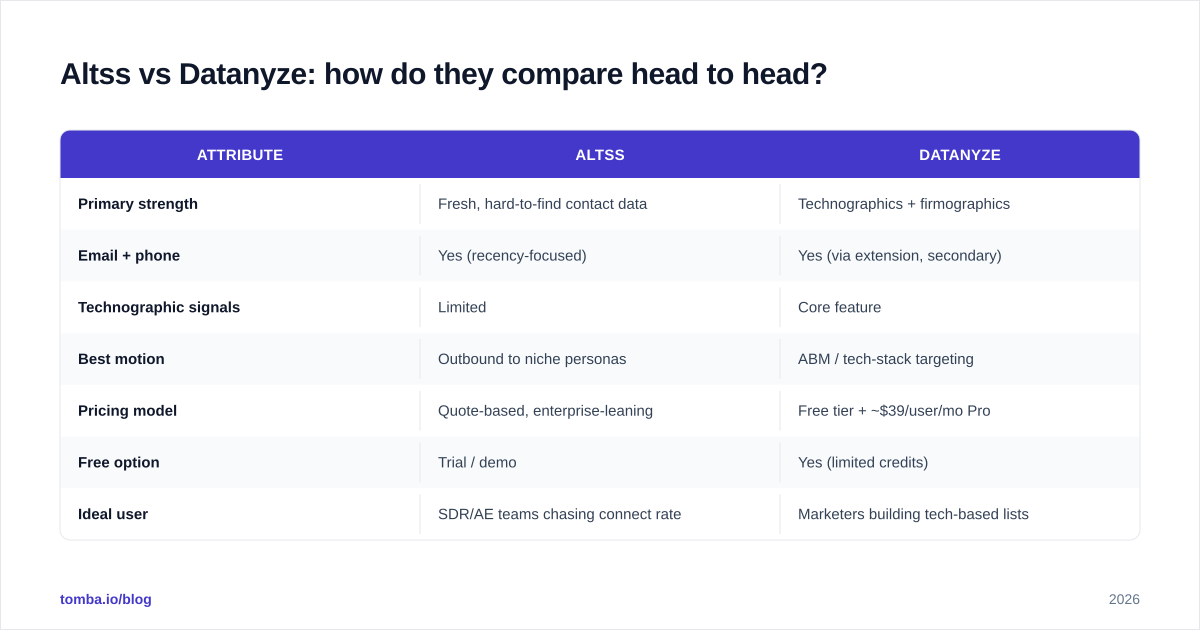
Here's the honest side-by-side. Treat published numbers as directional — vendor coverage claims move constantly and self-reported accuracy is rarely independently audited.
| Attribute | Altss | Datanyze |
|---|---|---|
| Primary strength | Fresh, hard-to-find contact data | Technographics + firmographics |
| Email + phone | Yes (recency-focused) | Yes (via extension, secondary) |
| Technographic signals | Limited | Core feature |
| Best motion | Outbound to niche personas | ABM / tech-stack targeting |
| Pricing model | Quote-based, enterprise-leaning | Free tier + ~$39/user/mo Pro |
| Free option | Trial / demo | Yes (limited credits) |
| Ideal user | SDR/AE teams chasing connect rate | Marketers building tech-based lists |
| Weak spot | Less breadth for broad list-building | Contact freshness vs depth |
The pattern: Altss optimizes for who you can reach, Datanyze optimizes for who you should target. Those are complementary, not interchangeable.
Which one is more accurate for contact data?#
Short answer: it depends on the persona, and you should never trust either number blind.
Technographics-first tools like Datanyze are excellent at the firmographic layer — the company is real, the tech signal is usually right. But the contact attached to that company is where decay shows up. People change jobs roughly every two to three years, and B2B email data degrades around 25–30% annually. A tool optimized for tech signals isn't necessarily re-verifying every email on a tight cycle.
Altss markets specifically against this decay, which is its whole reason to exist. For hard-to-find personas it often returns a usable address where a legacy database returns nothing or a catch-all. But "we refresh frequently" is a process claim, not a guarantee for any single record.
This is why the experienced play is verify, don't trust. Whatever either tool hands you, run it through verification before it touches a sequence. A catch-all domain in particular needs a dedicated check — a standard SMTP ping says "maybe," and "maybe" is how you tank a sending domain. Use a catch-all verifier for those, and a bulk email verifier for everything else.

How should you choose between them? (A decision framework)#
Pick based on the job, not the feature list. The framework below maps the most common scenarios to the right tool.
Choose Altss if:
- Your reps complain that contacts are role-changed or dials are dead.
- You sell to niche or hard-to-find personas (founders, technical buyers, SMB owners).
- Connect rate and reply rate are your north-star metrics.
- You can absorb quote-based, enterprise-style pricing.
Choose Datanyze if:
- Your targeting depends on a technology signal ("uses X platform").
- You run account-based marketing and need to build tech-segmented lists.
- You want a low-friction free tier and predictable per-seat pricing.
- Contact data is a nice-to-have layered on top of firmographics.
Choose neither as your contact source if:
- Your single biggest pain is bounce rate and deliverability.
- You need volume — thousands of verified emails by domain or company.
- You'd rather pay per verified result than per seat or per quote.
In that third case, a purpose-built finder + verifier stack is both cheaper and more accurate, because that's the only thing it's optimized to do.
What does each tool cost in 2026?#
Pricing is where the two diverge most clearly.
| Plan dimension | Altss | Datanyze | Tomba |
|---|---|---|---|
| Free tier | Demo / trial | Yes (limited) | 25 searches/mo |
| Entry paid | Custom quote | ~$39/user/mo | $49/mo (Starter) |
| Mid tier | Custom quote | — | $99/mo (Growth) |
| Scale tier | Custom quote | Enterprise (viaZoomInfo) | $249/mo (Pro) |
| Pricing transparency | Low | Medium | High |
| Billed on | Seats | Seats | Searches/credits |
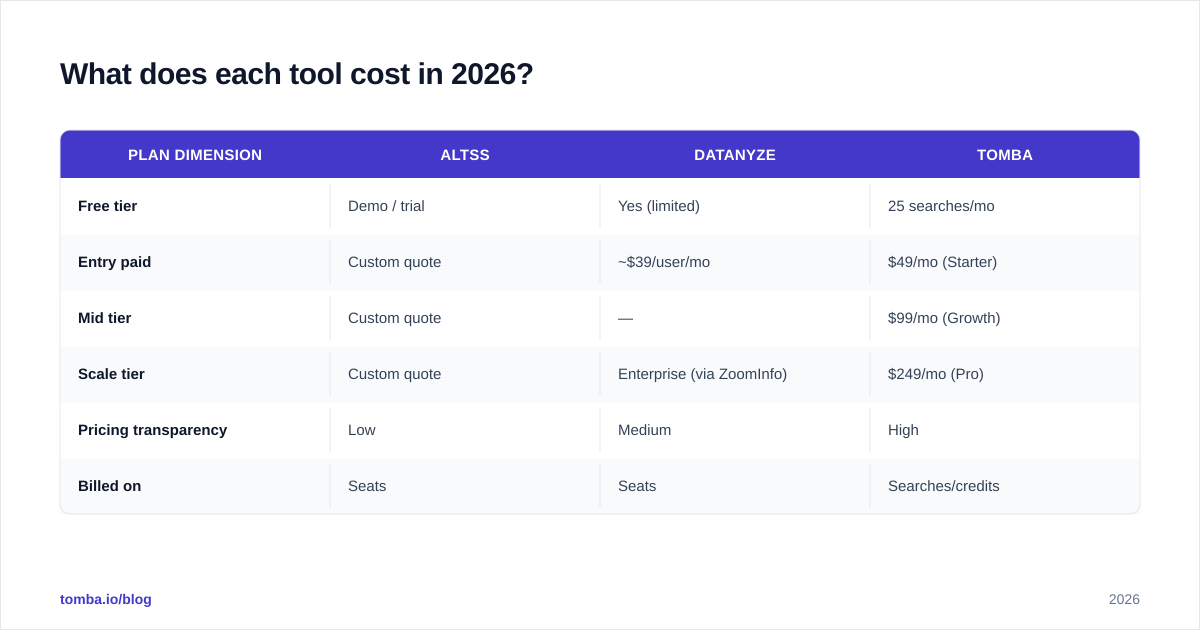
Datanyze wins on transparency and entry price for individual reps. Altss is opaque by design — you'll need a sales call to get a real number, and it tends to make sense at team scale rather than for a solo SDR.
For comparison, Tomba pricing is credit-based: you pay for finds and verifications rather than per seat, which is usually the better unit economics when your need is deliverable contacts rather than market intelligence. See where the underlying data comes from on the data sources page if accuracy provenance matters to your compliance team.
Where do email finders fit alongside Altss and Datanyze?#
They're not competitors so much as different layers of the same pipeline. Think of Altss/Datanyze as the targeting and signal layer and a finder/verifier as the deliverability layer.
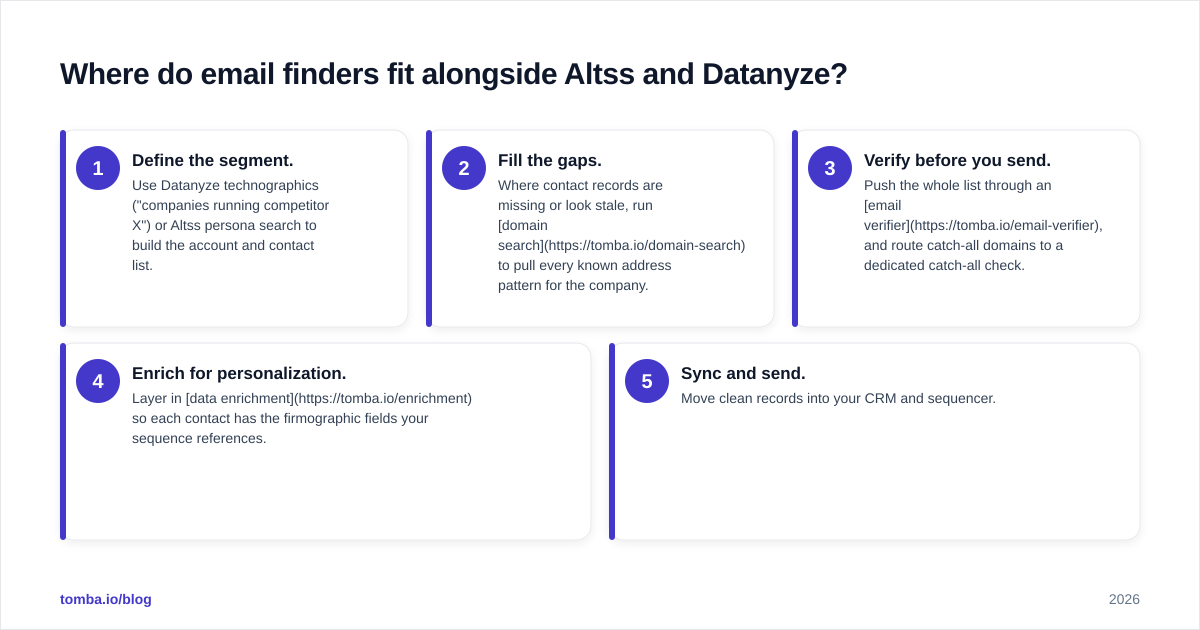
A clean 2026 workflow looks like this:
- Define the segment. Use Datanyze technographics ("companies running competitor X") or Altss persona search to build the account and contact list.
- Fill the gaps. Where contact records are missing or look stale, run domain search to pull every known address pattern for the company.
- Verify before you send. Push the whole list through an email verifier, and route catch-all domains to a dedicated catch-all check.
- Enrich for personalization. Layer in data enrichment so each contact has the firmographic fields your sequence references.
- Sync and send. Move clean records into your CRM and sequencer.
This is why most mature teams don't pick a single "winner." They use a signal tool for who, and a finder/verifier for make sure it actually arrives. Skipping step 3 is the single most common reason good lists produce bad results — a 5% bounce rate is enough to drag your sender reputation into spam-folder territory.
What do real users say about Altss vs Datanyze?#
Cross-reference reviews on a neutral marketplace like G2 before committing, and weight them by recency — data tools change fast.
Common themes you'll see:
- Datanyze praise: great technographic targeting, easy Chrome extension, generous free tier for testing. Datanyze gripes: contact data depth and freshness lag the big databases; some records feel dated.
- Altss praise: finds people other tools miss, strong direct dials, useful for hard niches. Altss gripes: opaque pricing, smaller browse-the-market breadth, you have to talk to sales to evaluate.
Neither pattern is disqualifying — they just confirm the core split. Datanyze is a signals tool with contact data attached; Altss is a contact tool with recency as its edge.
Frequently asked questions#
Is Altss better than Datanyze? Neither is universally "better." Altss is better when fresh, hard-to-find contact data drives your connect rate. Datanyze is better when technology signals drive your targeting. Match the tool to the job.
Can I use Datanyze just for technographics and get contacts elsewhere? Yes, and many teams do exactly that. Use Datanyze for the tech signal and account list, then pull verified emails with a dedicated email finder. It's often cheaper and more accurate than relying on the bundled contact layer.
Do either of these replace an email verifier? No. Both provide contact data, but neither is a substitute for a focused verification pass. Always re-verify before a campaign — especially catch-all domains, which need a catch-all verifier rather than a basic SMTP check.
Which is cheaper? Datanyze for individual reps (public ~$39/user/mo Pro plan and a free tier). Altss is quote-based and skews enterprise, so it's hard to compare without a sales call.
What about coverage outside North America? Both lean strongest in US/EU data. For international personas, test a sample before buying and benchmark verified-deliverable rates, not raw record counts.
The bottom line#
Altss and Datanyze solve adjacent problems: Altss chases reachability, Datanyze chases targeting signals. If you only remember one thing, let it be that the contact data from either tool is a starting point, not a finished list — decay is real, and unverified sends cost you deliverability.
If your actual bottleneck is getting clean, deliverable addresses at a predictable price, start with a tool built for exactly that. Tomba's Email Finder finds professional emails by name, company, or domain, pairs every result with built-in verification, and bills per result instead of per seat — so you can layer it on top of whichever signal tool you choose. Spin up the free tier (25 searches/month), run your hardest 25 contacts through it, and compare deliverable rates before you commit to anything quote-based.
// get started
Find, verify and enrich your first contacts today
Start on the free plan with 25 searches a month, then scale when your team is ready.
Free plan · No credit card required · GDPR & CCPA
// about the author