Altss vs DiscoverOrg: B2B Data Intelligence Compared (2026)
DiscoverOrg became ZoomInfo, and Altss arrived selling real-time data. Here's an honest 2026 breakdown of coverage, freshness, pricing, and which fits your team.
If you are evaluating Altss vs DiscoverOrg in 2026, you are really comparing two different eras of B2B data. DiscoverOrg is the legacy org-chart pioneer that folded into ZoomInfo. Altss is a newer entrant pitching real-time, on-demand data instead of a quarterly-refreshed warehouse. This guide breaks down what each actually delivers, where the data comes from, what it costs, and who should pick which.
TL;DR#
- DiscoverOrg no longer exists as a standalone product — it merged with
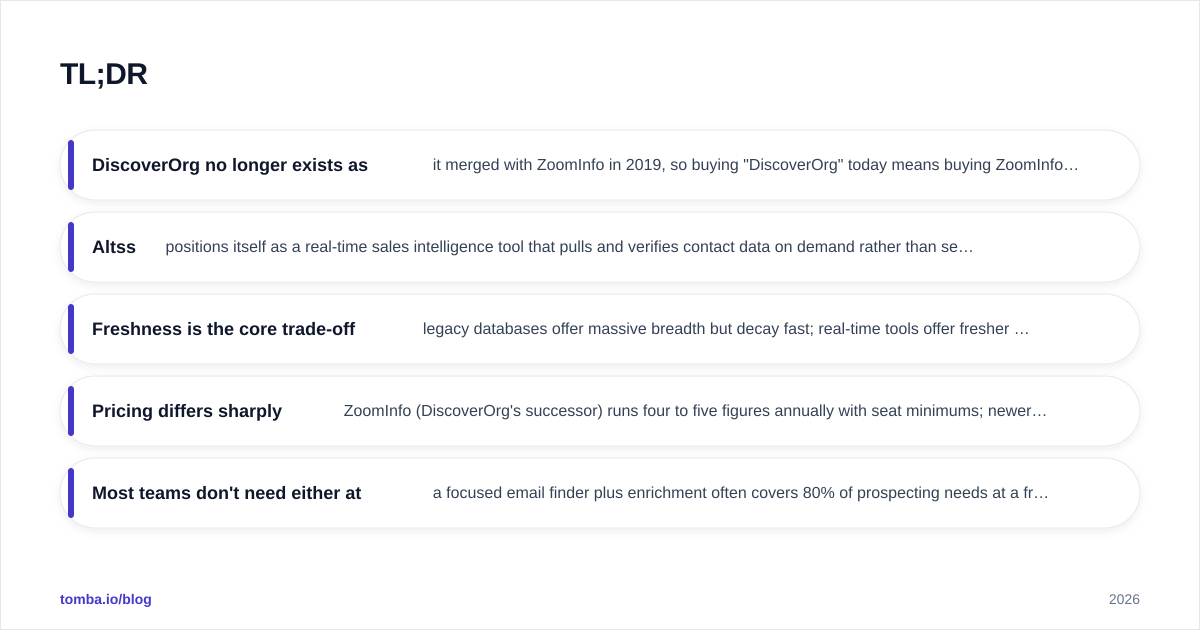
ZoomInfo in 2019, so buying "DiscoverOrg" today means buying ZoomInfo's enterprise data platform.
- Altss positions itself as a real-time sales intelligence tool that pulls and verifies contact data on demand rather than serving it from a static database.
- Freshness is the core trade-off: legacy databases offer massive breadth but decay fast; real-time tools offer fresher records but narrower guaranteed coverage.
- Pricing differs sharply — ZoomInfo (DiscoverOrg's successor) runs four to five figures annually with seat minimums; newer tools and email-finders start far lower.
- Most teams don't need either at full scale — a focused email finder plus enrichment often covers 80% of prospecting needs at a fraction of the cost.
Is DiscoverOrg still a product in 2026?#
Short answer: not on its own. DiscoverOrg merged with ZoomInfo in 2019, and the combined company kept the ZoomInfo brand. When a vendor or list still says "DiscoverOrg," they are pointing at ZoomInfo's enterprise data and org-chart capabilities, which absorbed DiscoverOrg's human-verified research model.
That history matters because DiscoverOrg's original reputation was built on deeply researched org charts — who reports to whom, which decision-makers own which budgets, and verified direct dials. That DNA still lives inside ZoomInfo's higher tiers. So when we say "DiscoverOrg" below, read it as "the ZoomInfo platform that DiscoverOrg became," because that is what you will actually license.
You can confirm the merger history on ZoomInfo's own site and on third-party review platforms like G2, where DiscoverOrg listings now redirect to ZoomInfo.
What is Altss?#
Altss is a sales intelligence platform built around real-time data retrieval. Instead of querying a database that was last refreshed weeks or months ago, Altss aims to fetch and verify a contact's details at the moment you request them. The pitch is simple: a record that is accurate the second you export it beats a record that was accurate last quarter.
That approach has clear appeal for outbound teams burned by bounce rates. Job changes, role moves, and company restructures are the silent killers of any static B2B database — and they happen constantly. A real-time model attacks that decay head-on.
The trade-off is predictability. A warehouse model like DiscoverOrg/ZoomInfo can tell you exactly how many contacts match a filter before you buy. A real-time model depends on what it can verify at query time, so coverage for any specific search can vary.
How do Altss and DiscoverOrg differ on data?#
The fundamental split is static database vs real-time retrieval. Everything else flows from that choice.
DiscoverOrg/ZoomInfo maintains an enormous, continuously researched warehouse: company firmographics, technographics, org charts, intent signals, and verified contacts. Breadth and structured filtering are its strengths. The weakness is decay — even the best-maintained database degrades between refresh cycles, and B2B contact data is estimated to go stale at roughly 25–30% per year.
Altss bets on freshness over warehouse breadth. When you request a contact, it works to surface and verify current details rather than hand you a possibly-aged row. For high-intent, low-volume prospecting — your top 200 accounts — that can mean materially lower bounce rates. For "give me every VP of Engineering at 5,000 companies," a warehouse still wins on raw enumeration.
This is the same tension every buyer faces in B2B data and intelligence: coverage versus accuracy. Neither model wins universally.
Altss vs DiscoverOrg: side-by-side comparison#
Here is the practical breakdown. Treat the DiscoverOrg column as the
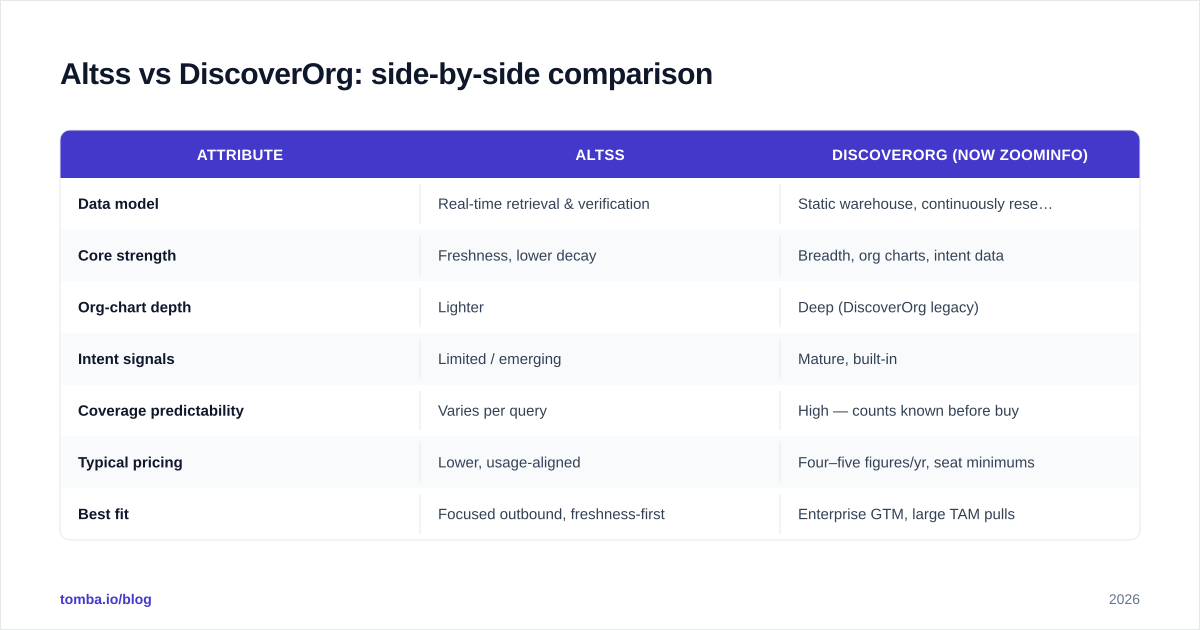
ZoomInfo platform it became.
| Attribute | Altss | DiscoverOrg (now ZoomInfo) |
|---|---|---|
| Data model | Real-time retrieval & verification | Static warehouse, continuously researched |
| Core strength | Freshness, lower decay | Breadth, org charts, intent data |
| Org-chart depth | Lighter | Deep (DiscoverOrg legacy) |
| Intent signals | Limited / emerging | Mature, built-in |
| Coverage predictability | Varies per query | High — counts known before buy |
| Typical pricing | Lower, usage-aligned | Four–five figures/yr, seat minimums |
| Best fit | Focused outbound, freshness-first | Enterprise GTM, large TAM pulls |
| Contract friction | Lower | Annual contracts common |
A few honest caveats. Altss is newer, so independent review volume on platforms like Capterra is thinner than ZoomInfo's — fewer data points to validate claims against. ZoomInfo's pricing is rarely public and is negotiated per deal, so the figures above are directional, not quotes.
Which is more accurate?#
Accuracy depends on what you're measuring and when. A real-time tool like Altss tends to win on point-in-time accuracy for the specific contacts you pull, because verification happens at request time. A warehouse like DiscoverOrg/ZoomInfo wins on structured completeness — you get the org chart, the technographics, and the intent signal alongside the contact, which a lean real-time lookup may not include.
The thing nobody markets loudly: every B2B dataset is wrong somewhere. The question is whether the errors land in records you actually use. If you prospect a narrow, high-value list, freshness-first tooling reduces the errors that hurt you. If you run broad campaigns where a 5% bounce rate is acceptable, warehouse breadth pays off.
Whichever you choose, run contacts through an email verifier before you send. Verification is cheap insurance against sender reputation damage, and it neutralizes a chunk of the accuracy debate regardless of source.
What does each one cost?#
Pricing is where the two diverge most clearly.
DiscoverOrg's successor,
ZoomInfo, sells enterprise contracts. Expect annual commitments, seat minimums, and four- to five-figure spend, with credits or export caps layered on top. It's powerful, but it's a procurement decision, not a credit-card purchase. Pricing is negotiated and rarely listed publicly.
Altss, as a newer entrant, leans toward lower, more usage-aligned pricing — though exact figures shift, so verify current rates directly. The broader point: real-time and email-finder tools have collapsed the entry price of B2B data. You no longer need a five-figure contract to start outbound.
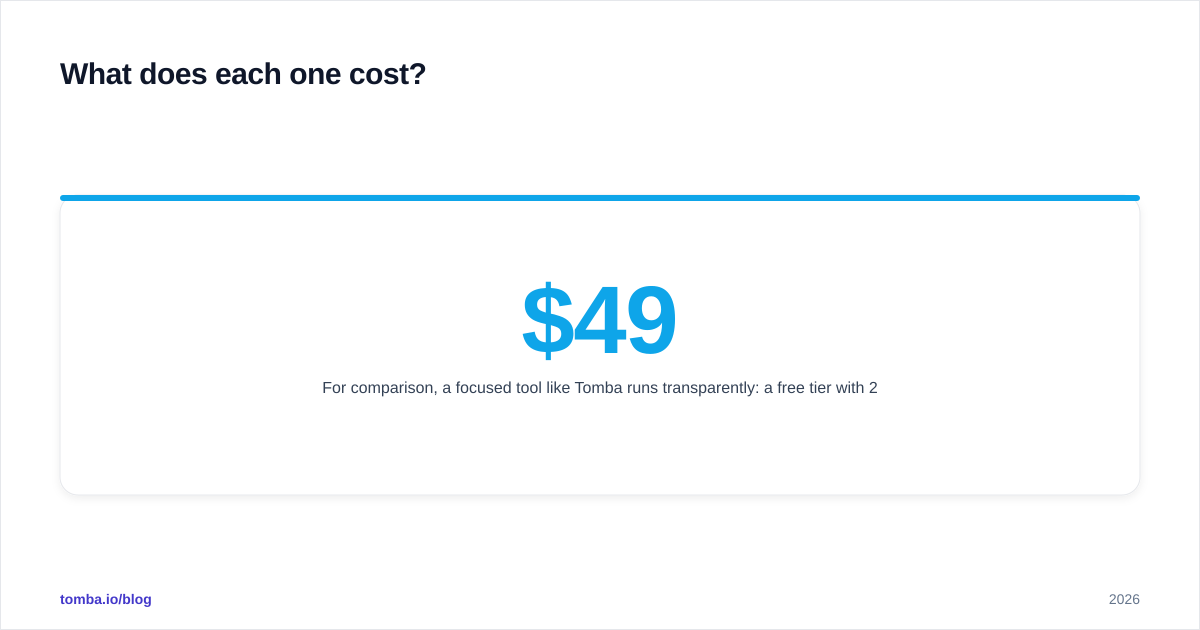
For comparison, a focused tool like Tomba runs transparently: a free tier with 25 searches/mo, then Starter at $49/mo, Growth at $99/mo, and Pro at $249/mo, with Enterprise custom. You can see the full Tomba pricing without a sales call. That transparency is itself a differentiator against legacy-style procurement.
Who should pick Altss?#
Choose Altss if:
- Your outbound is focused and high-value — a curated account list, not a mass blast.
- Bounce rate and freshness are your top pain, and you've been burned by stale warehouse exports.
- You want lower contract friction and usage-aligned pricing instead of an annual enterprise deal.
- You don't lean heavily on deep org charts or mature intent data to qualify accounts.
Altss rewards teams that value a clean, current record over a giant, partially-decayed list.
Who should stick with DiscoverOrg/ZoomInfo?#
Choose ZoomInfo (the DiscoverOrg lineage) if:
- You run enterprise GTM and need to enumerate a large total addressable market.
- Org charts and intent signals are central to how you prioritize accounts.
- You need predictable coverage counts before committing budget.
- You already have the procurement appetite and budget for an annual platform contract.
If your motion is account-based selling at scale, the warehouse model's breadth and structured intelligence are hard to replicate with point lookups.
Is there a lighter third option?#
Yes — and for many teams it's the most honest answer. A lot of buyers reach for Altss or ZoomInfo when what they actually need is accurate emails for a known list of people and companies, plus enrichment to fill gaps. That's a much smaller, cheaper problem than a full intelligence platform.
A dedicated email finder plus data enrichment covers the core prospecting job: turn a name and company into a verified, reachable contact. You skip the platform overhead, the annual contract, and the warehouse decay. For domain-level prospecting, domain search pulls every discoverable address at a company in one query.
This isn't an argument against intelligence platforms — it's a reminder to match the tool to the job. If you don't need org charts and intent scoring, don't pay for them. Buy fresh, verified contact data and move on.
Altss vs DiscoverOrg: the verdict#
There's no universal winner — there's a fit. Altss is the freshness-first choice for focused outbound teams who want current data without enterprise procurement. DiscoverOrg/ZoomInfo is the breadth-and-depth choice for enterprise GTM teams who live in org charts and intent data and can justify the contract.
But before you commit to either, be honest about your actual job-to-be-done. If it's "reach the right people at the right companies without high bounce rates," a transparent, verification-first email finder may get you there faster and cheaper than a platform built for a much bigger problem.
That's where Tomba Email Finder fits: find professional email addresses by name, company, or domain, verify them on the spot, and enrich what you keep — at a price you can read off the page, starting free at 25 searches a month. Try the Tomba Email Finder and see how far fresh, verified contact data gets you before you ever sign an enterprise contract.
// get started
Find, verify and enrich your first contacts today
Start on the free plan with 25 searches a month, then scale when your team is ready.
Free plan · No credit card required · GDPR & CCPA
// about the author