Altss vs Findymail 2026: Which Email Finder Wins?
Altss and Findymail both promise accurate B2B emails, but they solve different problems. Here's an honest, side-by-side breakdown to help you pick in 2026.
TL;DR
- Altss is built around real-time, on-demand search — it pulls fresh contact data at query time, which suits researchers and teams chasing hard-to-find prospects.
- Findymail is built around list enrichment and CRM cleanup — paste names or upload a list, get verified work emails back, with native Apollo/Sales Navigator workflows.
- On raw email accuracy, both verify before returning a result; Findymail leans on a strong verification promise, while Altss differentiates on data recency.
- On pricing, Findymail's credit plans start cheaper for list work; Altss positions higher for premium, real-time access.
- If you want one platform that does finding and verification and bulk enrichment without stitching tools together, a third option like Tomba is worth a look before you commit.
What are Altss and Findymail?#
Short answer: both are B2B email finders, but they optimize for opposite ends of the prospecting funnel.
Findymail is a well-known email-finding and verification tool that markets itself on accuracy and waste-free credits — you don't get charged for emails it can't verify. Its core appeal is workflow integration: it plugs directly into Apollo, LinkedIn Sales Navigator, and your CRM, so you can turn a list of names or a saved search into clean, deliverable emails in a few clicks. Think of it as the cleanup crew that walks behind your list-building and makes sure every address actually lands.
Altss takes a different posture. It emphasizes real-time search and data freshness — instead of returning a value from a static database snapshot, it aims to surface current contact data at the moment you query. That makes it attractive for recruiters, investors, and researchers who need niche or recently-changed contacts that bulk databases miss. The trade-off is that real-time querying is a different cost and speed profile than batch enrichment.
If Findymail is the cleanup crew, Altss is the field scout.
How do you choose between an email finder and an enrichment tool?#
Lead with the decision, then the reasoning: pick based on whether your bottleneck is finding new people or cleaning lists you already have.
Most teams misdiagnose this. They buy a real-time search tool when 80% of their work is enriching exports from Sales Navigator, or they buy a list-enrichment tool and then complain it can't find the one obscure founder they need. The framework below sorts it out.
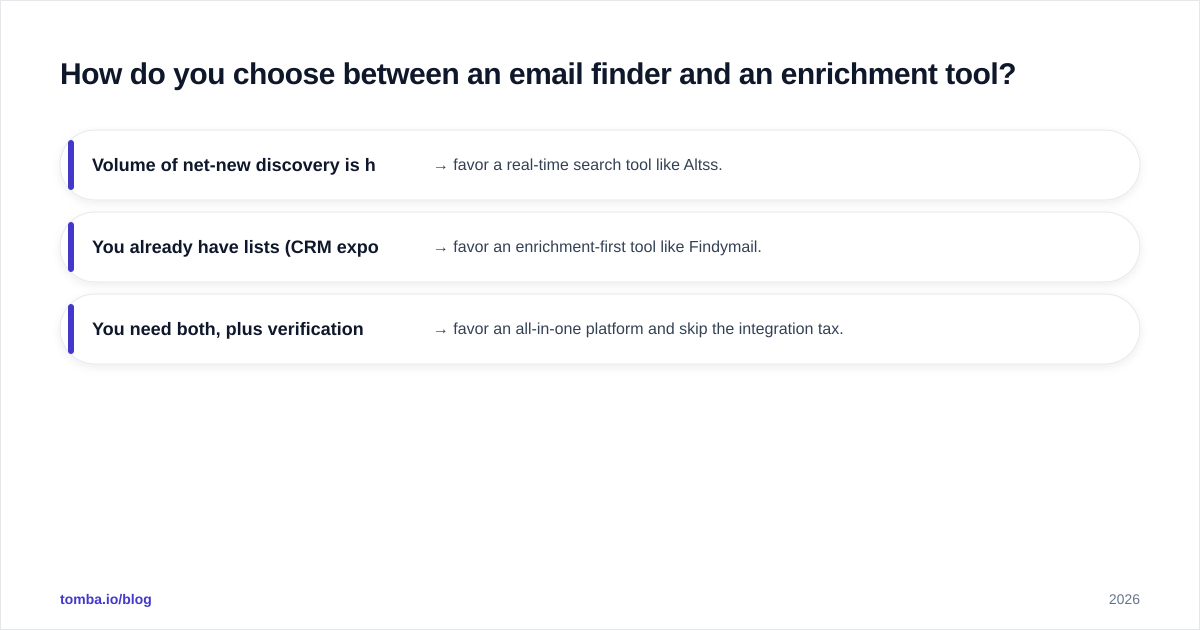
- Volume of net-new discovery is high, list cleanup is low → favor a real-time search tool like Altss.
- You already have lists (CRM exports, scraped Sales Nav, event attendees) → favor an enrichment-first tool like Findymail.
- You need both, plus verification, plus an API → favor an all-in-one platform and skip the integration tax.
Before you compare on price, make sure you're comparing tools that match your actual workflow. A cheaper credit is worthless if the tool can't do the job you're hiring it for. If you want a primer on how the underlying discovery works, our breakdown of the email finder explains the domain-and-name lookup that all three tools rely on.
Altss vs Findymail: full comparison table#
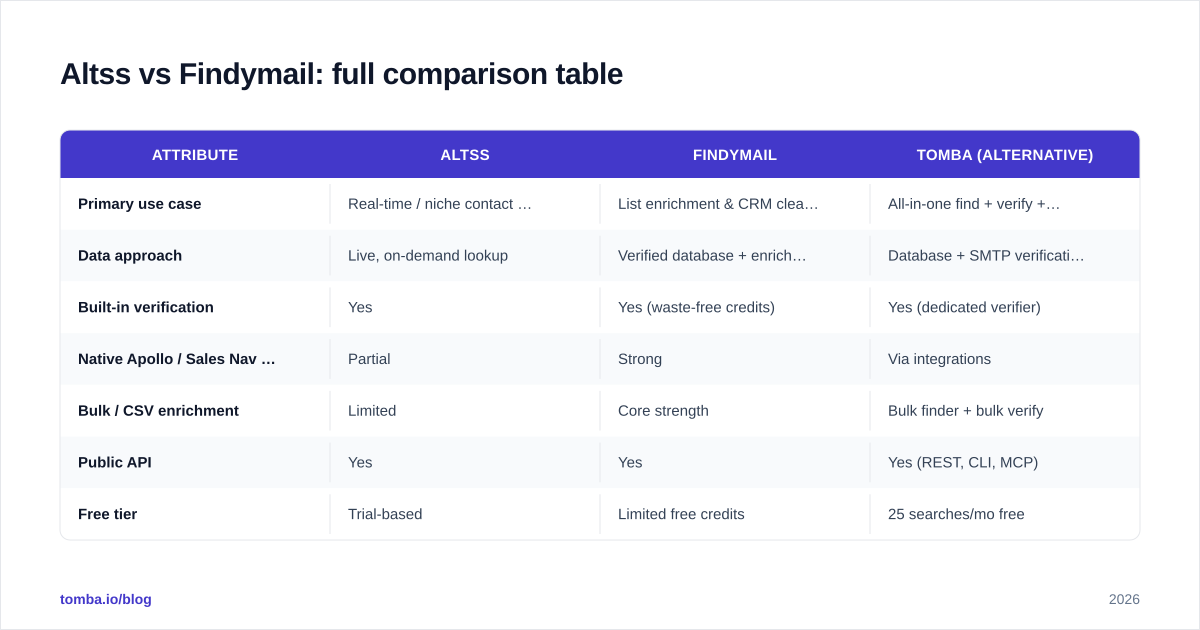
Here's the head-to-head. Treat vendor accuracy figures as directional — they're measured on different test sets, so the only number that matters is your own bounce rate on your own list.
| Attribute | Altss | Findymail | Tomba (alternative) |
|---|---|---|---|
| Primary use case | Real-time / niche contact search | List enrichment & CRM cleanup | All-in-one find + verify + enrich |
| Data approach | Live, on-demand lookup | Verified database + enrichment | Database + SMTP verification |
| Built-in verification | Yes | Yes (waste-free credits) | Yes (dedicated verifier) |
| Native Apollo / Sales Nav flow | Partial | Strong | Via integrations |
| Bulk / CSV enrichment | Limited | Core strength | Bulk finder + bulk verify |
| Public API | Yes | Yes | Yes (REST, CLI, MCP) |
| Free tier | Trial-based | Limited free credits | 25 searches/mo free |
| Entry paid price | Premium positioning | From ~$49/mo range | $49/mo Starter |
| Best for | Recruiters, researchers, VCs | SDR teams, agencies | Teams wanting one stack |
A few honest caveats. Pricing on both tools shifts with credit bundles and annual discounts, so check the live Findymail and Altss pages before budgeting. And "native Apollo flow" is where Findymail genuinely shines — if your whole motion is Sales Navigator → enriched emails, that integration alone can justify the choice.

Which one is more accurate?#
Conclusion first: for clean, deliverable emails on lists you already have, Findymail's verify-before-charge model is hard to beat; for finding contacts that don't exist in standard databases yet, Altss's real-time approach wins.
Accuracy in email finding has two separate dimensions people constantly conflate:
- Find rate — of the people you searched, how many emails did the tool return at all?
- Validity rate — of the emails it returned, how many actually deliver?
Findymail optimizes aggressively for validity. Its "you only pay for verified emails" stance means it would rather return nothing than return a guess, which keeps bounce rates low and protects your sender reputation. That's the right priority for high-volume cold email, where a 5% bounce rate can tank your domain.
Altss optimizes for find rate on the long tail. By querying in real time, it can surface contacts whose details changed last week — a new role, a new company, a fresh domain — that a quarterly database refresh would still have wrong. The cost is that real-time results sometimes need a second verification pass before you send.
Whichever you choose, run your output through a dedicated email verifier before a big send. No finder, however good, replaces a final catch-all and SMTP check — especially on catch-all domains where even strong tools have to make a judgment call.
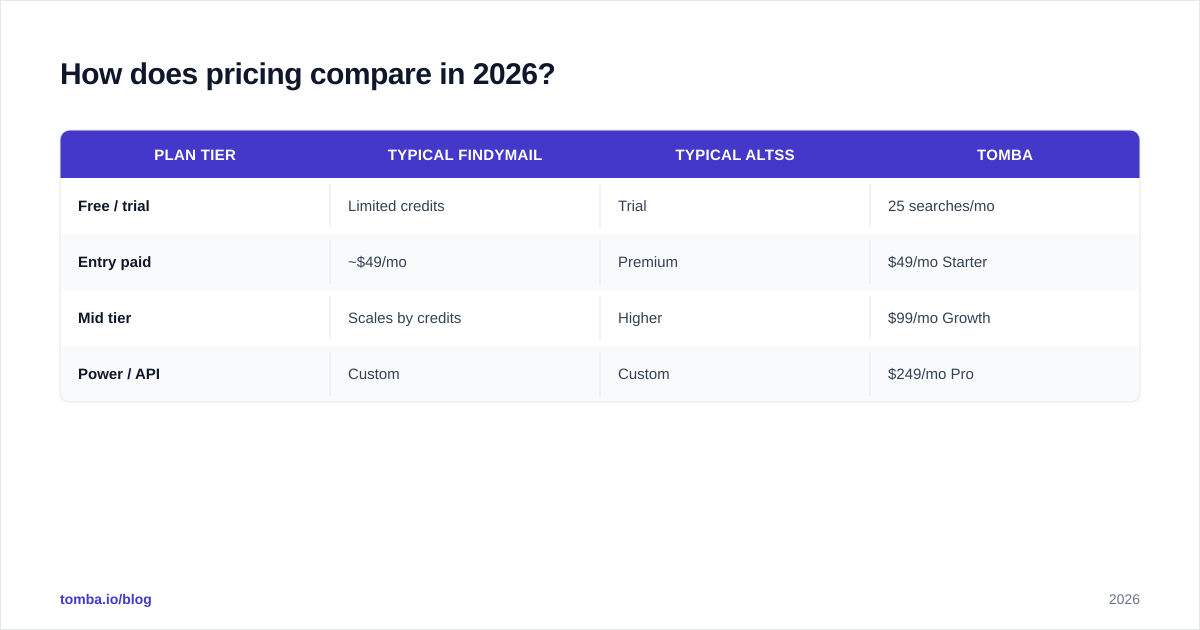
How does pricing compare in 2026?#
The honest summary: Findymail is usually cheaper for list-heavy work; Altss costs more because real-time lookups are more expensive to serve.
Findymail sells credit-based plans where one verified email equals roughly one credit, and unverified results don't burn credits. For an SDR enriching a few thousand contacts a month, that predictability is the selling point — you can model your cost per booked meeting cleanly.
Altss positions as a premium research tool. If you're a recruiter filling a niche role or a VC sourcing founders, paying more per contact is rational because the contact is worth more and harder to find. But if you tried to run a 50,000-send cold campaign through it, the unit economics would hurt.
This is exactly where an all-in-one platform changes the math. Tomba's plans bundle finding, verification, domain search, and enrichment into one credit pool — Free (25 searches/mo), Starter at $49/mo, Growth at $99/mo, Pro at $249/mo, and Enterprise custom. You can see current Tomba pricing for the exact credit allotments, but the structural advantage is that you're not paying two vendors and reconciling two credit systems for one outbound motion.
| Plan tier | Typical Findymail | Typical Altss | Tomba |
|---|---|---|---|
| Free / trial | Limited credits | Trial | 25 searches/mo |
| Entry paid | ~$49/mo | Premium | $49/mo Starter |
| Mid tier | Scales by credits | Higher | $99/mo Growth |
| Power / API | Custom | Custom | $249/mo Pro |
What do real workflows look like for each?#
Three quick scenarios, because the "best" tool is entirely situational.
Scenario 1 — Agency running cold email at scale. You're pulling 10,000 contacts a month from Sales Navigator and need clean emails fast. Findymail's native flow and waste-free credits make it the natural pick. Pair it with proper warmup and you protect email deliverability while keeping cost predictable.
Scenario 2 — Recruiter sourcing senior engineers. Your targets just changed jobs, their old emails bounce, and standard databases are stale. Altss's real-time lookup earns its premium here — you need the contact that exists today, not last quarter.
Scenario 3 — Founder-led sales with a mixed motion. Some days you're enriching a webinar list, other days you're hunting one specific decision-maker. You don't want two subscriptions. This is where a single platform with a domain search, bulk finder, and verifier under one roof removes friction — and where the Tomba API lets you wire it all into your own tooling.
What are the pros and cons of each?#
Altss — strengths
- Strong on net-new and hard-to-find contacts.
- Data freshness from real-time querying.
- Good fit for research-grade, low-volume, high-value targets.
Altss — weaknesses
- Premium pricing scales poorly for mass campaigns.
- Lighter on batch list-enrichment ergonomics.
- Real-time results may need a verification pass.
Findymail — strengths
- Excellent verified-email accuracy and waste-free credits.
- Best-in-class Apollo / Sales Navigator integration.
- Predictable, list-friendly pricing.
Findymail — weaknesses
- Less suited to surfacing brand-new or obscure contacts.
- You may still want a separate tool for non-Apollo discovery.
- Credit math can surprise you on low-verify-rate lists.
For deeper alternative comparisons, our Findymail alternative page lays out where a unified platform fits versus a specialist tool.

Is there a better all-in-one alternative?#
If your honest answer to "do I need finding or enrichment?" is "both, plus verification," then a specialist on either end leaves you stitching tools together. That's the case for evaluating a consolidated platform.
Tomba runs the email finder, email verification, domain search, catch-all verification, phone finder, and data enrichment on one credit pool and one API. You get Findymail-style bulk enrichment and Altss-style on-demand lookup without two contracts. It won't always beat a hyper-specialized tool at that tool's single best trick — a dedicated real-time scout may still edge it on the rarest contacts — but for the 90% of teams whose work is mixed, one stack beats two.
The data-quality question matters here too. Before trusting any finder, it's worth understanding where the data comes from, because freshness and sourcing drive both find rate and validity far more than marketing copy does. Reviewing how vendors rate on independent marketplaces like G2 is another sanity check before you commit budget.
Final verdict: which should you pick?#
- Choose Findymail if your motion is list-first, Apollo-heavy, and you want the lowest bounce rate per dollar on contacts you already source. It's the cleaner fit for high-volume SDR and agency teams.
- Choose Altss if your value-per-contact is high, your targets are hard to find, and data freshness beats price — recruiting, venture sourcing, and deep research.
- Choose an all-in-one like Tomba if you're tired of paying two vendors for one outbound motion and want finding, verification, and enrichment under a single API and credit pool.
There's no universal winner — there's only the tool that matches your bottleneck. Diagnose that first, then pick.
Ready to test a unified workflow? Start free with the Tomba Email Finder — 25 searches a month, no card required — and run a real sample of your own list against it. Compare the find rate and bounce rate side by side with whatever you're using now, then let the numbers, not the marketing, make the call.
// get started
Find, verify and enrich your first contacts today
Start on the free plan with 25 searches a month, then scale when your team is ready.
Free plan · No credit card required · GDPR & CCPA
// about the author