Altss vs Generect: Which B2B Lead Data Tool Wins in 2026?
Altss vs Generect compared on data freshness, coverage, pricing, and email accuracy — plus where each tool fits your outbound stack in 2026.
Picking between Altss and Generect comes down to one question most buyers skip until renewal: are you paying for a static database or a live data feed? Both tools promise fresh B2B contacts, but they get there in different ways — and that difference shows up in your bounce rates, your reply rates, and your bill.
This is a neutral breakdown. No tool is perfect, and the "best" one depends on how you prospect. By the end you'll know which fits your motion, where each one is weak, and how to plug the gaps with a dedicated finder when accuracy is non-negotiable.
TL;DR#
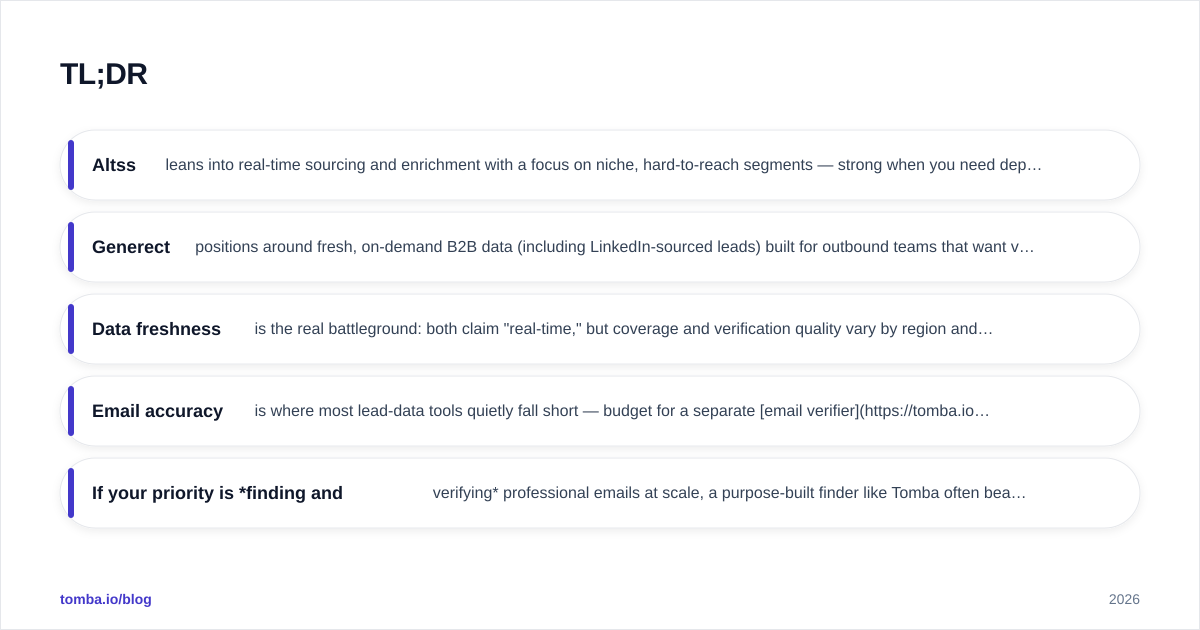
- Altss leans into real-time sourcing and enrichment with a focus on niche, hard-to-reach segments — strong when you need depth on specific accounts.
- Generect positions around fresh, on-demand B2B data (including LinkedIn-sourced leads) built for outbound teams that want volume without stale CSVs.
- Data freshness is the real battleground: both claim "real-time," but coverage and verification quality vary by region and role seniority.
- Email accuracy is where most lead-data tools quietly fall short — budget for a separate email verifier regardless of which you choose.
- If your priority is finding and verifying professional emails at scale, a purpose-built finder like Tomba often beats a general data platform on cost-per-valid-email.
What are Altss and Generect?#
Both Altss and Generect are B2B lead-data platforms. You give them a company, a role, or a LinkedIn profile, and they return contact data — names, titles, company info, and (the part everyone actually cares about) email addresses and sometimes phone numbers.
The category they compete in is "sales intelligence" or "lead data," the same neighborhood as Apollo, RocketReach, and Lusha. The pitch is always the same: skip manual research, get contactable leads faster.
Where they differ is sourcing philosophy. Altss markets itself around real-time enrichment and reaching niche segments other databases miss. Generect markets itself around freshly generated B2B data pulled on demand rather than served from a months-old static index. In practice, both make the "real-time" claim — so you have to test it against your own ICP rather than trust the homepage.
If you've used a B2B database before, the mental model is simple: static databases are like a printed phone book — comprehensive but aging the moment it ships. Real-time tools are like calling directory assistance — slower per lookup, but current. Most modern tools sit somewhere between those two poles, and that position is what you're really comparing.

How do Altss and Generect compare head to head?#
Here's the practical comparison. Treat specific numbers as directional — vendor pricing and limits shift, so confirm against each vendor's current pricing page before you buy.
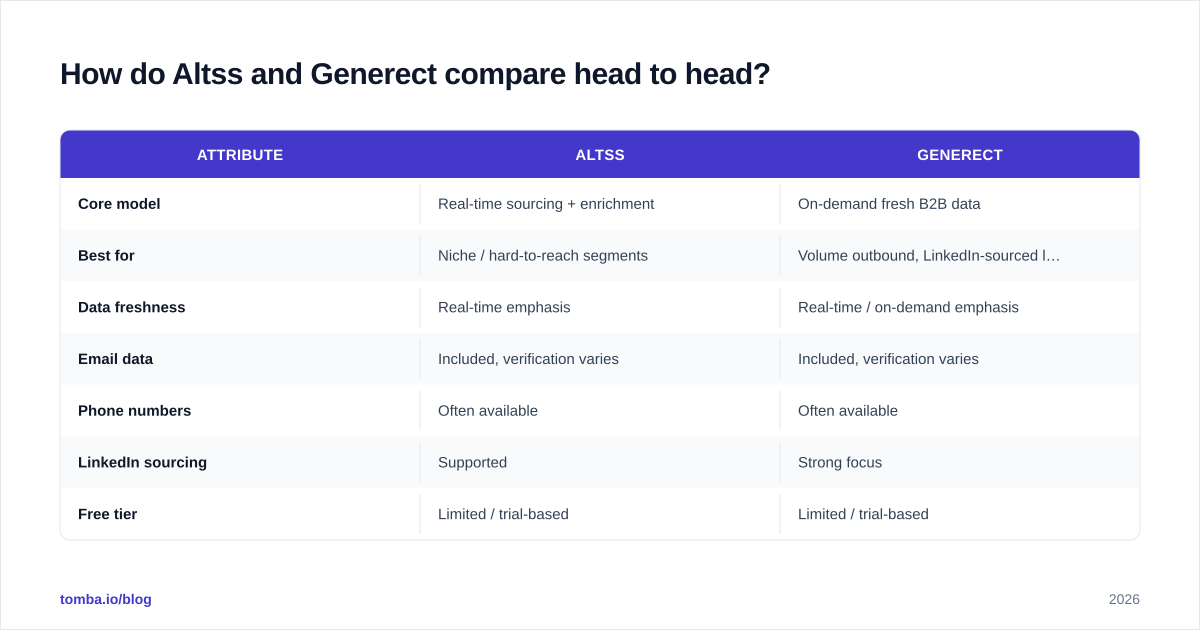
| Attribute | Altss | Generect |
|---|---|---|
| Core model | Real-time sourcing + enrichment | On-demand fresh B2B data |
| Best for | Niche / hard-to-reach segments | Volume outbound, LinkedIn-sourced leads |
| Data freshness | Real-time emphasis | Real-time / on-demand emphasis |
| Email data | Included, verification varies | Included, verification varies |
| Phone numbers | Often available | Often available |
| LinkedIn sourcing | Supported | Strong focus |
| Free tier | Limited / trial-based | Limited / trial-based |
| Typical buyer | Account-based teams, researchers | SDR teams, agencies |
| Native verification depth | Moderate | Moderate |
The pattern you'll notice: these tools overlap heavily on what they deliver and differ mostly on how and for whom. Generect tends to appeal to high-volume outbound teams and agencies that need a steady stream of fresh contacts. Altss tends to appeal to teams chasing specific, harder-to-source profiles where generic databases return blanks.
Neither claim survives without testing. The only honest way to choose is to run the same 50-account list through both trials and measure two things: fill rate (how many rows came back populated) and valid rate (how many of those emails actually deliver).
Which has better data freshness and coverage?#
Freshness is the headline feature for both, so judge it the same way you'd judge a used car — not by the brochure, but by the test drive.
Run this test:
- Build a list of 25 accounts that match your real ICP, including a few in awkward regions or niche industries.
- Pull contacts for the same target roles from each tool.
- Measure fill rate per tool.
- Verify every returned email through an independent checker.
- Compare valid contacts, not total contacts.
That last step matters more than anything on a feature page. A tool that returns 90 contacts at 60% valid (54 usable) loses to one that returns 70 contacts at 90% valid (63 usable) — even though the first "found more."
Coverage also varies sharply by geography and seniority. North American mid-market data is usually strong across both. EMEA, APAC, and very senior or very junior titles are where gaps appear. If your ICP lives in those harder pockets, Altss's niche-segment angle is worth a serious trial. If you're running broad NA/EU outbound at volume, Generect's on-demand sourcing is the more natural fit.
For a deeper look at why sourcing transparency matters, it's worth understanding where contact data actually comes from before you trust any vendor's freshness claim.
How accurate are the emails — and why it matters most?#
Accuracy is the metric that decides whether the whole exercise was worth it. You can have the freshest, most comprehensive data in the category, but if 25% of the emails bounce, your sender reputation takes the hit and your campaigns get throttled.

Here's the uncomfortable truth about general lead-data platforms: email verification is rarely their core competency. They source data well, but the verification layer is often a secondary feature — good enough to filter obvious junk, not aggressive enough to catch catch-all domains, role-based addresses, or recently-departed employees.
That's why experienced outbound teams treat lead data and email verification as two separate jobs:
- Job one: source contacts (Altss, Generect, or a finder).
- Job two: verify every address before it touches your sequencer.
If you skip job two, your bounce rate becomes a slot machine. The fix is cheap: run sourced lists through a dedicated email verifier and a catch-all verifier before import. A two-cent verification check is far cheaper than a domain reputation you can't easily rebuild.
What does each tool cost, and how does Tomba compare?#
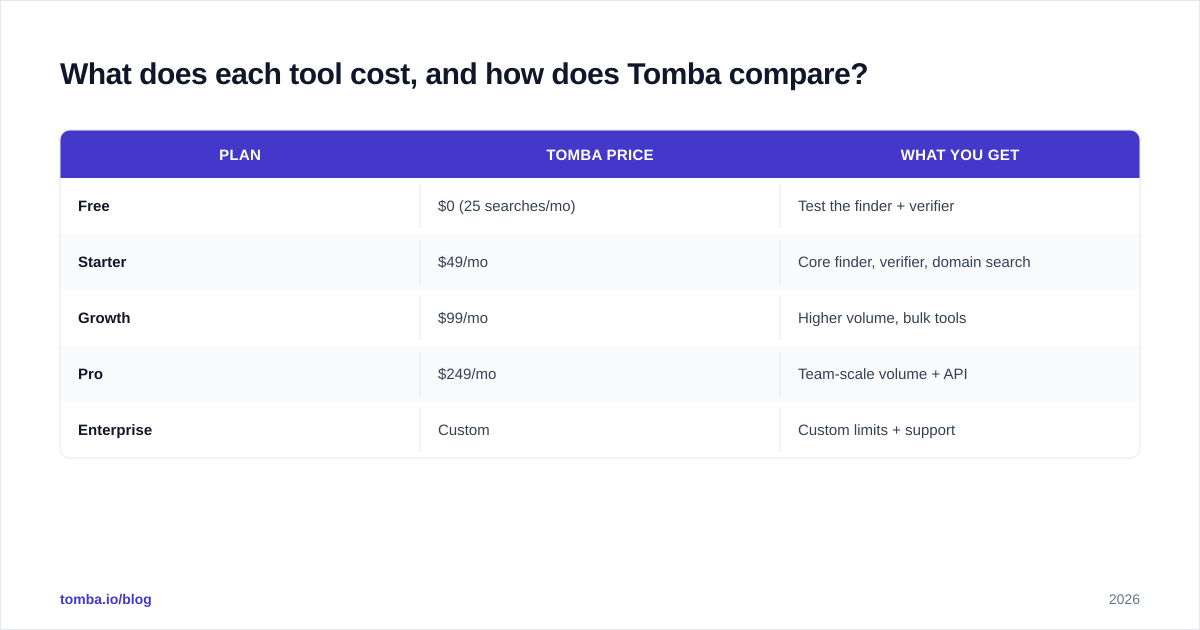
Pricing for both Altss and Generect is largely quote-driven or credit-based and changes over time, so always confirm current numbers directly. The more useful comparison is cost per valid email, because that's what actually drives pipeline.
This is where a purpose-built finder enters the conversation. Tomba is not a sprawling sales-intelligence suite — it's a focused email finder with verification baked in, which keeps the cost-per-valid-email predictable.

| Plan | Tomba price | What you get |
|---|---|---|
| Free | $0 (25 searches/mo) | Test the finder + verifier |
| Starter | $49/mo | Core finder, verifier, domain search |
| Growth | $99/mo | Higher volume, bulk tools |
| Pro | $249/mo | Team-scale volume + API |
| Enterprise | Custom | Custom limits + support |
Full details are on the Tomba pricing page. The point isn't that Tomba replaces a full data platform for every use case — it's that for the specific job of "find a professional email and confirm it's real," a transparent per-search model is easier to budget than enterprise quotes, and the verification is first-class rather than an afterthought.
If your workflow is enrichment-heavy — appending firmographics, technographics, and intent signals across thousands of accounts — a platform like Altss or Generect (or a dedicated data enrichment layer) earns its place. If your workflow is "I have a name and a company, get me a deliverable email," a finder is leaner.
When should you choose Altss vs Generect vs a finder?#
Match the tool to the motion:
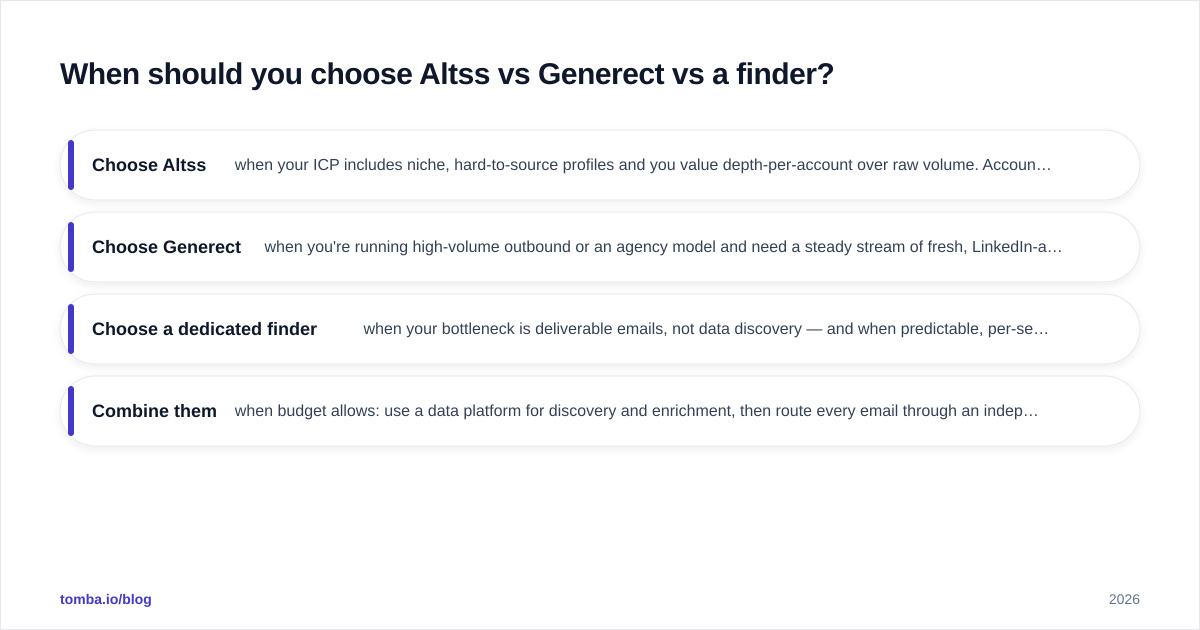
- Choose Altss when your ICP includes niche, hard-to-source profiles and you value depth-per-account over raw volume. Account-based teams and researchers benefit most here.
- Choose Generect when you're running high-volume outbound or an agency model and need a steady stream of fresh, LinkedIn-adjacent leads without manual research.
- Choose a dedicated finder when your bottleneck is deliverable emails, not data discovery — and when predictable, per-search pricing matters more than a full intelligence suite.
- Combine them when budget allows: use a data platform for discovery and enrichment, then route every email through an independent verification pass before sending.
Many teams land on a hybrid stack precisely because no single tool wins on coverage, freshness, and accuracy at the same time. The data platform finds the universe; the finder and verifier make sure what you send actually arrives.
Is real-time data always better than a database?#
Not always — and this is the nuance both vendors gloss over. Real-time sourcing is excellent for freshness but can be slower and occasionally thinner on coverage for common roles, because it generates on demand rather than serving a pre-built index. A well-maintained database can return broad results instantly for mainstream titles.
The honest answer: freshness matters most for volatile data (job changes, new hires, recently funded startups), while a strong index matters most for breadth on stable, well-documented companies. Test both against the segment you actually sell into rather than accepting either marketing frame.
One more reality check — even "real-time" tools can serve a cached record. The only way to know an email is good right now is to verify it right now, which is why the verification step is non-negotiable no matter how fresh the source claims to be.
The bottom line#
Altss and Generect are both credible B2B lead-data tools, and the right pick depends on your ICP and motion: Altss for niche depth, Generect for fresh outbound volume. But neither removes the need to verify before you send — that's the step that protects your deliverability and your pipeline.
If your real bottleneck is turning names into deliverable emails without enterprise pricing or a verification afterthought, start with the Tomba Email Finder. Find professional emails by domain, name, or company, verify them in the same workflow, and test it free with 25 searches a month before you commit a cent. Pair it with whichever data platform you choose, and you get the freshness of one with the accuracy of the other.
External references worth checking before you buy: real-user reviews on G2, each vendor's LinkedIn presence for product updates, and analyst framing from Gartner on the sales-intelligence category.
// get started
Find, verify and enrich your first contacts today
Start on the free plan with 25 searches a month, then scale when your team is ready.
Free plan · No credit card required · GDPR & CCPA
// about the author