Altss vs Kipplo 2026: Best B2B Email Finder Compared
Altss vs Kipplo, compared on data freshness, accuracy, coverage, and price — plus where each one fits your prospecting stack in 2026 and when a third option beats both.
(title rendered separately)
Choosing between Altss vs Kipplo comes down to one question: which tool puts accurate, current contact data in your sequence with the least manual cleanup? Both promise fresh B2B emails and lead intelligence. They get there differently, and the difference shows up in your bounce rate and your monthly bill.
TL;DR#
- Altss leans into real-time sourced contact data and is strong when you need niche or hard-to-find prospects that static databases miss.
- Kipplo packages email finding with lightweight sales-intelligence and list-building, aimed at SMB teams who want speed over depth.
- Accuracy and verification are the deciding factors — a "found" email that bounces costs you more than a credit.
- Neither tool is the cheapest path to verified emails at scale; a dedicated finder-plus-verifier stack often wins on cost per valid contact.
- If you want one transparent platform that finds, verifies, and enriches in the same workflow, Tomba is the alternative most teams should price out before committing.
What are Altss and Kipplo?#
Altss and Kipplo are both B2B contact-data tools — software that turns a name, company, or domain into a reachable email address (and often a phone number and enrichment fields). They sit in the same category as RocketReach, Apollo, and Tomba, but each picks a lane.
Altss markets itself around real-time sourcing — pulling contact details on demand rather than serving everything from a pre-scraped database. The pitch is freshness: when a static database goes stale, a live-sourced record is more likely to still be valid. That makes it appealing for recruiters and sales teams chasing contacts who don't show up in the usual data resellers.
Kipplo is closer to an all-in-one prospecting helper. It combines email finding with list building and basic company/contact intelligence, targeting small teams that want to go from "company name" to "outreach list" without stitching three tools together.
The shared weakness is the one buyers underestimate: finding an email is not the same as confirming it lands. That gap is where this comparison lives.

How do Altss and Kipplo compare on accuracy?#
Accuracy is two numbers, not one. The first is match rate — of the prospects you searched, how many returned any email. The second is valid rate — of those emails, how many actually accept mail. A tool can win on the first and lose badly on the second, and most marketing pages only advertise the flattering one.
Live-sourcing tools like Altss tend to do well on freshness because the record is assembled closer to query time. The trade-off is variability: real-time lookups can be slower and coverage can be patchy for the long tail. Database-first tools like Kipplo are fast and consistent on common roles at well-known companies, but their records age between refresh cycles, which quietly inflates bounce rates on smaller or fast-moving companies.
The honest answer is that neither vendor's headline accuracy number should be trusted without a verification layer. Whatever you find, you should run through an email verifier before it touches a live mailbox. Catch-all domains make this worse — a catch-all accepts everything at the SMTP handshake, so a naive check marks junk as valid. You need a real catch-all verifier to separate the deliverable from the decorative.
Altss vs Kipplo: feature and pricing comparison#
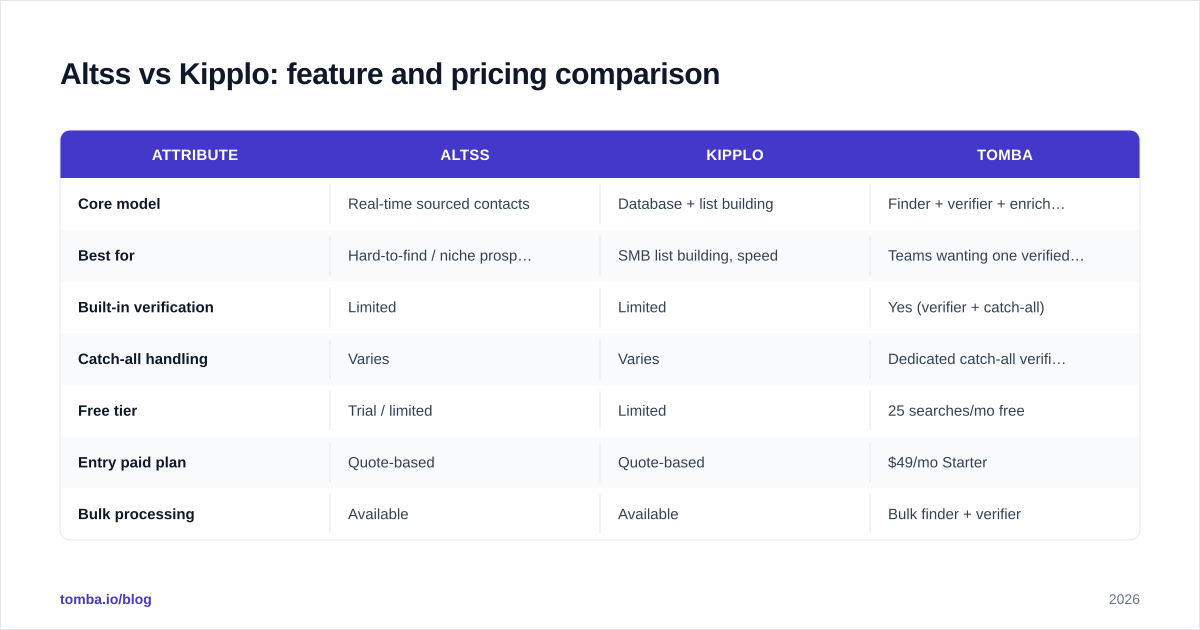
Here's the side-by-side. Pricing for both Altss and Kipplo shifts often and is partly quote-based, so confirm current numbers on each vendor's site and on review platforms like G2 before you buy — the structure matters more than any single figure.
| Attribute | Altss | Kipplo | Tomba |
|---|---|---|---|
| Core model | Real-time sourced contacts | Database + list building | Finder + verifier + enrichment |
| Best for | Hard-to-find / niche prospects | SMB list building, speed | Teams wanting one verified workflow |
| Built-in verification | Limited | Limited | Yes (verifier + catch-all) |
| Catch-all handling | Varies | Varies | Dedicated catch-all verifier |
| Free tier | Trial / limited | Limited | 25 searches/mo free |
| Entry paid plan | Quote-based | Quote-based | $49/mo Starter |
| Bulk processing | Available | Available | Bulk finder + verifier |
| Native API | Available | Limited | Full REST API |
| Phone numbers | Some coverage | Some coverage | Phone finder add-on |
Two takeaways. First, both Altss and Kipplo treat verification as a secondary concern, which means you'll likely bolt on a separate verifier and pay twice. Second, the transparent, published pricing that lets you model cost-per-valid-contact is easier to get from platforms with a public pricing page than from quote-based vendors.
)
Which tool fits which use case?#
Pick by the job, not the brand.
Choose Altss if your bottleneck is coverage of the obscure — candidates, founders at tiny companies, or roles that don't surface in the big resold databases. Real-time sourcing earns its keep when the alternative is "no record at all." Just budget for verification, because fresh does not automatically mean deliverable.
Choose Kipplo if you're an SMB team that values speed and simplicity — you want to build a list and start sending today without assembling a stack. Accept that you'll periodically clean the list, especially for smaller or recently-changed companies.
Choose a finder-plus-verifier platform if your real metric is cost per email that actually lands. When you're sending at volume, the cheapest "found" email is irrelevant; the cheapest verified email is what protects your sender reputation and your deliverability. This is also where a bulk email finder plus integrated verification removes a whole step from your process.
)
How should you evaluate either tool before buying?#
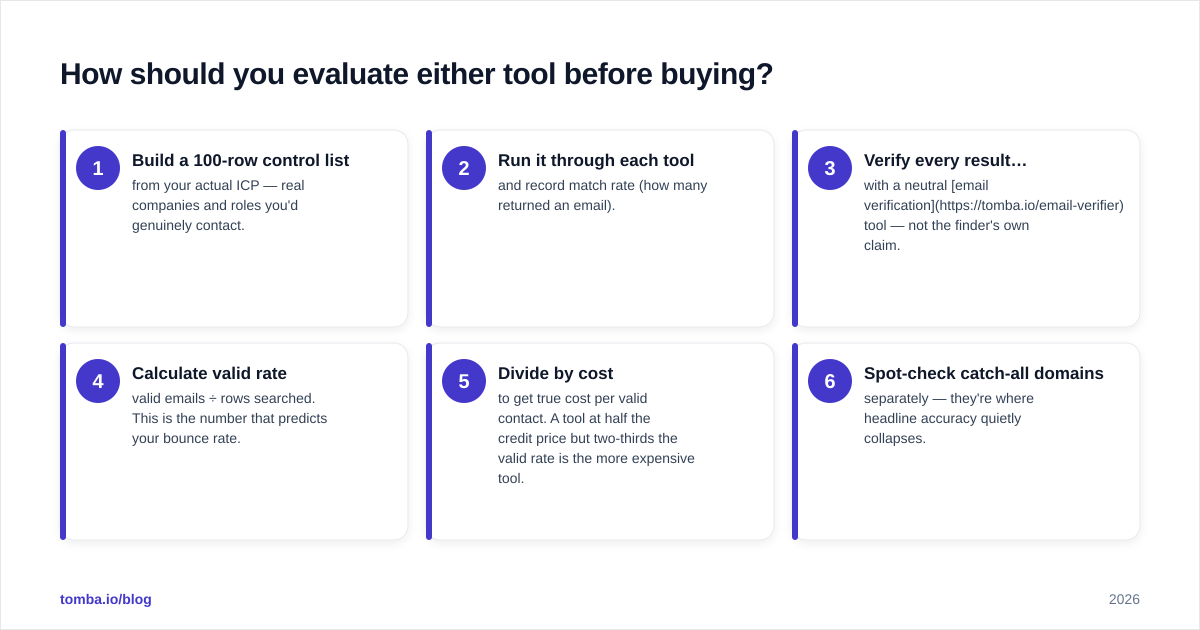
Run the same test on both, with your own data. Marketing benchmarks are run on the vendor's favorite list; yours isn't that list.
- Build a 100-row control list from your actual ICP — real companies and roles you'd genuinely contact.
- Run it through each tool and record match rate (how many returned an email).
- Verify every result independently with a neutral email verification tool — not the finder's own claim.
- Calculate valid rate: valid emails ÷ rows searched. This is the number that predicts your bounce rate.
- Divide by cost to get true cost per valid contact. A tool at half the credit price but two-thirds the valid rate is the more expensive tool.
- Spot-check catch-all domains separately — they're where headline accuracy quietly collapses.
This six-step test takes an afternoon and routinely overturns the choice people would have made from a pricing page. The tool that "finds more" frequently lands less.
Altss vs Kipplo: pros and cons#
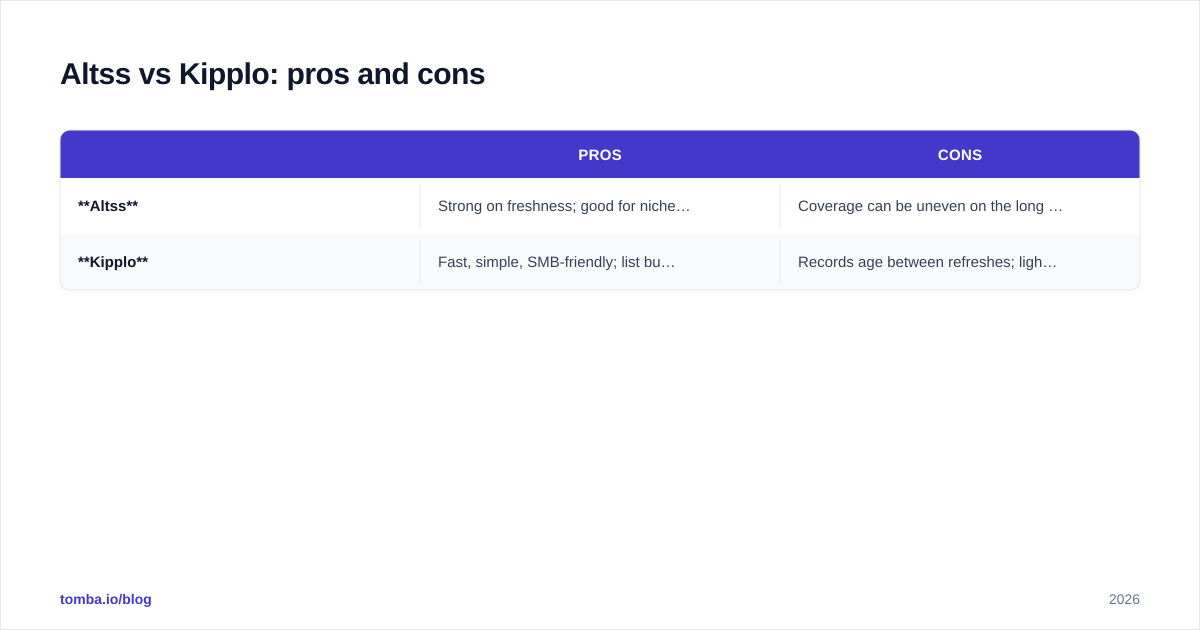
| Pros | Cons | |
|---|---|---|
| Altss | Strong on freshness; good for niche/hard-to-find contacts; real-time lookups | Coverage can be uneven on the long tail; verification not the core focus; quote-based pricing |
| Kipplo | Fast, simple, SMB-friendly; list building built in | Records age between refreshes; light verification; depth limited vs larger databases |
Both are legitimate tools. The pattern across reviews on sites like Capterra is consistent: users like the finding experience and wish the verification and data-freshness guarantees were stronger. That's not a knock on either company specifically — it's the structural limit of any tool that treats verification as an add-on instead of a built-in step.
Is there a better alternative to both?#
If the recurring complaint is "great finder, weak verification," the fix is a platform where finding and verifying are the same workflow. That's the case for evaluating Tomba alongside Altss and Kipplo.
With Tomba you can:
- Find emails by name, domain, or company with the email finder and domain search.
- Verify in the same place, including a dedicated catch-all verifier for the domains that fool simpler checks.
- Enrich records with firmographic and contact data via data enrichment instead of exporting to yet another tool.
- Scale through a full email finder API, bulk processing, and native integrations.
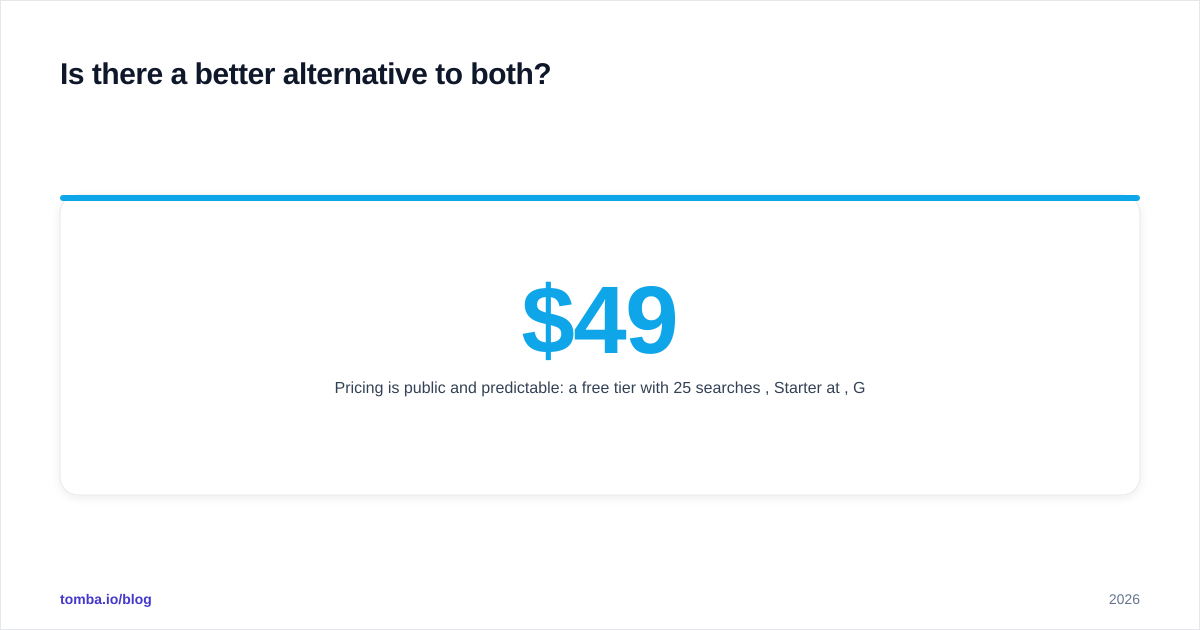
Pricing is public and predictable: a free tier with 25 searches/month, Starter at $49/mo, Growth at $99/mo, Pro at $249/mo, and custom Enterprise. That transparency is what lets you run the cost-per-valid-contact math before you commit — something quote-based competitors make harder.

Frequently asked questions#
Is Altss more accurate than Kipplo? It depends on your list. Altss tends to win on freshness for niche contacts; Kipplo is fast and consistent for common roles at known companies. Neither replaces independent verification, so test both on your own ICP before deciding.
Do Altss and Kipplo verify emails? Both include some validation, but verification isn't their core focus. For deliverability-critical sending, run results through a dedicated verifier and a catch-all check.
What's the cheapest way to get verified B2B emails? Optimize for cost per valid contact, not per credit. A combined find-and-verify platform usually beats buying a cheap finder plus a separate verifier once you account for bounces and reputation damage.
Can I migrate my existing lists? Yes — any serious tool, including Tomba, supports bulk verification, so you can clean a list you already own before your next campaign.
The bottom line#
Altss and Kipplo solve the finding half of prospecting well, each with a clear personality: Altss for fresh, hard-to-find contacts, Kipplo for fast SMB list building. Where both leave you exposed is the verification half — and that's the half that decides whether your emails land or your domain gets flagged.
If you'd rather not run two tools and reconcile two bills, start with the Tomba Email Finder. Find, verify, and enrich in one workflow, on public pricing, with a free tier to test against your own list today — then run the six-step evaluation above and let the cost-per-valid-contact number make the call for you.
// get started
Find, verify and enrich your first contacts today
Start on the free plan with 25 searches a month, then scale when your team is ready.
Free plan · No credit card required · GDPR & CCPA
// about the author