Altss vs LeadRocks 2026: B2B Contact Data Tools Compared
Altss promises real-time, AI-sourced B2B contacts while LeadRocks sells a fixed lifetime database. Here's an honest 2026 breakdown of accuracy, pricing, and which one fits your outbound.
Choosing between Altss and LeadRocks comes down to one question: do you want a static database you buy once, or live contact data you query when you need it? Both promise B2B emails and phone numbers, but they solve the problem from opposite directions. This breakdown cuts through the marketing so you can pick the one that actually fits how your team prospects in 2026.
TL;DR — Altss vs LeadRocks at a glance#
- Altss is built around real-time, AI-driven sourcing — it pulls fresh contact data at query time, which favors accuracy and recency over raw volume.
- LeadRocks is a fixed B2B database (popularized through lifetime deals) with ~100M+ stored contacts — great for cheap bulk pulls, weaker on freshness.
- Accuracy: live-lookup tools like Altss tend to beat static databases on email validity because stored records decay ~22–30% per year.
- Pricing model: LeadRocks leans on one-time/lifetime pricing; Altss uses recurring credits. Your cost-per-valid-lead matters more than sticker price.
- Best overall value for most teams: a verification-first email finder. If you only test one thing, test deliverability, not database size.
What is Altss?#
Altss positions itself as a real-time B2B contact intelligence tool. Instead of serving rows from a frozen table, it sources and assembles contact details — work emails, LinkedIn profiles, and phone numbers — closer to the moment you search. Think of it like ordering fish at the dock versus buying it frozen: the catch is fresher, but you pay per trip rather than stocking a freezer once.
The pitch is freshness and accuracy. Because B2B data rots fast — people change jobs, companies rebrand, domains migrate — a tool that re-checks at query time can outperform a giant static list on the metric that actually matters: whether the email bounces.
The trade-off is predictability. Real-time sourcing can return fewer results for obscure roles or thin-coverage regions, and per-query credit pricing means heavy bulk users watch the meter. If your motion is high-volume, low-personalization blasting, that model can feel expensive.
What is LeadRocks?#
LeadRocks is a B2B contact database with a stored pool of roughly 100M+ records, including emails, phone numbers, and LinkedIn URLs. It became well known through lifetime/one-time deals, which made it attractive to founders and small teams who hate recurring SaaS bills. You can browse its G2 listing and Capterra reviews to see how users rate it on volume versus accuracy.
The model is simple: search the database by title, company, industry, or location, then export contacts in bulk. For prospecting at scale on a tight budget, that's appealing — you're not paying per lookup, and the upfront cost can be trivial amortized over a year.
The catch is the same one every static database faces. A stored record is a snapshot. The day it's collected, it might be 95% accurate; twelve months later, a meaningful slice of those emails point to people who've moved on. LeadRocks counters with periodic refreshes, but no stored database escapes decay entirely — which is why verification before you send is non-negotiable.
Altss vs LeadRocks: how do they compare?#
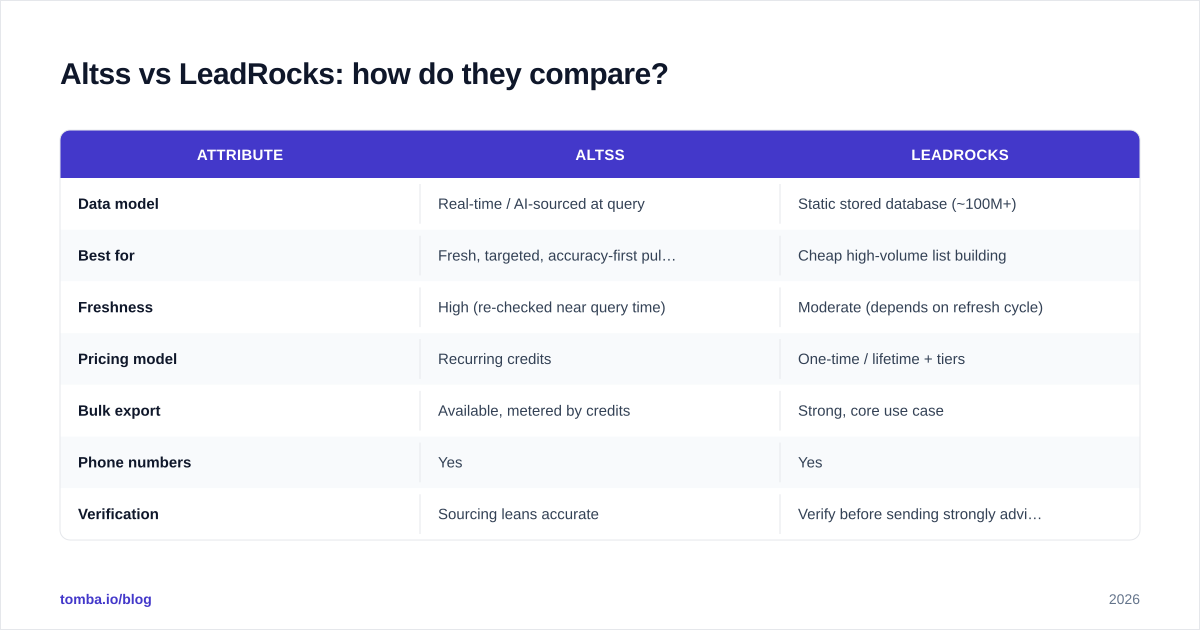
Here's the head-to-head on the attributes that change your reply rate and your bill.
| Attribute | Altss | LeadRocks |
|---|---|---|
| Data model | Real-time / AI-sourced at query | Static stored database (~100M+) |
| Best for | Fresh, targeted, accuracy-first pulls | Cheap high-volume list building |
| Freshness | High (re-checked near query time) | Moderate (depends on refresh cycle) |
| Pricing model | Recurring credits | One-time / lifetime + tiers |
| Bulk export | Available, metered by credits | Strong, core use case |
| Phone numbers | Yes | Yes |
| Verification | Sourcing leans accurate | Verify before sending strongly advised |
| Risk | Cost scales with volume | Decay on stale records |
Neither column is "the winner" in the abstract. A 100M-row database is worthless if 30% bounce and torch your sender reputation. A pristine real-time lookup is overkill — and over-budget — if you just need 5,000 rough leads to feed a warmed-up sequence. Match the tool to the motion.

Which is more accurate — real-time sourcing or a stored database?#
Real-time sourcing usually wins on accuracy, and the reason is decay. Industry consensus puts B2B data decay at roughly 22–30% per year — every quarter, a chunk of any stored list quietly goes stale. A tool that sources or re-validates at query time sidesteps most of that rot because it's working with the current state of the web, not a snapshot from an unknown collection date.
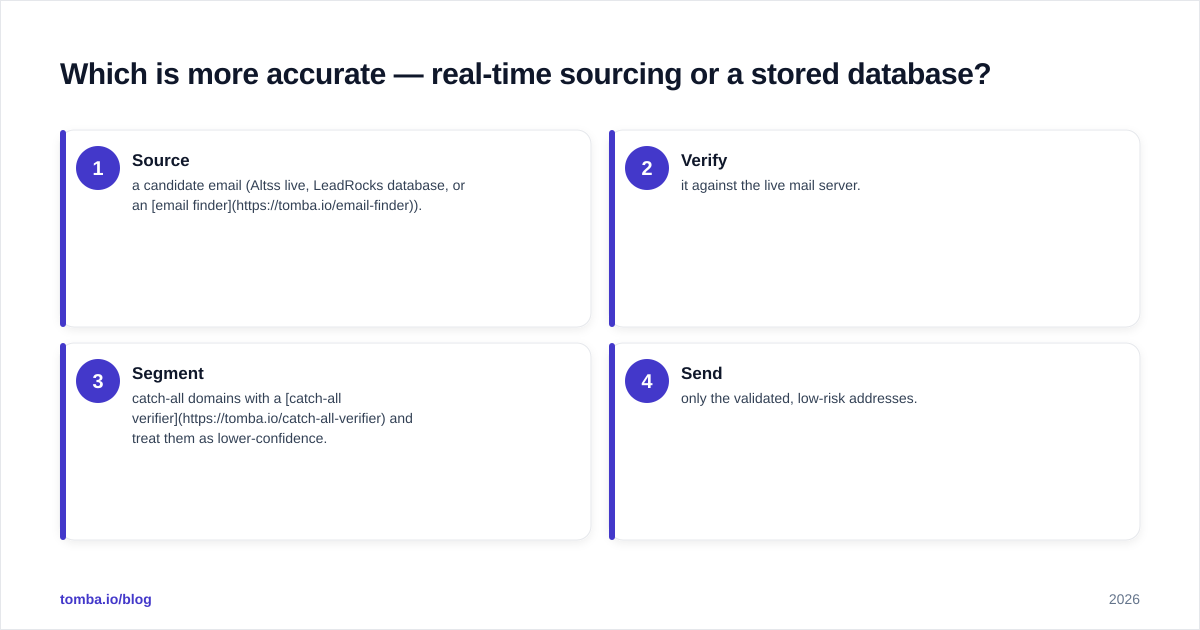
But "more accurate at the source" is not the same as "safe to send." Even fresh data should pass through an email verifier before it enters a sequence, because SMTP-level checks catch invalid mailboxes, full inboxes, and risky catch-all domains that no sourcing engine guarantees. The hierarchy that actually protects your domain looks like this:
- Source a candidate email (Altss live, LeadRocks database, or an email finder).
- Verify it against the live mail server.
- Segment catch-all domains with a catch-all verifier and treat them as lower-confidence.
- Send only the validated, low-risk addresses.
Skip step two and the database size debate is moot — you'll bounce your way onto a blocklist regardless of which vendor you chose.

How does pricing compare?#
Pricing is where the two diverge most, and where sticker price misleads. LeadRocks' lifetime/one-time angle looks unbeatable on a spreadsheet — pay once, export forever. Altss' recurring credits look expensive next to that. But the honest metric is cost per valid, deliverable contact, not cost per row.
Run the math: if a $500 lifetime database delivers 50,000 contacts at 70% validity, that's 35,000 usable leads — cheap. But if 30% bounce on send, the hidden cost is a damaged sender reputation that suppresses every future campaign. A recurring tool that delivers 90%+ validity can cost more per lead and still be cheaper per reply.
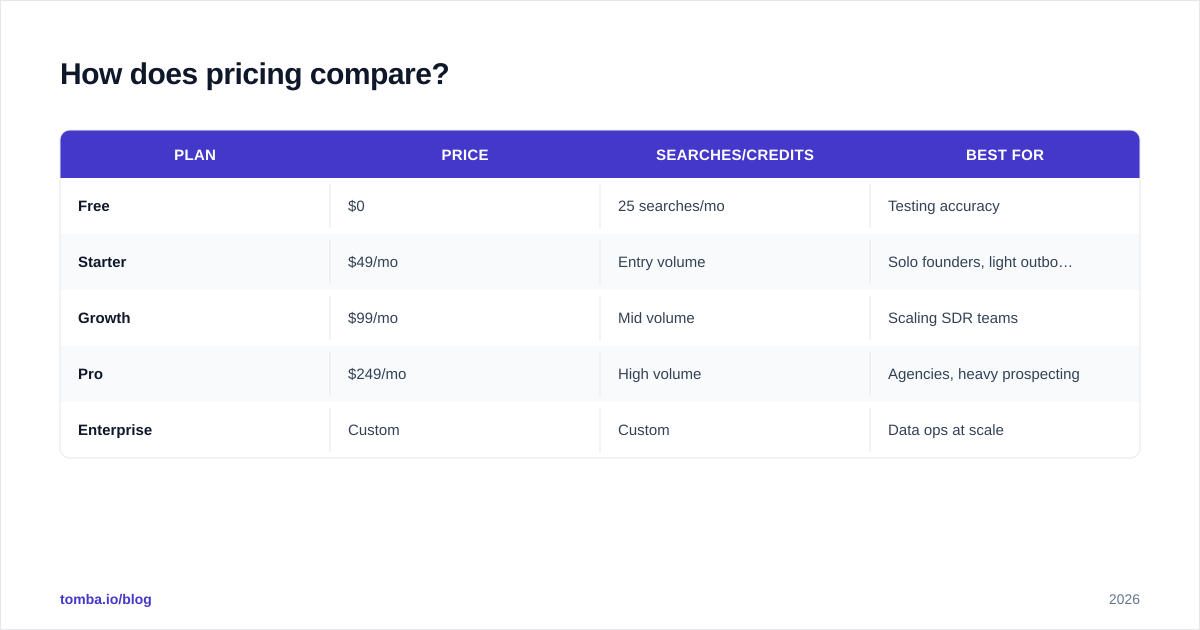
For context, here's how transparent, recurring B2B data pricing typically tiers — using Tomba's pricing as a reference point:
| Plan | Price | Searches/credits | Best for |
|---|---|---|---|
| Free | $0 | 25 searches/mo | Testing accuracy |
| Starter | $49/mo | Entry volume | Solo founders, light outbound |
| Growth | $99/mo | Mid volume | Scaling SDR teams |
| Pro | $249/mo | High volume | Agencies, heavy prospecting |
| Enterprise | Custom | Custom | Data ops at scale |
Whatever you compare, normalize to the same outcome: 1,000 verified, deliverable contacts. That number, not the database headline or the lifetime-deal sticker, is what your budget should track.
Which should you choose for your use case?#
The decision splits cleanly by motion.
Choose a real-time/accuracy-first tool (Altss-style) if you run targeted, personalized outbound where every contact matters, you sell into senior or niche roles where stale data is common, or you'd rather pay per fresh lead than maintain a decaying list. Accuracy compounds when your list is small and your message is tailored.
Choose a database (LeadRocks-style) if you need cheap volume to feed a high-throughput sequence, you're budget-constrained and lifetime pricing genuinely fits your cash flow, and — critically — you have a verification step bolted on before send. The database is the raw ore; verification is the smelting.
Choose a verification-first email finder if you want both: source by domain search or name, verify in the same workflow, and enrich with phone and social — without juggling a separate database export and a separate validator. For most outbound teams in 2026, this consolidated path beats betting everything on either pure-real-time or pure-database. You can read more on where contact data comes from to judge any vendor's sourcing claims.

What do Altss and LeadRocks have in common — and where do they fall short?#
Both tools share the core B2B contact stack: work emails, phone numbers, and LinkedIn data, with filtering by role, company, and geography. Both let you move contacts into outreach. And both, like every vendor in this category, are only as good as the verification layer you attach.
Where each falls short is predictable from its model. Altss-style real-time sourcing can return thin results for long-tail roles or under-covered regions, and credit pricing punishes spray-and-pray volume. LeadRocks-style databases carry decay risk and lean on you to verify before sending — the lifetime price saves money up front but transfers the deliverability risk to you.
Neither ships a full outbound stack. If you also need sequencing, deliverability monitoring, and CRM sync, you'll be stitching tools together regardless. That's worth factoring into total cost — a "cheap" database plus a separate verifier plus an enrichment tool often costs more, and breaks more, than one platform that does sourcing, verification, and data enrichment in one flow.

How to test either tool before you commit#
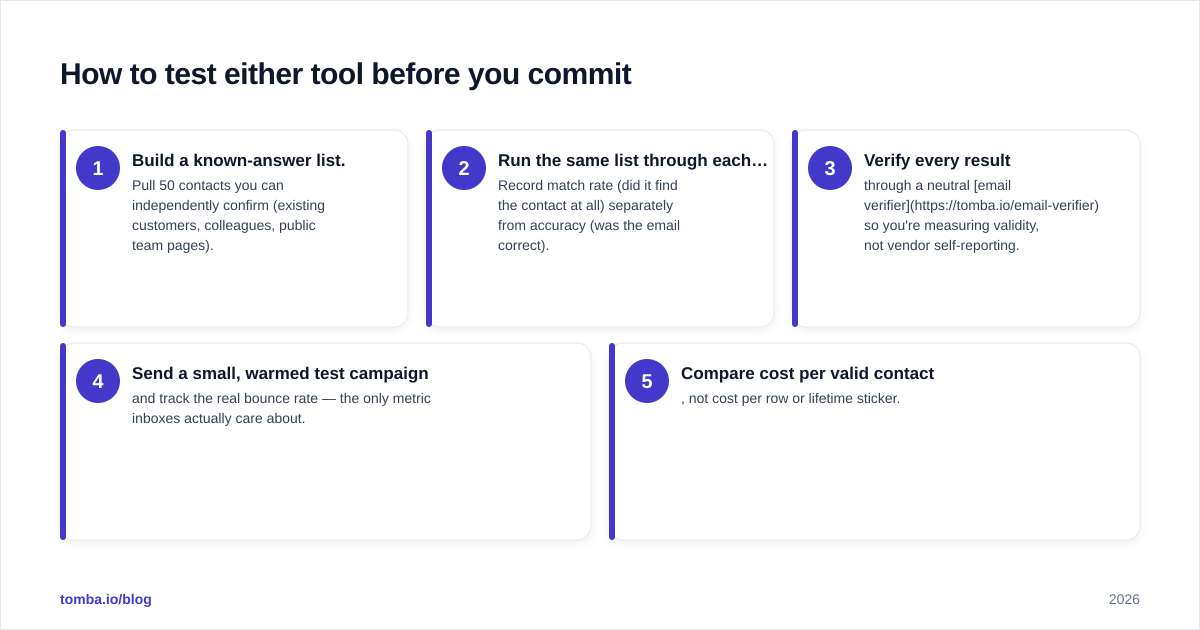
Don't trust the marketing — run a controlled bake-off. It takes an afternoon:
- Build a known-answer list. Pull 50 contacts you can independently confirm (existing customers, colleagues, public team pages).
- Run the same list through each tool. Record match rate (did it find the contact at all) separately from accuracy (was the email correct).
- Verify every result through a neutral email verifier so you're measuring validity, not vendor self-reporting.
- Send a small, warmed test campaign and track the real bounce rate — the only metric inboxes actually care about.
- Compare cost per valid contact, not cost per row or lifetime sticker.
Whichever tool wins your bake-off on deliverable leads is the right answer for your motion — and it won't always be the one with the bigger database or the flashier "AI" label. If you want a baseline to benchmark against, the official LeadRocks site lists its current coverage claims you can hold the test against.
The bottom line#
Altss bets on freshness; LeadRocks bets on volume and one-time pricing. For accuracy-first, targeted outbound, real-time sourcing has the structural edge because B2B data decays fast. For cheap bulk list-building on a budget, a static database works — if you verify religiously before you send. But for most teams, the smarter play is a verification-first platform that sources, validates, and enriches in one place, so you're never choosing between fresh and affordable.
That's exactly the gap the Tomba Email Finder fills: find professional emails by domain, name, or company, verify them against live mail servers, and enrich with phone and social data — all in one workflow, starting free with 25 searches a month before you scale to Starter at $49/mo. Run your 50-contact bake-off against it alongside Altss and LeadRocks, measure cost per deliverable lead, and let the bounce rate pick the winner.
Ready to find emails that actually work?
Join 150,000+ professionals who stopped guessing and started sending. Free credits on signup — no credit card required.
Get the Tomba newsletter
Practical outbound tactics and product updates — once every two weeks.
About the author