Altss vs Leadsforge 2026: Which Lead Data Tool Wins?
Altss vs Leadsforge, compared head-to-head for 2026: data freshness, accuracy, pricing, integrations, and where a dedicated email finder fits into your stack.
Altss vs Leadsforge is the matchup most outbound teams weigh before they buy a lead data tool. Here is the short version, then the detail.
TL;DR
- Altss leans into real-time, AI-assisted lead sourcing. Its pitch is freshness and signal-driven discovery, not a static database you query.
- Leadsforge is an AI lead-generation assistant. Describe your ideal customer in plain language, and it builds a contact list for you.
- Neither tool is a drop-in email finder. Both are list-builders first, and contact accuracy still depends on a verification layer you control.
- For most outbound teams, the winning setup is hybrid. Use a discovery tool for who, then a dedicated finder and verifier for how to reach them without burning your domain.
- Pricing transparency differs sharply. Confirm current quotes directly, because list-builder pricing shifts with credits, seats, and data volume.
What are Altss and Leadsforge?#
Short version: both are B2B lead generation tools. But they solve the problem from different angles.
Think of it like grocery shopping. Altss is the market that restocks its shelves every morning. It emphasizes real-time, recently-refreshed company and contact signals. The appeal is that what you grab is fresh, not sitting in a warehouse for two years. Leadsforge is the personal shopper. You say "I want VPs of Engineering at Series B fintech startups in the US," and it assembles the cart for you with an AI reading of your request.
That difference in philosophy matters more than any single feature checkbox. Altss optimizes for recency and discovery. Leadsforge optimizes for speed and ease of list creation. Where they overlap is the uncomfortable part for buyers. Both hand you contact records. And both leave you to trust that the email and phone fields are actually deliverable.
If you have ever exported a "verified" list and watched 20% of it bounce, you know why that last point is not a footnote. It is the whole ballgame.
Altss vs Leadsforge: how do they compare at a glance?#
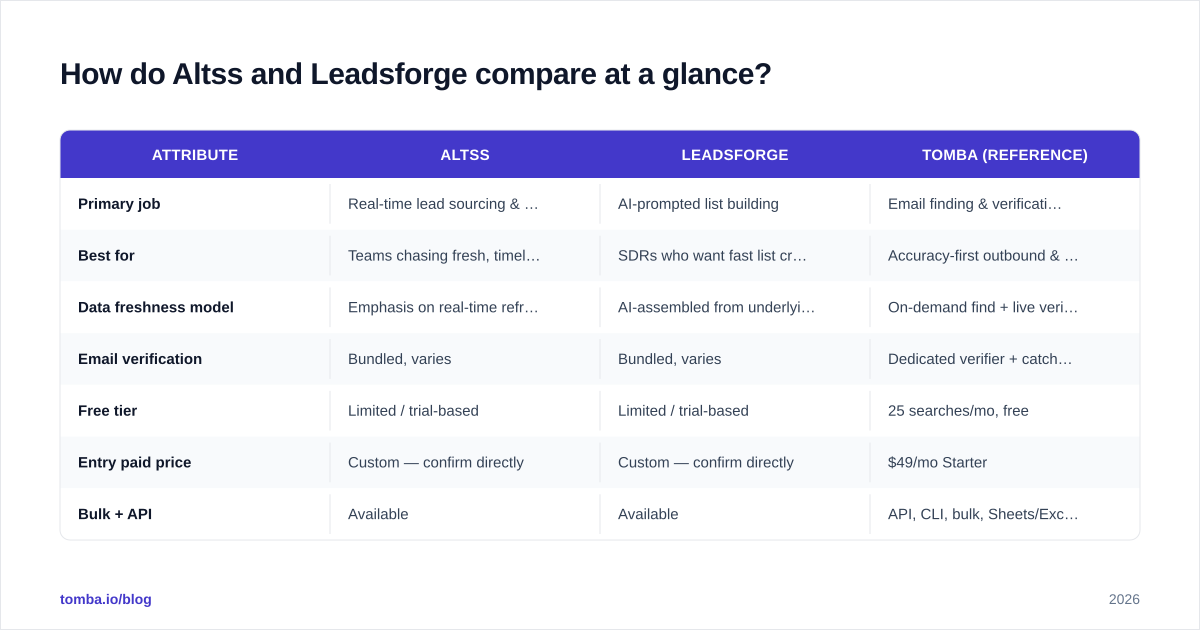
Here is the honest, attribute-by-attribute view. Treat pricing rows as directional. List-builder vendors change credit math often, so confirm a live quote before you commit. Tomba's numbers are exact and current.
| Attribute | Altss | Leadsforge | Tomba (reference) |
|---|---|---|---|
| Primary job | Real-time lead sourcing & signals | AI-prompted list building | Email finding & verification |
| Best for | Teams chasing fresh, timely accounts | SDRs who want fast list creation | Accuracy-first outbound & enrichment |
| Data freshness model | Emphasis on real-time refresh | AI-assembled from underlying sources | On-demand find + live verify |
| Email verification | Bundled, varies | Bundled, varies | Dedicated verifier + catch-all check |
| Free tier | Limited / trial-based | Limited / trial-based | 25 searches/mo, free |
| Entry paid price | Custom — confirm directly | Custom — confirm directly | $49/mo Starter |
| Bulk + API | Available | Available | API, CLI, bulk, Sheets/Excel |
| Transparency | Quote-driven | Quote-driven | Public pricing |
A few things stand out. Both Altss and Leadsforge lean toward quote-driven or credit-bundled pricing. That makes apples-to-apples budgeting hard until you are on a sales call. A tool with public Tomba pricing is easier to model against a target cost-per-lead. That matters when finance asks you to defend the line item.
Read independent reviews before you trust any vendor's own benchmark. G2 and Capterra both carry category listings. You can filter by company size and read unedited complaints. That is usually the fastest way to spot a data-quality or billing pattern the marketing page won't mention.
Is Altss better than Leadsforge for data freshness?#
For pure freshness, Altss has the stronger story. That is the lane it markets into. Say your motion depends on reaching people right after a trigger event — a funding round, a leadership hire, a tech-stack change. A tool built around real-time signals fits that better than one that assembles lists from a prompt.
But "fresh at the source" and "deliverable at send time" are two different guarantees. Buyers conflate them constantly.
A contact record can be sourced this morning and still bounce by afternoon. The mailbox may be a catch-all. The address may be a role account. The company may have just migrated domains. Freshness reduces staleness risk. It does not eliminate verification risk. This is why a standalone email verifier earns its place next to a "real-time" tool. It checks the address at the moment you use it, not the moment it was scraped.
So the fair verdict: Altss likely wins the freshness sub-debate on intent and architecture. Whether that becomes better campaigns depends on one thing. Do you bolt verification onto the end of the pipeline? Skip that step and you have simply paid more to bounce faster.
Is Leadsforge easier to use than Altss?#
Probably yes. And that is genuinely valuable, so don't dismiss it.
Leadsforge's natural-language list building lowers the floor for new SDRs. A rep types what they want and gets a starting list in minutes. There is no filter syntax or Boolean account list to learn. For a small team without a RevOps function, that speed-to-first-list is a real edge in the first 30 days.
The tradeoff is control. Prompt-driven generation is convenient until you need to be precise. Think excluding existing customers, deduping against your CRM, or enforcing a strict seniority band. The more exacting your targeting, the more the convenience layer gets in your way. You end up negotiating with an interpreter instead of setting hard filters.
Here's a practical way to decide:
| Your situation | Lean toward |
|---|---|
| New SDR team, need lists today | Leadsforge's prompt-first flow |
| Trigger-based, timing-sensitive outreach | Altss's real-time angle |
| High deliverability bar, owned data hygiene | Add a dedicated finder + verifier |
| Tight, defensible budget | A tool with transparent pricing |
Notice the bottom two rows are not really Altss-or-Leadsforge questions. They are stack questions. That is the point most "X vs Y" posts miss.
Where does an email finder fit alongside these tools?#
Right at the conversion-critical seam: between "I found a company" and "I sent a message that landed."
Discovery tools are excellent at telling you which accounts and roles to pursue. They are less consistent at the unglamorous part. That part is returning one correct, deliverable address for a named person at a named domain. Then proving it before you hit send. That is the job a dedicated email finder is built for.
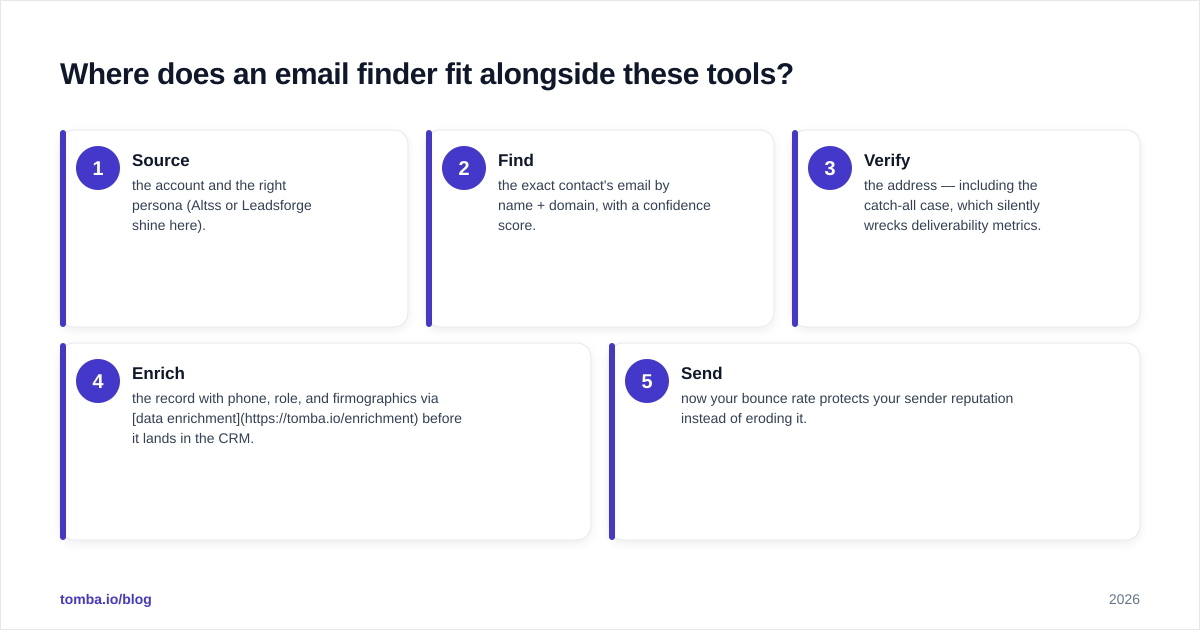
A typical resilient pipeline looks like this:
- Source the account and the right persona. Altss or Leadsforge shine here.
- Find the exact contact's email by name and domain, with a confidence score.
- Verify the address, including the catch-all case that silently wrecks deliverability.
- Enrich the record with phone, role, and firmographics via data enrichment before it hits the CRM.
- Send. Now your bounce rate protects your sender reputation instead of eroding it.
If you work at volume, the same logic runs through a bulk email finder. You verify thousands of rows without hand-checking each one. The principle doesn't change with scale. It gets more important, because one bad batch can land your domain on a blocklist.
This is also why "which is better, Altss or Leadsforge" is slightly the wrong question. For the discovery layer, pick the one whose model matches your motion. For the accuracy layer, neither generalist list-builder is your last line of defense. That is a job for a specialist.
What about pricing and total cost?#
Budget realistically, not optimistically.
Both Altss and Leadsforge tend to gate their real numbers behind a quote or a credit bundle. That is not inherently bad. But it makes cost-per-verified-lead hard to forecast. And cost-per-verified-lead is the only number that matters, because raw records you can't reach are worth zero.
Watch for three cost traps common to this category:
- Credit burn on bad data. If a tool charges per record and many of those records bounce, your real cost-per-usable-lead is higher than the sticker rate suggests.
- Seat minimums. Some platforms price per seat with annual minimums. Those don't flex down for a 2-person team.
- Verification billed separately. "Find" and "verify" are sometimes metered on their own, so the headline price is half the bill.
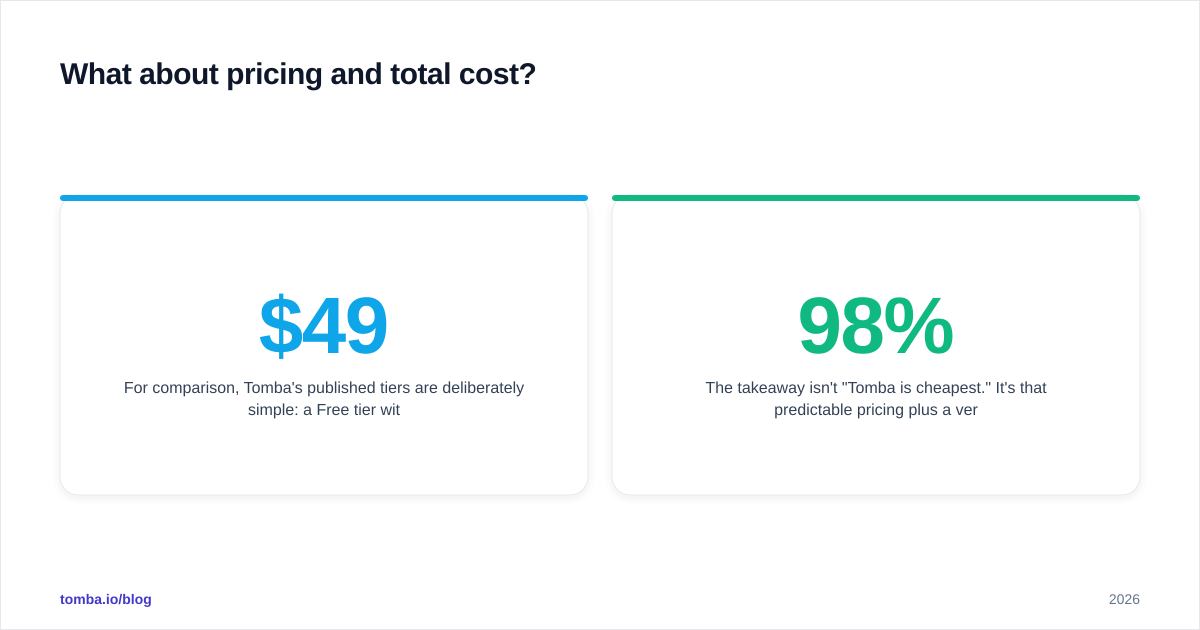
For comparison, Tomba's published tiers are simple. A Free tier gives 25 searches per month. Then Starter at $49/mo, Growth at $99/mo, Pro at $249/mo, and custom Enterprise. You can model that against a campaign size on a napkin. No sales call required. (And no, it is not $39 — the entry paid tier is $49/mo.)
The takeaway isn't "Tomba is cheapest." It's that predictable pricing plus a verification layer changes the unit economics of the whole motion. A slightly higher list cost with a 98% deliverability rate beats a cheap list that bounces a fifth of the time and drags your domain reputation down.
Which should you choose: Altss, Leadsforge, or a hybrid stack?#
Conclusion first: most teams should run a hybrid. Then choose the discovery tool by motion.
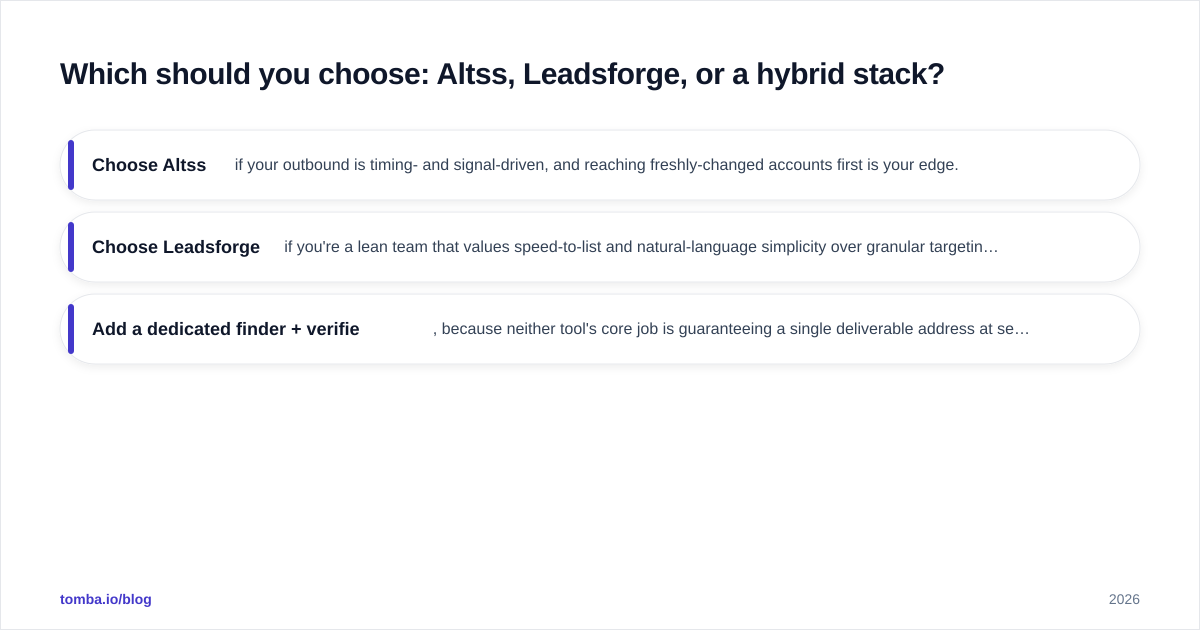
- Choose Altss if your outbound is timing- and signal-driven, and reaching freshly-changed accounts first is your edge.
- Choose Leadsforge if you're a lean team that values speed-to-list and natural-language simplicity over granular control.
- Add a dedicated finder and verifier either way. Neither tool's core job is guaranteeing a single deliverable address at send time. That guarantee protects your reputation and your reply rate.
Here's the mental model. Discovery tools answer who and when. A finder-and-verifier answers what address, and is it safe to send. Buy only the first half and hope the contact fields are clean, and you get great targeting with terrible deliverability. The two failures cancel out, and you can't tell which half is broken.
Run a 100-lead pilot through whichever discovery tool you favor. Then push the same list through an independent verifier. The bounce delta will tell you, in one afternoon, how much you've been overpaying in wasted sends.
The bottom line#
The Altss vs Leadsforge choice comes down to how you find who to contact. Altss bets on freshness, Leadsforge on ease. Neither is built to be the precision layer that returns and validates the exact address you'll email. That gap is predictable, and it's fixable.
Close it with the Tomba Email Finder. Find professional emails by name, domain, or company. Score every result by confidence. Verify deliverability — including catch-all domains — before a single message leaves your outbox. Pair it with whichever discovery tool fits your motion. Start free with 25 searches a month, and scale on transparent pricing when the pipeline proves out. Your reply rate and your sender reputation will both thank you.
// get started
Find, verify and enrich your first contacts today
Start on the free plan with 25 searches a month, then scale when your team is ready.
Free plan · No credit card required · GDPR & CCPA
// about the author