Altss vs Leadzenai 2026: Which Lead Data Tool Wins?
Altss and Leadzen.ai both promise fresh B2B contact data, but they win on very different fronts. Here's a side-by-side breakdown of accuracy, pricing, coverage, and the best fit for your outbound team in 2026.
TL;DR
- Altss leans on real-time, signal-driven contact discovery — it pulls fresher data the moment you search, which suits founders and small teams chasing hard-to-find decision-makers.
- Leadzen.ai is a broader lead-generation suite with a large prospect database, intent filters, and bulk list-building aimed at higher-volume outbound teams.
- Neither publishes transparent self-serve pricing the way mainstream finders do, so budgeting requires a sales call — a real friction point for solo operators.
- For raw email accuracy and predictable per-search cost, a dedicated email finder like Tomba often beats both on price-per-valid-contact.
- Pick Altss for niche, fresh, account-level discovery; pick Leadzen.ai for volume and Indian-market coverage; pick a verification-first tool when deliverability is the priority.
If you are comparing Altss vs Leadzenai to decide where your prospecting budget goes in 2026, the honest answer is that they solve overlapping problems with different philosophies. This guide breaks down what each does well, where each falls short, and how to tell which one fits your motion — without the marketing gloss.
What are Altss and Leadzen.ai?#
Altss positions itself as a real-time B2B contact intelligence tool. Instead of serving you a static database row that may be 18 months stale, it emphasizes fetching and assembling contact details closer to query time, with a focus on reaching decision-makers that broad databases miss. That makes it attractive for niche prospecting — think specialized B2B services, recruiting, or founder-led sales into hard-to-reach titles.
Leadzen.ai is a wider lead-generation platform. It combines a large contact and company database with search filters, intent signals, and bulk extraction. It has notable traction in the Indian market and markets itself to sales and marketing teams that want to build lists at scale, enrich them, and push them into outreach. It is less a surgical finder and more a prospecting workbench.
The core distinction: Altss optimizes for freshness and reach on individual lookups, Leadzen.ai optimizes for breadth and volume across list-building. Knowing which problem you actually have is most of the decision.
How do Altss and Leadzen.ai compare at a glance?#
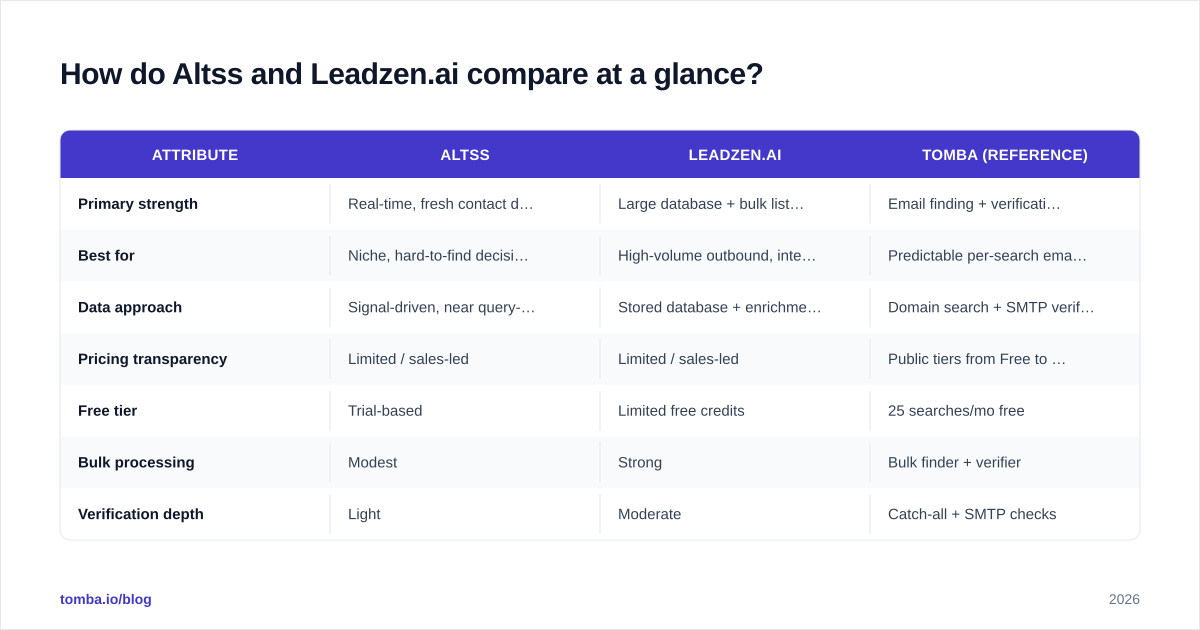
| Attribute | Altss | Leadzen.ai | Tomba (reference) |
|---|---|---|---|
| Primary strength | Real-time, fresh contact discovery | Large database + bulk list-building | Email finding + verification accuracy |
| Best for | Niche, hard-to-find decision-makers | High-volume outbound, intent filtering | Predictable per-search email accuracy |
| Data approach | Signal-driven, near query-time | Stored database + enrichment | Domain search + SMTP verification |
| Pricing transparency | Limited / sales-led | Limited / sales-led | Public tiers from Free to $249/mo |
| Free tier | Trial-based | Limited free credits | 25 searches/mo free |
| Bulk processing | Modest | Strong | Bulk finder + verifier |
| Verification depth | Light | Moderate | Catch-all + SMTP checks |
| Geographic sweet spot | US/EU niche titles | India + global | Global |
Treat the rows above as directional. Both vendors iterate quickly and gate exact numbers behind demos, so always confirm current limits during a trial rather than trusting any comparison table — including this one.
Which tool has better data accuracy?#
Accuracy is where the Altss vs Leadzenai debate gets interesting, because the two tools fail and succeed in opposite directions.
Altss's real-time angle means it tends to surface fewer but fresher records. When it returns a contact, the email is more likely to still be live because it was assembled recently rather than pulled from a months-old crawl. The trade-off is coverage: ask it for 5,000 contacts in a broad ICP and you may get thinner results than a big database delivers.
Leadzen.ai inverts that. Its large stored database returns high volume, but any database-first model carries decay — people change jobs, domains migrate, and roughly 2-3% of B2B contacts go stale every month. Without aggressive re-verification, a chunk of any bulk export will bounce.

This is the single biggest reason to separate finding from verifying. No matter which tool sources the contact, running the output through an email verifier before you send protects your sender reputation. A fresh-but-unverified email and a bulk-but-unverified email both bounce the same way — and bounces are what trigger spam folder placement. If you want to understand the downstream cost, our primer on email deliverability explains how bounce rate feeds directly into inbox placement.
)
How does pricing compare for Altss vs Leadzenai?#
Here is the blunt truth: neither Altss nor Leadzen.ai makes self-serve pricing easy to find, and both lean toward demo-led sales motions. That is fine for a funded team with a procurement process, but painful for a solo founder who just wants to buy 1,000 credits today and start sending.
When pricing is opaque, you pay in two hidden ways: the time spent on sales calls, and the difficulty of forecasting cost-per-valid-lead. A tool that charges a clear amount per search lets you calculate unit economics before you commit. A tool that quotes "custom" forces you to negotiate blind.
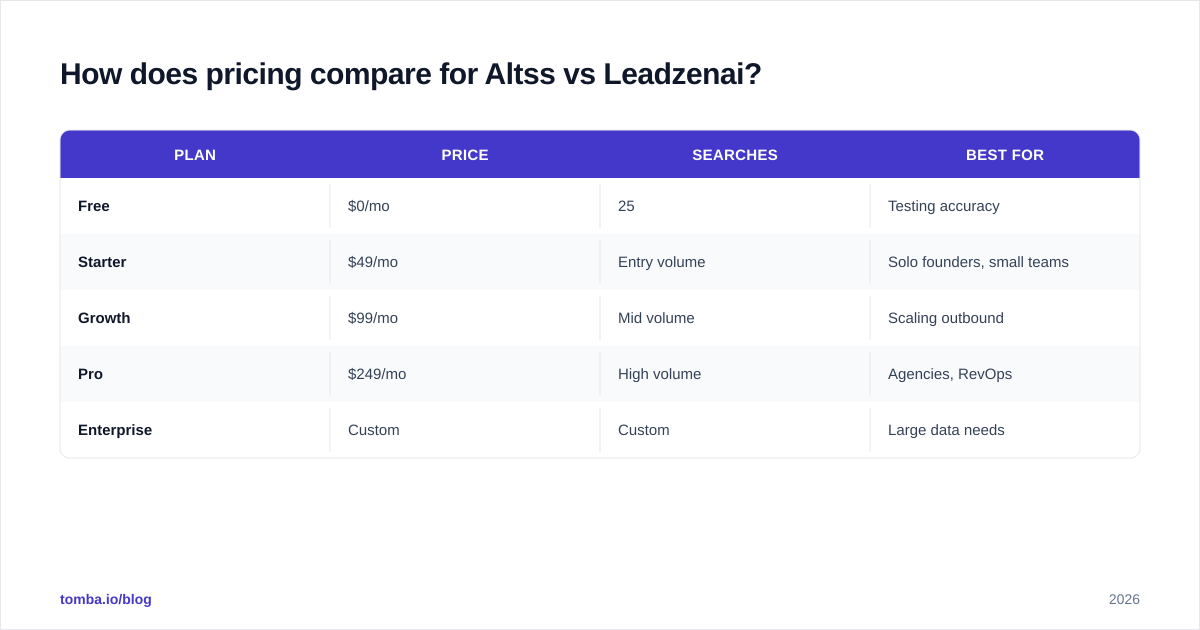
For reference, transparent finders publish their tiers. Tomba, for example, lists Tomba pricing openly:
| Plan | Price | Searches | Best for |
|---|---|---|---|
| Free | $0/mo | 25 | Testing accuracy |
| Starter | $49/mo | Entry volume | Solo founders, small teams |
| Growth | $99/mo | Mid volume | Scaling outbound |
| Pro | $249/mo | High volume | Agencies, RevOps |
| Enterprise | Custom | Custom | Large data needs |
The point is not that Tomba is automatically cheaper for every use case — it is that you can see the number and model your CAC against it. With Altss and Leadzen.ai, you typically cannot until you talk to sales. Build that friction into your evaluation timeline.
Which is better for compliance and data sourcing?#
If you sell into the EU, UK, or California, sourcing matters as much as accuracy. Real-time tools like Altss can reduce some retention risk because they assemble data closer to query time rather than warehousing massive stale profiles — but the assembly method itself still has to respect lawful-basis rules under GDPR and CCPA.
Leadzen.ai's database model means you should ask pointed questions about where the contacts originate and how opt-out requests propagate. Any vendor selling B2B contact data should be able to answer, in writing, how a person gets removed and how quickly. If they dodge, that is your answer.
Whatever you choose, document your own lawful basis for outreach. A useful neutral reference is the GDPR overview on Wikipedia, and most reputable vendors publish a data-processing addendum you should read before signing. For a deeper view of how sourcing affects quality, see how Tomba documents its data sources.
Who should choose Altss?#
Choose Altss if:
- You prospect into niche or senior titles that broad databases consistently miss.
- Freshness beats volume for you — you would rather have 50 live contacts than 5,000 half-stale ones.
- You run founder-led or low-volume, high-value outbound where each contact matters.
- You are comfortable with a demo-led purchase and do not need to self-serve at midnight.
Altss is a scalpel. If your motion is precision over scale, its real-time approach is a genuine differentiator, and the lighter coverage becomes a feature rather than a bug.
Who should choose Leadzen.ai?#
Choose Leadzen.ai if:
- You build large lists and run higher-volume outbound campaigns.
- Intent signals and filterable search are core to how you segment.
- You sell into India or want strong coverage in that market.
- You have the team to verify and clean bulk exports before sending.
Leadzen.ai is a workbench. It rewards teams that already have a verification and outreach process bolted on, because raw volume without cleanup is a deliverability liability.
)
What's the smarter alternative for email accuracy?#
Here is the angle most comparison posts skip: for many teams, the Altss vs Leadzenai question is the wrong question. If your real goal is reaching people by email rather than browsing an intelligence platform, a dedicated finder-plus-verifier stack often wins on both cost and deliverability.
A purpose-built workflow looks like this:
- Find the address with a domain search or name-based lookup.
- Verify every result with SMTP and catch-all checks before it enters your sequence.
- Enrich the confirmed contact with role, company, and phone data only where needed.
This separation keeps your bounce rate low, which is the metric that actually governs whether your cold email lands in the inbox. Tools that bundle finding and intelligence into one opaque subscription often under-invest in the verification step — and verification is what protects sender reputation. Independent review sites like G2 are a good place to cross-check real-user feedback on any of these vendors before you commit budget.
For teams that send at scale, a bulk email finder that returns verified results in one pass removes an entire manual cleanup stage. That is usually a bigger lever on reply rate than choosing between two intelligence platforms.
How should you actually decide?#
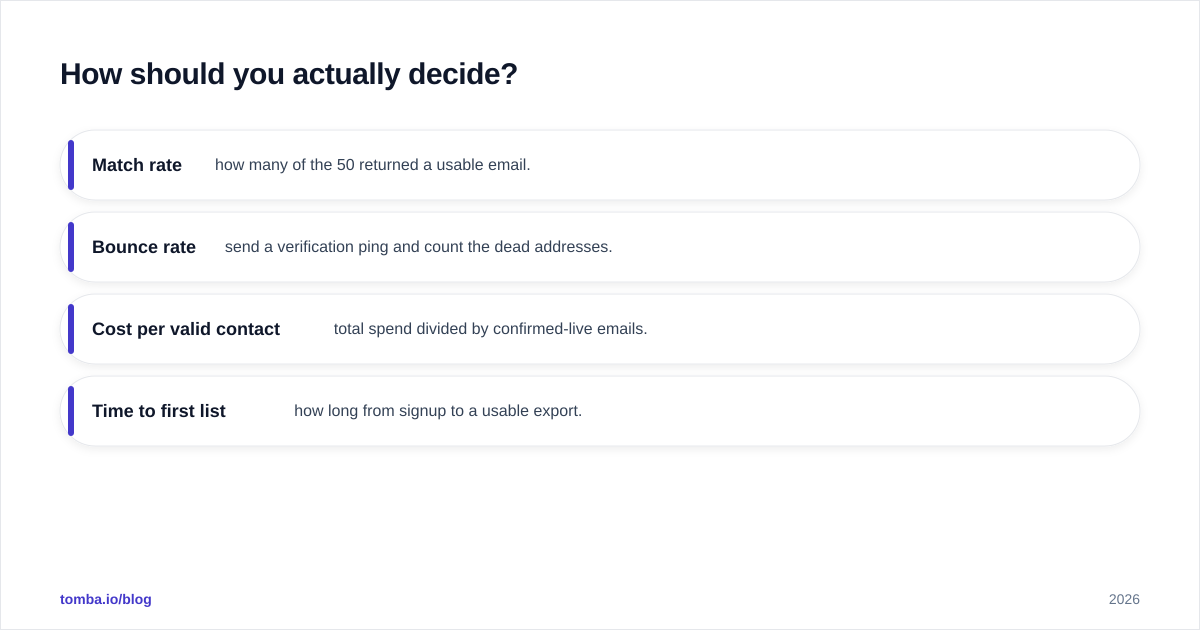
Run a 50-contact bake-off. Pick one well-defined ICP segment, pull the same 50 target accounts through Altss, Leadzen.ai, and a verification-first finder, then measure four things:
- Match rate — how many of the 50 returned a usable email.
- Bounce rate — send a verification ping and count the dead addresses.
- Cost per valid contact — total spend divided by confirmed-live emails.
- Time to first list — how long from signup to a usable export.
The tool that wins your bake-off on cost-per-valid-contact is the one to scale. Marketing claims and feature checklists do not survive contact with your real ICP — your own 50-row test will tell you more than any blog post, including this one.
The bottom line#
Altss and Leadzen.ai are both credible, but they are built for different teams. Altss rewards precision and freshness for niche, founder-led prospecting. Leadzen.ai rewards volume, intent filtering, and teams with a cleanup process already in place. Both trade away pricing transparency, so budget extra evaluation time.
If your priority is accurate emails at a predictable price with verification built in, skip the either/or framing and run a finder-first stack. Start free with the Tomba Email Finder — 25 searches a month, public pricing from $49/mo, and SMTP-level verification on every result — then put it head-to-head against Altss and Leadzen.ai in your own 50-contact bake-off. Let your bounce rate, not a sales deck, make the call.
// get started
Find, verify and enrich your first contacts today
Start on the free plan with 25 searches a month, then scale when your team is ready.
Free plan · No credit card required · GDPR & CCPA
// about the author