Altss vs Seamless.AI 2026: Which B2B Data Tool Wins?
Altss vs Seamless.AI compared on data accuracy, pricing, coverage, and workflow fit — plus where a focused email finder beats both for cold outbound in 2026.
Choosing between Altss and Seamless.AI comes down to one question most reviews skip: do you need a broad sales-intelligence database, or do you need accurate contact data you can actually email today? Both promise to fill your pipeline. They get there in very different ways, and the gap shows up the moment you load a list into your sequencer and watch the bounce rate.
This is a neutral, hands-on comparison of the two platforms in 2026 — data quality, pricing, coverage, compliance, and real workflow fit — plus an honest look at where a focused email-finding tool outperforms both.
TL;DR#
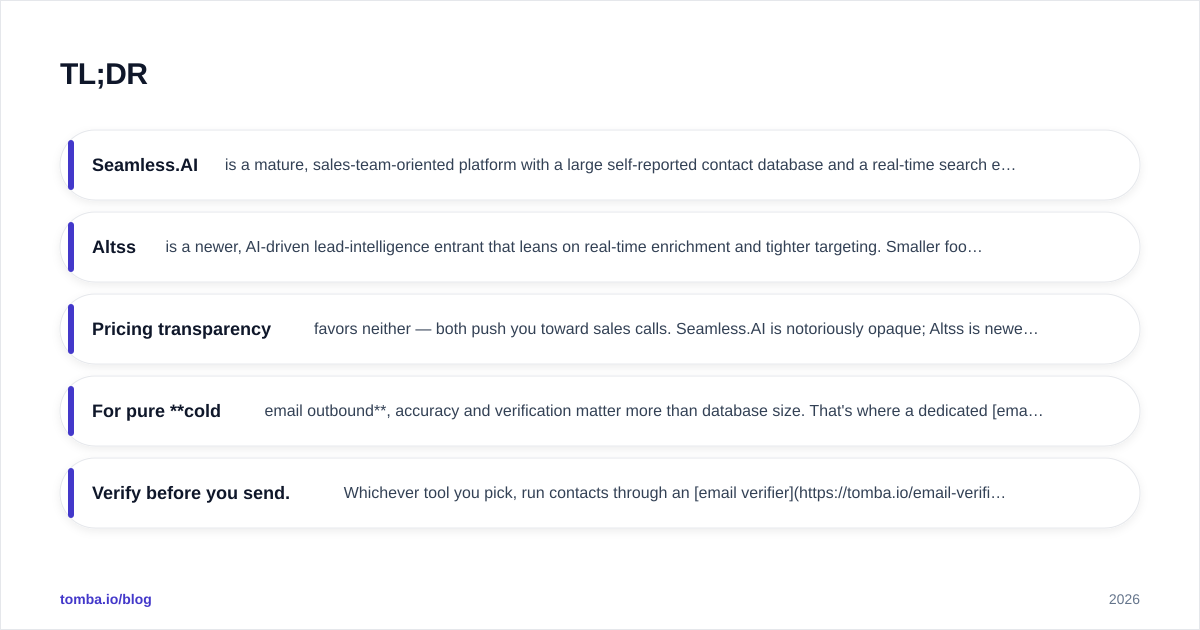
- Seamless.AI is a mature, sales-team-oriented platform with a large self-reported contact database and a real-time search engine. Its weak spot is well-documented: inconsistent accuracy and credit burn on bad records.
- Altss is a newer, AI-driven lead-intelligence entrant that leans on real-time enrichment and tighter targeting. Smaller footprint, less third-party validation, but promising on freshness.
- Pricing transparency favors neither — both push you toward sales calls. Seamless.AI is notoriously opaque; Altss is newer and still settling.
- For pure cold-email outbound, accuracy and verification matter more than database size. That's where a dedicated email finder like Tomba — Free tier, then $49/mo Starter — often beats a heavyweight platform.
- Verify before you send. Whichever tool you pick, run contacts through an email verifier to protect sender reputation.
What is Altss?#
Altss is a B2B lead-intelligence and prospecting platform positioned around AI-assisted targeting and real-time data enrichment. The pitch is freshness: instead of serving records from a static warehouse that decays every quarter, Altss emphasizes pulling and validating contact and company signals closer to the moment you search.
In practice that means Altss markets itself to founders, agencies, and lean outbound teams who want qualified contacts without the bloat — and the price tag — of a full revenue-intelligence suite. Because it's a newer name, there's less independent benchmarking on G2 and Capterra than you'll find for incumbents, so you should treat coverage and accuracy claims as "verify before you commit," not gospel.
What is Seamless.AI?#
Seamless.AI is an established sales-intelligence platform built around a search engine that assembles contact records — emails, direct dials, company data — in real time rather than serving only from a pre-built list. It's aimed squarely at sales teams and SDR floors that live in prospecting all day, and it integrates with the usual CRM and engagement stack.
Seamless.AI's strength is reach and familiarity: lots of seats sold, lots of integrations, and a search-as-you-go model that feels productive. Its recurring criticism, visible across public reviews, is data accuracy and credit economics — users report a meaningful share of emails that bounce or dials that miss, and credits get consumed whether or not the record was good. You can read the company's own positioning on seamless.ai, then weight it against third-party reviews.

Altss vs Seamless.AI: how do they compare?#
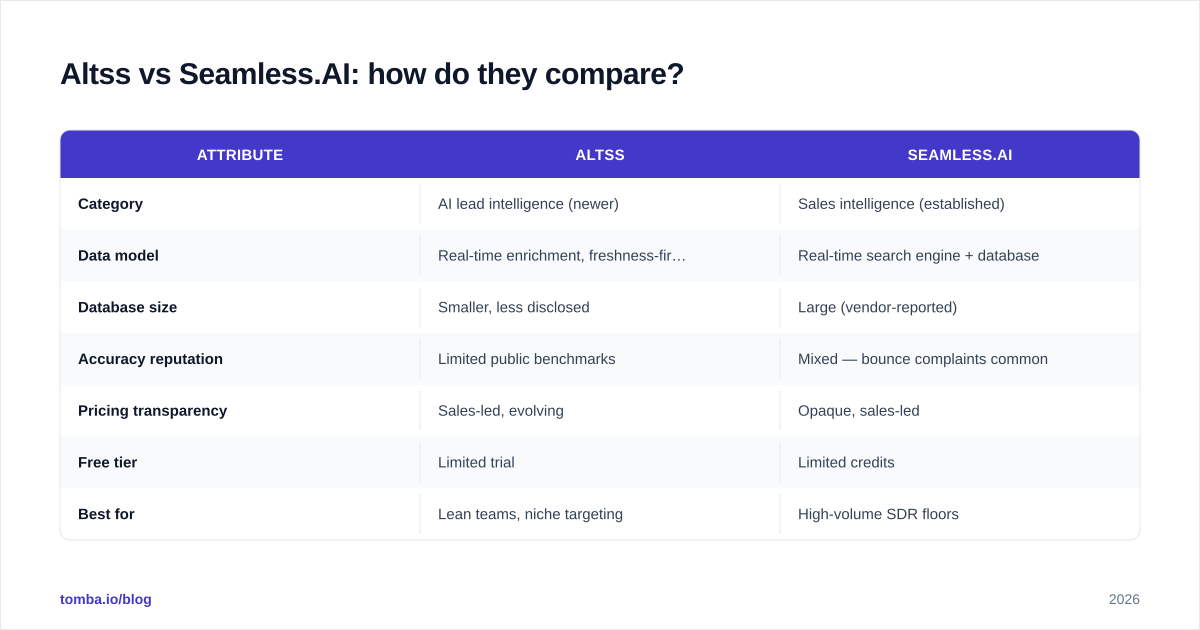
Here's the head-to-head on the attributes that actually change your results. Treat the database-size numbers as vendor-reported, not audited — that caveat is the whole point of this section.
| Attribute | Altss | Seamless.AI |
|---|---|---|
| Category | AI lead intelligence (newer) | Sales intelligence (established) |
| Data model | Real-time enrichment, freshness-first | Real-time search engine + database |
| Database size | Smaller, less disclosed | Large (vendor-reported) |
| Accuracy reputation | Limited public benchmarks | Mixed — bounce complaints common |
| Pricing transparency | Sales-led, evolving | Opaque, sales-led |
| Free tier | Limited trial | Limited credits |
| Best for | Lean teams, niche targeting | High-volume SDR floors |
| Email verification | Built-in claims | Built-in, accuracy disputed |
| Third-party validation | Thin (new entrant) | Extensive but polarized |
The pattern: Seamless.AI gives you scale and a known quantity with a known flaw. Altss gives you a fresher, more targeted approach with less of a track record. Neither removes the need to verify before you send.
Which has better data accuracy?#
Accuracy is the only metric that survives contact with your sequencer — and it's where both tools demand scrutiny.
Seamless.AI's accuracy is the platform's most-debated trait. Because records are assembled on the fly from multiple signals, quality varies by industry, seniority, and region. Niche or non-US contacts tend to be where the misses cluster. The credit model amplifies the pain: a wrong email still costs you.
Altss leans on freshness as its accuracy story, which is sound in theory — a recently validated record beats a two-year-old warehouse entry. The catch is sample size. Without a deep bench of independent reviews, you're trusting the vendor's word, so a paid pilot on your actual ICP is non-negotiable before you scale spend.
The hard truth for both: no provider is a substitute for verification. Even a high-quality finder should feed a catch-all verifier and standard validation step. A 5% bounce rate quietly wrecks deliverability; running every list through an email verifier keeps you under the threshold that triggers spam filtering.
)
How do Altss and Seamless.AI price?#
Both lean sales-led, which is the polite way of saying you'll book a demo before you see real numbers.
- Seamless.AI uses a credit-based model with tiers that are famously hard to compare apples-to-apples. Public complaints center on auto-renewal terms and credits expiring or burning on bad data. Get pricing in writing and confirm rollover rules before signing.
- Altss, as a newer entrant, is still shaping its packaging. Expect tiered plans with enrichment caps and a limited trial. Because it's young, pricing may shift — lock your terms in the contract.
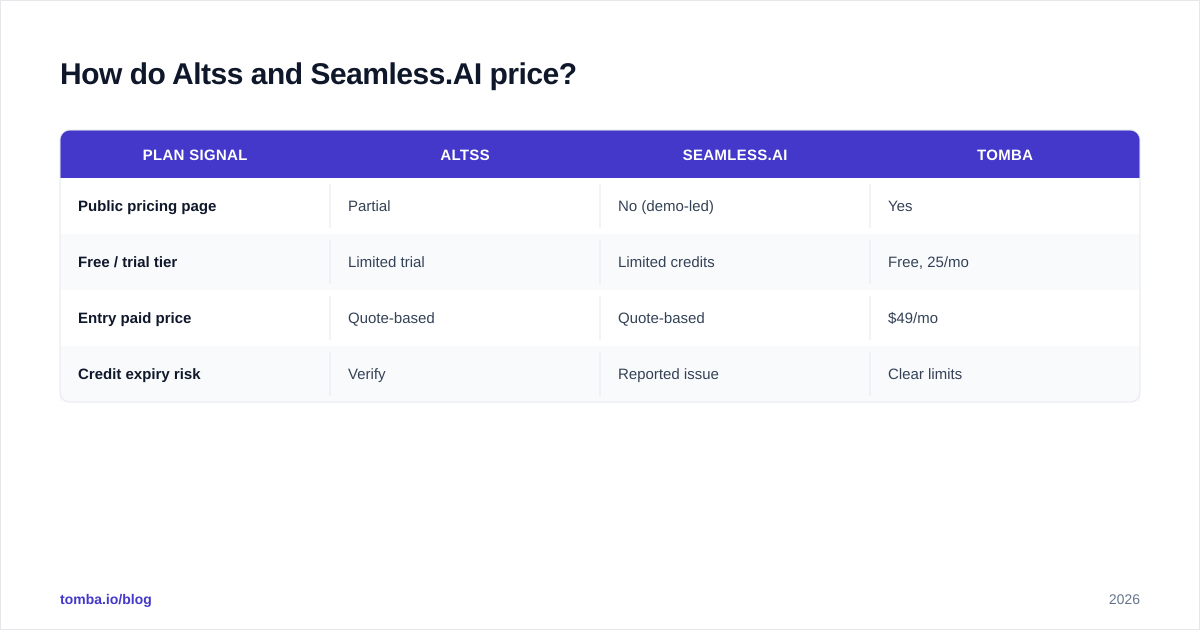
If transparent, published pricing matters to you, that's a point in favor of tools that list it openly. For reference, Tomba's pricing is public: Free (25 searches/mo), Starter $49/mo, Growth $99/mo, Pro $249/mo, Enterprise custom — no demo required to see the number.
| Plan signal | Altss | Seamless.AI | Tomba |
|---|---|---|---|
| Public pricing page | Partial | No (demo-led) | Yes |
| Free / trial tier | Limited trial | Limited credits | Free, 25/mo |
| Entry paid price | Quote-based | Quote-based | $49/mo |
| Credit expiry risk | Verify | Reported issue | Clear limits |
Which fits your workflow better?#
Match the tool to how your team actually prospects.
Pick Seamless.AI if you run a high-volume SDR floor, you're already bought into its integrations, and your team is disciplined about verifying before sending. The scale is real; the accuracy tax is the cost of entry.
Pick Altss if you're a lean team or agency chasing a specific niche, you value freshness over raw volume, and you're willing to run a pilot to confirm coverage on your ICP before committing budget.
Pick a dedicated email finder if your core need is simply accurate, verified contact data for outbound — without paying for a sales-intelligence suite you'll use 20% of. For domain-based prospecting, find emails by domain gets you every reachable contact at a target company, then you verify and load. This is the lane where a focused tool's economics win.
)
What about compliance and data sourcing?#
GDPR and CCPA exposure scales with how you source and store contact data, and it's the part of the buying decision teams skip until legal asks.
Both Altss and Seamless.AI aggregate data from multiple sources, which means you should ask each vendor directly: where does the data originate, what's your lawful basis for processing, and how do you honor deletion requests? A vendor that can't answer cleanly is a liability, not a tool. Reputable providers publish a data-sourcing explainer — Tomba documents where its data comes from, and you should expect the same transparency from any platform you pay.
Compliance also intersects with deliverability. Sending to scraped, unverified addresses doesn't just risk a privacy complaint — it tanks email deliverability by inflating bounces and spam reports. Clean sourcing and verification are the same discipline viewed from two angles.
Is there a better alternative for cold outbound?#
For teams whose primary job is cold email, yes — and it's a category difference, not a brand preference.
Altss and Seamless.AI are both trying to be platforms: databases, intent signals, dashboards. If you need that, fine. But most outbound teams really need three things: find the right contact, confirm the email is real, and load it into a sequence without burning a week of ops time. A purpose-built finder does exactly that for a fraction of the cost and complexity.
Tomba sits in that lane. The email finder resolves contacts by name, domain, or company; the email verifier confirms deliverability before you send; and bulk lead generation handles list-scale work. You also get a published price, a real free tier, and an email finder API if you want to wire it into your own stack. No demo gate, no credit-expiry surprises.
That's not to say a finder replaces a full revenue-intelligence platform for every team — if you genuinely need intent data and a CRM-grade database, a heavyweight tool earns its keep. But for the specific job of accurate, verified outbound contacts, the focused tool usually wins on accuracy-per-dollar.
How should you decide?#
Run this sequence before you sign anything:
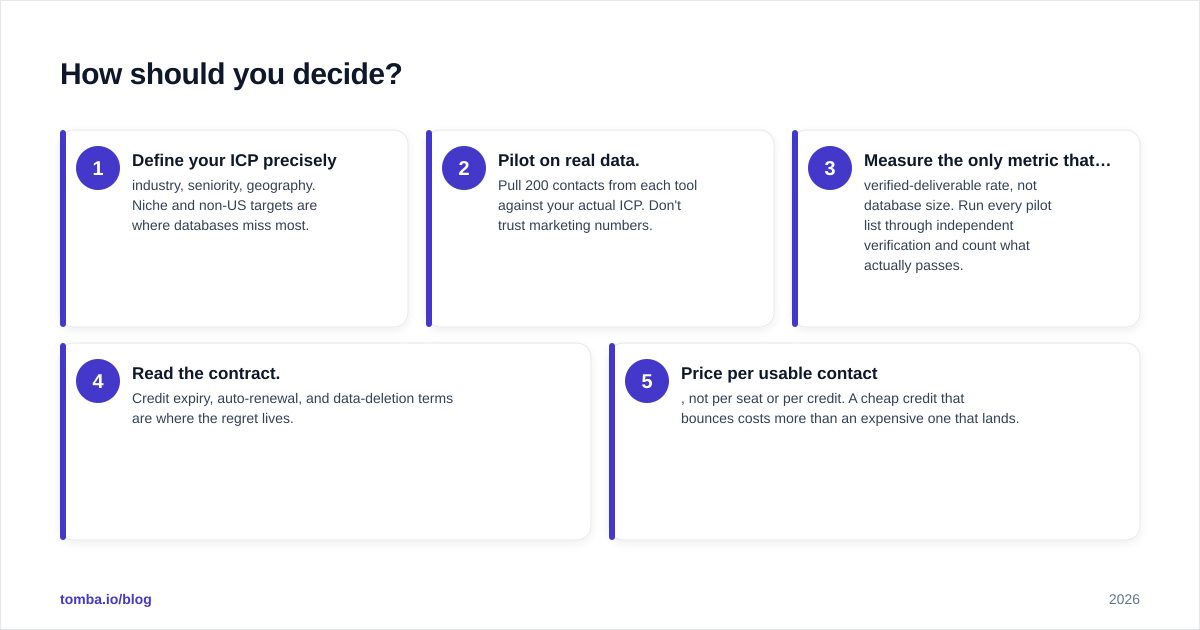
- Define your ICP precisely — industry, seniority, geography. Niche and non-US targets are where databases miss most.
- Pilot on real data. Pull 200 contacts from each tool against your actual ICP. Don't trust marketing numbers.
- Measure the only metric that matters: verified-deliverable rate, not database size. Run every pilot list through independent verification and count what actually passes.
- Read the contract. Credit expiry, auto-renewal, and data-deletion terms are where the regret lives.
- Price per usable contact, not per seat or per credit. A cheap credit that bounces costs more than an expensive one that lands.
Whichever platform wins your pilot, bolt a verification step onto it permanently. The tools differ; the discipline doesn't.
The bottom line#
Seamless.AI gives you scale and a known accuracy tax. Altss gives you a fresher, more targeted approach with a thinner track record. Both are sales-led on pricing, and both leave verification as your job. Pilot before you commit, and price by verified-deliverable contacts rather than by database brag-numbers.
If your real goal is accurate contacts for cold outbound — not a sprawling intelligence suite — start with the focused option. Try the Tomba Email Finder: find professional emails by domain, name, or company, verify them in the same workflow, and keep your bounce rate where deliverability stays healthy. The free tier costs nothing to test against your own ICP, which is exactly the pilot every buying decision on this page demands.
Ready to find emails that actually work?
Join 150,000+ professionals who stopped guessing and started sending. Free credits on signup — no credit card required.
Get the Tomba newsletter
Practical outbound tactics and product updates — once every two weeks.
About the author