Altss vs Smarte 2026: Which B2B Data Platform Wins?
Altss vs Smarte compared on data accuracy, coverage, pricing, and compliance for 2026 — plus where each fits in a modern outbound stack and when a leaner email finder beats both.
TL;DR
- Altss is an AI-native lead intelligence platform built around real-time signal discovery and enrichment, best for teams that want fresh, dynamically sourced contacts over a static list.
- Smarte (SMARTe) is an established B2B contact and account intelligence provider with strong international coverage and a compliance-first posture (GDPR/CCPA aligned), best for enterprise GTM teams that need governed data at scale.
- On accuracy, both lean on verification, but freshness models differ: Altss favors on-demand sourcing, Smarte favors a curated, continuously refreshed database.
- Pricing is quote-based for both, which makes them heavier commitments than a self-serve email finder.
- If you mostly need verified work emails fast and cheap, a focused tool like the Tomba Email Finder often beats either platform on speed and cost — and you can layer it on top of either one.
What are Altss and Smarte?#
Altss and Smarte solve the same core problem — getting accurate contact and company data into your pipeline — but they approach it from opposite ends.
Altss positions itself as an AI-driven lead intelligence tool. Instead of treating data as a fixed warehouse you query, it leans toward sourcing and enriching contacts dynamically, using AI to assemble profiles, surface intent signals, and keep records current. The pitch is freshness: you get contacts that reflect the present, not a snapshot from the last database refresh.
Smarte (SMARTe) is a more traditional — and more mature — B2B contact and account intelligence platform. It maintains a large, curated database of professional emails and direct-dial phone numbers, with a strong emphasis on global coverage (notably EMEA and APAC, where many U.S.-centric providers thin out) and on compliance. SMARTe markets itself heavily on being privacy-aware and aligned with regulations like GDPR.
Think of it like groceries. Altss is the chef who shops the market the morning you order — fresh, made-to-spec, but you wait and pay for the labor. Smarte is the well-stocked supermarket — vast, consistent, governed by safety standards, but the inventory is what's on the shelf today.
Neither approach is universally "better." The right pick depends on whether your bottleneck is freshness and signal (Altss) or scale, coverage, and governance (Smarte).
)
How do Altss and Smarte compare on data accuracy?#
Accuracy is the only metric that matters if the data drives outbound, because every bad record costs you deliverability, rep time, and sender reputation.
Both platforms verify contacts, but their failure modes differ:
- Altss reduces staleness risk by sourcing closer to the moment of use. The trade-off is variability — AI-assembled profiles can be excellent or thin depending on how much public signal exists for a given person or company.
- Smarte reduces gap risk with a deep, continuously maintained database. The trade-off is that any database, however well-curated, decays between refresh cycles — people change jobs roughly every two to three years, so even a "verified" email can quietly go stale.
The honest reality: no contact-data vendor is 100% accurate, and published accuracy numbers are notoriously hard to compare because everyone measures differently. The only reliable test is to run a sample of your ideal accounts through each tool and verify the output yourself with an independent email verifier before you trust the marketing claims.

That verification step is non-negotiable regardless of which platform you choose. A catch-all domain, a role-based inbox (info@, sales@), or a recently departed employee will all pass a surface-level check but bounce in production. Pair any data source with verification and you protect your sender reputation no matter where the record came from.
Altss vs Smarte: side-by-side comparison#
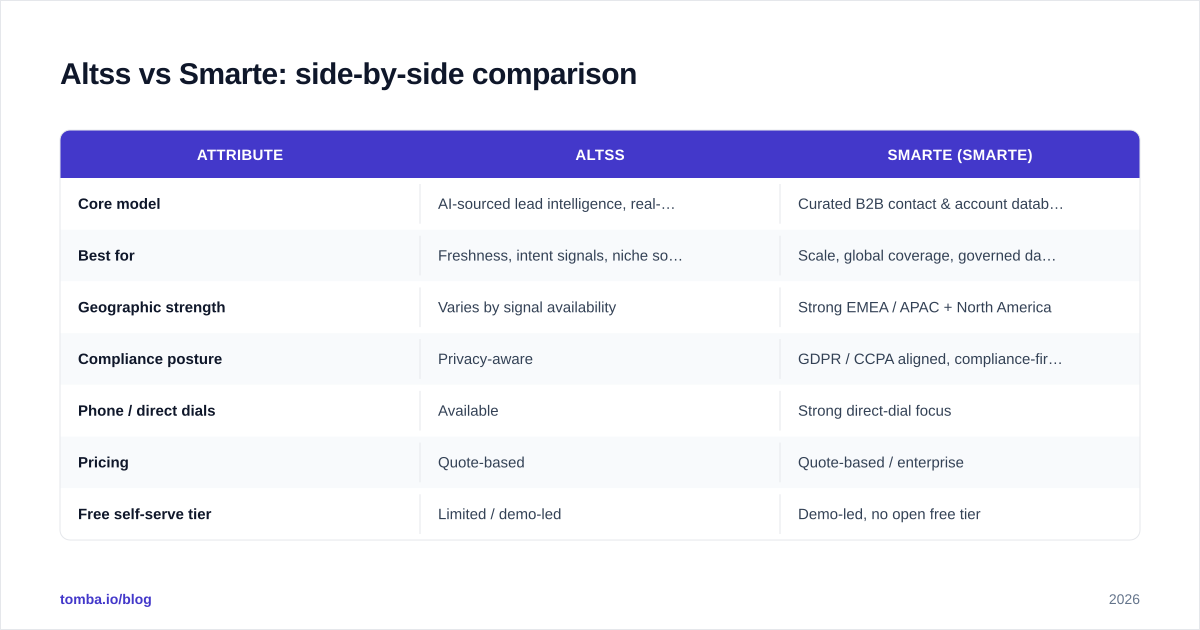
Here's how the two stack up across the attributes buyers actually evaluate. Treat quote-based pricing as directional — both vendors tailor deals to seat count and data volume.
| Attribute | Altss | Smarte (SMARTe) |
|---|---|---|
| Core model | AI-sourced lead intelligence, real-time enrichment | Curated B2B contact & account database |
| Best for | Freshness, intent signals, niche sourcing | Scale, global coverage, governed data |
| Geographic strength | Varies by signal availability | Strong EMEA / APAC + North America |
| Compliance posture | Privacy-aware | GDPR / CCPA aligned, compliance-first |
| Phone / direct dials | Available | Strong direct-dial focus |
| Pricing | Quote-based | Quote-based / enterprise |
| Free self-serve tier | Limited / demo-led | Demo-led, no open free tier |
| Ideal team size | SMB to mid-market | Mid-market to enterprise |

A few takeaways from the table:
- Smarte skews enterprise. If you need governed data, audit trails, and coverage across multiple continents, it's the safer institutional choice.
- Altss skews agile. If you're a smaller team chasing fresh contacts in fast-moving niches, the AI-sourcing model can surface people a static database misses.
- Both are demo-led. Neither lets you swipe a card and start in five minutes, which matters if you want to test before committing budget. Cross-check current ratings on G2 and Capterra before booking either demo — user reviews expose coverage gaps the sales deck won't.
How does pricing compare?#
Both Altss and Smarte use quote-based pricing, which is standard for data platforms targeting sales teams but creates two practical problems for buyers.
First, you can't easily benchmark cost-per-verified-contact without going through sales. That makes apples-to-apples comparison hard, and it slows down procurement.
Second, the floor is usually higher than self-serve tools. Enterprise data contracts often start in the thousands per year and bundle seats, credits, and platform fees. That's reasonable if you're staffing a full SDR team, but it's overkill if one or two people just need verified emails for targeted outreach.
This is exactly where a transparent, self-serve alternative changes the math. For reference, Tomba pricing is published openly: a free tier with 25 searches per month, Starter at $49/mo, Growth at $99/mo, Pro at $249/mo, and custom Enterprise. You know the number before you talk to anyone — and you can scale spend with usage instead of signing an annual floor.
)
The point isn't that cheaper is always better. It's that you should match the contract to the job. Paying enterprise data prices for entry-level email-finding volume is a common, expensive mistake.
Which platform should you choose?#
Map the decision to your actual constraint rather than the feature list.
Choose Altss if:
- Your market moves fast and last quarter's database is already stale.
- You value intent and signal discovery over raw record count.
- You're a smaller, nimble team that wants AI to do the sourcing legwork.
- You're sourcing in niches where conventional databases are thin.
Choose Smarte if:
- You sell internationally and need reliable EMEA/APAC coverage.
- Compliance and data governance are hard requirements (regulated industries, EU customers).
- You need direct-dial phone numbers alongside emails for a multi-channel motion.
- You're an enterprise GTM org that can absorb an annual contract and wants one governed source of truth.
Choose a focused email finder if:
- Your primary need is verified work emails, fast, at a predictable cost.
- You want to start today without a sales call.
- You'd rather pay for usage than seats.
These aren't mutually exclusive. Plenty of teams run an enterprise platform for account intelligence and a lightweight finder for ad-hoc, high-intent lookups. Layering is often cheaper and more accurate than forcing one tool to do everything.
Where does Tomba fit alongside Altss and Smarte?#
Tomba isn't trying to replace a full account-intelligence suite — it's the precision instrument in the stack.
The core use case is simple: you know the person and company, you need the verified email, and you need it now. The email finder returns professional addresses by name and domain, and every result can be confirmed with built-in verification before it touches your sequence. For broader fill, the Tomba data enrichment and B2B database layers add firmographic and contact detail to records you already have.
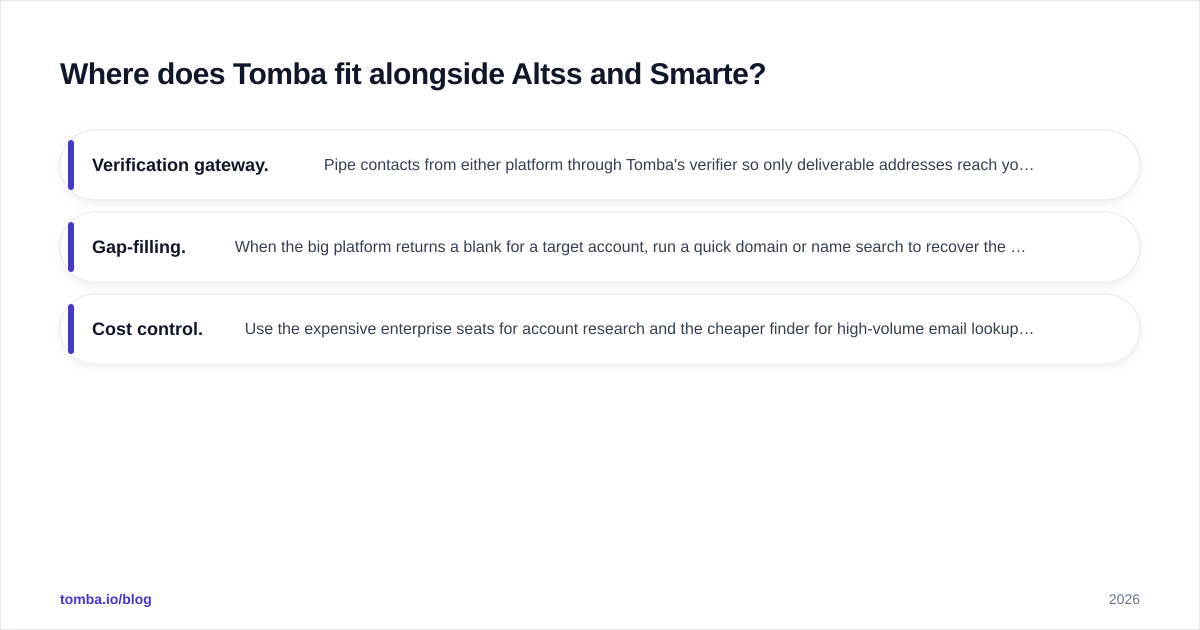
Three patterns where Tomba complements — rather than competes with — Altss or Smarte:
- Verification gateway. Pipe contacts from either platform through Tomba's verifier so only deliverable addresses reach your ESP. This protects sender reputation regardless of source.
- Gap-filling. When the big platform returns a blank for a target account, run a quick domain or name search to recover the contact instead of skipping the lead.
- Cost control. Use the expensive enterprise seats for account research and the cheaper finder for high-volume email lookups, so you're not burning premium credits on routine tasks.
The principle behind all three: the source of a contact and the verification of a contact are two different jobs. Mature outbound teams separate them. Whichever platform you pick for sourcing, an independent verification layer is what keeps your bounce rate low and your domain out of the spam folder.
Frequently asked questions#
Is Altss or Smarte more accurate? Neither has a decisive, independently verified edge — accuracy depends heavily on your target geography and industry. Altss optimizes for freshness via on-demand sourcing; Smarte optimizes for coverage via a curated database. Run a sample of your real accounts through both and verify the output yourself before deciding.
Does either offer a free trial? Both are demo-led and quote-based rather than open self-serve, so expect to talk to sales before you see pricing or test volume. If you want to start immediately without that step, a self-serve finder with a free tier is the faster path.
Can I use them together? Yes. A common stack uses one platform for account intelligence and a lightweight finder plus verifier for high-volume, high-intent email lookups. Layering usually costs less and produces cleaner data than forcing a single vendor to do everything.
Which is better for international outreach? Smarte is the stronger default for EMEA and APAC coverage and for compliance-sensitive markets. Altss can outperform in fast-moving niches where databases lag, but coverage varies with available public signal.
The bottom line#
Altss vs Smarte comes down to your bottleneck: pick Altss for AI-sourced freshness and signal in agile teams, pick Smarte for governed, globally-covered data at enterprise scale. Both are real contenders — and both are quote-based commitments you should validate with your own data sample before signing.
But don't over-buy. If your real need is verified professional emails delivered fast at a transparent price, start with the Tomba Email Finder. Use the free tier to test accuracy on your own target accounts, layer it on top of whichever intelligence platform you run, and verify every address before it enters a sequence. That combination — broad sourcing plus precise, verified finding — is what actually keeps your pipeline full and your sender reputation intact in 2026.
Ready to find emails that actually work?
Join 150,000+ professionals who stopped guessing and started sending. Free credits on signup — no credit card required.
Get the Tomba newsletter
Practical outbound tactics and product updates — once every two weeks.
About the author