Altss vs Zintlr 2026: B2B Sales Intelligence Compared
Altss vs Zintlr in 2026: we compare data accuracy, coverage, pricing, and real prospecting workflows so you can pick the right B2B contact tool without wasting credits.
Choosing between Altss and Zintlr usually comes down to one question: do you need deeper contact data or richer buyer context? Both promise to fill your pipeline with qualified B2B contacts, but they solve slightly different problems — and the wrong pick burns credits, clogs your CRM with bounces, and slows your reps down.
This breakdown compares Altss and Zintlr on accuracy, coverage, pricing, and the workflows that actually matter for outbound teams in 2026. No fluff, no vendor cheerleading — just the trade-offs.
TL;DR — Altss vs Zintlr at a glance#
- Altss leans toward fresh, AI-sourced contact discovery with a focus on hard-to-find direct emails and phone numbers — strong for reps chasing specific decision-makers.
- **
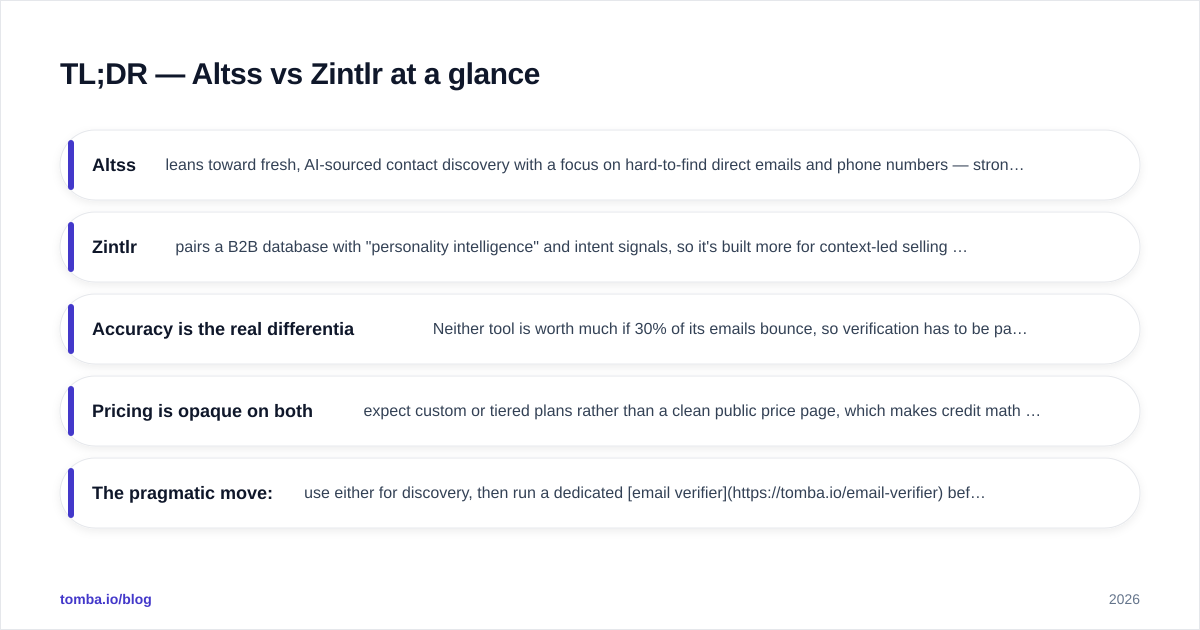
Zintlr** pairs a B2B database with "personality intelligence" and intent signals, so it's built more for context-led selling and account research.
- Accuracy is the real differentiator. Neither tool is worth much if 30% of its emails bounce, so verification has to be part of your stack regardless of which you choose.
- Pricing is opaque on both — expect custom or tiered plans rather than a clean public price page, which makes credit math harder to predict.
- The pragmatic move: use either for discovery, then run a dedicated email verifier before you send. A finder-plus-verifier pipeline beats betting everything on one database.
What is Altss?#
Altss is a B2B contact intelligence tool built around finding direct, decision-maker-level contact details — work and personal emails, mobile numbers, and enriched profile data. Its pitch is freshness: instead of leaning only on a static database, it emphasizes real-time sourcing so you're less likely to email someone who left the company 18 months ago.
For sales teams, that matters most when you're targeting senior buyers who aren't sitting in every generic list. The closer a tool gets to a verified direct line, the fewer gatekeepers and dead inboxes you fight through.
The catch with any "fresh-sourced" claim is that freshness and verification are not the same thing. A recently scraped email can still be a catch-all, a typo, or a role address that nobody reads. That's why pairing discovery with validation is non-negotiable — more on that below.
What is Zintlr?#
Zintlr is a B2B sales intelligence platform that combines a contact and company database with two things most finders skip: personality profiling and intent data. The idea is that you don't just get an email — you get a read on how a prospect likes to communicate and signals about whether their company is in-market.
That's a different philosophy. Altss optimizes for reaching the right person; Zintlr optimizes for understanding them before you reach out. For consultative, high-ACV deals where a single message can make or break a relationship, that context can be genuinely useful.
The trade-off is that personality and intent layers add cost and complexity. If your motion is high-volume outbound, you may be paying for insights you'll never personalize against at scale.
Altss vs Zintlr: how do they compare head-to-head?#
Here's the side-by-side on the attributes that drive a buying decision. Treat vendor-stated coverage numbers as marketing until you test against your own ICP — this is a directional comparison, not an audited benchmark.
| Attribute | Altss | Zintlr |
|---|---|---|
| Primary strength | Fresh direct emails & mobile numbers | Database + personality & intent intelligence |
| Best for | Decision-maker outreach, hard-to-find contacts | Context-led, consultative selling |
| Buyer-intent signals | Limited | Yes, a core feature |
| Personality insights | No | Yes |
| Phone/mobile data | Yes (emphasis) | Available |
| Pricing transparency | Custom / quote-based | Tiered, often quote-based |
| Native verification | Minimal | Minimal |
| Ideal team size | SMB to mid-market reps | Mid-market to enterprise AEs |
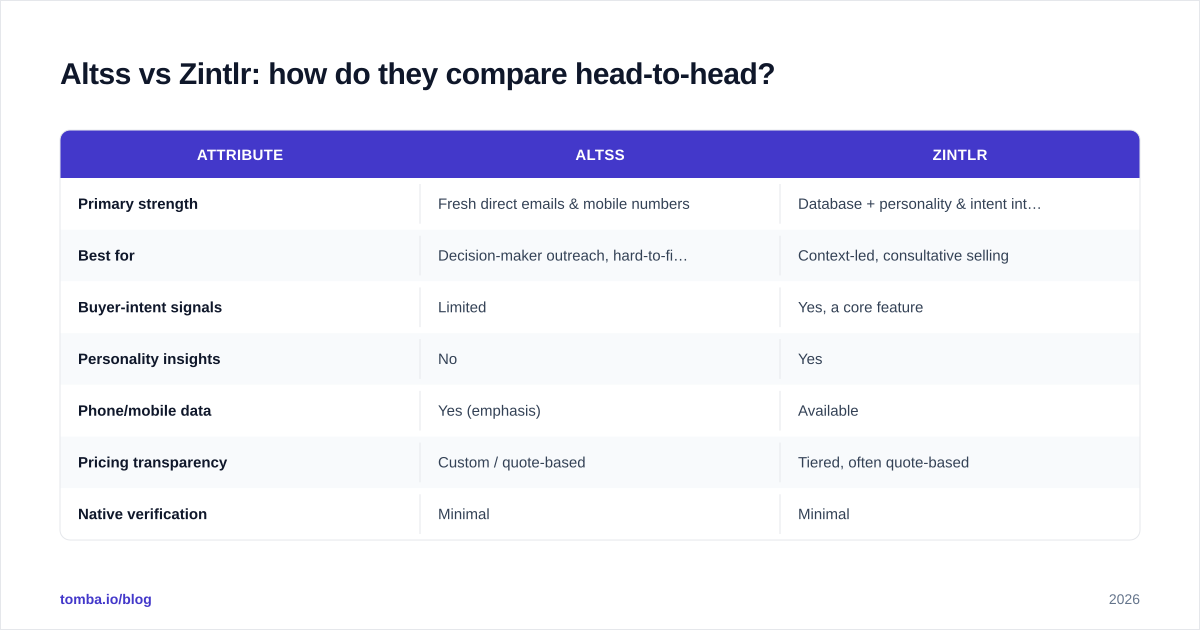
The honest read: these tools overlap less than their marketing implies. If your reps keep saying "I can't find the right email or number," Altss-style discovery solves a sharper pain. If they say "I don't know enough to write something relevant," Zintlr's intelligence layer earns its keep.
Which tool is more accurate?#
Accuracy is where most contact tools quietly lose you money, and it's the question vendors answer the least clearly. A tool can advertise hundreds of millions of contacts and still hand you a 25% bounce rate on the slice that matches your ICP.
Two failure modes matter:
- Stale data — the contact was real but the person changed roles, so the email now bounces or routes nowhere.
- Catch-all ambiguity — the domain accepts every address, so a finder "confirms" an email that no human will ever read.
Neither Altss nor Zintlr is primarily a verification engine. Both are discovery-first. That means the smart workflow is the same regardless of which you choose: find with one tool, then validate with a dedicated verifier and a catch-all verifier before anything hits your sequencer. Skipping that step is how good prospect lists quietly tank your sender reputation.

If you want a baseline before committing budget, run the same 50 target accounts through each tool, export the results, and verify all of them with an independent checker. The gap between "found" and "actually deliverable" is the only accuracy number that should influence your purchase.
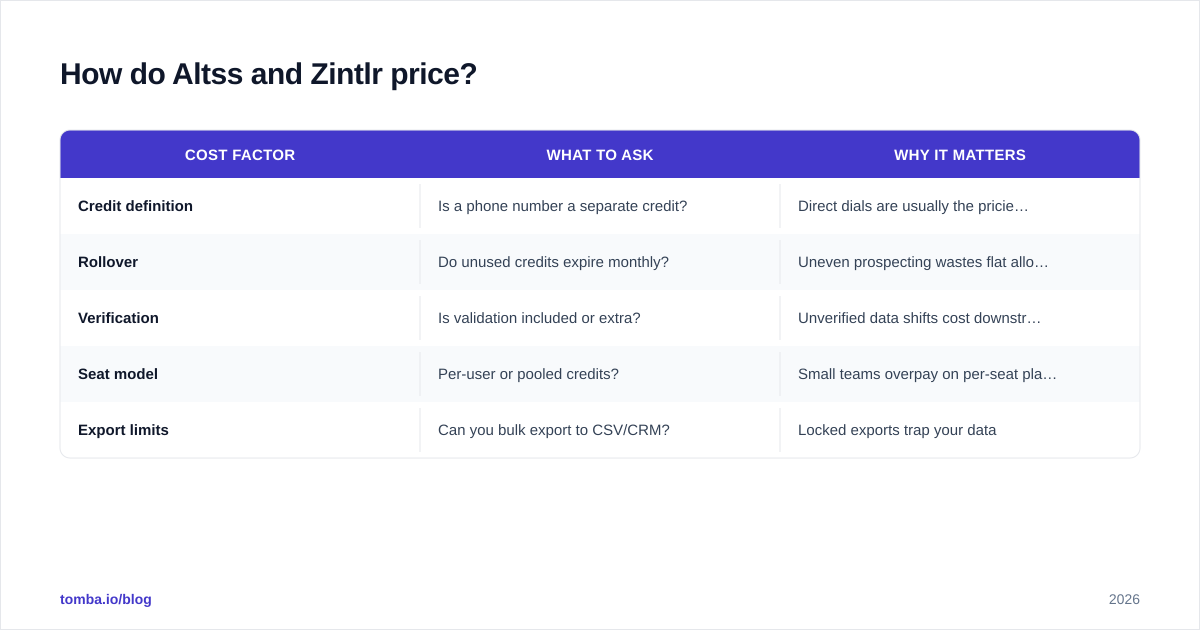
How do Altss and Zintlr price?#
Both tools lean toward quote-based or tiered pricing rather than a clean, public per-credit price. That's common in this category, but it makes budgeting harder and comparison shopping slower.
A few things to pin down before you sign anything:
- What counts as a credit? A search, a revealed email, a phone number, and an enrichment can all be billed differently.
- Do credits roll over? Monthly-reset credits inflate your effective cost if your volume is uneven.
- Are verified contacts billed the same as unverified ones? You don't want to pay full price for an email you then have to re-verify elsewhere.
| Cost factor | What to ask | Why it matters |
|---|---|---|
| Credit definition | Is a phone number a separate credit? | Direct dials are usually the priciest data |
| Rollover | Do unused credits expire monthly? | Uneven prospecting wastes flat allotments |
| Verification | Is validation included or extra? | Unverified data shifts cost downstream |
| Seat model | Per-user or pooled credits? | Small teams overpay on per-seat plans |
| Export limits | Can you bulk export to CSV/CRM? | Locked exports trap your data |
For reference, a transparent alternative like Tomba pricing publishes its tiers outright — a Free plan with 25 searches/month, Starter at $49/mo, Growth at $99/mo, and Pro at $249/mo — so you can model cost before you ever talk to sales. When you're comparing against quote-based vendors, that predictability is itself a feature.
What does a real prospecting workflow look like?#
Tool choice matters less than the pipeline you build around it. Here's a workflow that works whether you land on Altss,
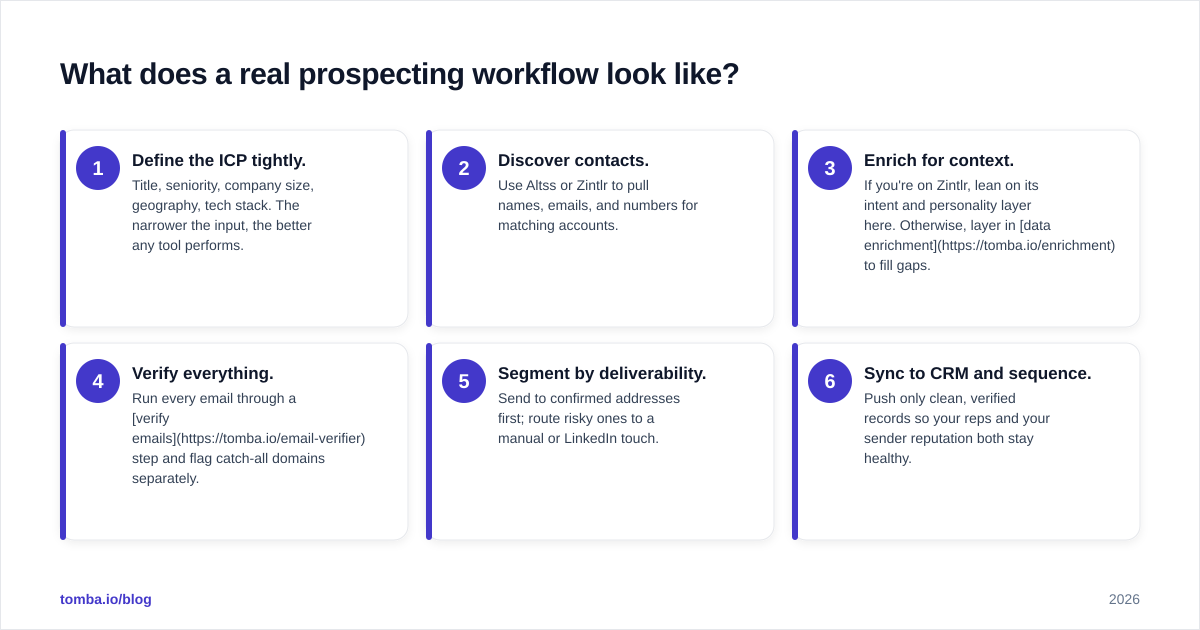
Zintlr, or something else entirely:
- Define the ICP tightly. Title, seniority, company size, geography, tech stack. The narrower the input, the better any tool performs.
- Discover contacts. Use Altss or Zintlr to pull names, emails, and numbers for matching accounts.
- Enrich for context. If you're on Zintlr, lean on its intent and personality layer here. Otherwise, layer in data enrichment to fill gaps.
- Verify everything. Run every email through a verify emails step and flag catch-all domains separately.
- Segment by deliverability. Send to confirmed addresses first; route risky ones to a manual or LinkedIn touch.
- Sync to CRM and sequence. Push only clean, verified records so your reps and your sender reputation both stay healthy.
The order matters. Verifying before you send protects your domain; verifying after is just damage control.
Is there a better-fit alternative for email-led outbound?#
Yes — if your core problem is finding and verifying professional emails at predictable cost, a purpose-built finder often beats a broad intelligence suite. Altss and Zintlr are strong at what they do, but they bundle features (and pricing opacity) you may not need.
| Use case | Best fit |
|---|---|
| Find hard-to-reach mobile numbers | Altss |
| Buyer intent + personality-led selling | Zintlr |
| High-volume, verified email outbound | Dedicated finder + verifier |
| Predictable, public pricing | Dedicated finder + verifier |
| Bulk list building from domains | Domain search |
This is where a focused tool like Tomba fits cleanly into the stack. You can run a bulk email finder across your target accounts, validate every result, and export clean records — without committing to an enterprise contract just to test the data quality.
You can also benchmark the category yourself before deciding. Independent review sites like G2 and Capterra let you filter by real user feedback on data accuracy and support, which is usually more honest than any vendor's own claims. For broader market context on sales intelligence platforms, Gartner tracks the category as well.
When should you pick Altss over Zintlr (and vice versa)?#
Use this quick decision guide:
- Pick Altss if your reps' biggest complaint is "I can't find a direct email or mobile for this exact person." Discovery depth is its edge.
- Pick Zintlr if your deals are consultative, your messaging needs to be tailored, and intent/personality signals will actually change how you sell.
- Pick a dedicated finder + verifier if you run volume outbound, care about deliverability, and want pricing you can forecast.
Most teams end up with a combination: an intelligence tool for research on top accounts, plus a fast, accurate finder-verifier for the long tail of everyday prospecting.
Final verdict: Altss vs Zintlr in 2026#
Altss wins on contact discovery depth; Zintlr wins on buyer context. Neither is a complete deliverability solution on its own, which is the trap most buyers fall into — they assume a "found" email is a deliverable one. It isn't until it's verified.
Whatever you choose, build the pipeline right: discover, enrich, verify, then send. The verification step is the cheapest insurance you'll ever buy for your sender reputation.
If your priority is fast, accurate, predictably priced email discovery, start with the Tomba Email Finder. Find professional emails by name, domain, or company, validate them in the same workflow, and export clean lists your reps can actually use — beginning on the free tier, no quote-based contract required. Pair it with the email finder you're evaluating, and let the bounce rates decide your winner.
// get started
Find, verify and enrich your first contacts today
Start on the free plan with 25 searches a month, then scale when your team is ready.
Free plan · No credit card required · GDPR & CCPA
// about the author