Altss vs ZoomInfo 2026: B2B Data Platform Comparison
Altss and ZoomInfo both promise accurate B2B contact data, but they fit very different teams and budgets. Here's an honest 2026 breakdown of pricing, accuracy, coverage, and the cheaper way to get just the emails you need.
Choosing between Altss and ZoomInfo usually comes down to one tension: you want fresh, accurate contact data, but you don't want to sign a five-figure annual contract to get it. One of these tools leans into lightweight, real-time sourcing; the other is the heavyweight database that most enterprise sales teams already know. Neither is "best" in the abstract — the right pick depends on your team size, budget, and how much data you actually consume each month.
This is a neutral breakdown of how the two stack up in 2026, where each one wins, and when a focused email finder is the smarter spend.
TL;DR#
- Altss is a leaner, real-time B2B data tool built for speed and freshness — good for small teams who want current contacts without legacy bloat.
- **
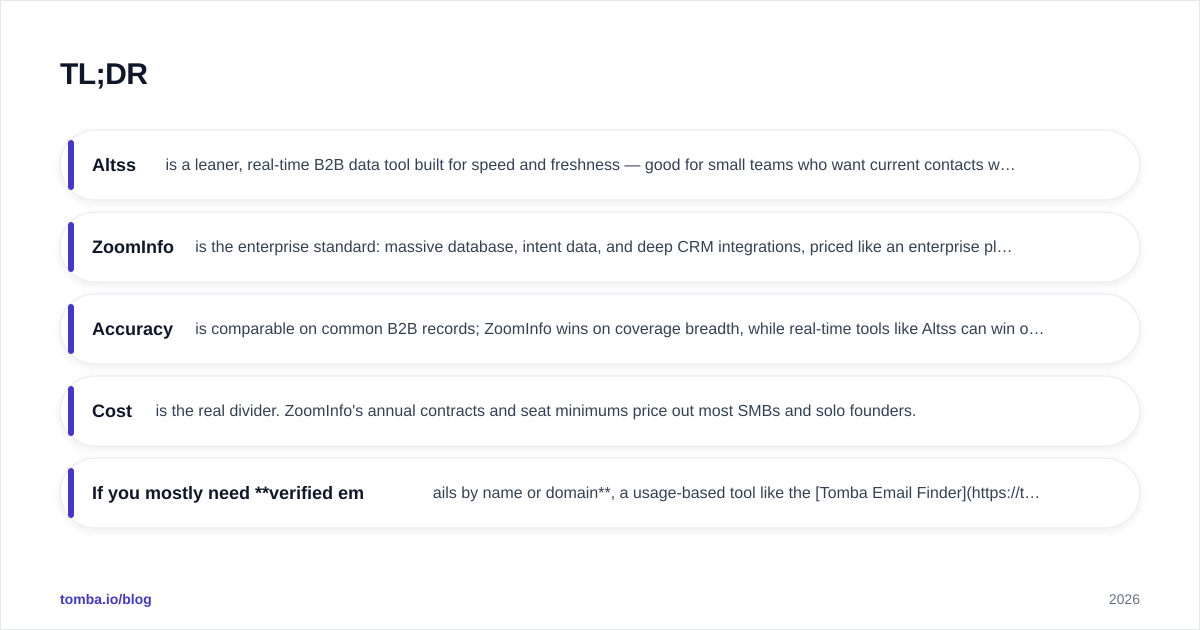
ZoomInfo** is the enterprise standard: massive database, intent data, and deep CRM integrations, priced like an enterprise platform (often $15k+/year with annual lock-in).
- Accuracy is comparable on common B2B records; ZoomInfo wins on coverage breadth, while real-time tools like Altss can win on recency.
- Cost is the real divider. ZoomInfo's annual contracts and seat minimums price out most SMBs and solo founders.
- If you mostly need verified emails by name or domain, a usage-based tool like the Tomba Email Finder does that one job for a fraction of either platform's price.
What is Altss?#
Altss is a B2B data platform that positions itself around real-time sourcing — pulling and refreshing contact and company records on demand rather than serving them from a slow-aging static database. The pitch is freshness: instead of querying a snapshot that was scraped months ago, you get data closer to its current state.
In practice, that makes Altss attractive to lean sales and recruiting teams who care more about whether a contact's role and email are current than about having the single largest database on the market. It tends to be lighter to onboard than a full enterprise suite, and the commercial model is generally more approachable for smaller teams.
Think of it like the difference between a live traffic app and a printed road atlas. The atlas (a giant static database) covers everything, but the live app tells you what's true right now. For outbound that depends on reaching the right person before they change jobs, recency matters.
What is ZoomInfo?#
ZoomInfo is the category's 800-pound gorilla. It's a sales intelligence platform with one of the largest B2B contact and company databases available, layered with intent signals, org charts, technographics, and tight integrations into Salesforce, HubSpot, and outreach tooling. You can read the breadth of its offering on the ZoomInfo website.
That breadth is exactly why enterprise revenue teams standardize on it. When you need to build large, segmented account lists with firmographic precision, see buying-intent spikes, and push everything into a CRM workflow, ZoomInfo is purpose-built for it. Reviews on G2 consistently praise coverage and integrations — and just as consistently flag the price and contract terms.
The trade-off is cost and commitment. ZoomInfo typically sells annual contracts with seat minimums, and real-world pricing frequently lands well into five figures per year. For a 50-person sales org that's a rounding error; for a three-person startup it's a non-starter.
Altss vs ZoomInfo: how do they compare?#
Here's the head-to-head on the attributes that actually drive a buying decision.
| Attribute | Altss | ZoomInfo |
|---|---|---|
| Core strength | Real-time, fresh contact sourcing | Largest database + intent data |
| Database size | Smaller, refreshed on demand | Very large static + enriched |
| Intent / technographics | Limited | Extensive |
| CRM integrations | Core tools | Deep (Salesforce, HubSpot, more) |
| Pricing model | Lower, more flexible | Annual contract, seat minimums |
| Typical annual cost | Low to mid | Often $15k+ |
| Best for | Lean teams, recruiters, founders | Enterprise revenue teams |
| Contract lock-in | Lighter | Annual commitment common |
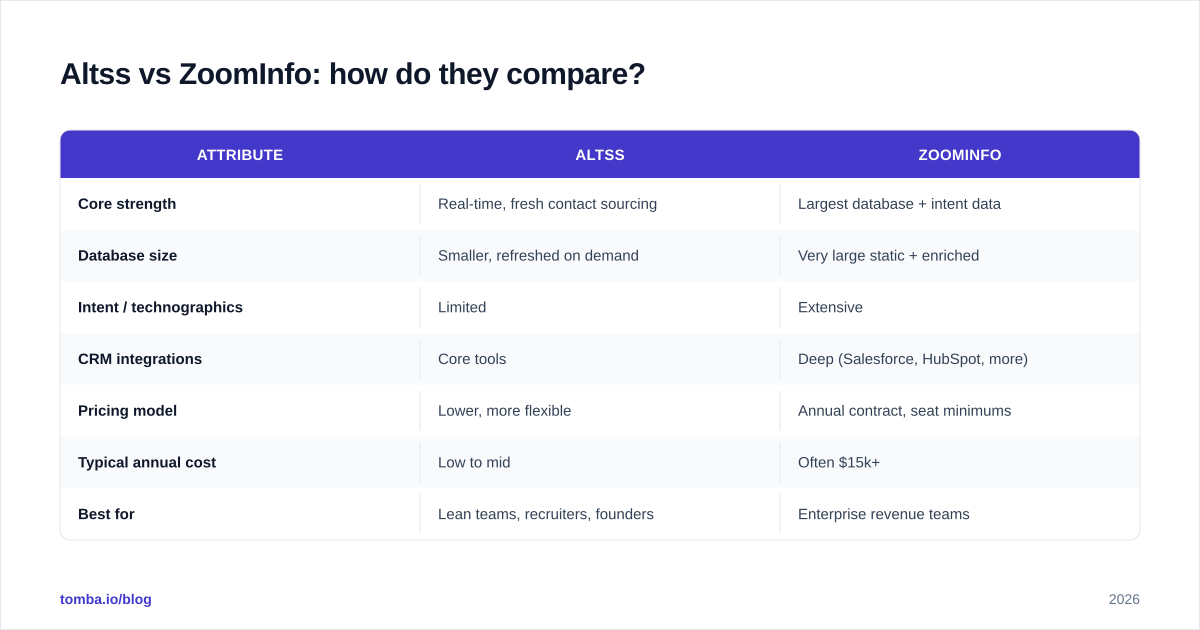
The pattern is clear: ZoomInfo buys you scale and depth at enterprise prices, while Altss buys you speed and flexibility at a fraction of the commitment. If your team consumes hundreds of thousands of records and lives inside intent data, ZoomInfo earns its cost. If you run targeted outbound and value freshness over raw volume, Altss is the lighter fit.

Which is more accurate?#
Accuracy is the question everyone asks and the hardest to answer cleanly, because "accurate" means different things for different records. Email deliverability, direct-dial validity, and job-title freshness all decay at different rates.
ZoomInfo's advantage is coverage — it's more likely to have a record for an obscure contact at all. Its size also means more cross-referenced data points per profile. But large static databases have a known weakness: staleness. B2B data degrades roughly 2–3% per month as people change jobs, so a record that was perfect at scrape time can be wrong by the time you email it.
Altss's real-time angle is designed to attack exactly that decay. For contacts that change frequently, fresher sourcing can mean a more current email or title even if the overall database is smaller.
The honest takeaway: neither tool is "more accurate" across the board. ZoomInfo wins on having the record; real-time tools can win on the record being current. Whichever you use, run found addresses through a dedicated email verifier before sending — verification is the only thing that actually protects your sender reputation, regardless of source.
What does each one cost in 2026?#
Cost is where most teams make the decision, so let's be concrete.
**
ZoomInfo** does not publish transparent self-serve pricing. Deals are quoted, annual, and tied to seat counts and data-credit tiers. Public reports and review-site threads put entry packages in the low-five-figures per year, climbing fast with add-ons like intent and engagement. There's almost always an annual commitment.
Altss sits well below that, with a lighter and more flexible model aimed at smaller teams. It's the kind of spend a founder or a small SDR pod can justify without a procurement cycle.
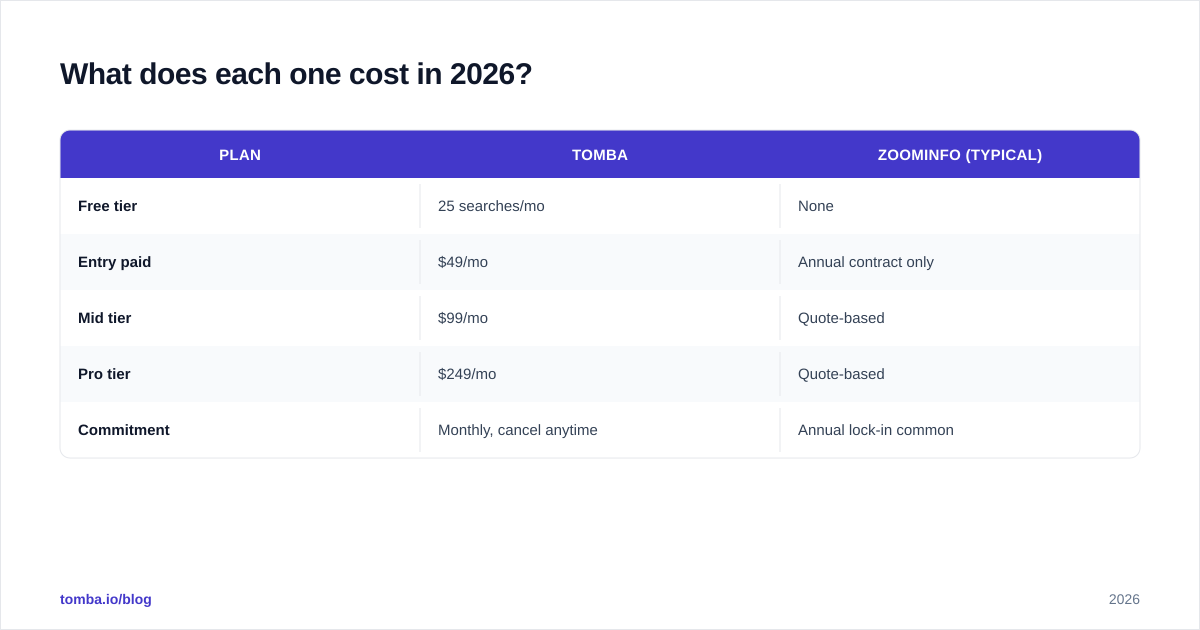
For comparison, a usage-based email finder is a different category of cost entirely:
| Plan | Tomba | ZoomInfo (typical) |
|---|---|---|
| Free tier | 25 searches/mo | None |
| Entry paid | $49/mo | Annual contract only |
| Mid tier | $99/mo | Quote-based |
| Pro tier | $249/mo | Quote-based |
| Commitment | Monthly, cancel anytime | Annual lock-in common |
If your real need is "find and verify emails for a list of prospects," paying enterprise-platform money is overkill. You can see straightforward Tomba pricing without talking to a sales rep — which is the opposite of the ZoomInfo buying experience.

When should you choose ZoomInfo?#
Pick ZoomInfo when your needs are genuinely enterprise-shaped:
- You run a mid-to-large sales org with multiple SDRs and a defined territory model.
- You depend on buying intent and technographic filters to prioritize accounts.
- You need deep CRM workflows — automatic enrichment, org charts, and routing inside Salesforce or HubSpot.
- Your data consumption is high volume, so per-record economics favor a flat platform fee.
- You have budget and procurement capacity for an annual contract.
In those conditions, ZoomInfo's breadth and integrations justify the price. Trying to replicate its intent + coverage stack with point tools would cost you more in glue work than the license saves. Gartner and Forrester both track this enterprise sales-intelligence category if you want analyst-level depth before committing — start at Gartner.
When is Altss (or a focused tool) the better call?#
Choose Altss or a leaner stack when:
- You're a startup, recruiter, or small team without an enterprise budget.
- Freshness matters more to you than having the single biggest database.
- You don't need intent data and won't use 80% of an enterprise suite.
- You want to avoid annual lock-in and prefer flexible, lower commitment.
- Your workflow is targeted outbound — quality lists over massive volume.
And there's a third path many teams miss: you may not need a full data platform at all. If your actual job-to-be-done is getting verified emails for known prospects, a specialized finder plus enrichment beats paying for breadth you'll never touch.
That's where layering focused tools wins. Use domain search to pull the right contacts at a target company, the email finder to get individual addresses by name, and data enrichment to fill in the fields your CRM is missing. You assemble exactly the data you need, usage-based, with no seat minimums.
How do you decide between them?#
Work through these questions in order — the first "no" usually points you to the lighter option:
- Do you need intent data and technographics? If no, you're overpaying for
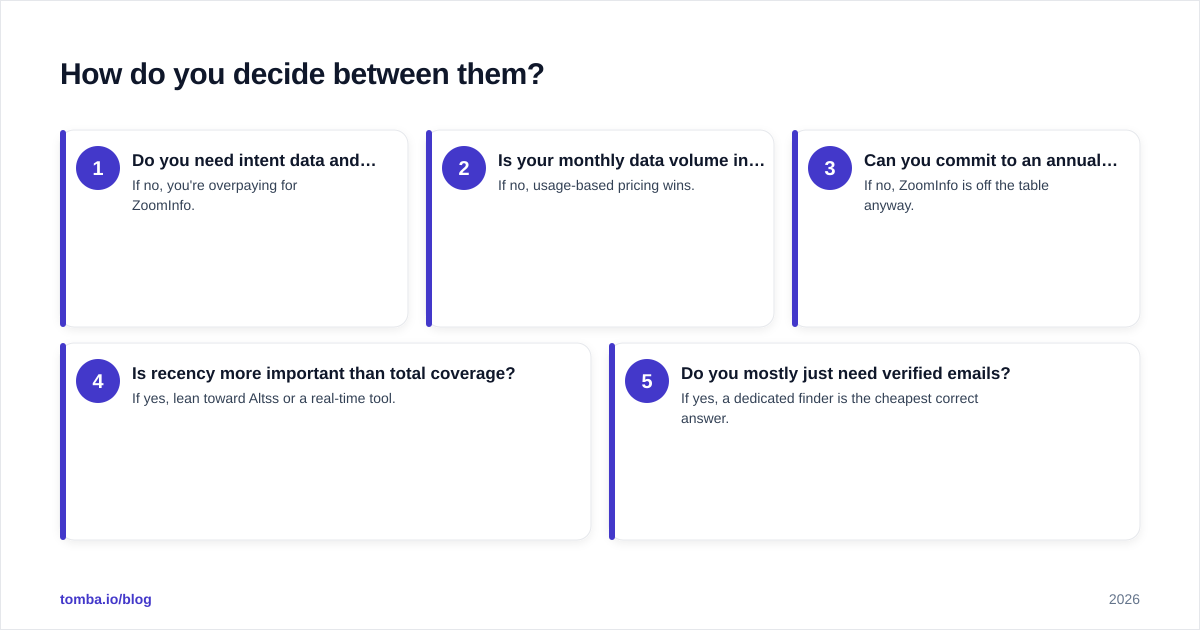
ZoomInfo. 2. Is your monthly data volume in the tens of thousands of records? If no, usage-based pricing wins. 3. Can you commit to an annual contract today? If no, ZoomInfo is off the table anyway. 4. Is recency more important than total coverage? If yes, lean toward Altss or a real-time tool. 5. Do you mostly just need verified emails? If yes, a dedicated finder is the cheapest correct answer.
A reasonable default for most teams under 20 reps: start with a focused, usage-based finder, prove the outbound motion works, and only graduate to a full platform when intent data and CRM-wide enrichment become bottlenecks you can measure. Don't buy enterprise tooling to solve a problem you haven't hit yet.
Can you combine tools instead of picking one?#
Yes — and many efficient teams do. The platform-vs-point-tool debate is a false binary. A common 2026 stack looks like this:
- A lightweight data source (Altss or similar) for company and contact discovery.
- A dedicated email finder + verifier for accurate, send-ready addresses.
- Enrichment to backfill CRM fields and keep records current.
This composable approach keeps you off annual lock-in, lets you swap any layer that underperforms, and scales with usage instead of seats. It's especially powerful for teams that want ZoomInfo-level data quality on specific contacts without ZoomInfo-level spend across the whole database.
The risk to manage is data hygiene across sources — dedupe and verify everything before it hits your sequencer, or you'll burn deliverability on stale records.
The bottom line#
ZoomInfo is the right tool if you're an enterprise revenue team that lives in intent data, needs the broadest possible coverage, and has the budget and procurement appetite for an annual contract. Altss is the better fit if you're a leaner team that values fresh, real-time data and flexible pricing over raw database size.
But if you strip the decision down to what most outbound teams actually do every day — find a real person's email and confirm it's safe to send — neither platform is the most cost-effective answer. A focused, usage-based finder is.
That's the gap the Tomba Email Finder fills. Find professional email addresses by name, company, or domain, verify them in the same workflow, and pay only for what you use — starting free with 25 searches a month and scaling to $49/mo when you're ready. No annual lock-in, no seat minimums, no sales call. Try it on your next prospect list and see how far focused tooling gets you before you ever need an enterprise platform.
// get started
Find, verify and enrich your first contacts today
Start on the free plan with 25 searches a month, then scale when your team is ready.
Free plan · No credit card required · GDPR & CCPA
// about the author