Amplemarket Pros and Cons (2026): An Honest Buyer's Review
A neutral, in-depth look at Amplemarket's pros and cons in 2026 — AI features, pricing reality, data quality, and where lighter tools beat the all-in-one bundle.
Amplemarket sells one promise: replace your scattered prospecting stack with a single AI-driven outbound engine. That promise is attractive, but it is not free of trade-offs — and the honest amplemarket pros and cons only show up once you look past the demo. This review weighs the platform the way a buyer should: feature by feature, dollar by dollar, and against the lighter tools that do one job well.
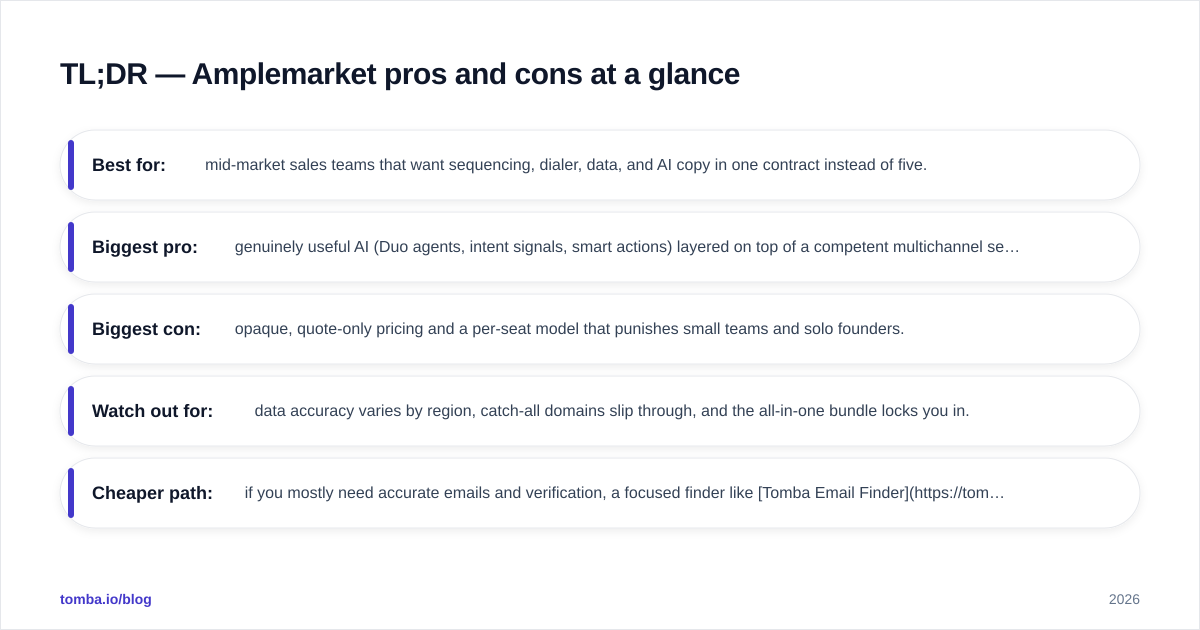
TL;DR — Amplemarket pros and cons at a glance#
- Best for: mid-market sales teams that want sequencing, dialer, data, and AI copy in one contract instead of five.
- Biggest pro: genuinely useful AI (Duo agents, intent signals, smart actions) layered on top of a competent multichannel sequencer.
- Biggest con: opaque, quote-only pricing and a per-seat model that punishes small teams and solo founders.
- Watch out for: data accuracy varies by region, catch-all domains slip through, and the all-in-one bundle locks you in.
- Cheaper path: if you mostly need accurate emails and verification, a focused finder like Tomba Email Finder costs a fraction and plugs into the tools you already run.
What is Amplemarket and who is it for?#
Amplemarket is an all-in-one sales engagement and AI prospecting platform. It bundles a contact database, multichannel sequencing (email, LinkedIn, phone), an integrated dialer, deliverability tooling, buying-intent signals, and a layer of AI agents marketed as "Duo." The pitch is consolidation: instead of paying separately for a data provider, a sequencer, a verification tool, and an AI copywriter, you run the whole motion inside one login.
That positioning targets a specific buyer — a funded startup or mid-market revenue team with several SDRs, a defined ICP, and the budget to commit annually. If that is you, the consolidation story is real. If you are a solo founder, a recruiter, or a small agency doing occasional outreach, the same bundle is heavier and pricier than the job requires.
The framework above is the lens for the rest of this review: weigh consolidation value against per-seat cost, then sanity-check data quality against a dedicated finder before you sign.
What are the main pros of Amplemarket?#
The strengths are concentrated in three areas: AI, breadth, and deliverability.
1. The AI is more than a wrapper. Amplemarket's Duo agents do real work — drafting personalized first lines from a prospect's recent activity, suggesting next steps, and flagging accounts showing buying intent. Plenty of vendors slap "AI" on a template engine. Amplemarket's version actually reduces manual research time, which is the expensive part of outbound.
2. True multichannel in one place. You can run an email step, a LinkedIn connection request, and a call task inside the same sequence without exporting CSVs between tools. For teams that previously stitched together a sequencer plus a dialer plus a LinkedIn automation tool, this is the headline benefit.
3. Built-in deliverability tooling. Amplemarket includes warmup, inbox rotation, and spam monitoring. Deliverability is where most cold campaigns quietly die, so folding it into the platform is a legitimate advantage. If you want to understand why this matters, the fundamentals of email deliverability and sender reputation are worth a read before any campaign.
4. Intent and "smart actions." The platform surfaces signals — job changes, hiring spikes, technology adoption — and turns them into prioritized tasks. Used well, this is the difference between spraying a list and timing an approach.
What are the cons of Amplemarket?#
No tool is all upside, and the weaknesses here are the kind that matter at renewal time.
1. Opaque, quote-only pricing. Amplemarket does not publish transparent self-serve tiers. You book a demo, get a custom quote, and negotiate. For buyers who like to compare line items before committing, this friction is real — and it usually signals annual contracts rather than month-to-month flexibility.
2. Per-seat cost adds up fast. Because pricing is seat-based and bundled, a five-person team pays for five full stacks even if three reps only need email finding. You cannot easily buy "just the data" or "just the sequencer."
3. Data accuracy is good, not perfect — and uneven by region. North American coverage tends to be strong; EMEA and APAC results are thinner. Catch-all domains, where a server accepts every address, remain a known soft spot for nearly every all-in-one provider. If your ICP sits outside the US, validate a sample before you trust the database.
4. Lock-in and overlap. Consolidation cuts both ways. Once your sequences, data, and deliverability live in one platform, switching is painful. And if you already own a CRM-native sequencer or a separate data tool, you are paying twice for overlapping capability.
5. Learning curve. The breadth that makes Amplemarket powerful also makes it dense. New reps need ramp time, and admin configuration is non-trivial.
How does Amplemarket compare to alternatives in 2026?#
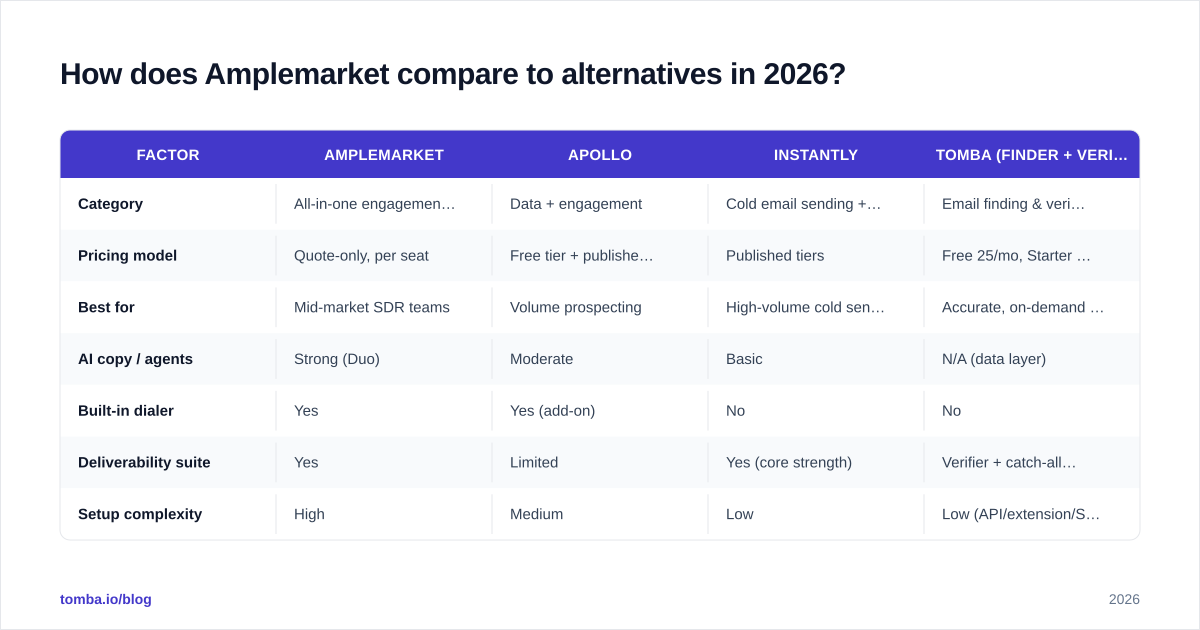
Here is the honest trade-off matrix. The "right" pick depends on whether you value consolidation or cost control.
| Factor | Amplemarket | Apollo | Instantly | Tomba (finder + verifier) |
|---|---|---|---|---|
| Category | All-in-one engagement + AI | Data + engagement | Cold email sending + warmup | Email finding & verification |
| Pricing model | Quote-only, per seat | Free tier + published paid tiers | Published tiers | Free 25/mo, Starter $49/mo, Growth $99/mo |
| Best for | Mid-market SDR teams | Volume prospecting | High-volume cold senders | Accurate, on-demand email data |
| AI copy / agents | Strong (Duo) | Moderate | Basic | N/A (data layer) |
| Built-in dialer | Yes | Yes (add-on) | No | No |
| Deliverability suite | Yes | Limited | Yes (core strength) | Verifier + catch-all checks |
| Setup complexity | High | Medium | Low | Low (API/extension/Sheets) |
| Lock-in risk | High | Medium | Low | Low |
A few reads from this table. If you want everything in one bill and have the budget, Amplemarket and to a lesser extent Apollo are the consolidation plays. If your single biggest pain is deliverability and sending at scale, Instantly is narrower and cheaper. And if what you actually need is reliable contact data feeding tools you already use, a dedicated finder and email verifier is the leanest path — see the full Amplemarket alternative breakdown for that angle.

Is Amplemarket worth the price?#
Conclusion first: Amplemarket is worth it when consolidation savings exceed the per-seat premium — and not before. Run the math, don't eyeball it.
Add up what you currently spend on a separate data provider, sequencer, dialer, warmup tool, and AI writer. If that total — across all seats — is higher than an Amplemarket quote, consolidation wins on cost alone, before you even count the time saved switching between tools. If you are running two of those functions on free or cheap tiers, the bundle will likely cost more than your current patchwork.
The hidden variable is utilization. A platform is only worth its seat price if each rep uses most of it. Three SDRs who live in sequences justify the spend; two managers who log in twice a month do not. Audit who actually needs the full stack before you size the contract. Compare that against transparent, usage-based options — for instance, Tomba pricing starts free at 25 searches a month and scales by usage, not by locked annual seats.
When should you choose a lighter tool instead?#
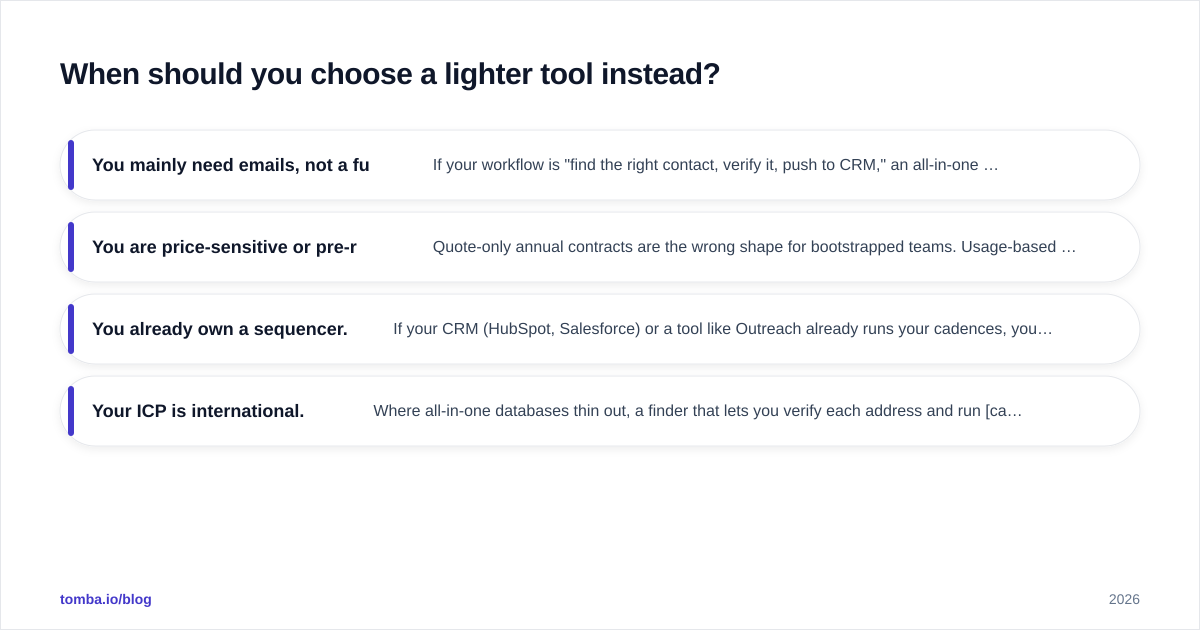
Pick a focused tool over Amplemarket in these cases:
- You mainly need emails, not a full engine. If your workflow is "find the right contact, verify it, push to CRM," an all-in-one platform is overkill. A finder with a Chrome extension, Google Sheets add-on, and an email finder API does that job for a fraction of the cost.
- You are price-sensitive or pre-revenue. Quote-only annual contracts are the wrong shape for bootstrapped teams. Usage-based pricing keeps spend proportional to output.
- You already own a sequencer. If your CRM (HubSpot, Salesforce) or a tool like Outreach already runs your cadences, you only need a data layer — not a second engagement platform.
- Your ICP is international. Where all-in-one databases thin out, a finder that lets you verify each address and run catch-all verification protects your sender reputation regardless of region.
The accuracy point deserves emphasis. Bounce rates above a few percent damage your domain reputation and drag down every future campaign. Whatever tool you choose, verify before you send — a dedicated verifier catching dead and catch-all addresses pays for itself by protecting deliverability.
What do real users say about Amplemarket?#
Aggregate review sentiment on platforms like G2 and Capterra leans positive, and the praise is consistent: reps like the AI personalization, the multichannel sequencing, and responsive support. The recurring complaints are equally consistent — pricing opacity, occasional data gaps outside North America, and a learning curve that slows new-rep onboarding.
Read reviews with a filter for company size. A 200-person sales org and a 4-person startup will rate the same platform very differently, because the per-seat economics and the value of consolidation flip entirely at small scale. Sort by reviewer profile that matches yours, and weigh the "cons" sections more heavily than the star rating — that is where the real amplemarket pros and cons surface. You can confirm any contact data against your own checks; details on Tomba's data sources show how independent verification complements a bundled database.
How should you test Amplemarket before committing?#
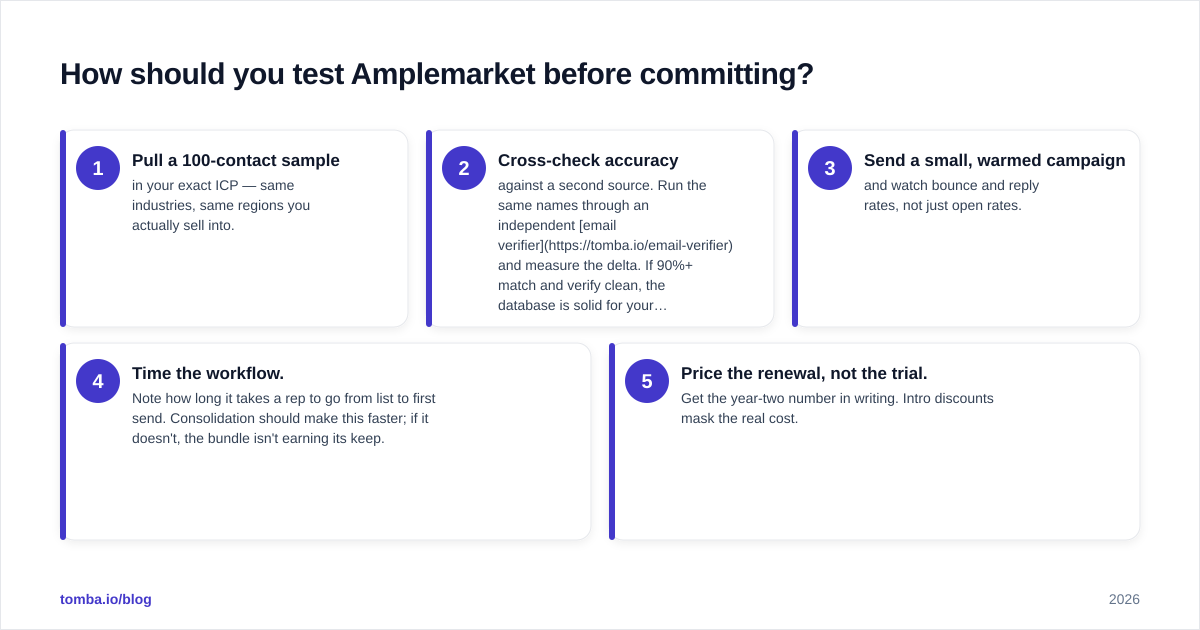
Run a structured trial, not a vibe check. A repeatable evaluation in your first two weeks will tell you more than any demo:
- Pull a 100-contact sample in your exact ICP — same industries, same regions you actually sell into.
- Cross-check accuracy against a second source. Run the same names through an independent email verifier and measure the delta. If 90%+ match and verify clean, the database is solid for your segment.
- Send a small, warmed campaign and watch bounce and reply rates, not just open rates.
- Time the workflow. Note how long it takes a rep to go from list to first send. Consolidation should make this faster; if it doesn't, the bundle isn't earning its keep.
- Price the renewal, not the trial. Get the year-two number in writing. Intro discounts mask the real cost.
If Amplemarket clears those gates for your team and region, the all-in-one bet is sound. If accuracy wobbles or the quote outruns your stack savings, you have your answer — and a cheaper, more flexible path.
The bottom line#
Amplemarket is a strong all-in-one platform with genuinely useful AI and real multichannel depth — for mid-market teams that will use every seat and can absorb annual, quote-based pricing. The cons are equally real: opacity, per-seat cost, regional data gaps, and lock-in. Weigh consolidation savings against the premium, validate the data for your ICP, and only then sign.
If your core need is accurate, verified contact data rather than a full engagement engine, start lean. Tomba's email finder finds professional emails by name, domain, or company, verifies them, handles catch-all domains, and plugs into your CRM, Sheets, or API — with a free tier and transparent Tomba pricing that scales by usage, not by locked seats. Find the emails first; add the heavy machinery only when your volume actually demands it.
// get started
Find, verify and enrich your first contacts today
Start on the free plan with 25 searches a month, then scale when your team is ready.
Free plan · No credit card required · GDPR & CCPA
// about the author