Amplemarket vs Jeeva AI 2026: Which AI SDR Platform Wins?
Amplemarket vs Jeeva AI, compared head-to-head for 2026: AI SDR automation, data accuracy, pricing, and deliverability so you can pick the right outbound engine.
Choosing between Amplemarket and Jeeva AI comes down to one question: do you want an AI layer bolted onto a mature outbound suite, or an AI-native SDR built to run the top of your funnel with minimal human input? Both promise to replace manual prospecting grunt work. They get there differently.
TL;DR#
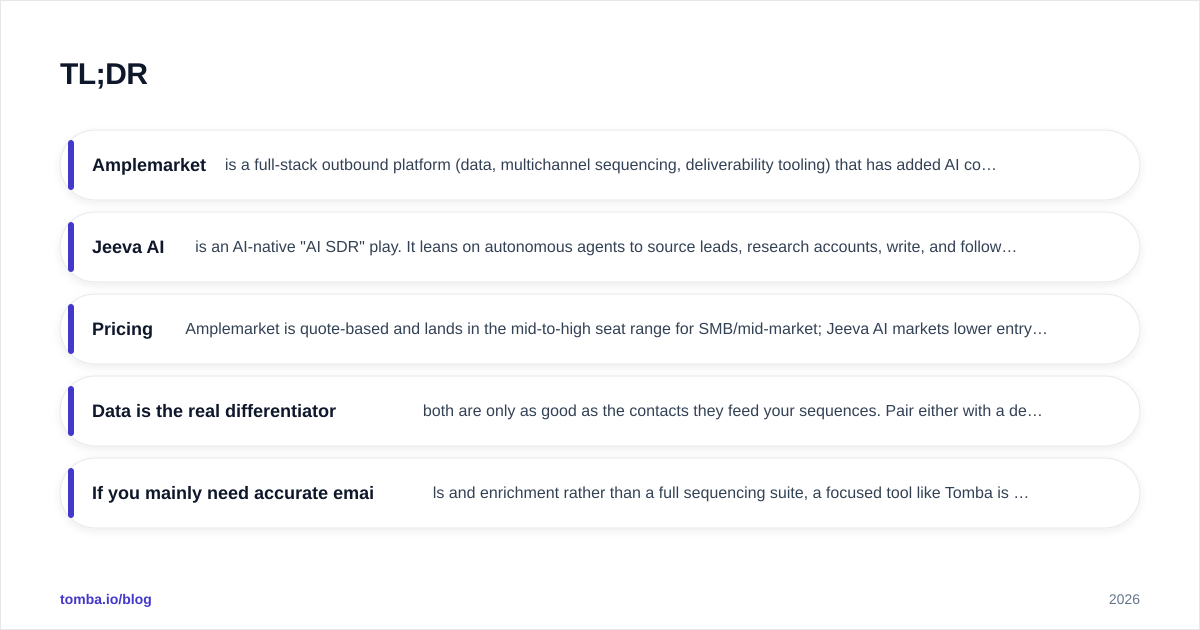
- Amplemarket is a full-stack outbound platform (data, multichannel sequencing, deliverability tooling) that has added AI copy and AI-SDR features on top of an established engine. Best for teams that already run structured outbound and want AI to accelerate it.
- Jeeva AI is an AI-native "AI SDR" play. It leans on autonomous agents to source leads, research accounts, write, and follow up with lighter human steering. Best for lean teams that want an always-on prospecting agent.
- Pricing: Amplemarket is quote-based and lands in the mid-to-high seat range for SMB/mid-market; Jeeva AI markets lower entry tiers plus usage-based AI. Neither publishes fully transparent public pricing.
- Data is the real differentiator — both are only as good as the contacts they feed your sequences. Pair either with a dedicated email finder and verifier to protect deliverability.
- If you mainly need accurate emails and enrichment rather than a full sequencing suite, a focused tool like Tomba is cheaper and more flexible than either platform.
What is Amplemarket?#
Amplemarket is an outbound sales platform that bundles B2B data, multichannel sequencing (email, LinkedIn, calls), deliverability optimization, and AI-assisted copywriting into one workspace. It positions itself as the "AI-powered sales platform" for full-cycle reps and SDR teams who want their prospecting, outreach, and reply handling in a single tool.
The pitch is consolidation. Instead of stitching a data vendor, a sequencer, a deliverability monitor, and a copy assistant together, you run them from one login. Amplemarket's "Duo" AI features handle things like buying-intent signals, lead recommendations, and reply classification. You can read their own framing on the Amplemarket site.
Where Amplemarket is strong: deliverability tooling (spam testing, domain monitoring), structured sequence logic, and a data set tuned for outbound. Where it frustrates teams: pricing opacity, a learning curve, and credit limits that bite when you scale volume.
What is Jeeva AI?#
Jeeva AI is an AI-native sales-development platform built around the idea of an autonomous "AI SDR." Rather than giving humans better tools, Jeeva's framing is that the agent does the prospecting: it identifies accounts, enriches contacts, drafts personalized messages, sends, and follows up — running continuously so a small team can cover a larger territory.
Jeeva markets itself to founders and lean revenue teams who can't staff a full SDR bench. The promise is "hire an AI SDR" rather than "buy software your SDRs operate." You can see the positioning on the Jeeva AI homepage.
Where Jeeva is strong: low operational overhead, fast setup, and a usage model that suits teams testing AI outbound without committing to seats. Where it's unproven relative to Amplemarket: depth of deliverability controls, data accuracy at scale, and the maturity of its reporting.
Amplemarket vs Jeeva AI: how do they compare?#
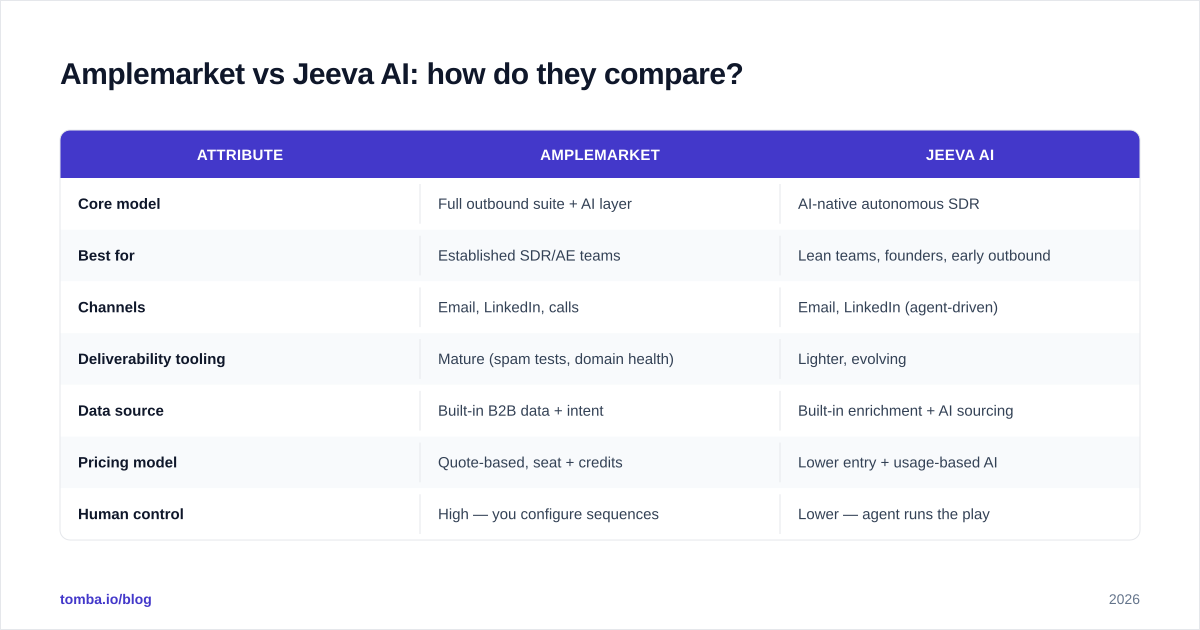
The honest summary: Amplemarket is the heavier, more proven platform with AI added on; Jeeva is the lighter, AI-first agent betting that autonomy beats configurability. Your choice depends on how much control you want and how mature your outbound motion already is.
| Attribute | Amplemarket | Jeeva AI |
|---|---|---|
| Core model | Full outbound suite + AI layer | AI-native autonomous SDR |
| Best for | Established SDR/AE teams | Lean teams, founders, early outbound |
| Channels | Email, LinkedIn, calls | Email, LinkedIn (agent-driven) |
| Deliverability tooling | Mature (spam tests, domain health) | Lighter, evolving |
| Data source | Built-in B2B data + intent | Built-in enrichment + AI sourcing |
| Pricing model | Quote-based, seat + credits | Lower entry + usage-based AI |
| Human control | High — you configure sequences | Lower — agent runs the play |
| Learning curve | Steeper | Faster to start |
| Reporting maturity | Strong | Developing |
A few caveats on that table. Both vendors iterate fast, and neither publishes a fully fixed feature matrix, so verify the current state on G2 before you buy — the Amplemarket reviews on G2 are a useful reality check on data quality and support responsiveness.
Is Amplemarket better than Jeeva AI?#
Better for whom is the only question that matters. Amplemarket wins when you have an outbound process worth scaling — defined ICP, multichannel sequences, reps who know how to work a cadence. The platform rewards structure. Its deliverability tooling alone justifies the price for teams sending real volume, because a burned domain costs more than any subscription.
Jeeva AI wins when you don't have that structure yet, or can't staff it. A two-person startup that needs pipeline tomorrow gets more from an agent that just runs than from a configurable suite nobody has time to configure. The trade-off is control: when the AI picks the wrong accounts or writes off-key copy, you have fewer levers to correct it mid-flight.
Think of it like transport. Amplemarket is a manual car with a great engine and a lot of dials — fast in skilled hands, intimidating for a new driver. Jeeva is closer to a self-driving shuttle — you tell it the destination and trust the route. Both get you down the road; the right one depends on whether you want to drive or be driven.
What about data accuracy and deliverability?#
This is where most AI SDR comparisons go quiet, and where deals actually succeed or fail. An AI agent that writes brilliant copy to a bounced or catch-all address still achieves nothing. Both Amplemarket and Jeeva include their own data, but no single provider has perfect coverage, and AI-sourced contacts are especially prone to plausible-but-wrong emails.
Two numbers drive the economics of either platform:
- Bounce rate. Every send to an invalid address dings your sender reputation and pushes you toward the spam folder. Keep hard bounces under 2–3%.
- Connect rate. The percentage of valid, deliverable contacts in your list. AI volume amplifies whatever your underlying data quality is — good or bad.
This is the strongest argument for not relying on a single suite's built-in data. Running contacts through an independent email verifier before they enter an Amplemarket or Jeeva sequence catches the misses their enrichment layer made. For tricky domains, a dedicated catch-all verifier resolves the addresses most tools flag as "unknown" and discard.
If your real bottleneck is finding and validating contacts — not orchestrating sequences — you may not need either platform's full suite. A focused email finder plus enrichment covers the top-of-funnel data job at a fraction of the cost, and feeds whatever sending tool you already use.
How does pricing compare?#
Neither vendor makes this easy. Amplemarket is quote-based: you talk to sales, and pricing scales with seats, data credits, and the AI features you enable. Expect mid-market SaaS pricing — not cheap, justified mostly by the deliverability and data bundle. Jeeva AI markets lower entry points with usage-based AI on top, which reads cheaper at the start but can climb as the agent's volume grows.
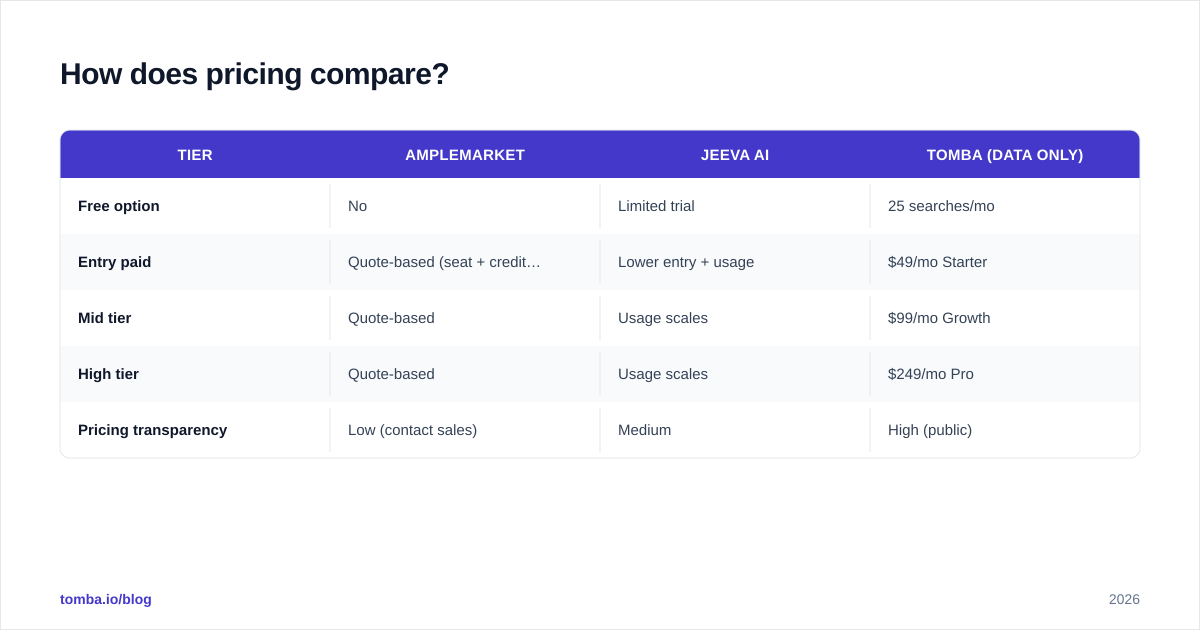
Here's a transparent comparison using Tomba's published numbers as a reference anchor, since the AI SDR platforms keep theirs behind a form:
| Tier | Amplemarket | Jeeva AI | Tomba (data only) |
|---|---|---|---|
| Free option | No | Limited trial | 25 searches/mo |
| Entry paid | Quote-based (seat + credits) | Lower entry + usage | $49/mo Starter |
| Mid tier | Quote-based | Usage scales | $99/mo Growth |
| High tier | Quote-based | Usage scales | $249/mo Pro |
| Pricing transparency | Low (contact sales) | Medium | High (public) |
The point of that last column isn't that Tomba does the same job — it doesn't run sequences. It's that the data-and-verification layer underneath both platforms can be bought transparently and cheaply on its own. Compare against the full Tomba pricing if you want to budget the data piece separately from the sending tool.
If Amplemarket specifically is the one you're weighing, it's worth knowing what a leaner stack looks like — see how teams assemble an Amplemarket alternative from a focused finder, verifier, and their existing sequencer.
Which should you choose?#
Match the tool to your motion, not the marketing:
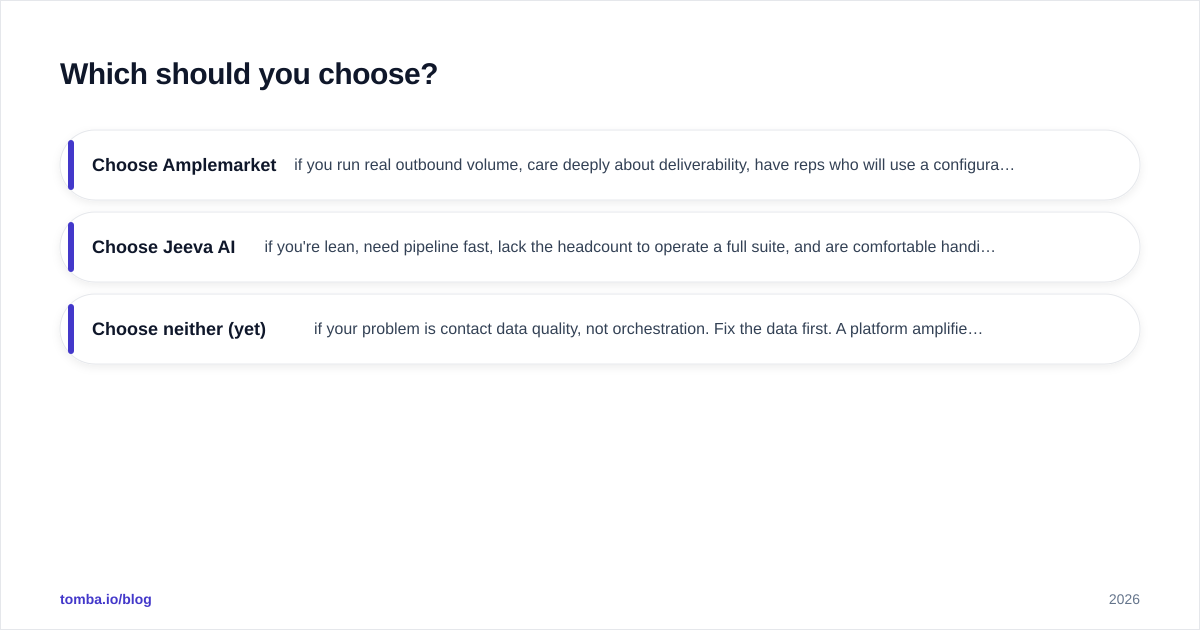
- Choose Amplemarket if you run real outbound volume, care deeply about deliverability, have reps who will use a configurable system, and can absorb mid-market pricing. It's the safer bet for scaling an existing, working motion.
- Choose Jeeva AI if you're lean, need pipeline fast, lack the headcount to operate a full suite, and are comfortable handing the play to an agent with lighter oversight. It's the better bet for getting outbound off the ground.
- Choose neither (yet) if your problem is contact data quality, not orchestration. Fix the data first. A platform amplifies your list; it doesn't fix it.
Whichever you pick, instrument your response rate and bounce rate from day one. AI outbound fails silently — volume goes up, replies don't — and the cause is almost always data, not copy.
A practical hybrid many teams land on: use a transparent data layer to source and verify contacts, then route the clean list into whichever AI sender fits your stage. You get accuracy you can audit and the automation you wanted, without betting your whole motion on one vendor's enrichment.
The bottom line#
Amplemarket is the mature, configurable suite with AI on top; Jeeva AI is the AI-native agent built to run outbound for lean teams. Neither escapes the fundamental truth that outbound lives or dies on contact data. Before you commit to either subscription, make sure the emails feeding it are real.
That's the gap Tomba's Email Finder fills. Find verified, professional email addresses by name, domain, or company, validate them before they ever hit a sequence, and enrich them with the firmographic context your AI copy needs to land. Start free with 25 searches a month, then scale on transparent pricing — and let Amplemarket or Jeeva do the sending on top of data you can actually trust.
// get started
Find, verify and enrich your first contacts today
Start on the free plan with 25 searches a month, then scale when your team is ready.
Free plan · No credit card required · GDPR & CCPA
// about the author