Ampliz Pricing in 2026: Plans, Real Costs & Alternatives
A neutral breakdown of Ampliz pricing in 2026 — how its quote-based plans work, what you actually pay per contact, hidden costs, and cheaper alternatives for B2B prospecting.
TL;DR
- Ampliz pricing is quote-based, not published — there is no public price list, so every team negotiates its own number based on data volume, regions, and seats.
- The platform leans on a credit/contact model: you pay for revealed contacts and enrichment lookups, and costs climb fast once you move past the free trial.
- Ampliz's real strength is healthcare and APAC B2B data, which is why buyers tolerate the opaque pricing — but it's overkill (and overpriced) for general email finding.
- If you mainly need verified work emails and firmographic enrichment, a flat-rate tool like Tomba (Free tier, then $49/mo) is far easier to budget than Ampliz's "talk to sales" approach.
- Use the framework below to decide whether Ampliz's specialty data justifies the cost, or whether a transparent per-month tool wins.
What is Ampliz and who is it for?#
Ampliz is a B2B data intelligence platform best known for two things: deep healthcare contact data (physicians, hospitals, decision-makers) and strong coverage across APAC and global markets that many US-centric tools miss. Its flagship products are the Ampliz SalesBuddy Chrome extension, a global B2B database, and a healthcare-specific intelligence layer.
Think of Ampliz less like a simple email finder and more like a specialized data vendor. If a generic email finder is a phone book, Ampliz is closer to a curated industry directory with a sales rep attached — richer in a narrow lane, but priced like a premium service rather than a self-serve tool.
That positioning matters because it shapes the entire pricing conversation. You are not buying a $49 monthly subscription off a pricing page. You are entering a sales process where the final number depends on how much data you want and which verticals you need.
How does Ampliz pricing actually work in 2026?#
The short answer: Ampliz does not publish standard pricing — it's quote-based. Unlike tools that list tiers openly, Ampliz routes most buyers through a "request a demo" or "contact sales" flow, then builds a custom quote.
Here is what's consistent across reports and reviews on platforms like G2 and Capterra:
- Free trial / freemium entry. Ampliz offers a limited free way in (typically a small number of credits through SalesBuddy) so you can test data quality before committing.
- Credit / contact-based billing. You consume credits when you reveal a contact, pull enrichment fields, or export records. Bigger commitments unlock lower effective per-contact rates.
- Tiered by volume and module. Healthcare data, global APAC data, and standard B2B data can be priced differently. Add seats, add cost.
- Annual contracts are common. The most quoted savings come from yearly commitments, which is standard for data vendors but locks you in.
Because the numbers are negotiated, treat any specific dollar figure you see online as a rough signal, not a guarantee. I'm being honest here: I won't invent a precise Ampliz price, because the company deliberately keeps it custom. What you can count on is the structure — credits, modules, seats, annual terms — and that structure is what you should pressure-test before signing.

What are the hidden costs in Ampliz pricing?#
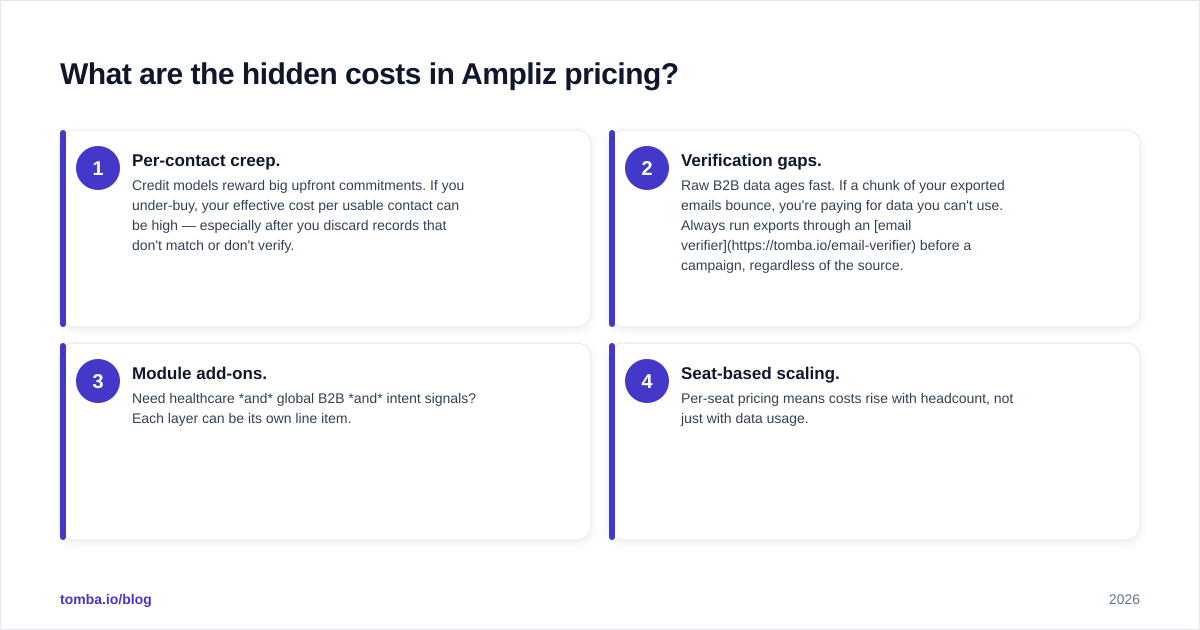
The sticker price is only part of what you pay. With quote-based data tools, the budget surprises usually come from four places:
- Per-contact creep. Credit models reward big upfront commitments. If you under-buy, your effective cost per usable contact can be high — especially after you discard records that don't match or don't verify.
- Verification gaps. Raw B2B data ages fast. If a chunk of your exported emails bounce, you're paying for data you can't use. Always run exports through an email verifier before a campaign, regardless of the source.
- Module add-ons. Need healthcare and global B2B and intent signals? Each layer can be its own line item.
- Seat-based scaling. Per-seat pricing means costs rise with headcount, not just with data usage.
The practical lesson: when you get an Ampliz quote, ask for the effective cost per verified, usable contact — not the headline credit price. That single question reframes the whole negotiation.
How does Ampliz pricing compare to alternatives?#
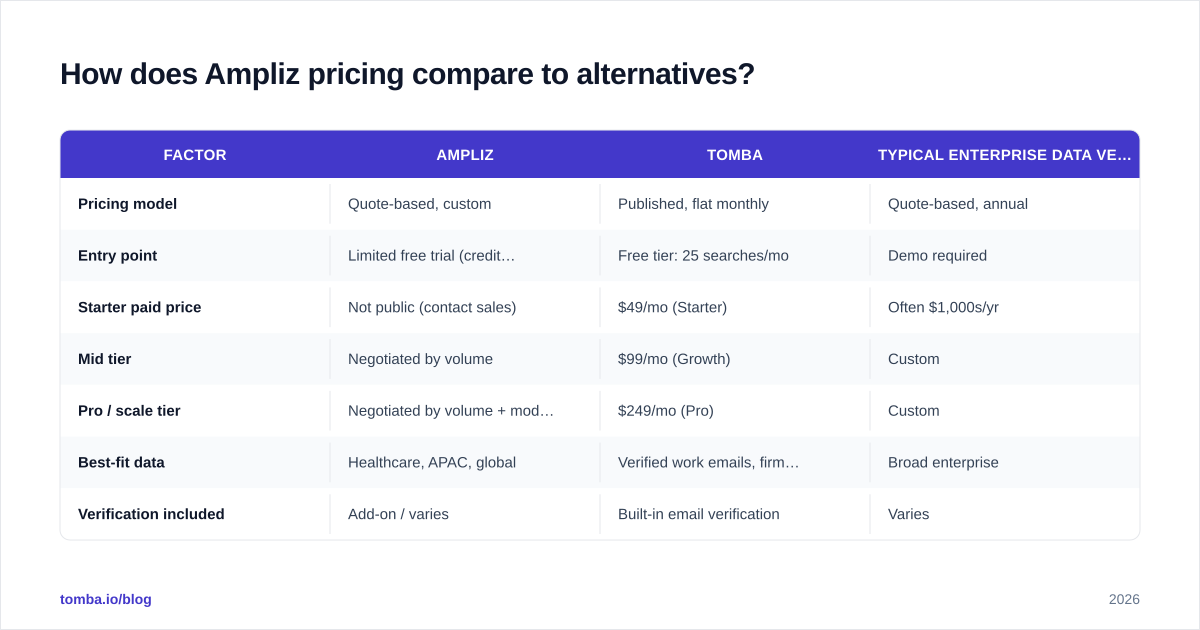
Here's a side-by-side of how Ampliz stacks up against transparent, self-serve options. Note that Ampliz figures are quote-based, so the comparison is about pricing model and fit, not exact dollars.
| Factor | Ampliz | Tomba | Typical enterprise data vendor |
|---|---|---|---|
| Pricing model | Quote-based, custom | Published, flat monthly | Quote-based, annual |
| Entry point | Limited free trial (credits) | Free tier: 25 searches/mo | Demo required |
| Starter paid price | Not public (contact sales) | $49/mo (Starter) | Often $1,000s/yr |
| Mid tier | Negotiated by volume | $99/mo (Growth) | Custom |
| Pro / scale tier | Negotiated by volume + modules | $249/mo (Pro) | Custom |
| Best-fit data | Healthcare, APAC, global | Verified work emails, firmographics | Broad enterprise |
| Verification included | Add-on / varies | Built-in email verification | Varies |
| Time to first value | Sales cycle | Same day, self-serve | Weeks |
A few honest takeaways:
- Ampliz wins on specialty data. If you sell into hospitals, clinics, or APAC markets, its database depth can justify the opaque pricing. That's a real, defensible reason to pay more.
- Flat-rate tools win on predictability. When you can read Tomba pricing on a page and self-serve the same afternoon, budgeting and onboarding are dramatically simpler.
- Enterprise vendors win on breadth, lose on speed. They cover everything but make you sit through a sales cycle for it.

When is Ampliz worth the price?#
Ampliz earns its premium in specific situations. Use this quick framework:
Choose Ampliz when:
- Your ICP is healthcare (providers, payers, med-device buyers) and you need clinically accurate titles and affiliations.
- You're selling into APAC or global markets where US-first tools have thin coverage.
- You have a defined budget for data and a sales motion that monetizes high-value, hard-to-find contacts.
- You're comfortable with a vendor relationship — quarterly business reviews, custom exports, account management.
Skip Ampliz when:
- You mostly need verified work emails by name and domain for general B2B outreach.
- You want transparent, self-serve pricing you can scale up or down without renegotiating.
- You're a startup or small team that needs to prove ROI this month, not after a procurement cycle.
- Your volume is spiky — credit commitments punish irregular usage.
If you landed in the "skip" column on two or more points, a transparent email-finding and enrichment stack will almost certainly cost less and onboard faster.
What's the cheaper alternative for everyday prospecting?#
For the majority of teams whose real need is "find a verified email for this person at this company, then enrich it," a flat-rate tool is the rational choice. This is where Tomba fits.
With Tomba you get published pricing and a self-serve workflow:
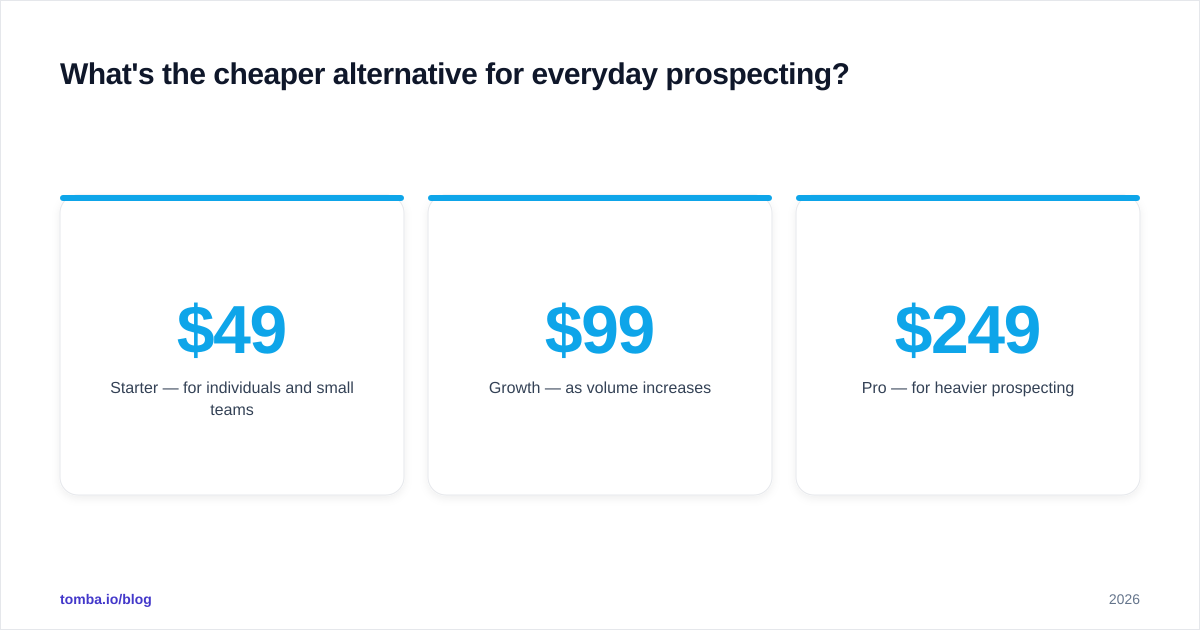
- Free tier — 25 searches/month, no sales call.
- Starter — $49/mo for individuals and small teams.
- Growth — $99/mo as volume increases.
- Pro — $249/mo for heavier prospecting.
- Enterprise — custom when you genuinely need bespoke terms.
Functionally, the day-to-day jobs map cleanly:
- Use the email finder to get a professional address from a name and domain.
- Run results through the email verifier so you don't pay (in deliverability) for stale data.
- Use data enrichment to append firmographic and contact detail to your CRM records.
The trade-off is honest: Tomba is not a specialized healthcare database, and it won't replace Ampliz for a team whose entire motion depends on clinical contact depth. But for general B2B email finding and enrichment — which is what most teams actually do most days — the flat, readable pricing removes the biggest friction of the Ampliz model.
How should you evaluate any quote-based data tool?#
Whether you end up with Ampliz, Tomba, or something else, run every option through the same checklist before you commit budget:
- Test data quality first. Use the free trial or free tier on your ICP, not a generic demo list. Reveal 25–50 contacts and measure how many are accurate and deliverable.
- Calculate cost per usable contact. Take the quote (or subscription), divide by the contacts you'll actually use after verification. This is the only number that compares tools fairly.
- Check verification. Is it built in, or another line item? Unverified data is a hidden cost wearing a discount's clothing.
- Match coverage to your ICP. Specialty data (healthcare, APAC) is worth a premium only if your ICP lives there. Otherwise you're paying for breadth you won't touch.
- Demand exit clarity. Quote-based annual contracts can be sticky. Know your renewal terms and export rights before signing.
Run those five steps and the "is Ampliz pricing worth it?" question usually answers itself within a week — long before a contract is on the table.
Frequently asked questions about Ampliz pricing#
Is Ampliz pricing public? No. Ampliz uses a quote-based model, so you request a demo or contact sales for a custom number based on volume, modules, and seats.
Does Ampliz have a free version? It offers a limited free entry point (credits through SalesBuddy) so you can test data quality before buying.
Why is Ampliz more expensive than a standard email finder? You're paying for specialized healthcare and global/APAC data depth, plus an account-managed vendor relationship — not just an email lookup.
What's the most predictable alternative? A flat-rate tool with published tiers. Tomba, for example, runs Free, then $49, $99, and $249/mo, so you can budget without a sales cycle.
The bottom line#
Ampliz pricing rewards a specific buyer: teams selling into healthcare or global markets that need data depth they can't get elsewhere, and that have the budget and patience for a quote-based, account-managed relationship. For that buyer, the opacity is a fair trade for specialty data.
For everyone else — teams that mostly need verified work emails, clean enrichment, and a number they can read off a page — the math favors transparency. If that's you, start free with the Tomba Email Finder: find professional emails by name, domain, or company, verify them in the same workflow, and scale on flat monthly pricing instead of a negotiation. You'll know exactly what you're paying, today, before you send a single email. You can compare the Tomba plans in about a minute — which is roughly the time it takes to book an Ampliz demo call.
// get started
Find, verify and enrich your first contacts today
Start on the free plan with 25 searches a month, then scale when your team is ready.
Free plan · No credit card required · GDPR & CCPA
// about the author