Ampliz vs AroundDeal 2026: Which B2B Data Tool Wins?
Ampliz vs AroundDeal compared on data accuracy, APAC coverage, pricing, and email verification — plus where each one quietly falls short in 2026.
Picking between Ampliz and AroundDeal usually comes down to one question that neither vendor's homepage answers cleanly: whose contact data actually lands in inboxes, and at what cost. Both promise millions of verified B2B records, Chrome extensions, and enrichment APIs. The difference shows up only when you push real records through them.
TL;DR#
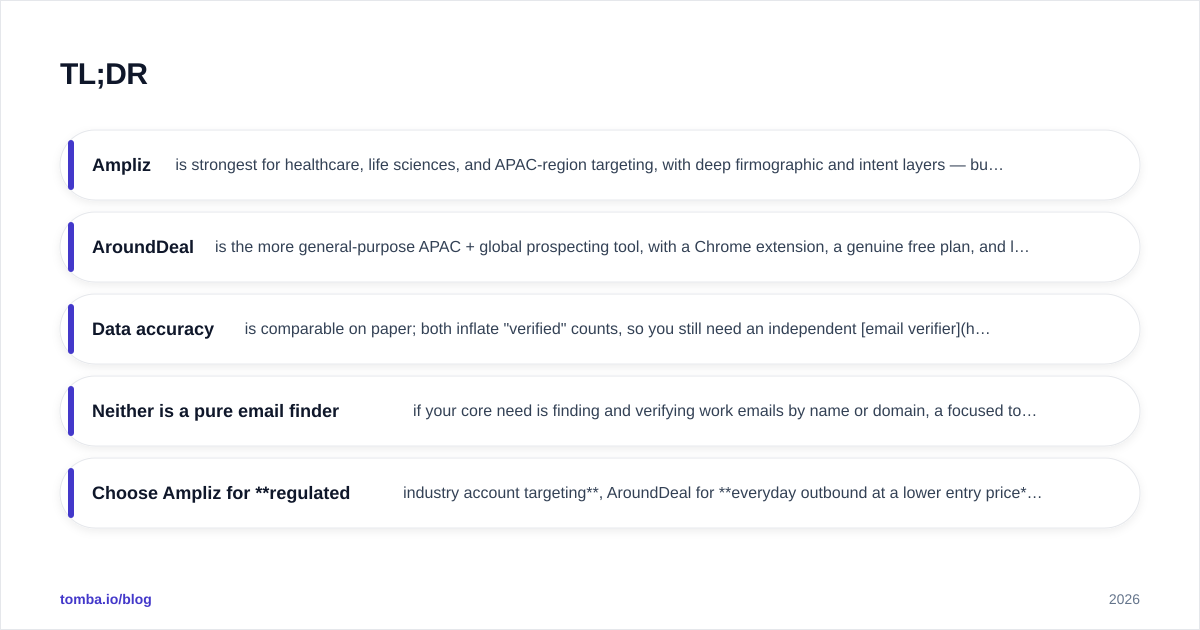
- Ampliz is strongest for healthcare, life sciences, and APAC-region targeting, with deep firmographic and intent layers — but it's priced for teams, not solo reps.
- AroundDeal is the more general-purpose APAC + global prospecting tool, with a Chrome extension, a genuine free plan, and lighter pricing.
- Data accuracy is comparable on paper; both inflate "verified" counts, so you still need an independent email verifier before any send.
- Neither is a pure email finder — if your core need is finding and verifying work emails by name or domain, a focused tool like Tomba is cheaper and more accurate per credit.
- Choose Ampliz for regulated-industry account targeting, AroundDeal for everyday outbound at a lower entry price, and a dedicated finder when deliverability is the whole game.
What are Ampliz and AroundDeal?#
Think of both as contact databases with a browser overlay — like two competing phone books that also follow you onto LinkedIn and whisper email addresses while you browse.
Ampliz markets itself as a sales and marketing intelligence platform with a particular reputation in healthcare and life sciences data (the "Ampliz Healthcare Intelligence" product line) and broad Asia-Pacific coverage. It leans toward account-based targeting: firmographics, technographics, intent signals, and contact discovery bundled together.
AroundDeal is a B2B contact and company database that grew out of strong APAC coverage and now spans global records. It's built around a Chrome extension for LinkedIn prospecting, list building, and enrichment, with a workflow that feels closer to Apollo or Lusha than to a heavyweight ABM suite.
The overlap is real: both surface emails and phone numbers, both enrich CRM records, both offer APIs. The divergence is in depth versus breadth — Ampliz goes deep on specific verticals and regions, AroundDeal goes wide and cheap.
How do Ampliz and AroundDeal compare at a glance?#
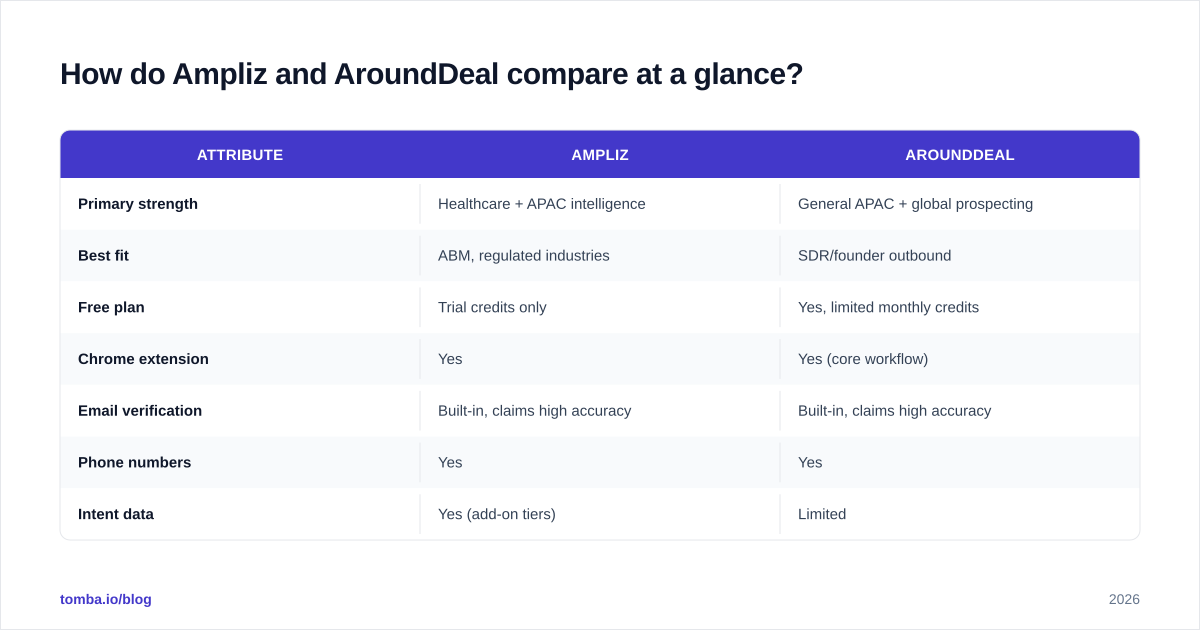
| Attribute | Ampliz | AroundDeal |
|---|---|---|
| Primary strength | Healthcare + APAC intelligence | General APAC + global prospecting |
| Best fit | ABM, regulated industries | SDR/founder outbound |
| Free plan | Trial credits only | Yes, limited monthly credits |
| Chrome extension | Yes | Yes (core workflow) |
| Email verification | Built-in, claims high accuracy | Built-in, claims high accuracy |
| Phone numbers | Yes | Yes |
| Intent data | Yes (add-on tiers) | Limited |
| Entry price (verify current) | Higher, team-oriented quotes | Lower, self-serve plans |
| API access | Yes | Yes |
Treat the pricing rows as directional. Both vendors gate exact numbers behind sales calls or change them quarterly, so confirm on Ampliz's site and AroundDeal's site before you commit. The structural point holds: AroundDeal is the lower-friction, lower-cost entry, while Ampliz is sold as a heavier platform.
Whose data is more accurate?#
Short answer: close enough that "accuracy" alone shouldn't decide it — and both numbers are softer than the marketing implies.
Every B2B database quotes a headline like "95% accurate." That figure usually measures whether a record matched at the time of collection, not whether the email still resolves today. People change jobs, domains rebrand, and catch-all servers accept everything without confirming a real mailbox exists. By the time a record reaches your sequence, decay has already started.

In practice, the gap between Ampliz and AroundDeal on a given list is rarely large. What varies is where each is strong:
- Ampliz tends to win on niche healthcare titles and on APAC mid-market firms where its sourcing is concentrated.
- AroundDeal tends to win on volume — more records returned per search across general industries — at the cost of more guessed or stale entries on the long tail.
The honest move with either tool is to never trust the "verified" badge on faith. Export the list, run it through an independent email verification pass, and especially flag catch-all domains with a dedicated catch-all verifier before you load anything into a sender. That single step protects your domain reputation more than choosing the "right" database ever will.

Is Ampliz better for healthcare and APAC targeting?#
Yes — that's its clearest advantage. If your ICP includes hospitals, clinics, pharma, medical device buyers, or APAC enterprise accounts, Ampliz's vertical depth is a real differentiator. Its healthcare datasets carry specialty, NPI-style identifiers, and decision-maker mapping that a general database simply doesn't model.
That depth comes with a cost profile aimed at marketing and ABM teams rather than individual reps. You're paying for intent data, firmographic filters, and account-level enrichment — useful if you run multi-touch campaigns against a defined account list, overkill if you just need a few hundred verified emails this month.
If you want to understand the broader category mechanics first, the concept of a marketing qualified lead is worth grounding before you pay for intent signals you won't action.
Is AroundDeal better for everyday prospecting?#
For most SDRs, founders, and small teams, AroundDeal is the easier yes. Three reasons:
- A real free plan. You can test coverage on your actual ICP without a sales call. Credits are limited, but they're enough to judge match rates.
- Extension-first workflow. The Chrome extension turns LinkedIn browsing into list building, which is how most reps actually prospect day to day.
- Lower entry price. Self-serve tiers mean you're not negotiating an annual contract to send 500 emails a week.
The trade-off is breadth over precision. On general-industry searches you'll get more records, but a larger share will be guesses, role-based addresses (info@, sales@), or contacts who left months ago. That's manageable — if you verify before sending.
How do pricing and free tiers stack up?#
Pricing is where the two genuinely diverge, and where a third option starts to look attractive.
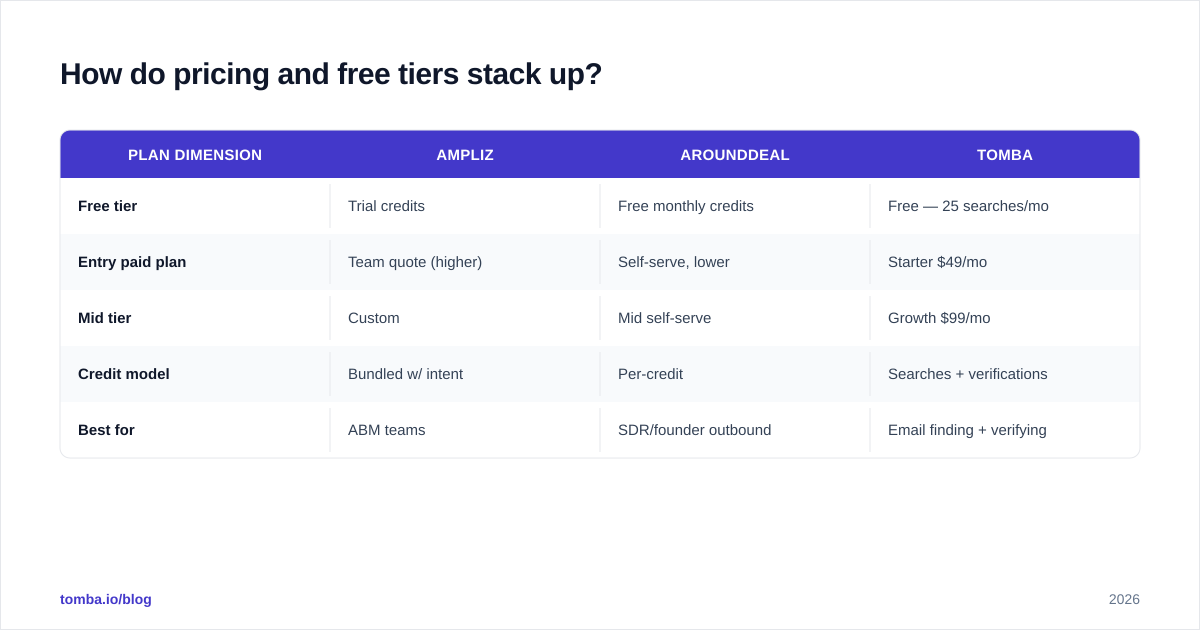
| Plan dimension | Ampliz | AroundDeal | Tomba |
|---|---|---|---|
| Free tier | Trial credits | Free monthly credits | Free — 25 searches/mo |
| Entry paid plan | Team quote (higher) | Self-serve, lower | Starter $49/mo |
| Mid tier | Custom | Mid self-serve | Growth $99/mo |
| Credit model | Bundled w/ intent | Per-credit | Searches + verifications |
| Best for | ABM teams | SDR/founder outbound | Email finding + verifying |
A few honest caveats. Ampliz rarely publishes flat self-serve pricing, so "higher" reflects its team-platform positioning rather than a single sticker number. AroundDeal's per-credit math gets expensive fast at volume, even though the entry point is friendly. And if email finding plus verification is 80% of what you need, a focused tool priced like Tomba's plans — $49/mo Starter, $99/mo Growth — often beats paying platform rates for features you won't touch.

What about email verification and deliverability?#
This is the section that should actually change your behavior, regardless of which tool you pick.
Both Ampliz and AroundDeal verify emails internally and report a status. That's table stakes — but internal verification has a conflict of interest: the same system that found the email grades whether it's valid. An optimistic grade keeps your usage (and renewal) high. It does nothing for your sender reputation when half the "valid" addresses bounce.
Deliverability lives or dies on a few mechanics that no contact database controls for you:
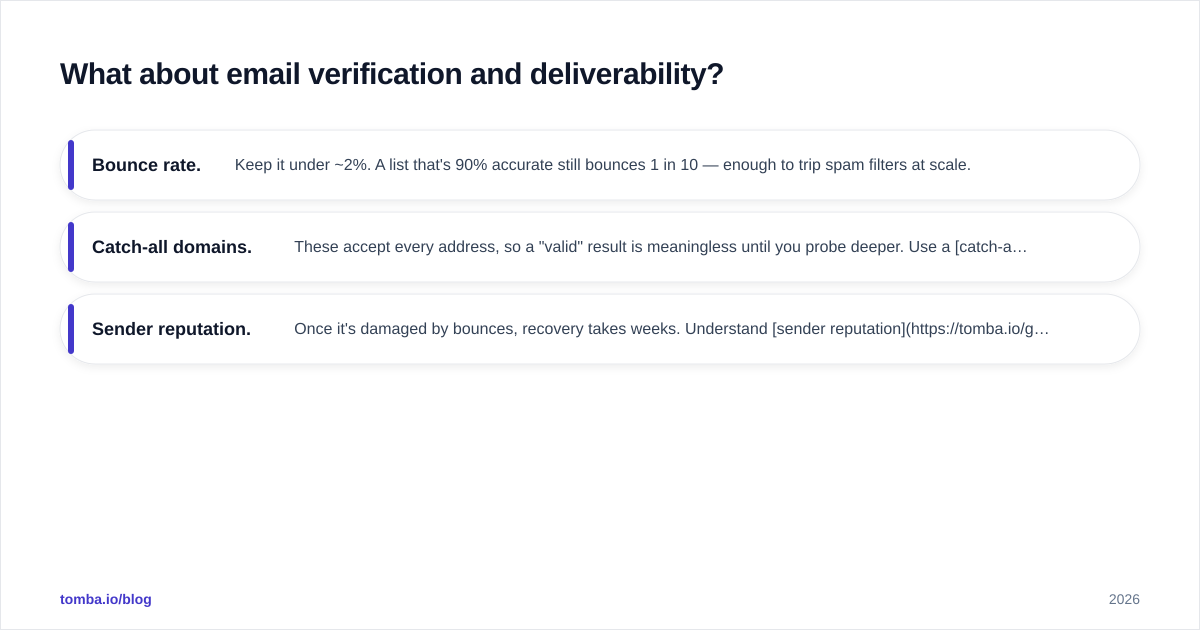
- Bounce rate. Keep it under ~2%. A list that's 90% accurate still bounces 1 in 10 — enough to trip spam filters at scale.
- Catch-all domains. These accept every address, so a "valid" result is meaningless until you probe deeper. Use a catch-all verifier before trusting them.
- Sender reputation. Once it's damaged by bounces, recovery takes weeks. Understand sender reputation before you scale sends.
The reliable pattern: use Ampliz or AroundDeal to source contacts, then run a separate verification layer to qualify them. Treating the database's own grade as final is the most common reason good lists produce bad results. Pair sourcing with independent data enrichment and verification, and your deliverability stops depending on which vendor you trusted.
Which should you choose: Ampliz or AroundDeal?#
Decide by your ICP and your budget shape, not by feature-count bingo:
- Choose Ampliz if you sell into healthcare, life sciences, or APAC enterprise accounts, run account-based campaigns, and have a marketing budget that justifies intent data and firmographic depth.
- Choose AroundDeal if you're a rep, founder, or small team doing LinkedIn-driven outbound, want a free plan to test first, and need a low monthly entry price more than vertical depth.
- Choose neither as your finder if your real job is finding and verifying work emails by name or domain at predictable cost — that's a specialized task, and a focused tool does it better per dollar.
The mistake is buying a broad intelligence platform to solve a narrow finding-and-verifying problem. You end up paying ABM prices for an email lookup you run a few hundred times a month.
Where does Tomba fit in the Ampliz vs AroundDeal decision?#
Tomba isn't trying to be a full sales-intelligence suite — and that's the point. If the core job is turning a name and a company into a verified, send-safe email, a dedicated email finder plus domain search does it with higher per-credit accuracy and transparent pricing: a free tier with 25 searches/month, Starter at $49/mo, and Growth at $99/mo. You can run found contacts straight through built-in email verification, flag catch-alls, and export clean lists — without the platform overhead.
A practical setup many teams land on: keep AroundDeal or Ampliz for discovery and account context where their regional depth helps, then route every contact through Tomba's finder and verifier as the deliverability gate before anything reaches your sequencer. You get the breadth of a database and the precision of a specialist — and your bounce rate, not a vendor's badge, tells you it worked.
Start with Tomba's Email Finder on the free tier, verify a sample of your current Ampliz or AroundDeal list, and let the bounce numbers settle the debate for your data, not someone else's benchmark.
Ready to find emails that actually work?
Join 150,000+ professionals who stopped guessing and started sending. Free credits on signup — no credit card required.
Get the Tomba newsletter
Practical outbound tactics and product updates — once every two weeks.
About the author