Ampliz vs Atompark Software: Which B2B Tool Wins in 2026?
Ampliz sells B2B contact data; Atompark sells bulk email software. They solve different problems—here's how they compare on features, pricing, and real fit for 2026.
Ampliz vs Atompark Software is one of those matchups that confuses buyers because the two products barely overlap. One sells you contacts. The other sells you a way to email contacts you already have. Picking between them as if they were interchangeable is how teams end up paying for two tools and using neither well.
This guide breaks down what each platform actually does, where they fit in a modern outbound stack, what they cost, and which one (if either) belongs in your 2026 budget.
TL;DR#
- Ampliz is a B2B data intelligence and contact-discovery platform, strongest in healthcare and APAC data. You use it to find prospects.
- Atompark Software is a long-running maker of desktop bulk-email tools (Atomic Mail Sender, Atomic Email Hunter, and related apps). You use it to send mail or scrape addresses at volume.
- They are not direct competitors. Ampliz feeds the top of your funnel; Atompark sits near the sending layer.
- For most B2B teams in 2026, neither is a complete solution — accuracy, deliverability, and compliance gaps push you toward a verified email-finder plus a reputable sending platform.
- If your core problem is finding accurate, deliverable contacts, a dedicated finder like Tomba is a closer fit than either tool.
What is Ampliz?#
Ampliz is a B2B data platform built around contact and company intelligence. Its pitch is access to a large database of business profiles with firmographic and technographic filters, plus a "data concierge" service for custom list requests. The company leans hard into healthcare intelligence (physicians, hospitals, decision-makers) and has solid coverage in Asia-Pacific markets where many US-centric tools thin out.
In practice you use Ampliz to build targeted prospect lists: filter by industry, geography, job title, company size, and tech stack, then export contacts into your CRM or outreach tool. It also offers enrichment — taking a partial record and filling in missing fields like email, phone, or company data.
The trade-off with any large prebuilt database is freshness. Contact data decays roughly 2-3% per month as people change jobs, so a list that looked great in Q1 is meaningfully stale by Q4. Ampliz competes on coverage and niche depth, not on real-time verification.
What is Atompark Software?#
Atompark Software is a Cyprus-based developer that has shipped Windows email utilities for two decades. Its best-known products are Atomic Mail Sender (a desktop bulk-email client), Atomic Email Hunter (a web/email scraper that extracts addresses from websites and search engines), Atomic Email Verifier, and a hosted service called MassMailer/eSputnik in some regions.
The core idea is volume sending and address harvesting from your own machine, often with a one-time license rather than a subscription. That model appeals to people who dislike SaaS pricing and want to "own" the software.
But the category it belongs to — desktop bulk senders and scrapers — has aged badly. Modern inbox providers (Gmail, Outlook) authenticate senders aggressively, and mail blasted from a desktop IP with scraped lists lands in spam or gets the sending domain blacklisted fast. Atompark still has users, but the deliverability landscape it was built for no longer exists in the same form.
How do Ampliz and Atompark Software compare?#
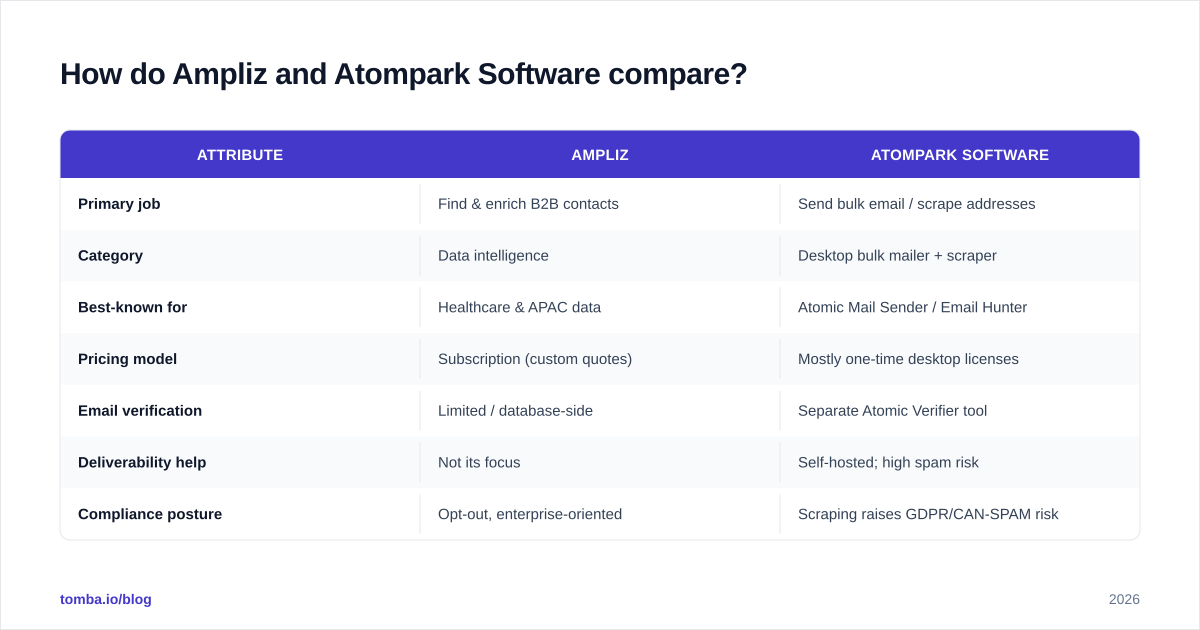
Here is the honest side-by-side. Notice that several rows are "not applicable" — that gap is the whole point. These tools live in different parts of the funnel.
| Attribute | Ampliz | Atompark Software |
|---|---|---|
| Primary job | Find & enrich B2B contacts | Send bulk email / scrape addresses |
| Category | Data intelligence | Desktop bulk mailer + scraper |
| Best-known for | Healthcare & APAC data | Atomic Mail Sender / Email Hunter |
| Pricing model | Subscription (custom quotes) | Mostly one-time desktop licenses |
| Email verification | Limited / database-side | Separate Atomic Verifier tool |
| Deliverability help | Not its focus | Self-hosted; high spam risk |
| Compliance posture | Opt-out, enterprise-oriented | Scraping raises GDPR/CAN-SPAM risk |
| Ideal user | SDRs, demand gen, healthcare sales | Solo senders, legacy volume mailers |
| API access | Yes | Limited |
The takeaway: comparing them feature-for-feature is mostly apples to oranges. The real question isn't "which is better" but "which job am I trying to do?"
Which one should you choose for prospecting?#
Choose based on the job, not the brand.
If you need to find net-new contacts, Ampliz is the more relevant of the two — especially for healthcare or APAC territories where its database genuinely outperforms generalist tools. It is not the right buy for a US tech SaaS team where Apollo, ZoomInfo, or a focused email finder will give you fresher, more verifiable data.
If you already have a clean, opted-in list and just need to send, Atompark's desktop sender can technically do the job. But "technically" is doing heavy lifting. Sending volume mail from a desktop app in 2026 fights every deliverability signal modern inbox providers reward. A proper ESP (with authenticated domains, warmup, and reputation monitoring) is safer and not much more expensive. See the email deliverability fundamentals before you blast anything.
If your problem is address scraping, Atomic Email Hunter will pull emails off pages — but scraped addresses are unverified, often role-based or stale, and harvesting them creates real exposure under GDPR and CAN-SPAM. You trade a small upfront cost for a large downstream risk to your sending domain.
What does each tool cost?#
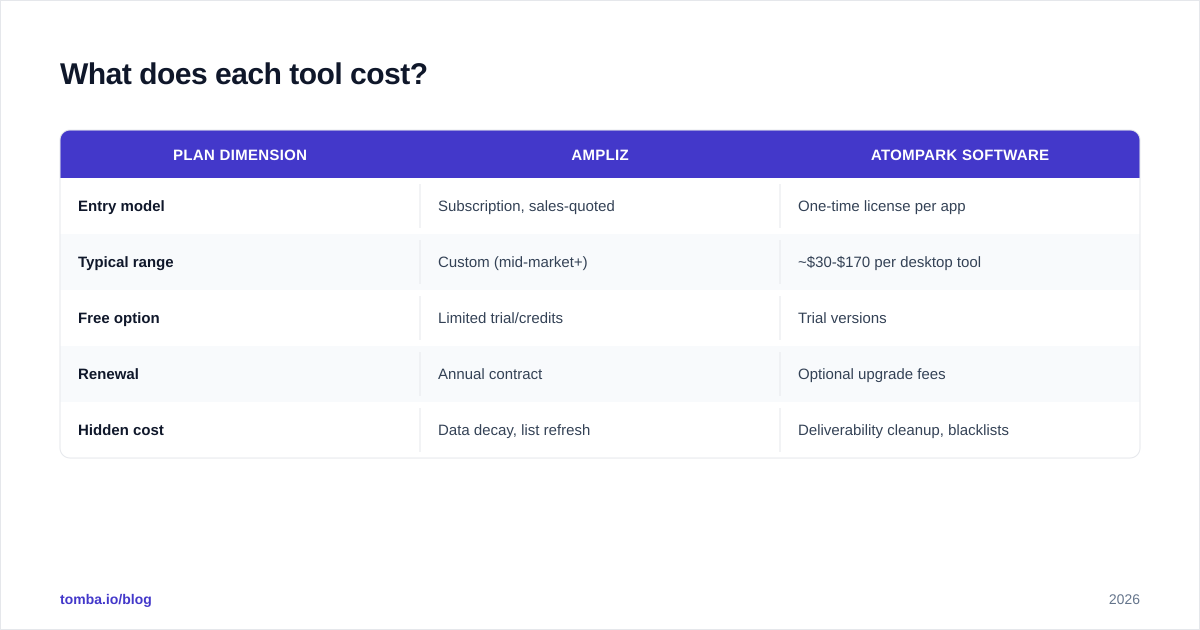
Pricing is where the two diverge sharply, and where you should read the fine print.
| Plan dimension | Ampliz | Atompark Software |
|---|---|---|
| Entry model | Subscription, sales-quoted | One-time license per app |
| Typical range | Custom (mid-market+) | ~$30-$170 per desktop tool |
| Free option | Limited trial/credits | Trial versions |
| Renewal | Annual contract | Optional upgrade fees |
| Hidden cost | Data decay, list refresh | Deliverability cleanup, blacklists |
Atompark looks cheaper because a desktop license is a one-time number. The real cost shows up later: deliverability remediation, domain reputation repair, and the labor of cleaning scraped lists. Ampliz costs more upfront but bundles ongoing data access — though you still pay the hidden tax of decay and re-verification.
Compare both against transparent, usage-based Tomba pricing: a free tier with 25 searches/mo, Starter at $49/mo, Growth at $99/mo, and Pro at $249/mo. Predictable per-search economics are easier to forecast than "request a quote" or "buy the license then fix the fallout."
You can cross-check current user sentiment and pricing notes on independent directories like G2 and Capterra before committing.
How do they fit into a modern outbound stack?#
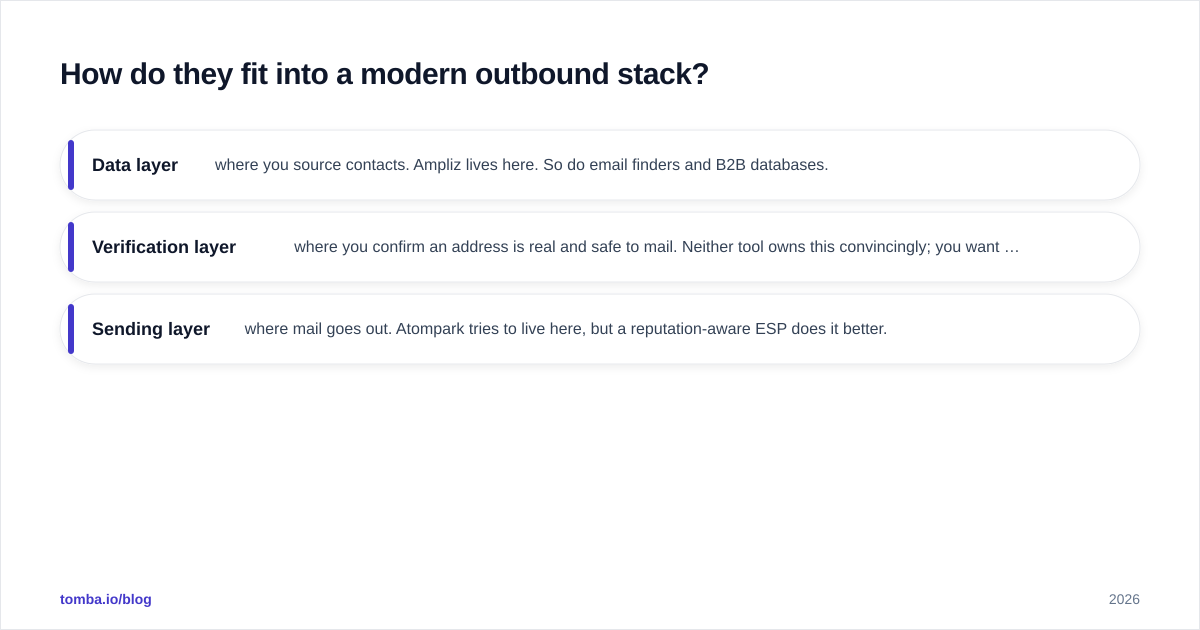
Think of B2B outreach as three layers, like building a house: you need a foundation (data), plumbing (verification), and the visible structure (sending and sequencing). No single tool here does all three well.
- Data layer — where you source contacts. Ampliz lives here. So do email finders and B2B databases.
- Verification layer — where you confirm an address is real and safe to mail. Neither tool owns this convincingly; you want a dedicated email verifier to strip bounces before they hurt your reputation.
- Sending layer — where mail goes out. Atompark tries to live here, but a reputation-aware ESP does it better.
The mistake teams make is buying a tool from one layer and assuming it covers the others. Ampliz won't fix your deliverability. Atompark won't give you accurate net-new contacts. Bolting verification in the middle — and enriching records with data enrichment — is what keeps the whole stack from leaking.
Is accuracy or deliverability the bigger risk?#
Both, and they compound each other.
Accuracy is the input problem. If Ampliz hands you a contact who left the company eight months ago, every downstream step is wasted — and worse, mailing a dead address signals low-quality sending to inbox filters. Database tools that don't verify at the moment of export pass this risk straight to you.
Deliverability is the output problem. If you push a list through Atompark's desktop sender without authenticated SPF, DKIM, and DMARC, you torch your domain reputation in days. Once you're on a blacklist, even your good mail stops landing. This is why the "cheap one-time license" math falls apart: the cost isn't the software, it's the recovery.
The defensive move is the same in both directions — verify before you send. A real-time verification step catches the stale records Ampliz exports and protects the reputation Atompark would otherwise put at risk. According to deliverability guidance echoed by providers like HubSpot, keeping bounce rates under 2% is the threshold most senders should hold.
Pros and cons at a glance#
Ampliz
- Pros: strong healthcare and APAC coverage, enrichment, data concierge, API access.
- Cons: opaque pricing, data decay, verification is not its strength, overkill for some segments.
Atompark Software
- Pros: one-time license, desktop ownership, simple for tiny volumes.
- Cons: deliverability risk, scraping compliance exposure, dated category, weak fit for 2026 inbox rules.
What's a better-fit alternative for most teams?#
If your actual goal is the most common one — find accurate, deliverable B2B email addresses and not get burned — a dedicated, verification-first email finder beats both a broad database and a desktop blaster.
That's where Tomba fits. The Tomba Email Finder lets you find professional email addresses by domain, name, or company, with verification built into the workflow rather than bolted on as a separate purchase. Alongside it sit a domain search, catch-all verifier, phone finder, and enrichment — so you cover the data and verification layers without stitching together mismatched tools. Compared to Ampliz, you get transparent per-search pricing and real-time verification; compared to Atompark, you get a finder that's designed around modern deliverability instead of fighting it.
You can pull Tomba data into your existing stack through the HubSpot integration, Sheets, or the API, which keeps the data layer feeding your CRM without manual CSV gymnastics.
How do I decide in 2026?#
Run these questions in order:
- Do I need contacts, or do I need to send? That single question tells you whether Ampliz (find) or a sender belongs in the conversation — they're rarely both the answer.
- Is my market healthcare or APAC? If yes, Ampliz earns a real look. If no, generalist finders likely beat it on price and freshness.
- Will I verify every address before sending? If you can't say yes, accuracy and deliverability will sink you regardless of tool.
- Am I comfortable with the compliance posture? Scraping addresses (Atompark Email Hunter) and mailing them is the riskiest path; opted-in, verified data is the safe one.
If you answered "I mostly need accurate, ready-to-mail contacts," skip the apples-to-oranges debate entirely. Start with the free tier of the Tomba Email Finder — 25 searches a month, no card — and verify your first list before you spend a cent on either Ampliz or Atompark. Find the right people, confirm they're reachable, and let your sending platform do what it does best.
For deeper reading, both vendors' official sites (Ampliz and Atompark) lay out their feature sets, and independent review platforms will show you what current users actually experience — read those before any contract.
// get started
Find, verify and enrich your first contacts today
Start on the free plan with 25 searches a month, then scale when your team is ready.
Free plan · No credit card required · GDPR & CCPA
// about the author