Ampliz vs Biscred 2026: B2B Data Platform Comparison
Ampliz targets healthcare and global B2B data; Biscred owns commercial real estate contacts. Here's an honest 2026 breakdown of accuracy, pricing, coverage, and which one fits your pipeline.
TL;DR
- Ampliz is a broad B2B data and sales-intelligence platform with a strong healthcare and APAC/global lean — good when you need physician, provider, and international contact data.
- Biscred is a vertical specialist for commercial real estate (CRE) — brokers, owners, developers, lenders, and property professionals. Outside CRE it has little to offer.
- Neither is a general-purpose email finder. Choose by niche fit first, accuracy second, price third.
- Expect to layer a verification and enrichment step on top of either one before you send — raw niche data still decays 2–3% per month.
- If your ICP is general B2B (SaaS, agencies, services), a horizontal finder like Tomba is usually cheaper and more accurate than forcing a vertical tool to stretch.
Why compare Ampliz and Biscred at all?#
These two tools rarely show up on the same shortlist — and that's exactly the point. People searching "ampliz vs biscred" are usually deciding between a broad data provider and a deep vertical one, and they want to know which model wins for their specific motion.
Here's the one-line answer: pick Biscred only if you sell into commercial real estate; pick Ampliz if you need healthcare or international B2B coverage; pick neither if your ICP is mainstream B2B. The rest of this post explains why, with concrete attributes you can check against your own pipeline.
Think of it like buying tires. Biscred is a winter tire — unbeatable on the one surface it's built for, mediocre everywhere else. Ampliz is an all-season tire — competent across more conditions, never the absolute best on any single one. The wrong question is "which is better?" The right question is "what road am I driving on?"
What is Ampliz?#
Ampliz is a B2B contact and company intelligence platform. Its calling card is healthcare data — physicians, hospitals, clinics, NPI-linked records — plus broader B2B firmographics with notably better APAC and global coverage than most US-centric tools.
Core capabilities:
- People & company search with firmographic and demographic filters
- Healthcare intelligence (specialty, license, affiliation, NPI)
- Email and phone enrichment via API and a Chrome extension
- Intent and technographic signals on higher tiers
Where Ampliz earns its keep is the combination of vertical depth in healthcare and geographic breadth. If you sell medical devices in Southeast Asia, very few horizontal tools will match it.
Where it frustrates: data freshness is uneven outside its strongest segments, the UI feels dated, and pricing is quote-driven, which slows down small teams that just want to swipe a card and start.
What is Biscred?#
Biscred is a commercial real estate data platform. It maps the CRE ecosystem — brokers, investors, owners, developers, lenders, property managers, and the firms they work for — and ties contacts to companies, asset types, and deal roles.
Core capabilities:
- CRE-specific search by role, asset class (office, multifamily, industrial, retail), and geography
- Verified contact data for hard-to-reach property professionals
- Company and relationship mapping within the CRE graph
- CRM and outreach integrations to push lists into your stack
Biscred's strength is obvious: it knows things about CRE professionals that a horizontal database simply doesn't model. The trade-off is equally obvious — it's a single-vertical tool. Ask it for a SaaS VP of Engineering or a Tokyo cardiologist and you've bought the wrong product.
Ampliz vs Biscred: how do they compare head-to-head?#
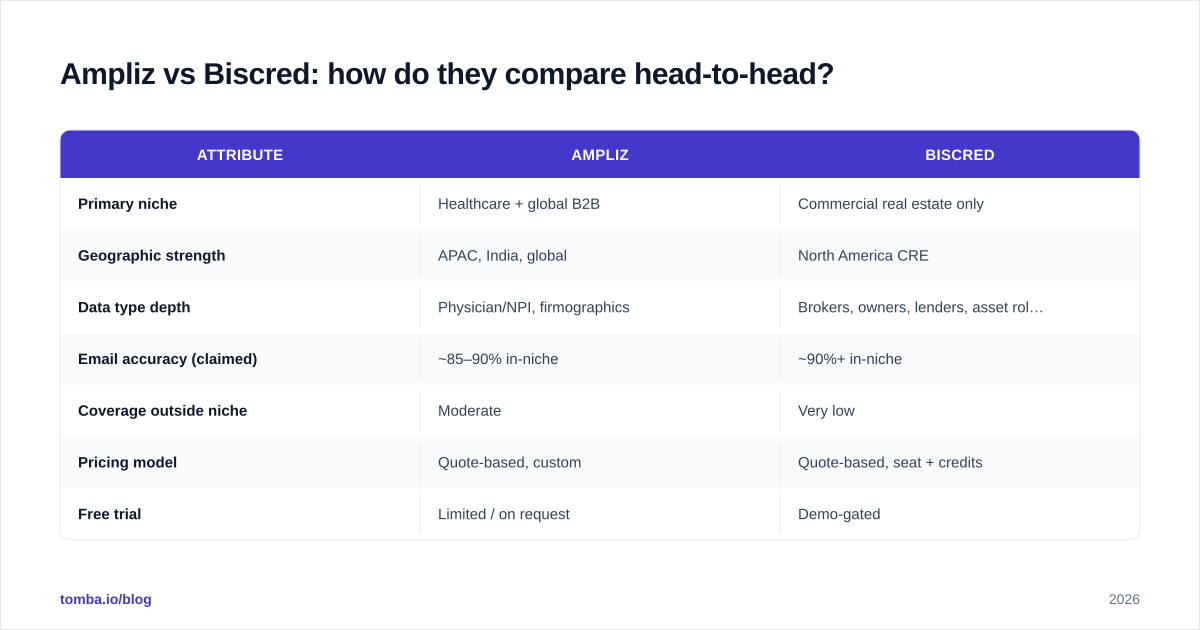
The fastest way to see the split is attribute by attribute. Treat the accuracy figures below as directional ranges based on vendor claims and public reviews on G2 — always run your own sample test before committing.
| Attribute | Ampliz | Biscred |
|---|---|---|
| Primary niche | Healthcare + global B2B | Commercial real estate only |
| Geographic strength | APAC, India, global | North America CRE |
| Data type depth | Physician/NPI, firmographics | Brokers, owners, lenders, asset roles |
| Email accuracy (claimed) | ~85–90% in-niche | ~90%+ in-niche |
| Coverage outside niche | Moderate | Very low |
| Pricing model | Quote-based, custom | Quote-based, seat + credits |
| Free trial | Limited / on request | Demo-gated |
| Best for | Medical, international outbound | CRE brokers & investors |
| Weakness | Uneven freshness, dated UI | Useless outside CRE |
The pattern is consistent: both tools are excellent inside their lane and weak outside it. Neither is a horizontal email finder, and trying to use either as one is where teams waste money.
Which one is more accurate?#
Inside its niche, Biscred tends to edge ahead — a tighter vertical with fewer records is easier to keep clean, and CRE contacts change roles less chaotically than, say, startup employees. Ampliz's healthcare records are strong too, but its broader global database carries more variance: excellent in some regions, thin in others.
But "accuracy" claims from any vendor are marketing until you test them. Two rules hold regardless of which tool you pick:
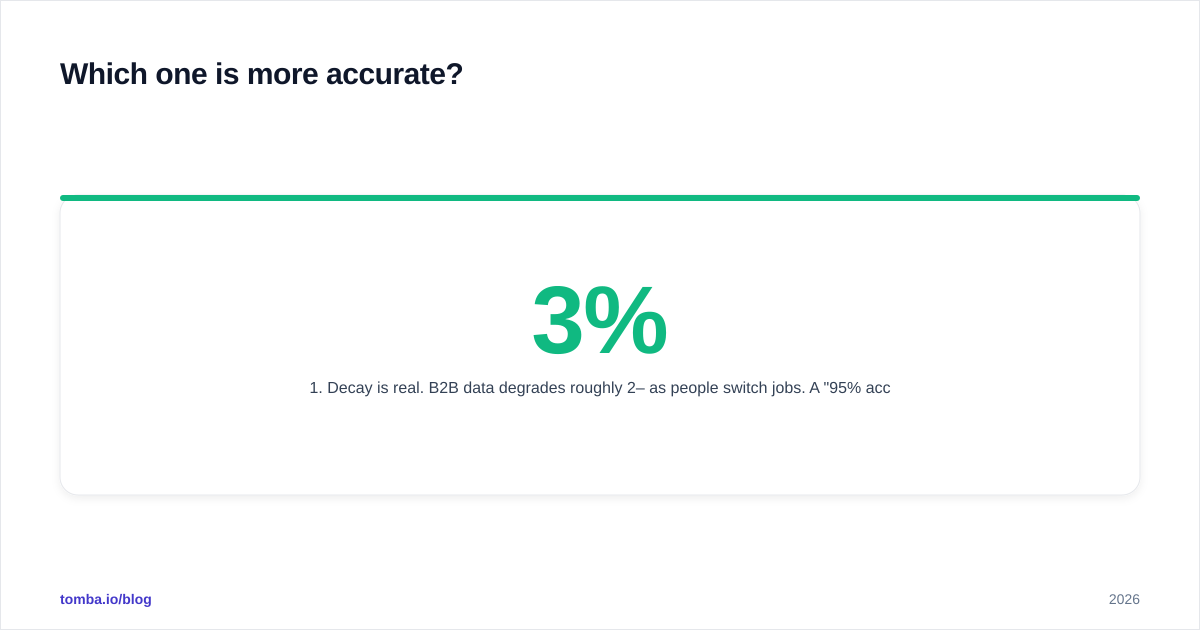
- Decay is real. B2B data degrades roughly 2–3% per month as people switch jobs. A "95% accurate" list is 80%-ish accurate a year later. Niche data decays slower but never stops.
- Catch-all domains hide bounces. Many corporate and CRE-firm domains accept every address at the SMTP layer, so a contact can look valid and still bounce.
That's why serious teams treat any provider — Ampliz, Biscred, or otherwise — as a source, not a guarantee. You pull the data, then run it through an independent email verifier before it touches your sending domain. For ambiguous corporate domains, a dedicated catch-all verifier saves your deliverability from silent bounces.
What does Ampliz vs Biscred pricing look like?#
Both vendors hide behind "request a demo," which is its own signal: expect annual contracts and sales calls, not self-serve checkout.
- Ampliz prices by credits and modules, with healthcare and global data often gated to higher tiers. Custom quotes scale with volume and API access.
- Biscred prices by seats plus contact credits, weighted toward teams that live in CRE prospecting daily.
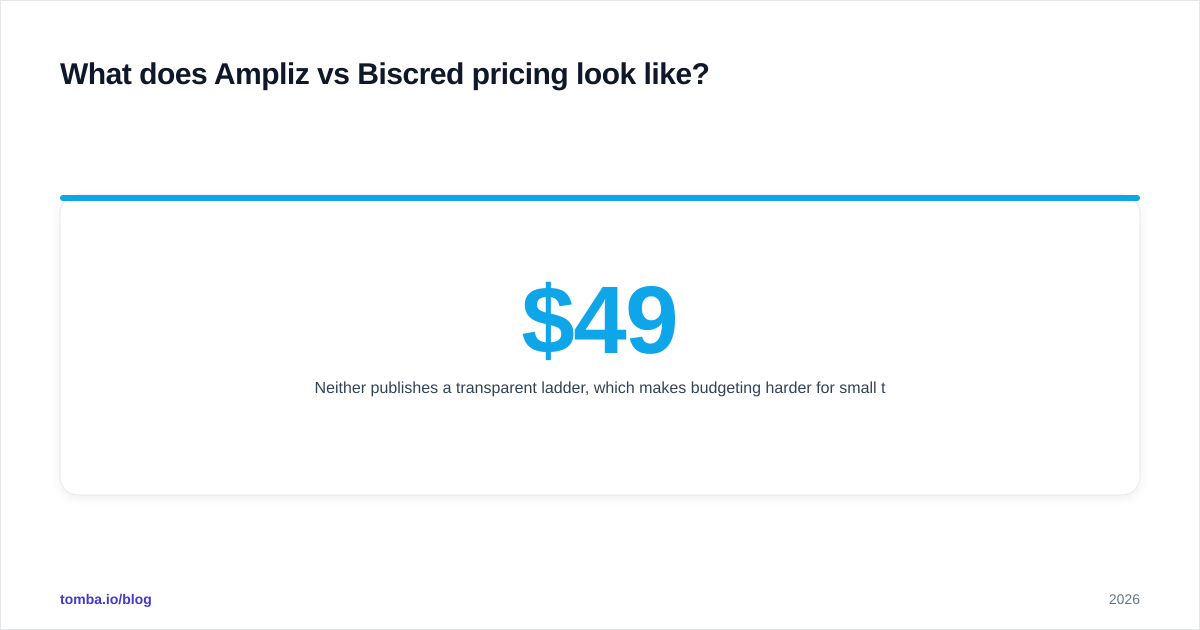
Neither publishes a transparent ladder, which makes budgeting harder for small teams. If predictable, published pricing matters to you, that's a point against both — and a reason to keep a self-serve horizontal tool in the mix. For reference, transparent Tomba pricing runs Free (25 searches/mo), Starter $49/mo, Growth $99/mo, and Pro $249/mo, with no sales call required to start.

When should you pick Ampliz?#
Choose Ampliz when:
- Your ICP is healthcare — providers, hospitals, medical device buyers, pharma.
- You're selling internationally, especially across APAC and India, where US-first databases go thin.
- You need NPI and specialty-level filtering that horizontal tools don't model.
- You can tolerate quote-based pricing and a less polished UI in exchange for niche depth.
Skip Ampliz if your buyers are mainstream B2B (SaaS, agencies, professional services). You'll pay for healthcare and global depth you never use, while a general finder returns fresher mainstream contacts.
When should you pick Biscred?#
Choose Biscred when:
- You sell into or around commercial real estate — proptech, lending, brokerage tools, construction, CRE services.
- You need asset-class and deal-role targeting (e.g., "multifamily investors in Texas").
- Your reps already work the CRE graph and want a database that mirrors it.
Skip Biscred the moment your ICP leaves CRE. It is the textbook case of a tool that is world-class at one job and irrelevant at every other one. There's no shame in that — it's the correct design for a vertical product — but it means Biscred is a line item only CRE teams should carry.
What if your ICP is general B2B?#
Then neither tool is your best primary source, and forcing one to fit is the most common mistake behind a "vs" search like this.
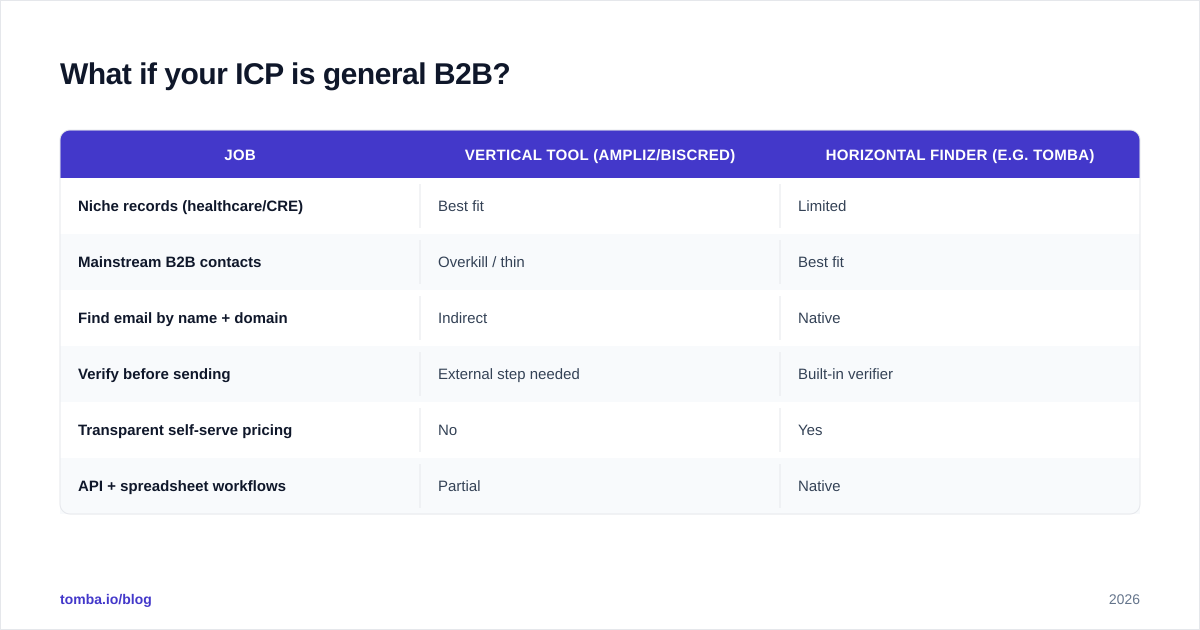
A horizontal email finder is built for exactly this case: find a verified work email from a name and company, or pull every contact at a domain, across any industry, without paying for vertical depth you don't need. This is the lane Tomba's email finder is built for, and it pairs cleanly with data enrichment to fill in titles, companies, and social profiles after the match.
A practical stack for mixed pipelines:
| Job | Vertical tool (Ampliz/Biscred) | Horizontal finder (e.g. Tomba) |
|---|---|---|
| Niche records (healthcare/CRE) | Best fit | Limited |
| Mainstream B2B contacts | Overkill / thin | Best fit |
| Find email by name + domain | Indirect | Native |
| Verify before sending | External step needed | Built-in verifier |
| Transparent self-serve pricing | No | Yes |
| API + spreadsheet workflows | Partial | Native |
The honest takeaway: vertical tools win their vertical; a horizontal finder wins the long tail. Most teams that sell broadly need the second, and only add the first when a specific niche justifies the contract.
How do you actually decide between Ampliz and Biscred?#
Run this three-step gate before you book a single demo:
- Niche test. Is 60%+ of your pipeline in healthcare/global (Ampliz) or commercial real estate (Biscred)? If no, stop — buy a horizontal tool instead.
- Sample test. Ask each vendor for 50–100 records matching your exact ICP. Push them through an independent verifier and measure the real valid rate, not the claimed one.
- Total-cost test. Add the contract price plus the verification/enrichment you'll layer on top. Compare that to a self-serve finder doing the same job for your mainstream segments.
Whichever side of "ampliz vs biscred" you land on, the verification step is non-negotiable. Niche data is a head start, not a finished list.
The bottom line#
Biscred wins commercial real estate. Ampliz wins healthcare and global B2B. Everyone else should reach for a horizontal finder first and add a vertical tool only when a niche earns its keep. Don't buy a winter tire for a summer road — match the data source to the road you actually drive.
If most of your prospecting is mainstream B2B and you want verified emails without a sales call or a single-vertical contract, start with the Tomba Email Finder. It returns work emails by name, domain, or company across every industry, ships with built-in verification so your bounce rate stays low, and runs on transparent pricing from a free tier up — so you can pressure-test it against any Ampliz or Biscred quote before you commit a budget.
// get started
Find, verify and enrich your first contacts today
Start on the free plan with 25 searches a month, then scale when your team is ready.
Free plan · No credit card required · GDPR & CCPA
// about the author