Ampliz vs Clodura.ai 2026: B2B Data Platform Comparison
Ampliz and Clodura.ai both promise accurate B2B contact data, but they serve different buyers. Here's an honest breakdown of accuracy, pricing, coverage, and which one wins for your outbound motion in 2026.
Choosing a B2B data provider usually comes down to one painful question: whose contacts are actually real, and whose are recycled from a 2019 scrape? Ampliz and Clodura.ai both sell themselves as accurate sales intelligence platforms, but they were built for different jobs. This comparison breaks down where each one earns its price tag and where it quietly falls short.
TL;DR — Ampliz vs Clodura.ai in 30 seconds#
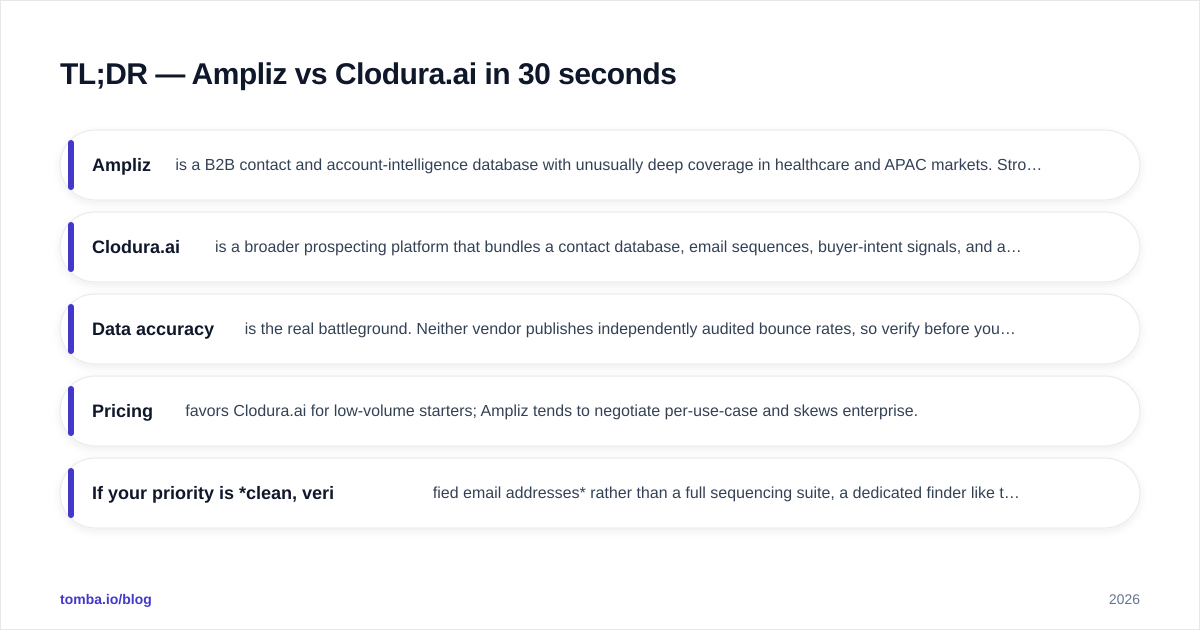
- Ampliz is a B2B contact and account-intelligence database with unusually deep coverage in healthcare and APAC markets. Strong for niche, ICP-specific list building; weaker as an all-in-one outbound engine.
- Clodura.ai is a broader prospecting platform that bundles a contact database, email sequences, buyer-intent signals, and a built-in dialer. Strong for teams that want database plus sending in one tab.
- Data accuracy is the real battleground. Neither vendor publishes independently audited bounce rates, so verify before you trust either one at scale.
- Pricing favors Clodura.ai for low-volume starters; Ampliz tends to negotiate per-use-case and skews enterprise.
- If your priority is clean, verified email addresses rather than a full sequencing suite, a dedicated finder like the Tomba Email Finder often beats both on cost-per-valid-contact.
What are Ampliz and Clodura.ai?#
Ampliz is a B2B data intelligence company best known for its healthcare and APAC datasets. It offers a contact database, account intelligence, and an "APAC Intelligence" product that profiles companies and decision-makers in markets where Western providers are notoriously thin. Sales and marketing teams use it to build targeted lists by firmographic and, in healthcare, by specialty, NPI, and facility type. You can review user feedback on Ampliz's G2 profile before committing.
Clodura.ai positions itself as an all-in-one sales prospecting platform. Alongside its contact and company database, it ships email-sequencing, buyer-intent data, org charts, a power dialer, and direct-dial discovery. The pitch is consolidation: find the prospect, verify the email, sequence the outreach, and dial — without leaving the tool. Its positioning and reviews live on the Clodura.ai homepage and G2.
The short version: Ampliz is a data source with niche depth. Clodura.ai is a workflow platform with a database attached. That distinction drives almost every other difference below.
How do Ampliz and Clodura.ai compare at a glance?#
Here is the head-to-head on the attributes that actually change a buying decision.
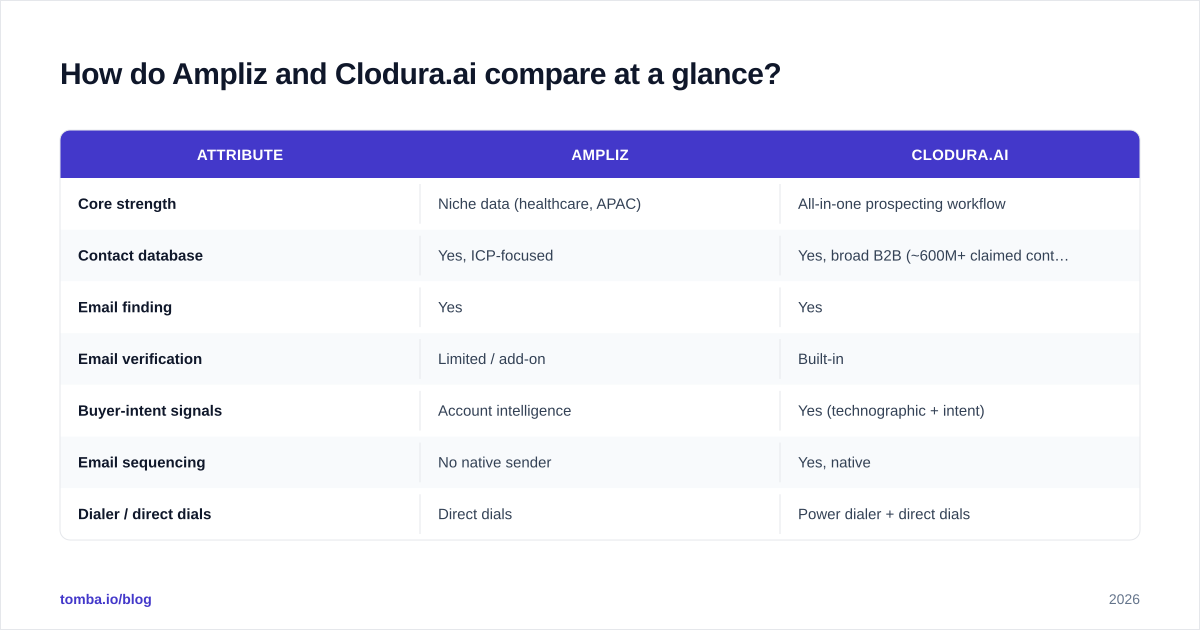
| Attribute | Ampliz | Clodura.ai |
|---|---|---|
| Core strength | Niche data (healthcare, APAC) | All-in-one prospecting workflow |
| Contact database | Yes, ICP-focused | Yes, broad B2B (~600M+ claimed contacts) |
| Email finding | Yes | Yes |
| Email verification | Limited / add-on | Built-in |
| Buyer-intent signals | Account intelligence | Yes (technographic + intent) |
| Email sequencing | No native sender | Yes, native |
| Dialer / direct dials | Direct dials | Power dialer + direct dials |
| Best-fit buyer | Healthcare & APAC teams | SMB/mid-market outbound teams |
| Free tier | Limited trial | Free plan available |
| Pricing transparency | Mostly quote-based | Published tiers + custom |
The pattern is clear. If you only need to enrich and target a very specific audience, Ampliz's depth can be worth the premium. If you need to find, verify, and send from one place, Clodura.ai covers more of the workflow out of the box.
Which has better data accuracy and coverage?#
Conclusion first: it depends entirely on your target market, and you should verify both before scaling. Neither vendor publishes third-party-audited deliverability numbers, so treat marketing claims as starting points, not guarantees.
Ampliz wins on depth in narrow segments. If you sell to hospitals, clinics, or APAC enterprises, its records frequently include fields generic databases miss — specialty codes, facility size, regional decision-makers. That specificity is the whole reason buyers tolerate quote-based pricing.
Clodura.ai wins on breadth. It advertises a very large global contact pool with technographic and intent layers, which is useful when your ICP is wide and you care more about volume than surgical precision. The trade-off with any large database is staleness: the bigger the pool, the more records drift out of date between refreshes.
The honest reality of B2B data is that every provider decays. People change jobs, domains migrate, catch-all servers hide invalid mailboxes. That is why the smartest teams treat any database — Ampliz, Clodura.ai, or otherwise — as a source and run a separate verification pass before sending. A standalone email verifier catches the bounces your provider's internal check missed, and a catch-all verifier handles the domains that silently accept everything.
Use a simple evaluation framework instead of trusting any single accuracy number:
Run a 200-record sample from each vendor against an independent verifier and measure cost per valid, deliverable contact — not headline database size. That single metric reorders most vendor shortlists.
How do pricing and plans stack up?#
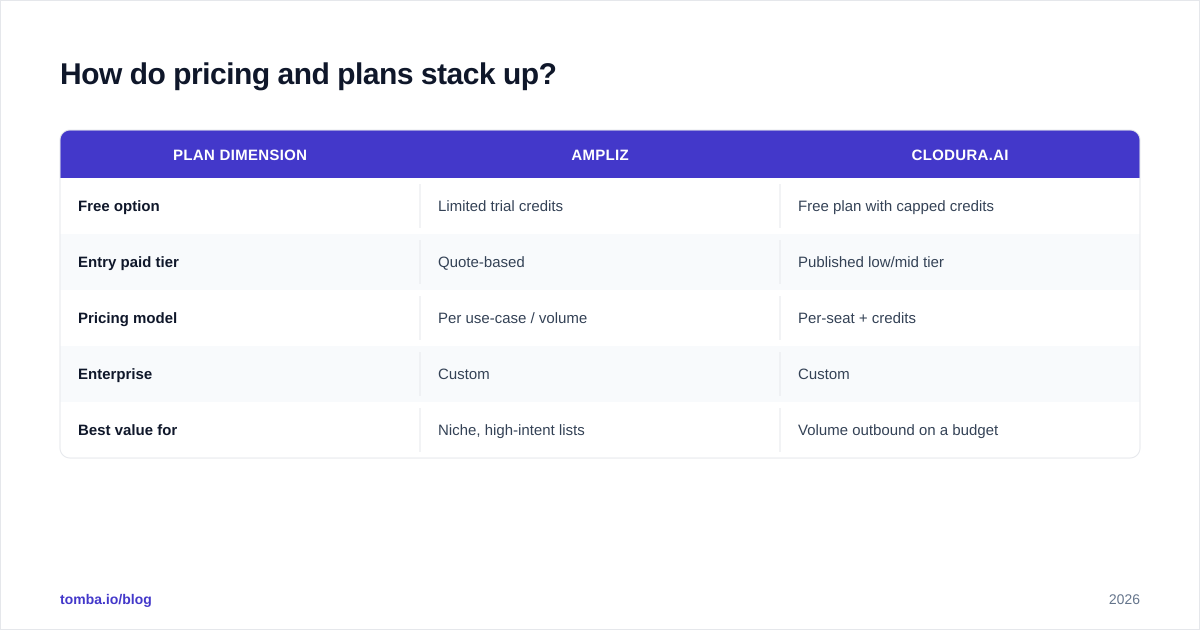
Pricing is where the two diverge most. Clodura.ai publishes tiered plans and offers a genuine free entry point, which lowers the risk of trying it. Ampliz leans toward custom quotes tied to your use case, data volume, and region — common for niche data vendors but harder to budget against.
| Plan dimension | Ampliz | Clodura.ai |
|---|---|---|
| Free option | Limited trial credits | Free plan with capped credits |
| Entry paid tier | Quote-based | Published low/mid tier |
| Pricing model | Per use-case / volume | Per-seat + credits |
| Enterprise | Custom | Custom |
| Best value for | Niche, high-intent lists | Volume outbound on a budget |
A practical note on budgeting: a low sticker price means little if half the records bounce. Always normalize on price per usable contact. A "cheaper" tool that delivers 60% deliverability can cost more per booked meeting than a pricier one at 90%. If you want a transparent, credit-based baseline to benchmark both vendors against, compare them to public Tomba pricing, which starts free (25 searches/month) and moves to a $49/month Starter tier.
Which fits cold outreach and email finding better?#
For pure outreach execution, Clodura.ai is the more complete tool because it sends. You can build a list, drop contacts into a sequence, and dial — all without exporting a CSV. For teams that want one login instead of five, that consolidation is the headline benefit.
Ampliz is not a sending platform. It feeds your existing stack. If you already run Outreach, Salesloft, Instantly, or your own SMTP setup, Ampliz becomes a high-quality input rather than a competitor to your sequencer. Healthcare and APAC teams often prefer this because they trust their existing sending infrastructure and just want better contacts going into it.
But here is the catch for both: a sequencer is only as good as the addresses you load into it. Bad data tanks your sender reputation, drives spam complaints, and silently kills deliverability long before you notice fewer replies. Whether you choose Ampliz or Clodura.ai, protect your domain by verifying lists and warming sends. Tomba's glossary explains why email deliverability hinges on list hygiene more than copy.
If email finding is genuinely your core need — you have your own outreach stack and just want accurate addresses by name and domain — a focused finder will usually out-perform a bundled database on cost and precision. That is the gap a dedicated tool like Tomba's domain search fills: point it at a company, get the verified addresses and patterns, skip the platform you only half-use.
What about integrations and workflow?#
Both tools integrate with mainstream CRMs and offer Chrome-extension-style capture, but they optimize for different ends of the workflow.
- Ampliz integrates as a data layer — push enriched records into your CRM and let your existing tools do the sending and tracking. It plays nicely when it is one component of a larger stack.
- Clodura.ai wants to be the stack. Its value compounds when you use the database, sequencer, intent data, and dialer together; use only the database and you are overpaying for unused modules.
Think about your team's actual maturity. A two-person SDR team with no sequencer benefits from Clodura.ai's consolidation. A RevOps-led org with a tuned sales automation stack often prefers Ampliz-style point data that slots into existing workflows without forcing a migration. There is no universal winner here — only fit.
A common, cost-effective pattern is to decouple data from sending entirely: pull contacts from your best-fit database, run them through independent verification and data enrichment, then load the clean file into whatever sequencer you already trust. This keeps you from being locked into one vendor's weakest module.
Ampliz vs Clodura.ai: which should you choose?#
Here is the decision, stated plainly:
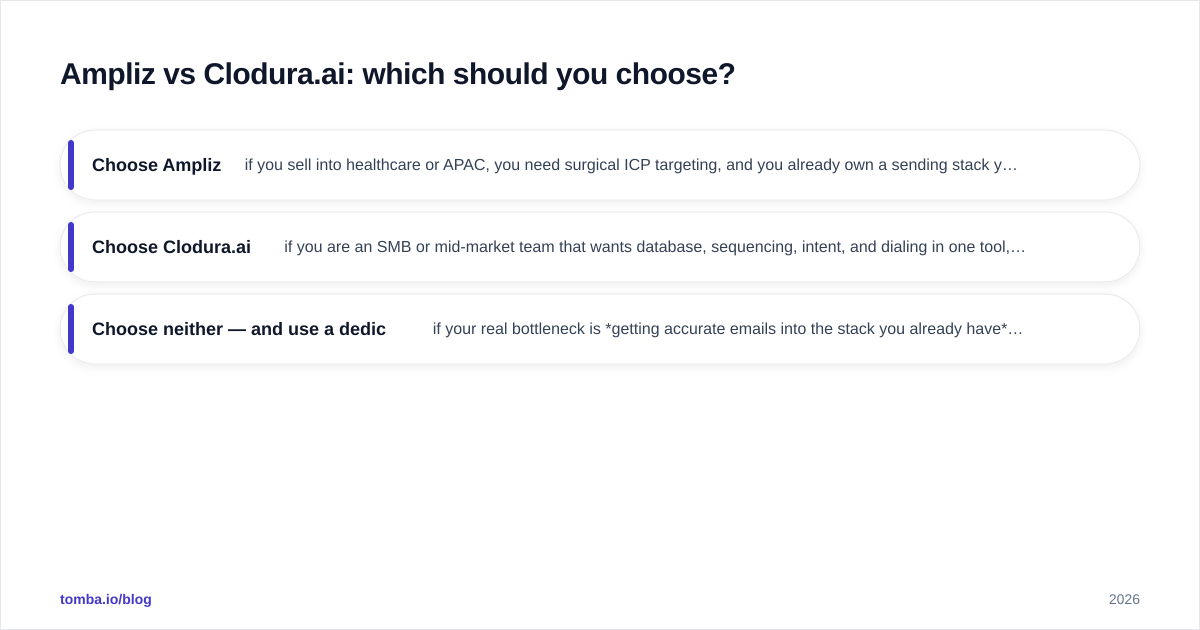
- Choose Ampliz if you sell into healthcare or APAC, you need surgical ICP targeting, and you already own a sending stack you trust. Pay the premium for depth, feed it into your existing tools, and verify before you send.
- Choose Clodura.ai if you are an SMB or mid-market team that wants database, sequencing, intent, and dialing in one tool, and you value consolidation over best-in-class depth in any single category.
- Choose neither — and use a dedicated finder + verifier if your real bottleneck is getting accurate emails into the stack you already have. Many teams discover they were paying platform prices for what is fundamentally an email-finding job.
Whatever you pick, run the sample test. Pull 200 records, verify them independently, and compare cost-per-valid-contact. That fifteen-minute exercise will tell you more than any feature matrix — including this one.
The bottom line#
Ampliz and Clodura.ai are both legitimate tools that win for different buyers: Ampliz on niche data depth, Clodura.ai on all-in-one workflow. The mistake is assuming either one's internal verification removes your need to check the data yourself. It doesn't. Job changes and catch-all domains erode every database, and your sender reputation pays the price for unverified sends.
If your core need is finding and verifying professional email addresses — by name, by domain, or in bulk — start with the Tomba Email Finder. It's free to try (25 searches a month, no card), uses transparent credit-based pricing from $49/month, and pairs with a built-in verifier so the addresses you load into Ampliz, Clodura.ai, or your own sequencer are actually deliverable. Find the contact, verify it, then send with confidence — that's the order that protects your numbers.
// get started
Find, verify and enrich your first contacts today
Start on the free plan with 25 searches a month, then scale when your team is ready.
Free plan · No credit card required · GDPR & CCPA
// about the author