Ampliz vs DiscoverOrg 2026: B2B Data Intelligence Compared
Ampliz vs DiscoverOrg in 2026: how the APAC/healthcare data specialist stacks up against the enterprise giant now folded into ZoomInfo — coverage, accuracy, pricing, and the cheaper alternative.
Choosing between Ampliz and DiscoverOrg comes down to one question most comparison posts skip: you are not really comparing two products anymore. DiscoverOrg was absorbed into ZoomInfo back in 2019, so when a vendor pitches you "DiscoverOrg-grade data," they mean the ZoomInfo platform with enterprise pricing attached. Ampliz, meanwhile, has carved out a narrower lane — healthcare and Asia-Pacific contact data. This guide breaks down what each one actually delivers in 2026, where they win, and when neither is worth the spend.
TL;DR#
- DiscoverOrg is now ZoomInfo. The DiscoverOrg brand was merged into ZoomInfo; you are buying the ZoomInfo platform, with enterprise contracts that typically start around $15K–$25K/year.
- Ampliz is a specialist, strongest in healthcare (HealthPlanRx/physician data) and APAC markets where the big US databases thin out.
- Accuracy is comparable on US tech accounts; Ampliz pulls ahead in healthcare and Asia, DiscoverOrg/ZoomInfo pulls ahead on org charts, intent, and scale.
- Pricing is the real divider. Both are annual-contract, sales-call products. Neither has a meaningful self-serve free tier.
- If you mostly need verified emails on demand, a credit-based tool like Tomba does the core job at a fraction of the cost — no annual lock-in.
What is the real difference between Ampliz and DiscoverOrg?#
Conclusion first: Ampliz is a focused data provider; DiscoverOrg is a legacy enterprise brand that no longer exists as a standalone product. Treat this as "Ampliz vs ZoomInfo (the DiscoverOrg lineage)."
Think of it like comparing a regional specialty grocer to a national supermarket chain that just bought out its biggest rival. Ampliz stocks deep, hard-to-find inventory in a few categories — physician contacts, hospital decision-makers, APAC firmographics. DiscoverOrg, post-acquisition, is the supermarket: enormous shelves, org charts for nearly every mid-to-large US company, intent signals, and a price tag to match.
DiscoverOrg built its reputation on human-researched org charts and reporting structures, especially for IT and engineering departments. That research DNA carried into ZoomInfo. Ampliz built its reputation on serving go-to-market teams that the US-centric giants underserve: medical device sellers, healthcare SaaS, and companies expanding into India, Singapore, and broader Asia-Pacific.
How do Ampliz and DiscoverOrg compare head-to-head?#
Here is the practical breakdown across the attributes that actually change a buying decision.
| Attribute | Ampliz | DiscoverOrg (nowZoomInfo) |
|---|---|---|
| Status in 2026 | Independent, active | Merged into ZoomInfo |
| Core strength | Healthcare + APAC data | US org charts, intent, scale |
| Database size | Tens of millions of contacts | 100M+ contacts, 100M+ companies |
| Org chart depth | Basic | Deep, human-verified |
| Intent data | Limited | Strong (ZoomInfo Intent) |
| Free / self-serve tier | Trial only | Trial only |
| Typical entry cost | ~$3,600+/yr (custom) | ~$15K–$25K+/yr (custom) |
| Best fit | Healthcare, APAC GTM teams | Large US enterprise sales orgs |
| Contract model | Annual, sales-led | Annual, sales-led |
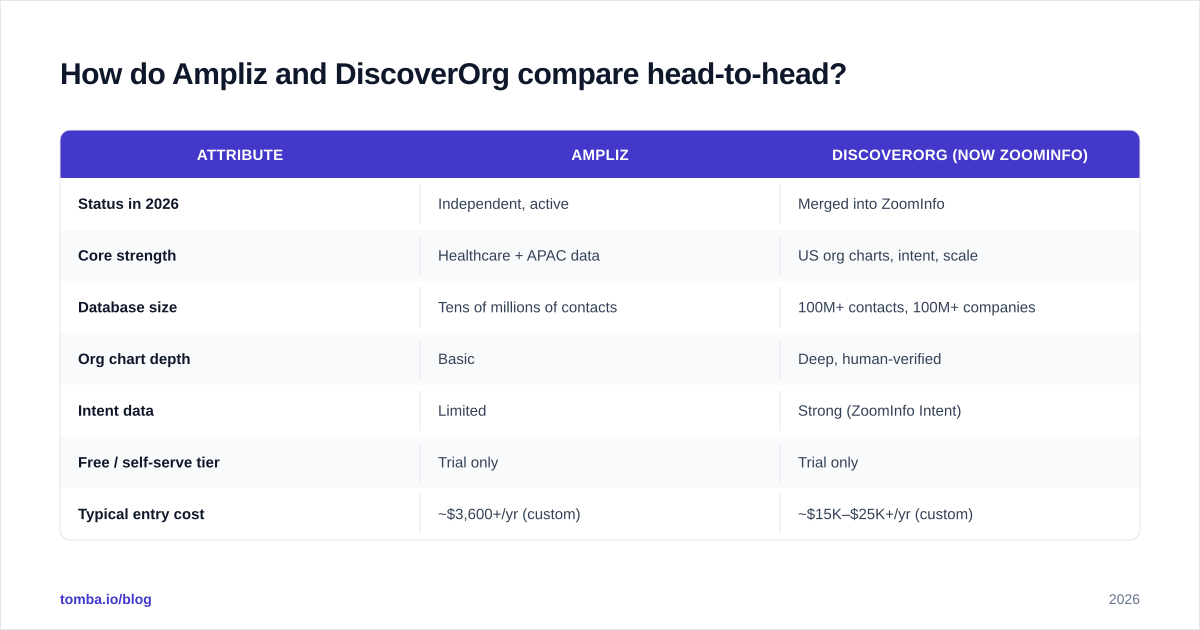
Two things stand out. First, both sit behind a sales call and an annual contract — neither lets you swipe a card and start finding emails this afternoon. Second, the gap in scale is real: the ZoomInfo platform is an order of magnitude larger than Ampliz, but that scale is concentrated in US accounts.
Which has better data accuracy?#
It depends entirely on your target market — there is no single winner.
For US technology and mid-market accounts, the DiscoverOrg/ZoomInfo lineage is the safer bet. Its human-research process and continuous re-verification keep org charts and direct dials unusually fresh. Independent reviews on G2 consistently rate ZoomInfo highly on data accuracy and depth, even as users flag the price.
For healthcare and APAC, Ampliz frequently returns contacts the larger databases simply do not have — NPI-linked physician records, hospital procurement leads, and decision-makers at companies headquartered in Asia. If your ICP is a cardiologist in Bangalore or a procurement head at a Singapore hospital system, Ampliz's specialization beats raw volume.
A reliable rule of thumb: no third-party database is "set and forget." Whichever vendor you pick, route exported lists through an email verifier before launching a campaign. Even premium providers carry stale records, and a single bad send batch can dent your sender reputation for weeks.

Is DiscoverOrg/ZoomInfo worth the price?#
Worth it only if you are a large, well-funded sales org that uses the whole platform — data, intent, org charts, workflow integrations, and engagement tooling together.
The ZoomInfo platform is genuinely powerful, but pricing reflects that. Public buyer reports and ZoomInfo's own materials point to annual contracts that commonly land in the $15K–$25K range for a small team, climbing quickly with seats and add-on modules like Intent or Engage. There is no realistic month-to-month option.
If you are a five-person team that mostly needs verified contact emails for outbound, you will pay enterprise rates for capabilities you never touch. That is the classic mismatch: buying a supermarket membership to grab one aisle.

When should you choose Ampliz instead?#
Pick Ampliz when your go-to-market motion lives where the US giants are weak.
- Healthcare and life sciences. Ampliz's physician and hospital datasets, including offerings built around health-plan and provider data, are its core advantage. If you sell medical devices, healthcare SaaS, or pharma services, this is the differentiator.
- APAC expansion. Selling into India and Southeast Asia? Ampliz's regional coverage routinely outperforms databases optimized for North America.
- Budget below enterprise tier. Ampliz's custom plans generally start lower than the
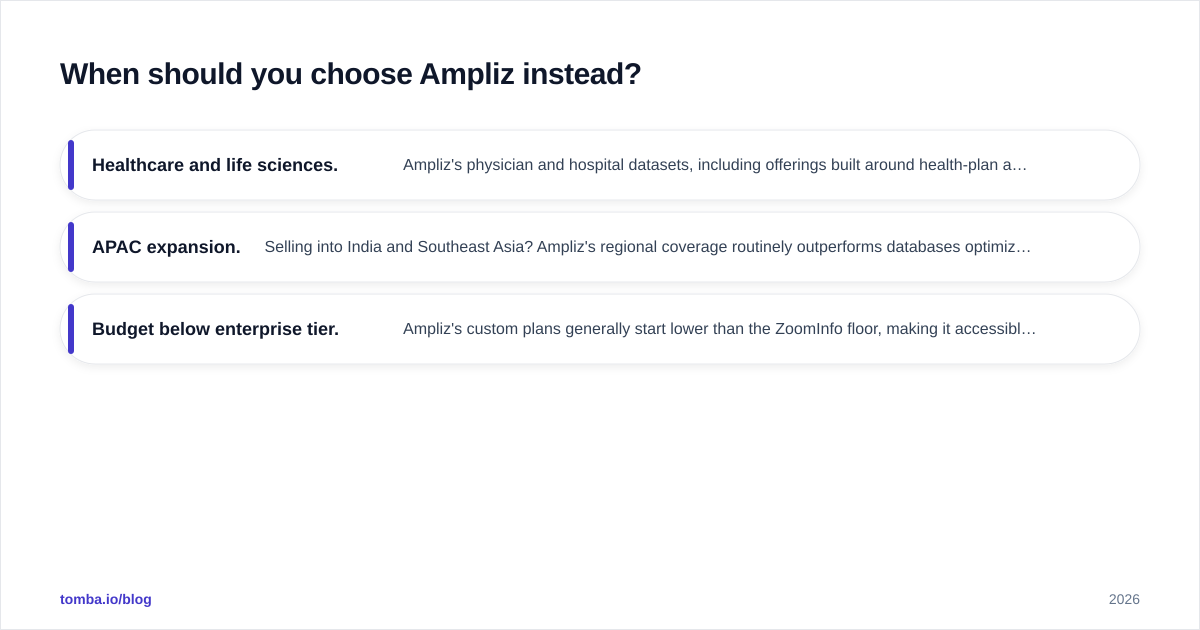
ZoomInfo floor, making it accessible to mid-market teams that still want a managed database.
Ampliz is the wrong call if you need deep US org charts, mature intent data, or a single platform that also handles sequencing and engagement. That is ZoomInfo territory.
What if you only need emails, not a full data platform?#
Then both of these are overkill — and there is a faster, cheaper path.
A large share of teams comparing "Ampliz vs DiscoverOrg" don't actually want a sprawling intelligence suite. They want to take a name and a company and get a verified, deliverable email address. For that job, a credit-based email finder is a better tool than a five-figure annual database.
Here is how the categories differ in practice:
| Need | Best tool type | Example |
|---|---|---|
| Full intelligence + intent + org charts | Enterprise database | ZoomInfo (DiscoverOrg) |
| Specialist healthcare / APAC data | Niche database | Ampliz |
| Find + verify emails on demand | Credit-based finder | Tomba |
| Bulk list enrichment | Enrichment API | Tomba enrichment |
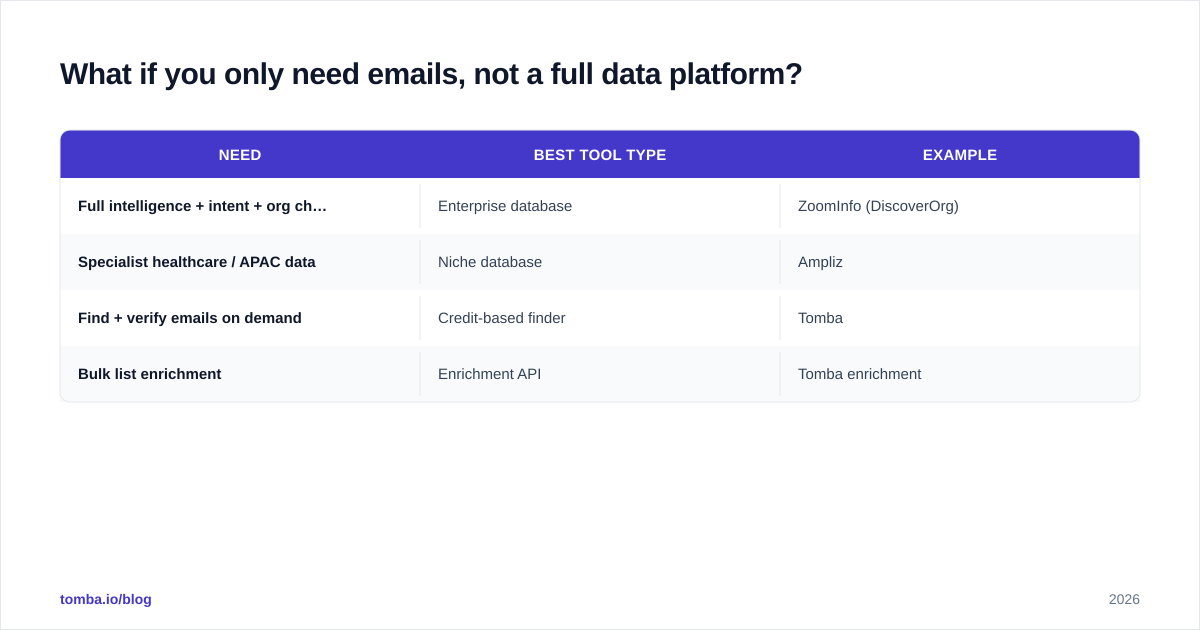
Tomba's model is the inverse of the enterprise database. Instead of a sales call and an annual commitment, you start on a free tier (25 searches/month) and scale up only as you need volume. The Tomba pricing ladder is Starter at $49/mo, Growth at $99/mo, Pro at $249/mo, and custom Enterprise — transparent, monthly, and cancellable.
You can also do real-time data enrichment and pull contacts by company using domain search, which covers the most common reason teams reach for a database in the first place: "I have a target account, find me the right person's email."
How do the three options compare on total cost?#
Cost is where the practical decision usually lands. Here is a realistic picture for a small team finding ~2,000 contacts a month.
| Cost factor | Ampliz | DiscoverOrg/ZoomInfo | Tomba |
|---|---|---|---|
| Entry commitment | Annual contract | Annual contract | Monthly, cancel anytime |
| Realistic year-1 cost | $3,600+ | $15,000–$25,000+ | $588–$1,188 |
| Free tier | Trial only | Trial only | 25 searches/mo, free |
| Onboarding | Sales call | Sales call | Self-serve |
| Verification included | Add-on | Add-on | Built in |
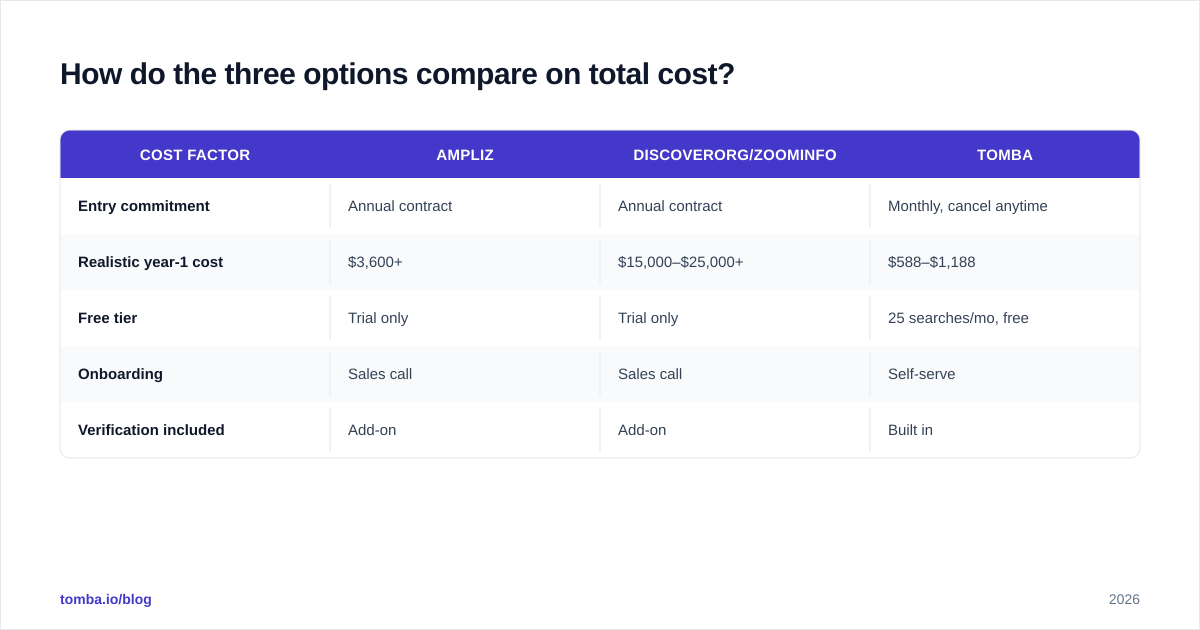
The takeaway is not that Tomba replaces an enterprise intelligence platform — it doesn't ship org charts or intent scoring. It is that most teams overpay for those features when their actual workflow is find-verify-export. Match the tool to the job.
What about data sources and compliance?#
All three pull from a mix of public web, contributed data, and partner feeds, then verify against live signals. The differences are in transparency and freshness cadence.
ZoomInfo (DiscoverOrg lineage) is the most mature here, with documented re-verification cycles and compliance tooling for GDPR/CCPA workflows — important if you operate in the EU. Ampliz documents its healthcare data provenance, which matters for regulated medical outreach. Tomba publishes how it sources and validates records on its data sources page, and exposes everything through a documented Tomba API and a queryable B2B database so you can audit results yourself.
Whatever you choose, treat compliance as your responsibility, not the vendor's. Verify consent basis for your jurisdiction before you send.
Frequently asked: Is DiscoverOrg still a product?#
No. DiscoverOrg merged with ZoomInfo and the standalone DiscoverOrg product was retired. When you evaluate "DiscoverOrg" in 2026, you are evaluating the ZoomInfo platform. Any vendor or list claiming to sell "DiscoverOrg data" is selling either ZoomInfo or a resold legacy dataset — verify before you buy.
The verdict: which should you pick?#
- Choose ZoomInfo (DiscoverOrg) if you are an enterprise sales org targeting US accounts, you'll use intent and org charts, and the budget is there.
- Choose Ampliz if healthcare or APAC is your market — its specialization beats raw scale where it counts, at a lower entry price.
- Choose a credit-based finder if your real job is finding and verifying emails, and you'd rather not sign an annual five-figure contract for features you won't touch.
Most teams reading a comparison like this fall into that third bucket without realizing it. If that's you, the simplest move is to skip the sales calls entirely and test the workflow today.
Start finding verified emails in minutes#
If your actual goal is reaching the right people — not licensing a data warehouse — start with the Tomba Email Finder. Find professional email addresses by name, company, or domain, verify them in the same flow, and export clean lists without an annual contract. The free tier gives you 25 searches a month to test accuracy on your own ICP before you spend a dollar. When you're ready to scale, plans start at $49/mo — roughly what an enterprise database charges per hour. Run a side-by-side on your next 50 prospects and let the deliverability numbers decide.
Ready to find emails that actually work?
Join 150,000+ professionals who stopped guessing and started sending. Free credits on signup — no credit card required.
Get the Tomba newsletter
Practical outbound tactics and product updates — once every two weeks.
About the author