Ampliz vs EasyLeadz 2026: Which B2B Data Tool Wins?
Ampliz pushes healthcare-grade B2B intelligence while EasyLeadz chases mobile direct dials. Here's an honest 2026 breakdown of accuracy, pricing, and fit.
TL;DR
- Ampliz is a B2B data-intelligence platform with a strong healthcare/life-sciences bias and deep firmographic enrichment — best when your ICP is niche and account context matters more than raw volume.
- EasyLeadz (and its "Mr. E" browser tool) is built around mobile direct dials sourced from LinkedIn profiles — best when your team lives on the phone and needs cell numbers fast.
- Neither is a true email-finding workhorse: Ampliz leans contextual intelligence, EasyLeadz leans phone. Email accuracy and verification are secondary in both.
- Pricing favors EasyLeadz for solo SDRs and small teams; Ampliz gets expensive but justifies it for regulated, account-based selling.
- If your core need is verified work emails at scale across any industry, a dedicated finder/verifier stack will out-perform both on cost per valid contact.
What are Ampliz and EasyLeadz?#
Short answer: they solve adjacent problems, not the same one.
Ampliz positions itself as a global B2B data and intelligence platform with an unusually deep healthcare and life-sciences database — physicians, hospital decision-makers, NPI-linked records, and firmographic context. Think of it less like a phonebook and more like a research analyst that hands you account context before you reach out. You can read their own positioning on the Ampliz homepage.
EasyLeadz approaches the market from the opposite end. Its flagship is "Mr. E," a Chrome extension that surfaces direct mobile numbers as you browse LinkedIn profiles and company pages. The pitch is speed-to-dial: see a prospect, pull their cell, call them. Their product is described on the EasyLeadz homepage.
So when people search "ampliz vs easyleadz," they're usually really asking: do I need rich account intelligence, or do I need a phone number right now? That framing decides most of the comparison.
How do Ampliz and EasyLeadz compare at a glance?#
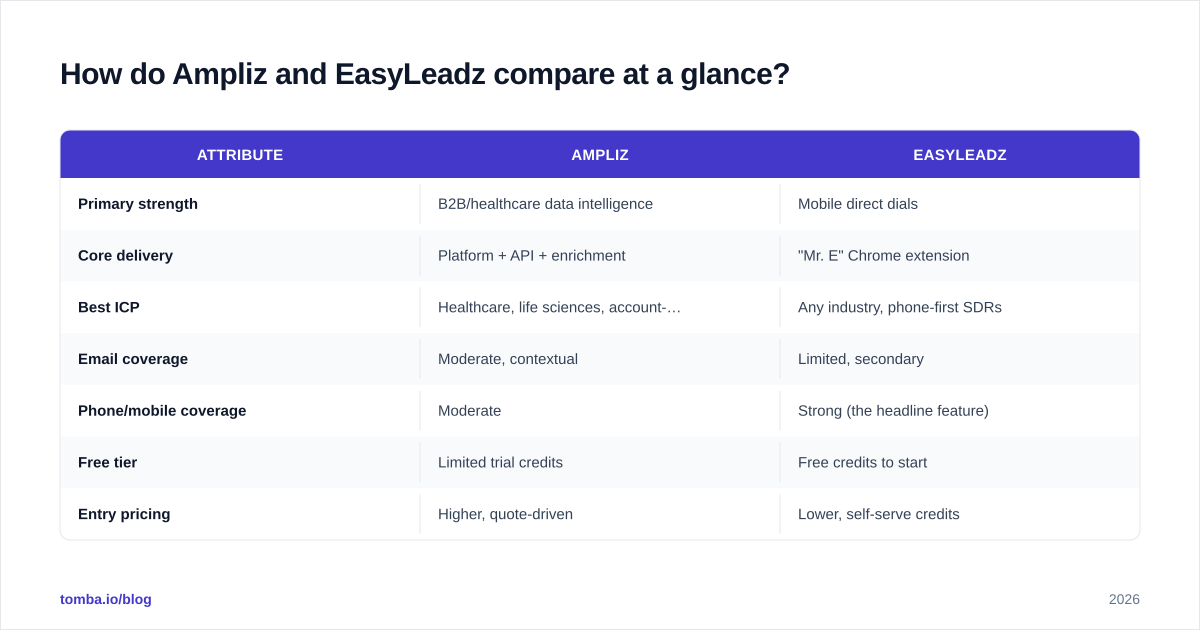
Here's the head-to-head on the attributes that actually change a buying decision.
| Attribute | Ampliz | EasyLeadz |
|---|---|---|
| Primary strength | B2B/healthcare data intelligence | Mobile direct dials |
| Core delivery | Platform + API + enrichment | "Mr. E" Chrome extension |
| Best ICP | Healthcare, life sciences, account-based | Any industry, phone-first SDRs |
| Email coverage | Moderate, contextual | Limited, secondary |
| Phone/mobile coverage | Moderate | Strong (the headline feature) |
| Free tier | Limited trial credits | Free credits to start |
| Entry pricing | Higher, quote-driven | Lower, self-serve credits |
| Verification depth | Firmographic + contact | Phone-focused |
| Compliance posture | Strong (healthcare context) | Standard B2B |
A few honest caveats: both vendors change credit packaging often, and self-serve pricing pages don't always reflect negotiated enterprise deals. Treat the table as direction, not a contract. Independent reviews on G2 and Capterra are worth scanning for current sentiment before you commit.
Is Ampliz better than EasyLeadz for data accuracy?#
It depends on what "accurate" means for your motion.
Ampliz wins on contextual accuracy — the records carry firmographic depth, intent-style signals, and (in healthcare) specialty/role precision that generic databases miss. If you're selling a clinical SaaS product and need to reach the right department head at a 400-bed hospital, that context is the product.
EasyLeadz wins on phone-number freshness for the specific profile you're looking at. Because it pulls in real time from the profile you're viewing, the mobile number is often current. But coverage is uneven across regions and seniority — you'll hit "no data" on plenty of profiles, especially outside its strong markets.
The thing neither does brilliantly is verified work email at volume. If your sequence is email-led, you'll find yourself exporting contacts and running them through a dedicated email verifier anyway to protect deliverability. Bounces above ~3% start dragging your sender reputation down, and neither tool's native email validation is built to be your last line of defense.
)
Quick reality check on that meme: "which is more accurate" is the wrong question. Ampliz and EasyLeadz are accurate at different things. Buying the wrong one because it scored higher on a generic accuracy chart is how teams end up with a tool that technically works and practically sits unused.
Which tool is better for cold calling and phone-first teams?#
EasyLeadz, clearly — that's its entire reason to exist.
If your SDRs run a phone-heavy motion, the workflow is hard to beat: open a LinkedIn profile, click Mr. E, get a mobile number, dial. There's almost no context-switching. For a high-velocity calling team, shaving 30 seconds off every contact lookup compounds into real pipeline.
Ampliz can supply phone data too, but it's not optimized for the rapid-fire "find a dial in two clicks" loop. Its value shows up earlier in the funnel — when you're building a target account list and deciding who's worth calling in the first place.
If phone is your channel, pair whichever tool you pick with disciplined list hygiene. Running numbers through a phone validator before a calling sprint keeps connect rates honest and stops reps from burning hours on dead lines. You can also enrich thin records with a dedicated phone finder when your primary tool comes up empty.
Which is better for email-led outbound and ABM?#
This is where the two split hard.
For account-based marketing, Ampliz is the stronger backbone. The firmographic depth and account intelligence let you build tiered target lists, map buying committees, and personalize at the account level. That's the slow, deliberate, high-ACV motion ABM is built for. Pull it into your CRM and you've got context, not just contacts. (Tomba's own HubSpot integration and Salesforce integration show the same principle — data is only useful once it's living in the system reps actually work in.)
For email-led volume outbound, honestly, neither is ideal as a standalone. EasyLeadz is phone-first; Ampliz is intelligence-first. If your engine runs on hundreds of cold emails a week, you need:
- A finder that resolves work emails by name + domain at scale.
- A verifier that catches catch-alls, role accounts, and dead boxes before send.
- Clean list dedup and segmentation.
That's a different tool class. A purpose-built email finder plus domain search will out-deliver both Ampliz and EasyLeadz on cost-per-valid-email, simply because that's the job it was designed for.
)
How does pricing compare between Ampliz and EasyLeadz?#
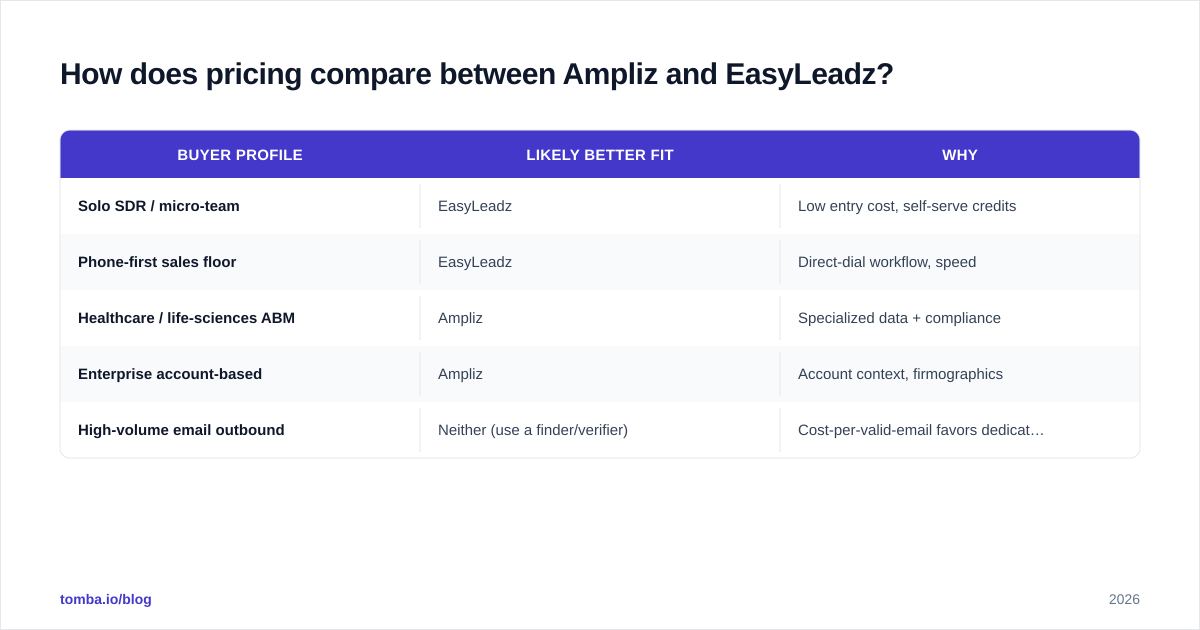
EasyLeadz is friendlier to small teams; Ampliz is built for budgets that expect to negotiate.
EasyLeadz uses a credit model with free credits to start and self-serve paid tiers — attractive for a solo SDR or a small team that wants to test without a sales call. The trade-off is that heavy usage scales credit costs quickly, and mobile-number credits get consumed fast on a busy calling team.
Ampliz pricing is quote-driven and higher, reflecting the depth of data and healthcare specialization. You're paying for intelligence and compliance posture, not just rows. For a regulated, high-ACV sale, that math often works. For a generalist startup doing broad outbound, it usually doesn't.
| Buyer profile | Likely better fit | Why |
|---|---|---|
| Solo SDR / micro-team | EasyLeadz | Low entry cost, self-serve credits |
| Phone-first sales floor | EasyLeadz | Direct-dial workflow, speed |
| Healthcare / life-sciences ABM | Ampliz | Specialized data + compliance |
| Enterprise account-based | Ampliz | Account context, firmographics |
| High-volume email outbound | Neither (use a finder/verifier) | Cost-per-valid-email favors dedicated tools |
For reference on how transparent, tier-based pricing can look in this category, compare against published Tomba pricing — Free (25 searches/mo), Starter $49/mo, Growth $99/mo, Pro $249/mo, and custom Enterprise. The point isn't that one model is universally right; it's that you should know your cost-per-valid-contact before you sign, not after.
What about data sources and compliance?#
Both pull from a mix of public web, company data, and proprietary aggregation, but they emphasize different things.
Ampliz leans into verified, context-rich records, especially in healthcare where data quality and provenance carry regulatory weight. That focus is a genuine differentiator if you operate in a space where reaching the wrong contact isn't just wasted effort — it's a compliance risk.
EasyLeadz emphasizes real-time profile-based lookups, which keeps mobile data fresh but makes coverage profile-dependent. It's standard B2B compliance, fine for most outbound, but not built around the regulated-industry edge cases Ampliz targets.
Whatever you choose, understand where the data comes from before you build a motion on it. Provenance affects accuracy, refresh cadence, and your exposure under GDPR/CCPA. Don't assume — ask the vendor directly and get it in writing.
When should you pick a dedicated email-finding stack instead?#
Pick a dedicated stack when verified work email at scale is the bottleneck — which, for most email-led outbound teams, it is.
Ampliz and EasyLeadz are excellent at their respective specialties: account intelligence and mobile dials. But if you measure success in delivered emails, reply rates, and protected sender reputation, you want tools engineered specifically for that pipeline:
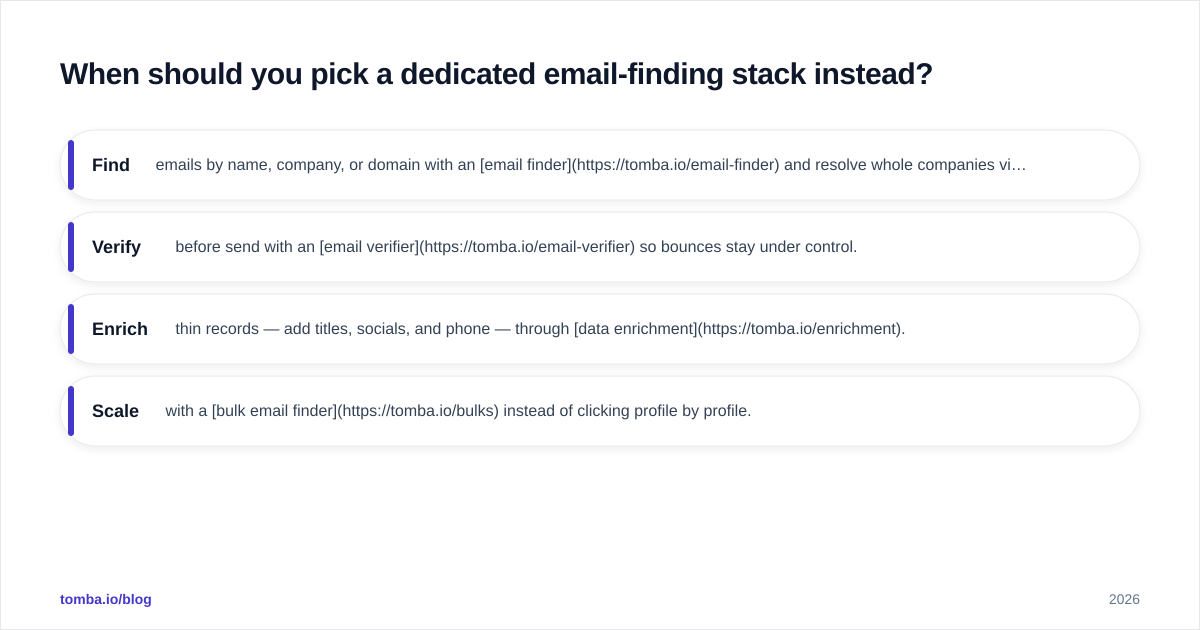
- Find emails by name, company, or domain with an email finder and resolve whole companies via domain search.
- Verify before send with an email verifier so bounces stay under control.
- Enrich thin records — add titles, socials, and phone — through data enrichment.
- Scale with a bulk email finder instead of clicking profile by profile.
That stack isn't competing with Ampliz on healthcare intelligence or with EasyLeadz on dials. It's solving the email-deliverability job those two treat as a side feature.
So which one should you choose: Ampliz or EasyLeadz?#
Decide on your channel and ICP, and the answer falls out:
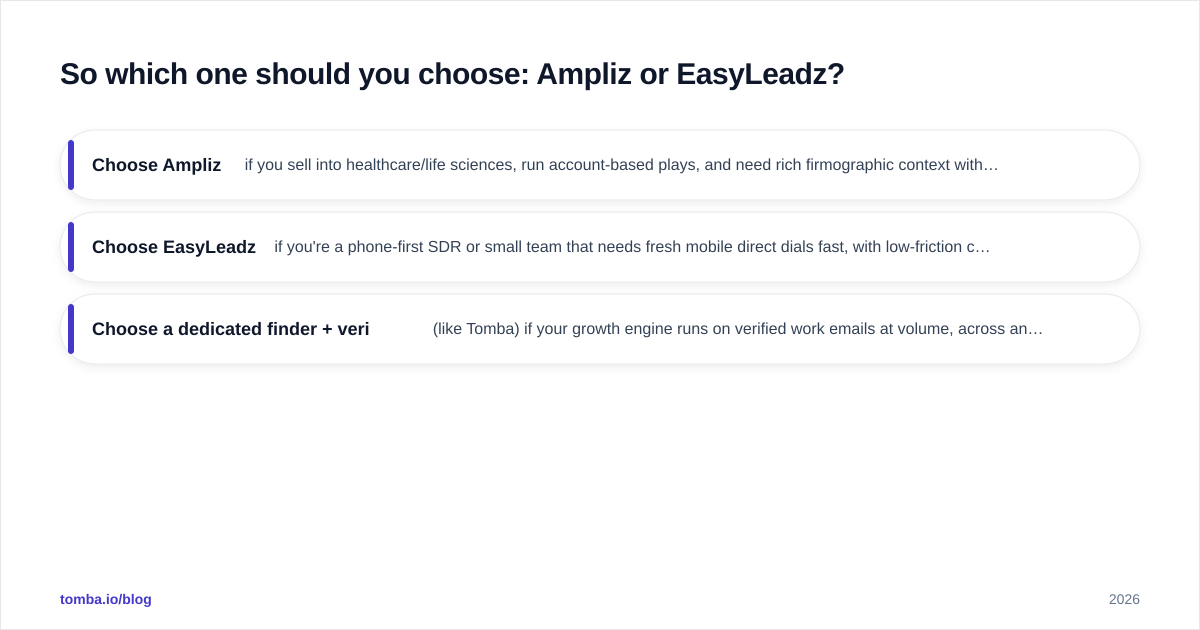
- Choose Ampliz if you sell into healthcare/life sciences, run account-based plays, and need rich firmographic context with a strong compliance posture. You're buying intelligence, and you have the budget for it.
- Choose EasyLeadz if you're a phone-first SDR or small team that needs fresh mobile direct dials fast, with low-friction credit-based pricing.
- Choose a dedicated finder + verifier (like Tomba) if your growth engine runs on verified work emails at volume, across any industry, and you care about cost-per-valid-contact and deliverability above all else.
Most scaling teams end up with a combination: an intelligence layer for targeting, and a finder/verifier layer for execution. The mistake is forcing one tool to do a job it was never built for — that's how a perfectly good subscription becomes shelfware.
Ready to fix the email half of your stack?#
If your bottleneck is reaching the right people by email — not just knowing who they are — start with the Tomba Email Finder. Find professional email addresses by name, company, or domain, verify them before you send, and keep your sender reputation clean as you scale. Pair it with Ampliz's account intelligence or EasyLeadz's dials if you like, but let a purpose-built finder own the part of the funnel that actually decides whether your message lands. Spin up the free tier, run your next target list through it, and compare your cost-per-valid-email against what you're paying today.
Ready to find emails that actually work?
Join 150,000+ professionals who stopped guessing and started sending. Free credits on signup — no credit card required.
Get the Tomba newsletter
Practical outbound tactics and product updates — once every two weeks.
About the author