Ampliz vs Emailchaser 2026: Data vs Cold Email Compared
Ampliz sells B2B contact intelligence; Emailchaser sends cold email at scale. Here's an honest 2026 breakdown of pricing, data, and which one your pipeline actually needs.
TL;DR
- Ampliz is a B2B data and contact-intelligence platform with a strong APAC and healthcare slant. You buy it to find and enrich accounts and contacts.
- Emailchaser is a cold-email automation tool with a lightweight built-in email finder. You buy it to send and follow up at scale.
- They are not really direct competitors — one fills the top of your list, the other works the list. Most teams that pick "one or the other" pick wrong.
- On raw email accuracy and verification depth, a dedicated finder/verifier beats both. On sending deliverability, neither replaces a proper warmup stack.
- If you only have budget for one tool and you need correct contact data first, start with a specialized email finder and layer sending on top.
What are Ampliz and Emailchaser?#
Short version: Ampliz hands you the leads, Emailchaser emails them.
Ampliz positions itself as a B2B data intelligence platform. Its core value is the database — company firmographics, contact records, intent signals, and an API for enrichment. It became known for unusually deep coverage of the APAC region and the healthcare/physician vertical, which is where most generic North-America-first databases go thin. You log in to build a target list and push enriched records into your CRM.
Emailchaser sits on the other side of the funnel. It's a cold-email sending tool: multi-step sequences, automatic follow-ups, inbox rotation, and a basic email-finder credit pool bundled in. You log in to run a campaign against a list you already have.
Think of it like a restaurant. Ampliz is the supplier delivering ingredients to your kitchen. Emailchaser is the line cook turning orders into plates. Asking "which is better" is like asking whether you'd rather have a vegetable supplier or a cook — you usually need both, and the question is really which one is your current bottleneck.
How do Ampliz and Emailchaser compare head-to-head?#
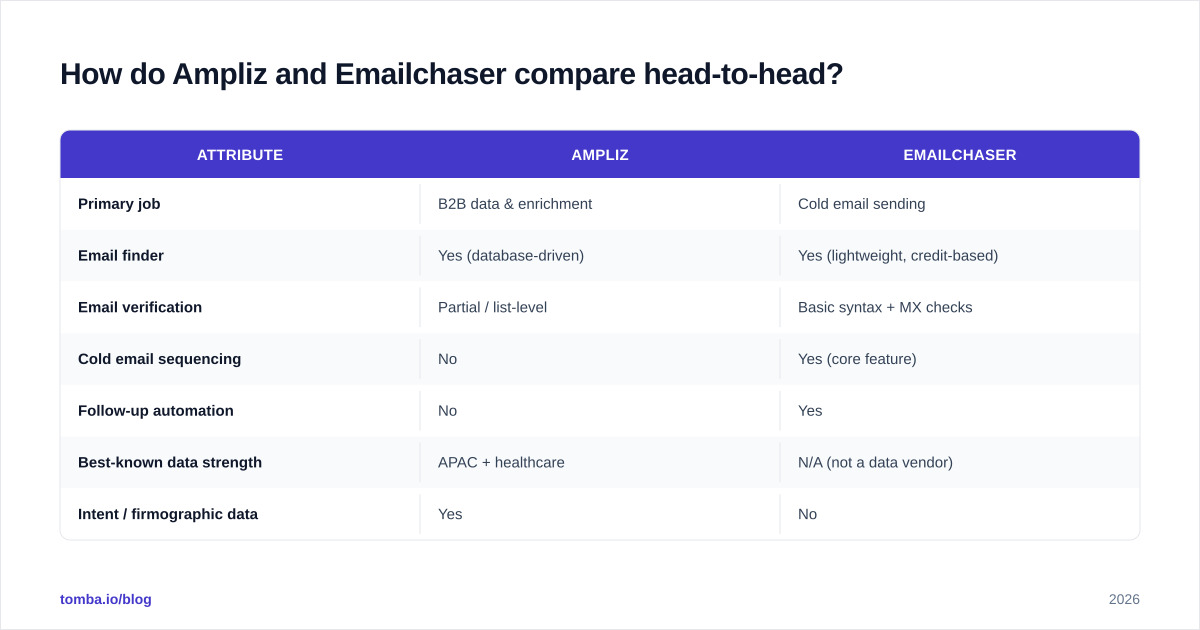
Here's the honest side-by-side. Pricing shifts often, so treat figures as directional and confirm on each vendor's page before you buy.
| Attribute | Ampliz | Emailchaser |
|---|---|---|
| Primary job | B2B data & enrichment | Cold email sending |
| Email finder | Yes (database-driven) | Yes (lightweight, credit-based) |
| Email verification | Partial / list-level | Basic syntax + MX checks |
| Cold email sequencing | No | Yes (core feature) |
| Follow-up automation | No | Yes |
| Best-known data strength | APAC + healthcare | N/A (not a data vendor) |
| Intent / firmographic data | Yes | No |
| Typical entry price | Custom / quote-based | ~$24/mo per inbox tier |
| Free trial | Limited trial | Trial available |
| API access | Yes (enrichment API) | Limited |
| Who it's for | RevOps, data teams, ABM | SDRs, founders, small outbound teams |
The pattern is clear. Ampliz is the heavier, data-first platform that tends toward annual contracts and quote-based pricing once you scale. Emailchaser is the lightweight, self-serve sending tool with a transparent monthly price. They overlap only in the thin middle — both touch email addresses — but their centers of gravity are completely different.
Which one has better data and email accuracy?#
Neither is built primarily to be your accuracy layer, and that matters.
Ampliz wins on coverage — especially if your ICP lives in APAC or healthcare, where it genuinely outperforms US-centric databases. But database coverage and email deliverability accuracy are two different things. A record can exist in a database and still bounce, because the person left, the domain changed, or the address is a catch-all that silently accepts everything. Ampliz gives you the contact; it doesn't guarantee the inbox is live today.
Emailchaser's finder is a convenience feature, not a precision instrument. It's there so you don't have to leave the tool to grab an address, and it works fine for low-volume, well-known domains. It is not designed to crawl deep for hard-to-find contacts or to run rigorous verification.
This is the gap most teams fall into: they trust the finder bundled with their sending tool, send to unverified records, and watch their bounce rate climb past the 3-4% line where mailbox providers start throttling. Before any address enters a campaign, run it through a real email verifier and screen risky domains with a catch-all verifier. The few minutes that costs is cheaper than a burned sending domain.
If accuracy is your actual priority — not coverage, not sending — a purpose-built finder that scores confidence on every address and exposes its data sources will beat the finder buried inside either of these tools.
Quick reframe: "Do they have the contact?" and "Will the email land?" are separate questions. Ampliz answers the first. Neither tool fully answers the second.
How does pricing compare for Ampliz vs Emailchaser?#
Two very different buying motions.
Emailchaser is transparent and self-serve. You pick an inbox tier (entry plans land around the low-$20s per month), you pay monthly, and you can cancel without a sales call. That predictability is the whole appeal for founders and small outbound teams.
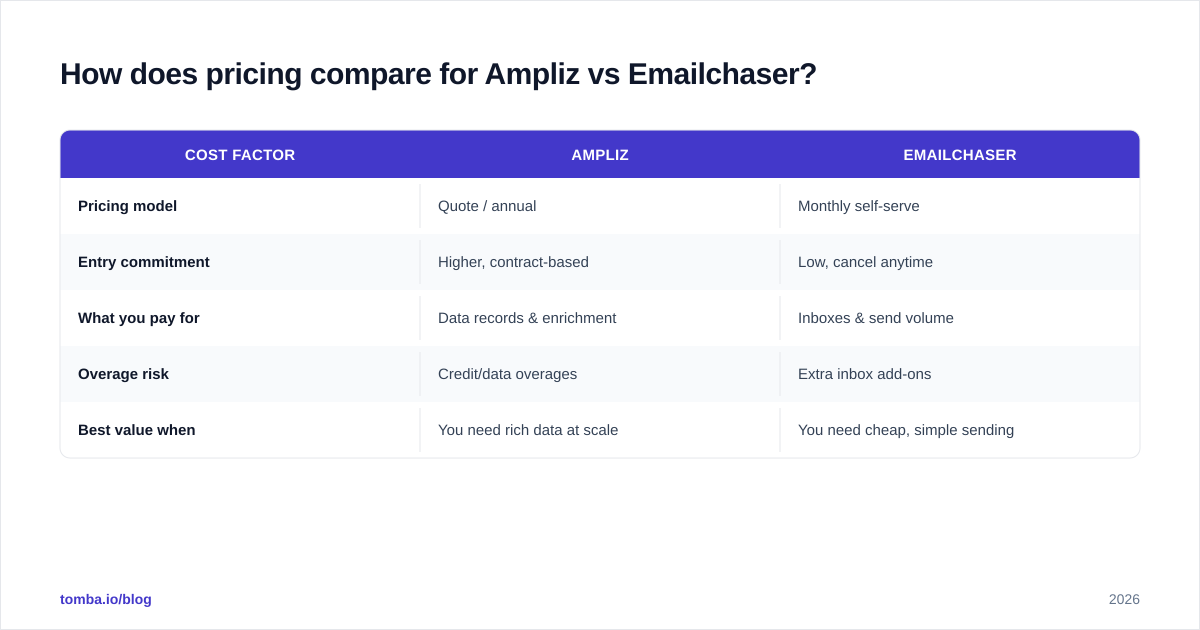
Ampliz is quote-driven once you move past the trial. Database platforms price on seats, credits, data volume, and contract length — which means the sticker you pay depends on negotiation, and the real cost usually shows up as an annual commitment. That's normal for data vendors, but it's a different financial conversation than a $24/month sending tool.
So a literal "Ampliz vs Emailchaser price" comparison is apples-to-oranges:
| Cost factor | Ampliz | Emailchaser |
|---|---|---|
| Pricing model | Quote / annual | Monthly self-serve |
| Entry commitment | Higher, contract-based | Low, cancel anytime |
| What you pay for | Data records & enrichment | Inboxes & send volume |
| Overage risk | Credit/data overages | Extra inbox add-ons |
| Best value when | You need rich data at scale | You need cheap, simple sending |
For comparison, a dedicated data/finder tool like Tomba sits in between with published, no-call tiers — a free plan (25 searches/mo), Starter at $49/mo, Growth at $99/mo, and Pro at $249/mo. You can see the full Tomba pricing breakdown rather than book a demo to learn the number. The takeaway isn't "Tomba is cheapest" — it's that you should know exactly what you're paying before you commit, and only one of these two makes that easy.
Is Ampliz better than Emailchaser?#
Wrong question — but here's the answer that's actually useful.
Choose Ampliz if: your bottleneck is finding the right accounts and contacts, your ICP skews APAC or healthcare, you run account-based marketing, and you have a RevOps or data function that will actually use enrichment and intent signals. You're buying a database, and you should evaluate it like one: coverage of your exact segment, refresh frequency, and API quality.
Choose Emailchaser if: your bottleneck is sending and following up, you already have a clean list, you're a founder or small team, and you want a cheap, simple sequencer without a Salesloft-sized contract. You're buying a sending engine.
Choose neither as your accuracy layer. This is the part both tools quietly leave to you. Whatever you pick, you still need:
- A real verification pass before sending (to protect bounce rate and sender reputation).
- A domain search step to map every contact at a target company, not just the one record your tool happened to have.
- A warmup and deliverability foundation — SPF, DKIM, DMARC, gradual volume ramp — that neither of these tools fully provides.
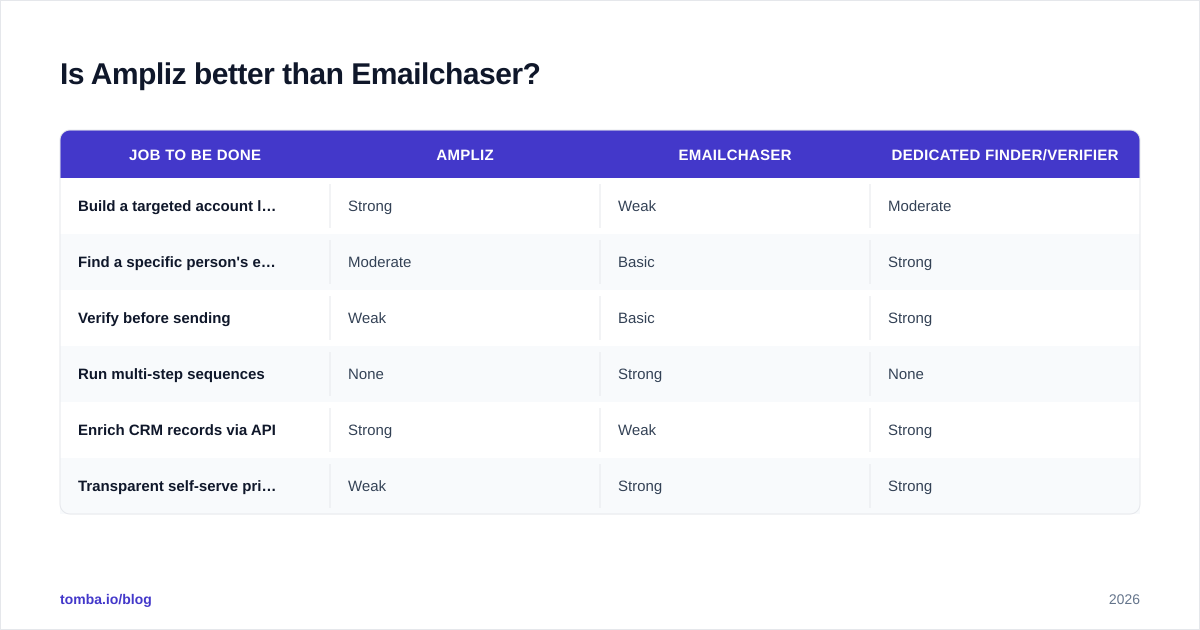
Here's how the three roles actually stack up:
| Job to be done | Ampliz | Emailchaser | Dedicated finder/verifier |
|---|---|---|---|
| Build a targeted account list | Strong | Weak | Moderate |
| Find a specific person's email | Moderate | Basic | Strong |
| Verify before sending | Weak | Basic | Strong |
| Run multi-step sequences | None | Strong | None |
| Enrich CRM records via API | Strong | Weak | Strong |
| Transparent self-serve pricing | Weak | Strong | Strong |
What's the smartest stack in 2026?#
Stop forcing a one-tool decision. The teams that win combine layers.
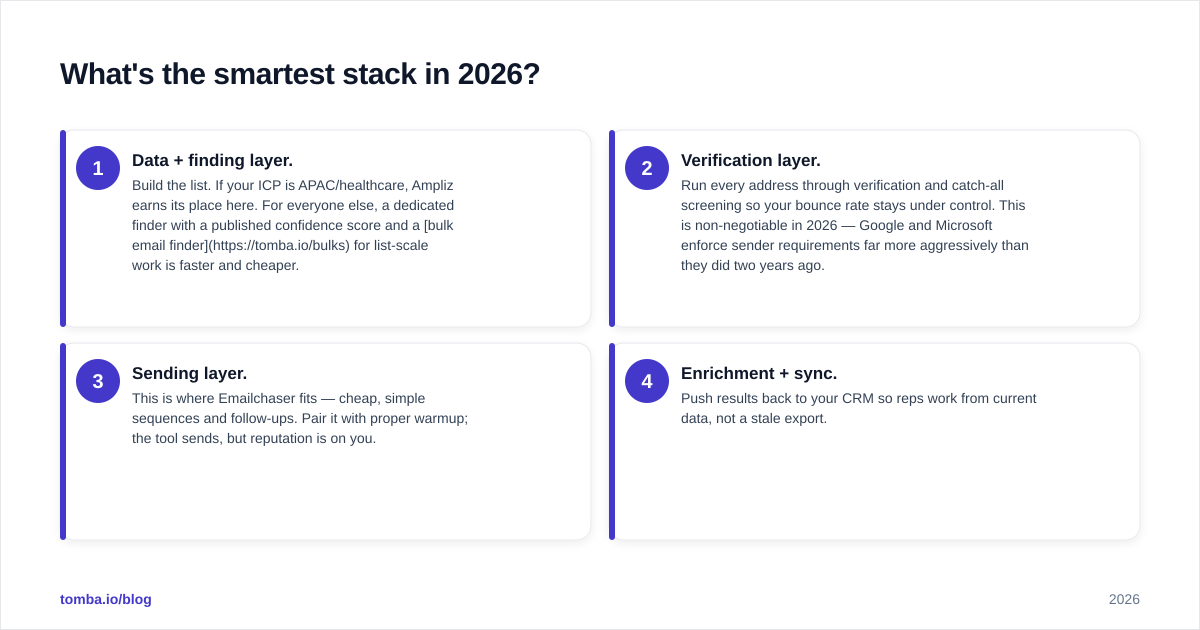
A clean, modern outbound stack usually looks like this:
- Data + finding layer. Build the list. If your ICP is APAC/healthcare, Ampliz earns its place here. For everyone else, a dedicated finder with a published confidence score and a bulk email finder for list-scale work is faster and cheaper.
- Verification layer. Run every address through verification and catch-all screening so your bounce rate stays under control. This is non-negotiable in 2026 — Google and Microsoft enforce sender requirements far more aggressively than they did two years ago.
- Sending layer. This is where Emailchaser fits — cheap, simple sequences and follow-ups. Pair it with proper warmup; the tool sends, but reputation is on you.
- Enrichment + sync. Push results back to your CRM so reps work from current data, not a stale export.
The mistake is buying a heavyweight data contract and a sending tool while skipping the verification layer that sits between them — which is exactly the layer that determines whether your campaign lands or bounces. You can validate your setup quickly with free utilities like a free email checker before committing volume.
For most teams reading an "Ampliz vs Emailchaser" comparison, the real unlock isn't picking a winner. It's recognizing you've been comparing a supplier to a cook and forgetting the inspector in the middle.
Frequently asked questions#
Is Emailchaser a good email finder? It's adequate for grabbing known addresses while you build a campaign, but it's a convenience feature, not a precision finder. For hard-to-find contacts or high-volume list building, use a dedicated finder and verify the results.
Does Ampliz send cold emails? No. Ampliz is a data and enrichment platform. You export or sync its contacts into a separate sending tool — which is exactly where something like Emailchaser would slot in.
Which is cheaper, Ampliz or Emailchaser? Emailchaser, on a sticker basis — it's a low-monthly self-serve tool. Ampliz is quote-based and typically annual. But they do different jobs, so "cheaper" only matters within the same category.
Can one tool replace both? Not cleanly. A finder/verifier replaces Ampliz's email-finding role and adds the verification both tools lack, but it won't send sequences. A sender like Emailchaser won't build or enrich a database. Match the tool to your current bottleneck.
What about data accuracy and bounce rates? Neither tool is built to be your accuracy layer. Always verify addresses before sending. A 3-4%+ bounce rate signals mailbox providers to throttle you, so verification protects the entire campaign.
The bottom line#
Ampliz and Emailchaser aren't really rivals — they're two different stages of the same pipeline. Ampliz is a data platform worth its price if your ICP lives where its coverage is deepest. Emailchaser is a cheap, no-drama sequencer for teams that already have a list. The trap is treating either one as your source of email accuracy, because neither is built for that.
If your honest problem is getting correct, verified contact data into your funnel — the step that decides whether every downstream campaign succeeds — start there. Try the Tomba Email Finder: find professional emails by name, domain, or company, get a confidence score on every result, and verify before you ever hit send. Layer your sender of choice on top, and you'll spend less arguing about which single tool wins and more time booking meetings.
// get started
Find, verify and enrich your first contacts today
Start on the free plan with 25 searches a month, then scale when your team is ready.
Free plan · No credit card required · GDPR & CCPA
// about the author