Ampliz vs Enrow 2026: Which Email Finder Wins on Accuracy?
Ampliz leans on APAC healthcare data; Enrow chases waterfall-verified B2B emails. Here's how the two stack up on accuracy, pricing, and fit in 2026 — plus where a third option beats both.
You have two shortlisted tools, one budget line, and a sales team that needs working email addresses by Monday. Ampliz and Enrow both promise B2B contact data, but they solve the problem from opposite ends. Here is the honest breakdown so you pick the right one the first time.
TL;DR#
- Ampliz is a B2B data platform with deep APAC and healthcare coverage. Strong if your ICP lives in Asia-Pacific or you sell into hospitals, clinics, and life sciences.
- Enrow is a focused email-finding and verification tool built around "waterfall" enrichment — it queries multiple data sources per contact to push accuracy up.
- Accuracy: Enrow wins on pure email validity for Western B2B; Ampliz wins on niche firmographic depth in healthcare and APAC.
- Pricing: Both are credit-based. Enrow is cheaper per email at volume; Ampliz bundles intelligence you may not need.
- Better-value option: If you mainly need verified emails at predictable cost, a dedicated email finder like Tomba covers the same job for less.
What is Ampliz?#
Ampliz is a sales intelligence and B2B data platform. Its calling card is geographic and industry depth that most US-centric tools ignore — particularly Asia-Pacific markets and the healthcare vertical (physicians, hospital decision-makers, NPI-linked records). You search by firmographics, technographics, and intent signals, then export contacts into your CRM.
Think of Ampliz as a specialist library. If your question is "which cardiologists in Singapore work at private hospitals," it has shelves others don't. If your question is "give me the verified email for this marketing VP at a SaaS company in Berlin," you're using a reference library to answer a phone-book question.
What is Enrow?#
Enrow is a dedicated email-finding and verification tool. Its core mechanic is the waterfall model: for each contact, it pings several underlying data providers in sequence and returns the first verified hit. That layered approach is designed to lift match rates and cut bounces compared to single-source finders.
Enrow stays narrow on purpose. You give it a name and a company (or upload a list), and it returns deliverable emails with a verification status. No intent graphs, no healthcare taxonomy — just emails that land.
Is Ampliz better than Enrow?#
Neither is "better" in the abstract — they're built for different jobs. The right framing is which problem are you solving.
- Choose Ampliz when your bottleneck is finding the right accounts and people in hard-to-reach markets (APAC, healthcare, life sciences). The value is the data graph, not just the email.
- Choose Enrow when you already know who you want and your bottleneck is getting a clean, deliverable email without bounces tanking your sender reputation.
That distinction maps directly onto email deliverability. A waterfall verifier like Enrow exists to protect your domain from the bounce-rate spikes that wreck cold campaigns. Ampliz assumes you'll verify elsewhere or accept its native confidence scores.
)
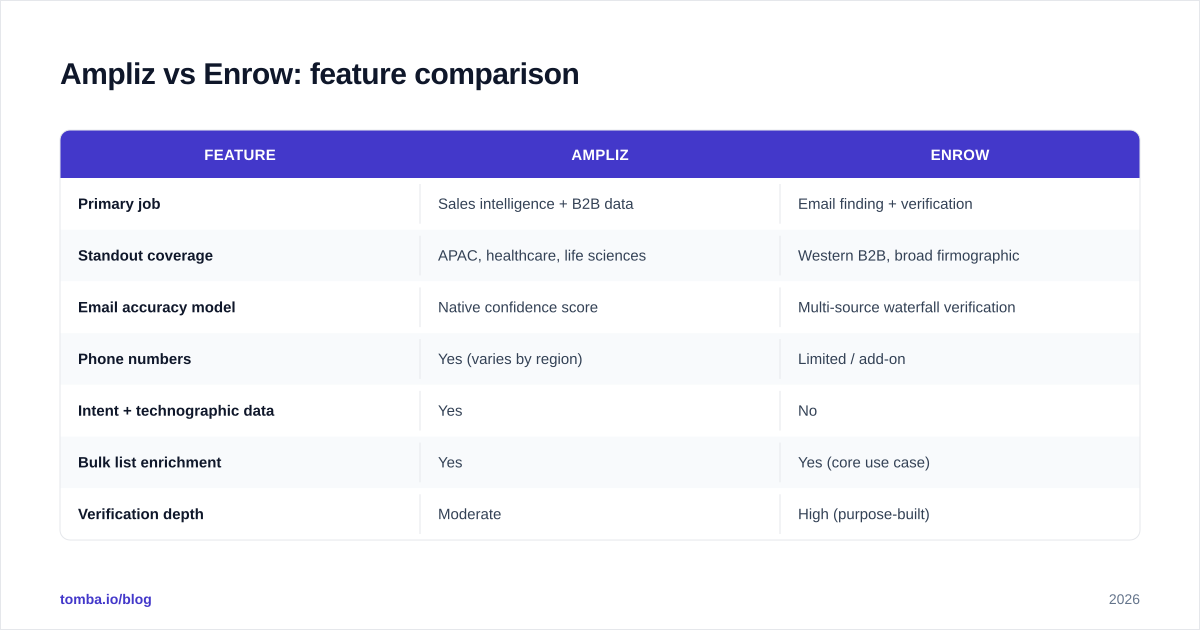
Ampliz vs Enrow: feature comparison#
| Feature | Ampliz | Enrow |
|---|---|---|
| Primary job | Sales intelligence + B2B data | Email finding + verification |
| Standout coverage | APAC, healthcare, life sciences | Western B2B, broad firmographic |
| Email accuracy model | Native confidence score | Multi-source waterfall verification |
| Phone numbers | Yes (varies by region) | Limited / add-on |
| Intent + technographic data | Yes | No |
| Bulk list enrichment | Yes | Yes (core use case) |
| Verification depth | Moderate | High (purpose-built) |
| Best for | Account discovery in niche markets | Clean emails for known targets |
| Pricing model | Credit + plan tiers | Credit-based, pay per valid email |
| Free trial | Limited | Limited credits |
The takeaway: Ampliz is a wider tool with a deeper bench in two verticals. Enrow is a sharper tool that does one thing — return emails that don't bounce — with more rigor.
How accurate are Ampliz and Enrow?#
Accuracy is the only metric that survives contact with a real campaign, so weigh it carefully.
Enrow's waterfall approach structurally favors validity. By checking a contact against several providers and verifying before return, it minimizes catch-all guesses and stale records. For standard Western B2B roles, that typically translates to lower bounce rates out of the box. If you run cold email at scale, that protects your sender reputation — the single thing that decides whether you land in the inbox or spam.
Ampliz's accuracy is strongest where its data is freshest: APAC contacts and healthcare records that mainstream US databases simply don't maintain. Outside those strongholds, coverage thins and you'll want to run results through a separate email verifier before sending.
A practical rule: no single database is right 100% of the time. Whatever you pick, verify before you send. Independent accuracy benchmarks across the email-finder category make the spread obvious.

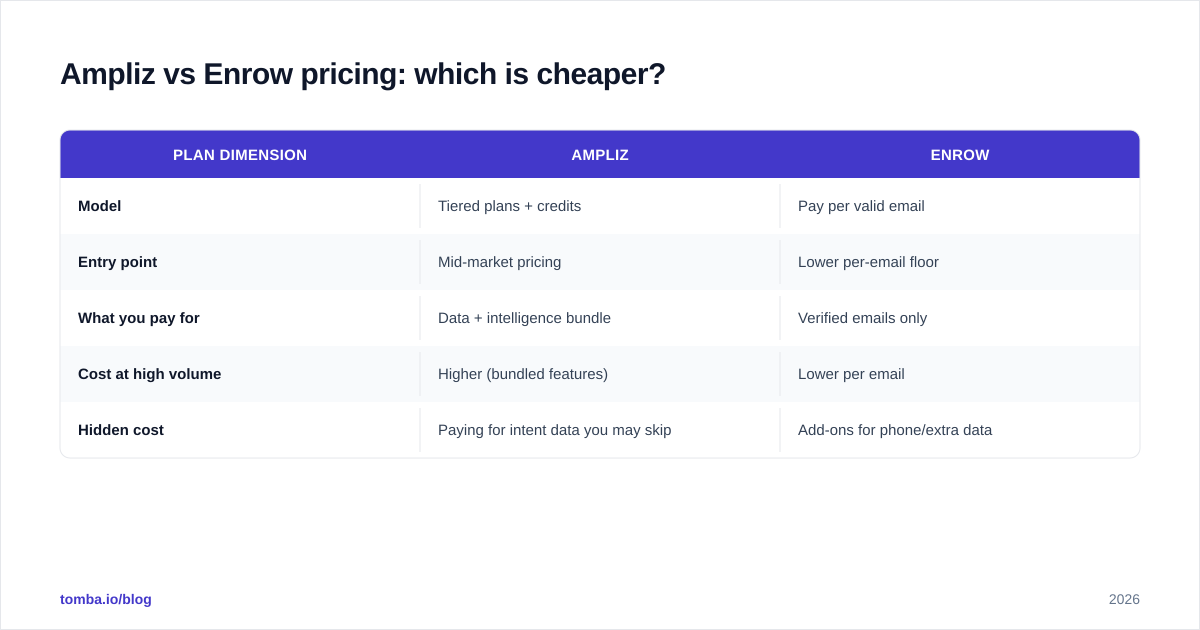
Ampliz vs Enrow pricing: which is cheaper?#
Both run on credits, but the cost logic differs.
| Plan dimension | Ampliz | Enrow |
|---|---|---|
| Model | Tiered plans + credits | Pay per valid email |
| Entry point | Mid-market pricing | Lower per-email floor |
| What you pay for | Data + intelligence bundle | Verified emails only |
| Cost at high volume | Higher (bundled features) | Lower per email |
| Hidden cost | Paying for intent data you may skip | Add-ons for phone/extra data |
If you only need emails, Enrow's "pay for valid results" model is usually the cheaper path — you're not subsidizing an intent graph. If you need the firmographic and healthcare intelligence, Ampliz's bundle can justify its higher line item.
For full transparency on how a flat, predictable model compares, see Tomba pricing — Free (25 searches/mo), Starter $49/mo, Growth $99/mo, and Pro $249/mo, with verification included rather than billed separately.
)
Which should you choose — and is there a third option?#
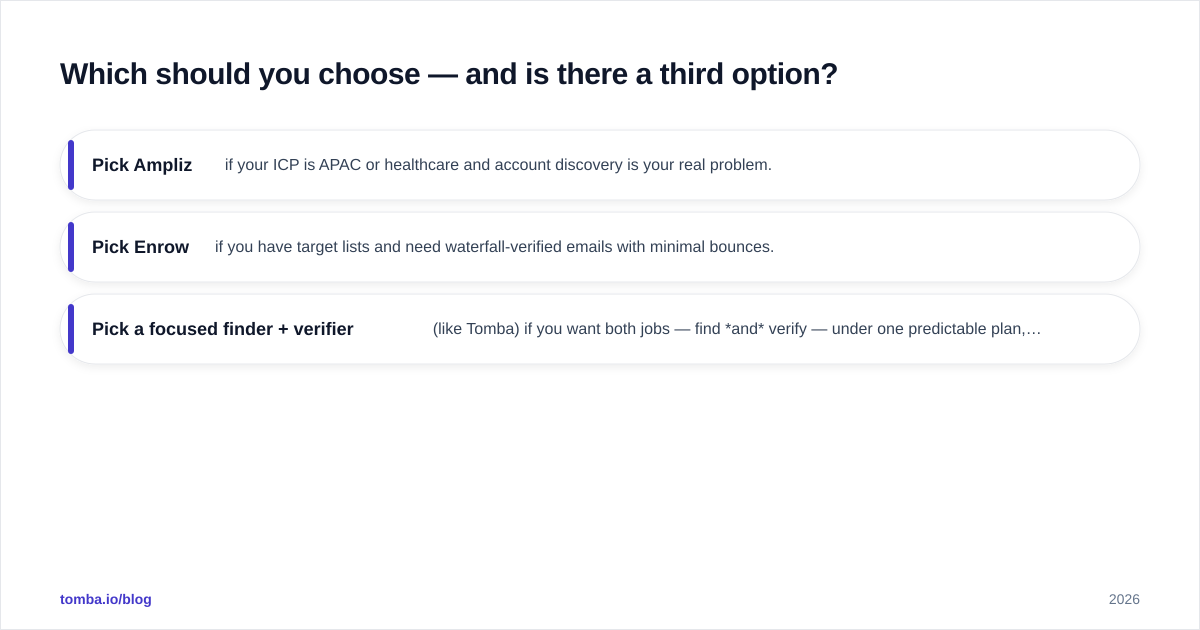
Here's the decision in one pass:
- Pick Ampliz if your ICP is APAC or healthcare and account discovery is your real problem.
- Pick Enrow if you have target lists and need waterfall-verified emails with minimal bounces.
- Pick a focused finder + verifier (like Tomba) if you want both jobs — find and verify — under one predictable plan, with API access for automation.
That third lane matters more than vendors admit. Most teams don't need a 12-source waterfall or a healthcare intelligence graph — they need accurate emails, a way to verify them in bulk, and a domain search to pull every contact at a target company. When that's the job, a single tool that does finding, verification, and enrichment beats stitching two specialists together.

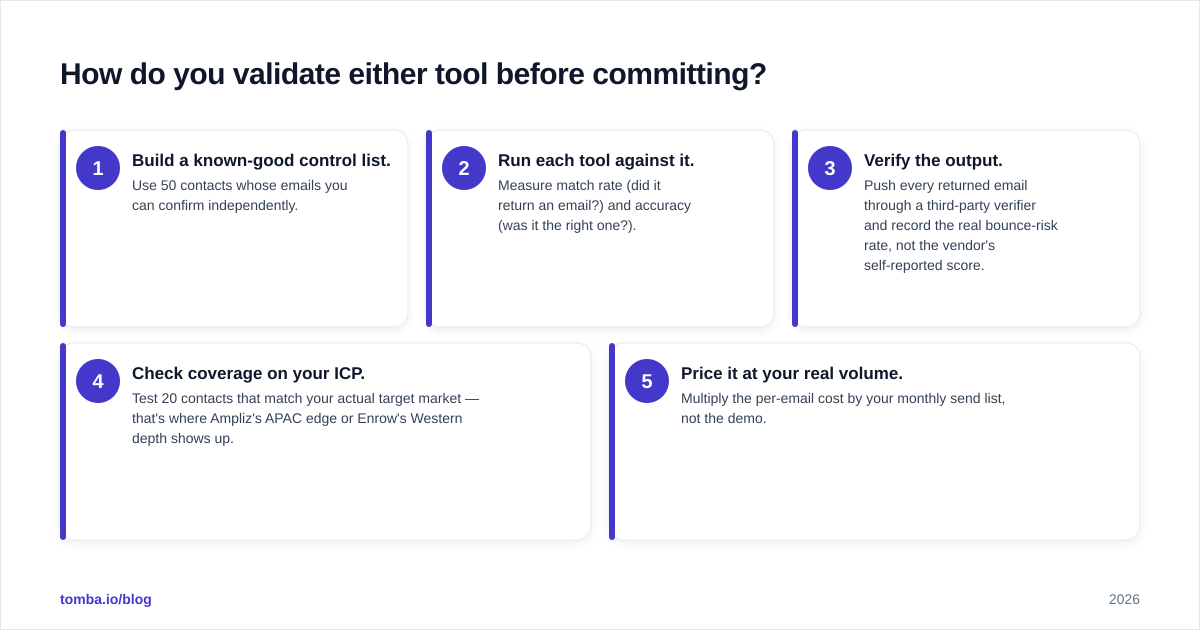
How do you validate either tool before committing?#
Run the same 50-contact test on both before you sign anything:
- Build a known-good control list. Use 50 contacts whose emails you can confirm independently.
- Run each tool against it. Measure match rate (did it return an email?) and accuracy (was it the right one?).
- Verify the output. Push every returned email through a third-party verifier and record the real bounce-risk rate, not the vendor's self-reported score.
- Check coverage on your ICP. Test 20 contacts that match your actual target market — that's where Ampliz's APAC edge or Enrow's Western depth shows up.
- Price it at your real volume. Multiply the per-email cost by your monthly send list, not the demo.
This 30-minute exercise tells you more than any review, including this one. Vendor accuracy claims are marketing; your control-list result is data. You can read more about where contact data comes from to understand why match rates vary so much between providers in the first place.
Frequently asked questions#
Is Enrow just an email verifier? No — Enrow both finds and verifies emails. The waterfall model is what separates it from single-source finders: it cross-checks multiple providers before returning a result.
Does Ampliz cover markets outside APAC and healthcare? Yes, but those two are its strongest verticals. For generic Western B2B, dedicated finders often match or beat its coverage at lower cost.
Can I use both together? You can — Ampliz for discovery, Enrow for verification — but running two credit systems gets expensive. A combined finder-and-verifier usually removes the need.
Which has an API for automation? Enrow offers programmatic access, and Ampliz exposes data via integrations. If API-first workflows matter, also compare the Tomba API, which exposes finding, verification, and enrichment through one endpoint.
The bottom line#
Ampliz and Enrow are both legitimate, but they're aimed at different bottlenecks: Ampliz at finding the right accounts in niche markets, Enrow at returning emails that don't bounce. Match the tool to your actual constraint and you'll be happy with either.
If your real need is the common one — accurate professional emails, verified before you send, at a price that doesn't balloon with volume — start with the Tomba Email Finder. Search by name, company, or domain, verify in the same workflow, and keep your bounce rate low without juggling two subscriptions. The free tier gives you 25 searches a month to run the control-list test above before you spend a cent. Compare your shortlist on a third-party review site like G2 too — then let your own data, not the marketing, make the call. (Vendor homepages: Ampliz and Enrow.)
// get started
Find, verify and enrich your first contacts today
Start on the free plan with 25 searches a month, then scale when your team is ready.
Free plan · No credit card required · GDPR & CCPA
// about the author