Ampliz vs Generect 2026: Which B2B Data Tool Wins?
Ampliz vs Generect compared on data coverage, accuracy, pricing, and real-time lookups — plus where a verification-first finder like Tomba fits in 2026.
Choosing between Ampliz and Generect comes down to one question: do you need a deep, segment-specific data warehouse, or a real-time lookup engine that pulls fresh contacts the moment you need them? Both promise accurate B2B contacts, but they solve different problems, and picking wrong means either paying for coverage you never touch or chasing leads that bounce.
This guide breaks down both tools on coverage, accuracy, real-time capability, pricing, and fit — then shows where a verification-first finder fits if neither one closes the gap.
TL;DR — Ampliz vs Generect at a glance#
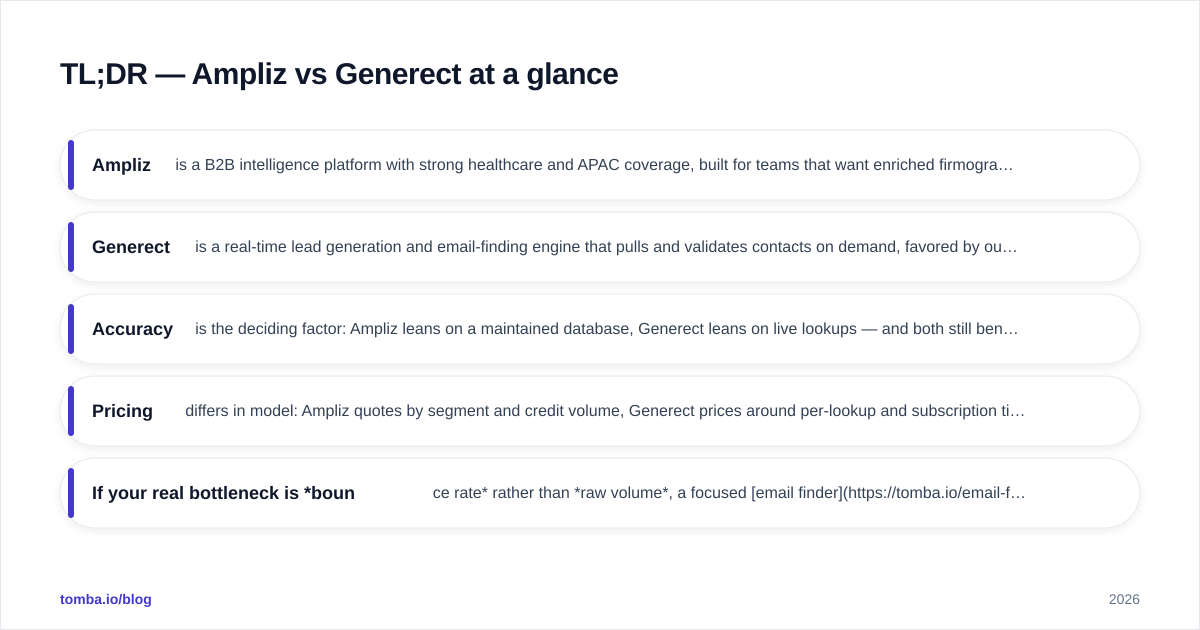
- Ampliz is a B2B intelligence platform with strong healthcare and APAC coverage, built for teams that want enriched firmographic and contact data inside curated segments.
- Generect is a real-time lead generation and email-finding engine that pulls and validates contacts on demand, favored by outbound teams running high-volume sequences.
- Accuracy is the deciding factor: Ampliz leans on a maintained database, Generect leans on live lookups — and both still benefit from an independent verification pass before you hit send.
- Pricing differs in model: Ampliz quotes by segment and credit volume, Generect prices around per-lookup and subscription tiers.
- If your real bottleneck is bounce rate rather than raw volume, a focused email finder with built-in verification often beats both.
What is Ampliz?#
Ampliz is a B2B data intelligence platform that specializes in enriched contact and company records, with a reputation for healthcare intelligence and Asia-Pacific market coverage that many US-centric tools lack. Instead of just handing you an email address, Ampliz is designed to deliver context — firmographics, intent signals, and segment filtering — so sales and marketing teams can build targeted lists rather than spray-and-pray.
Think of Ampliz like a specialty library. It may not stock every book ever printed, but in its chosen sections — healthcare, APAC enterprise — the shelves are deep and well-organized. That focus is the whole point: teams selling into those verticals get records generic providers simply don't carry.
The trade-off is that a curated database ages. Job changes, departures, and rebrands erode any static dataset over time, so the freshness of a given record depends on when it was last refreshed. You can read independent user reviews on G2 to see how teams rate Ampliz coverage in their specific segment before committing.
What is Generect?#
Generect is a lead generation tool built around real-time email finding and validation. Rather than serving records from a pre-built warehouse, it queries live sources at the moment of search, then runs validation so the contact you export is one that exists right now — not one captured months ago.
The everyday analogy: Ampliz is a stocked pantry, Generect is fresh produce from the market. Generect's pitch is freshness and the ability to find contacts for companies and roles that a static database may have missed entirely. For outbound teams pushing volume through cold email sequences, that live-lookup model can mean fewer dead addresses landing in a sequence.
The downside of real-time lookups is consistency. Live querying depends on what's publicly discoverable at query time, so coverage can vary by region, seniority, and company size. You can check the official feature set on the Generect homepage and weigh it against your target market.
How do Ampliz and Generect compare on features?#
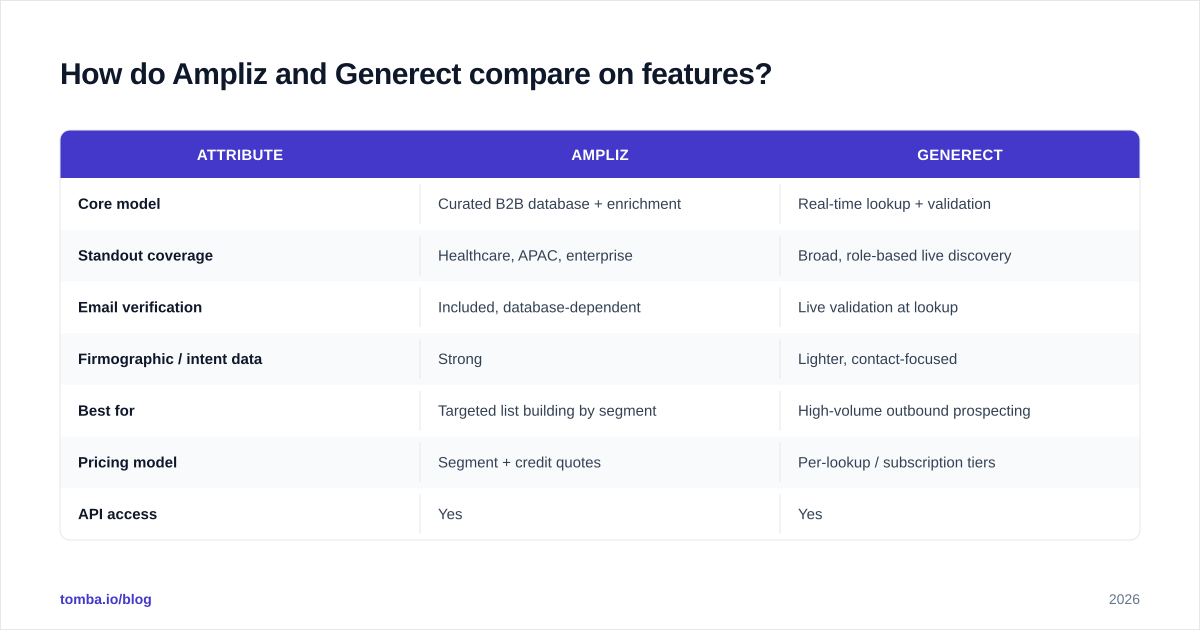
Here's the head-to-head on the attributes that actually change your results:
| Attribute | Ampliz | Generect |
|---|---|---|
| Core model | Curated B2B database + enrichment | Real-time lookup + validation |
| Standout coverage | Healthcare, APAC, enterprise | Broad, role-based live discovery |
| Email verification | Included, database-dependent | Live validation at lookup |
| Firmographic / intent data | Strong | Lighter, contact-focused |
| Best for | Targeted list building by segment | High-volume outbound prospecting |
| Pricing model | Segment + credit quotes | Per-lookup / subscription tiers |
| API access | Yes | Yes |
| Data freshness risk | Ages between refreshes | Fresh, but coverage varies |
The pattern is clear: Ampliz optimizes for depth within a segment, Generect optimizes for freshness at the moment of search. Neither is strictly better — they're tuned for different motions.

Which tool is more accurate?#
Accuracy is the metric that quietly decides your sender reputation, so it deserves more than a marketing claim. The honest answer: it depends on how each tool sources the specific record you need.
A curated platform like Ampliz can be extremely accurate inside its strongest segments because those records are maintained deliberately. But any database degrades — research consistently shows B2B contact data decays meaningfully every year as people change jobs. A record that was perfect at capture can be wrong six months later.
Generect's live model sidesteps some decay by querying at search time, but it inherits a different risk: if the contact isn't publicly discoverable when you search, coverage drops or the result is a best-guess pattern. Live validation reduces bad sends, yet validation quality varies by provider.

This is exactly why experienced teams treat finding and verifying as two separate jobs. No matter which tool surfaces the address, running it through an independent email verifier before a campaign is the single highest-ROI habit for protecting deliverability. A second opinion catches the records that decayed since capture and the live lookups that returned a pattern guess.
How does pricing compare?#
Pricing is where the two tools diverge most, and where you should be most careful comparing apples to apples.
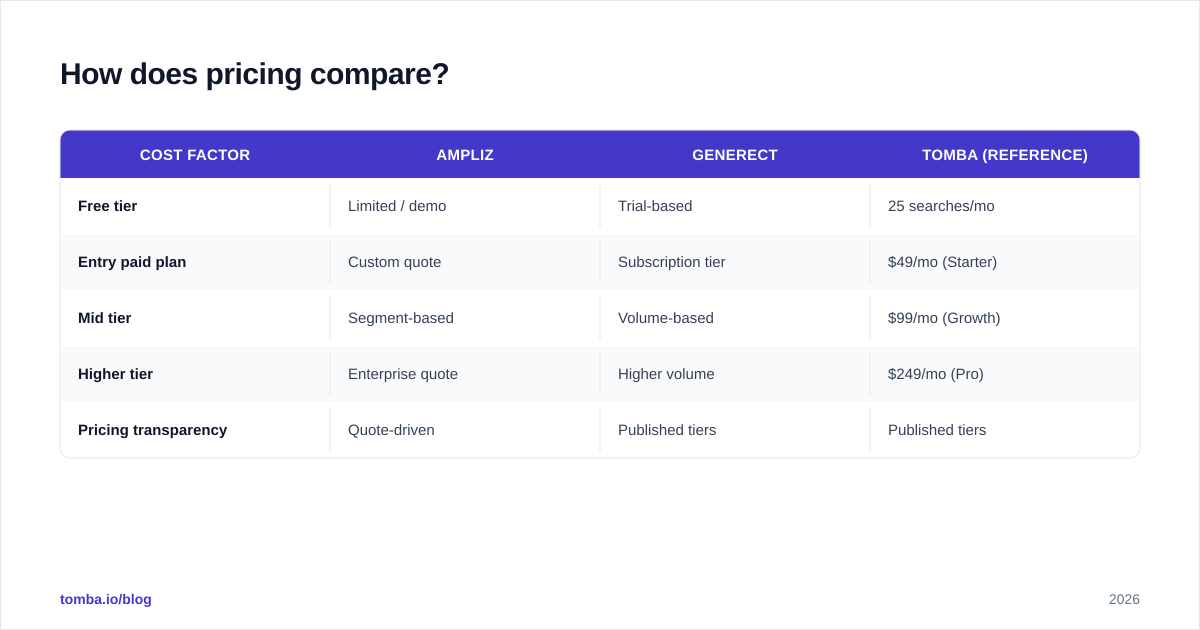
Ampliz generally prices around segments and credit volume, often with custom quotes depending on the verticals and regions you need. That model rewards teams with a clear, narrow target market — you pay for the slice you actually sell into.
Generect tends toward per-lookup economics and subscription tiers, which suits teams running consistent, high-volume outbound where predictable per-contact cost matters more than deep enrichment.
| Cost factor | Ampliz | Generect | Tomba (reference) |
|---|---|---|---|
| Free tier | Limited / demo | Trial-based | 25 searches/mo |
| Entry paid plan | Custom quote | Subscription tier | $49/mo (Starter) |
| Mid tier | Segment-based | Volume-based | $99/mo (Growth) |
| Higher tier | Enterprise quote | Higher volume | $249/mo (Pro) |
| Pricing transparency | Quote-driven | Published tiers | Published tiers |
Because Ampliz leans quote-driven, budget directly against your target segment rather than a sticker price. For a transparent point of comparison, the published Tomba pricing tiers — Free, Starter at $49/mo, Growth at $99/mo, and Pro at $249/mo — show what predictable, per-credit costing looks like when you don't want a sales call to learn the number.

Which should you choose for your use case?#
Match the tool to the motion, not the hype.
Choose Ampliz if:
- You sell into healthcare or APAC markets where its coverage is deepest.
- You want firmographic and intent context alongside contacts, not just an email.
- Your motion is targeted list building, and segment quality beats raw volume.
Choose Generect if:
- You run high-volume outbound and need fresh contacts on demand.
- Real-time validation matters more than deep enrichment.
- You're hitting coverage gaps in static databases for newer or niche companies.
Choose a focused finder + verifier (like Tomba) if:
- Your bottleneck is bounce rate and deliverability, not list size.
- You want transparent per-credit pricing without a quote process.
- You need to find contacts by company domain and verify them in one workflow, then push to your CRM.
For that last motion, pairing a domain search to map a company's contacts with an immediate verification step is often faster — and cheaper — than licensing a full intelligence platform you'll only partly use. You can also see how vendors source records on the data sources page, since provenance is what ultimately drives accuracy.

What are the main pros and cons?#
Ampliz pros: strong segment depth (healthcare, APAC), enrichment and intent context, good for targeted account selection. Ampliz cons: quote-driven pricing, database freshness depends on refresh cadence, less ideal for broad volume outside its strong segments.
Generect pros: real-time lookups, live validation, good for high-volume outbound and niche company discovery. Generect cons: coverage varies by region and seniority, lighter on firmographic/intent enrichment, results depend on public discoverability at query time.
The meta-lesson across both: whichever tool you pick, the contact still has to be real and current when you email it. Tools that find addresses and tools that verify them are complementary, not interchangeable. Industry guidance from established CRM vendors like HubSpot consistently points to list hygiene — not list size — as the lever that moves reply rates and protects sender reputation.
How do these tools fit a modern prospecting stack?#
Most teams don't run a single tool — they run a chain. A typical 2026 stack looks like: discover the target account, find the right contacts, verify before send, enrich for personalization, then sequence. Ampliz fits the discover-and-enrich stages well in its segments; Generect fits the find-and-validate stage for volume.
The gap that bites teams is the handoff between find and send. A contact that looked good at export can be wrong by the time your sequence reaches it. Building an explicit verification checkpoint into the workflow — ideally one that also handles catch-all domains and risky records — is what separates a 2% bounce rate from a 15% one that gets your domain throttled.
If you'd rather consolidate find-and-verify into one transparent, API-friendly step instead of stitching two vendors together, that's precisely the niche a dedicated finder fills.
The bottom line#
Ampliz and Generect both deliver real value — Ampliz for segment depth, Generect for real-time freshness — and the right pick depends entirely on whether your motion is targeted enrichment or high-volume discovery. Neither removes the need to verify before you send.
If your actual goal is finding professional email addresses by name, company, or domain and confirming they're deliverable in the same workflow — without a quote process — start with the Tomba Email Finder. Its free tier gives you 25 searches a month to test accuracy against your own list, and paid plans start at $49/mo with verification built in, so the contacts you export are the contacts that actually land.
Ready to find emails that actually work?
Join 150,000+ professionals who stopped guessing and started sending. Free credits on signup — no credit card required.
Get the Tomba newsletter
Practical outbound tactics and product updates — once every two weeks.
About the author