Ampliz vs Goava 2026: B2B Sales Intelligence Compared
Ampliz vs Goava: one chases global healthcare data, the other owns Nordic B2B. See which sales intelligence platform fits your pipeline in 2026 — and where a leaner stack wins.
TL;DR
- Ampliz is built for global reach with a strong healthcare/APAC data slant — physician databases, firmographics, and intent signals aimed at teams selling into hospitals, life sciences, and broad international markets.
- Goava is a Nordic-first sales intelligence engine — deep, fresh data on Swedish, Danish, Norwegian, and Finnish companies, with AI lead recommendations tuned to that region.
- Pick Ampliz if your ICP is healthcare or you need worldwide contact coverage; pick Goava if you sell into the Nordics and want local accuracy plus prospecting automation.
- Neither is a cheap entry point. Both quote custom pricing, which makes budgeting harder for small teams.
- If your real bottleneck is finding and verifying work emails fast, a focused tool like Tomba covers that job at a fraction of the cost — and pairs well with either platform.
When you put Ampliz vs Goava side by side, you are not comparing two versions of the same product. You are comparing two bets about where your buyers live. One platform optimizes for global breadth with a healthcare core; the other optimizes for regional depth. This guide breaks down data coverage, accuracy, pricing, and the use cases where each one earns its seat in your stack.
What is Ampliz?#
Ampliz is a B2B data and sales intelligence platform best known for its healthcare intelligence database. It markets two flavors of product: a general B2B contact and company database with firmographic and technographic filters, and a specialized healthcare dataset covering physicians, hospitals, clinics, and decision-makers across specialties.
The pitch is reach plus segmentation. You search by industry, geography, company size, job role, or — in healthcare — by specialty, NPI-style attributes, and facility type. Ampliz then surfaces contact details, company firmographics, and intent or technographic signals you can push into outreach. Its data network leans heavily toward APAC and North America, with healthcare as the standout vertical.
In practice, teams reach for Ampliz when they need to build large, segmented lists for verticals where generic databases run thin — medical device sales, pharma, healthcare SaaS, or international expansion plays where a US-only tool falls short.
What is Goava?#
Goava is a sales intelligence platform built for the Nordic market. Where most global databases treat Sweden, Norway, Denmark, and Finland as thin afterthoughts, Goava treats them as the entire product. It pulls from local company registries, financial filings, web signals, and proprietary scoring to deliver fresh, accurate company data for the region.
Its signature feature is AI-driven lead recommendations: Goava analyzes your existing customers, identifies look-alike companies in its Nordic database, and serves a prioritized prospecting list. Reps get company profiles, buying signals, financial health indicators, and trigger events — without manually trawling registries.
Goava is a CRM-adjacent tool. It integrates with popular CRMs so the recommended accounts and enriched data land where reps already work. The trade-off is scope: outside the Nordics, coverage drops off sharply. This is a regional specialist, not a global directory.
Ampliz vs Goava: how do they compare at a glance?#
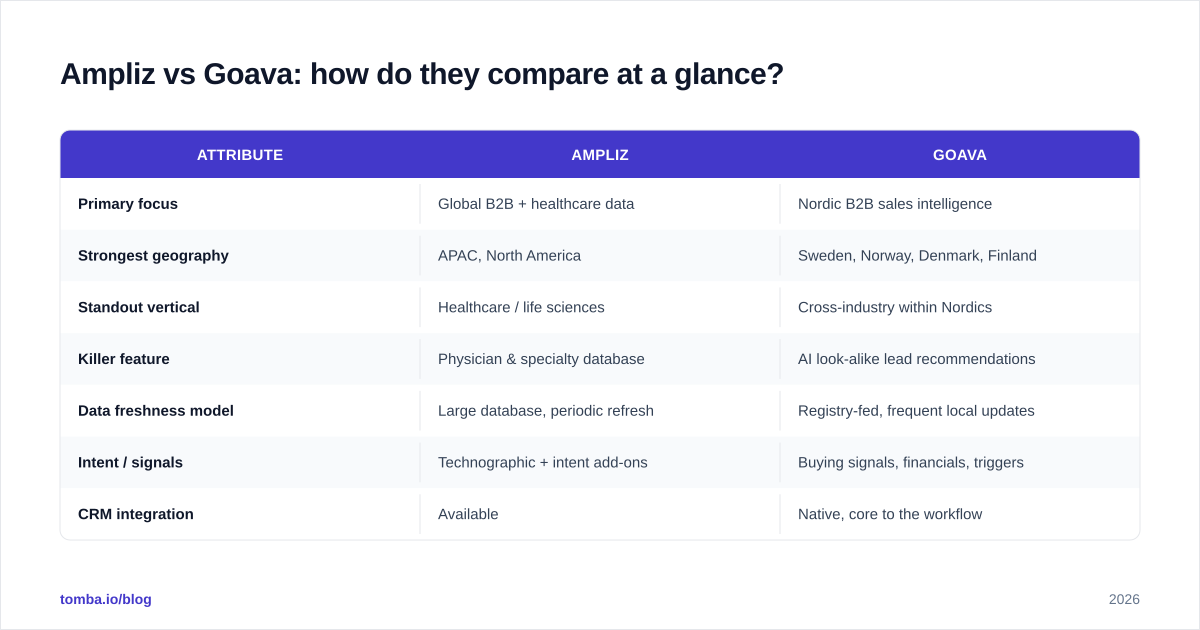
Here is the head-to-head on the attributes that actually drive a buying decision.
| Attribute | Ampliz | Goava |
|---|---|---|
| Primary focus | Global B2B + healthcare data | Nordic B2B sales intelligence |
| Strongest geography | APAC, North America | Sweden, Norway, Denmark, Finland |
| Standout vertical | Healthcare / life sciences | Cross-industry within Nordics |
| Killer feature | Physician & specialty database | AI look-alike lead recommendations |
| Data freshness model | Large database, periodic refresh | Registry-fed, frequent local updates |
| Intent / signals | Technographic + intent add-ons | Buying signals, financials, triggers |
| CRM integration | Available | Native, core to the workflow |
| Pricing | Custom quote | Custom quote |
| Free trial | Limited / on request | On request |
| Best for | Healthcare & global outreach | Nordic-focused sales teams |
The pattern is clear: these tools rarely compete for the same deal. A medical-device company selling across Asia and the US shortlists Ampliz. A Stockholm SaaS company expanding across Scandinavia shortlists Goava. The overlap is small.
Which has better data coverage and accuracy?#
Coverage and accuracy depend entirely on where you sell — there is no universal winner.
Ampliz wins on breadth and healthcare depth. If your motion spans multiple countries or targets healthcare decision-makers, Ampliz's database is the larger, more relevant net. Its physician and facility data is genuinely hard to replicate with generic providers. The caveat is that breadth and freshness pull against each other: a database covering millions of global contacts will always carry some stale rows, and Ampliz is no exception. Plan to verify before you send.
Goava wins on regional accuracy. Because it feeds from Nordic company registries and local sources, its data on Swedish or Finnish companies is fresher and more complete than what a global player offers for the same accounts. Registry-backed data also means firmographics like revenue, employee count, and ownership tend to be reliable. The flip side: ask Goava about a company in Texas or Tokyo and it has little to say.
The accuracy lesson holds for both: no database is a substitute for verification at send time. Bounce rates wreck your sender reputation, and a list that looked clean at export can degrade within weeks. Running exports through an email verifier before a campaign is the cheapest insurance you can buy, regardless of which platform sourced the data.
How do Ampliz and Goava price their plans?#
Both platforms use custom, quote-based pricing rather than public self-serve tiers. That is standard for enterprise data vendors, but it has consequences:
- No quick budgeting. You cannot estimate cost without a sales call, which slows down evaluation for small teams.
- Seat- and volume-based. Expect pricing to scale with users, record/credit volume, and add-on modules (intent, healthcare data, API access).
- Annual commitments are common. Month-to-month flexibility is rare at this tier.
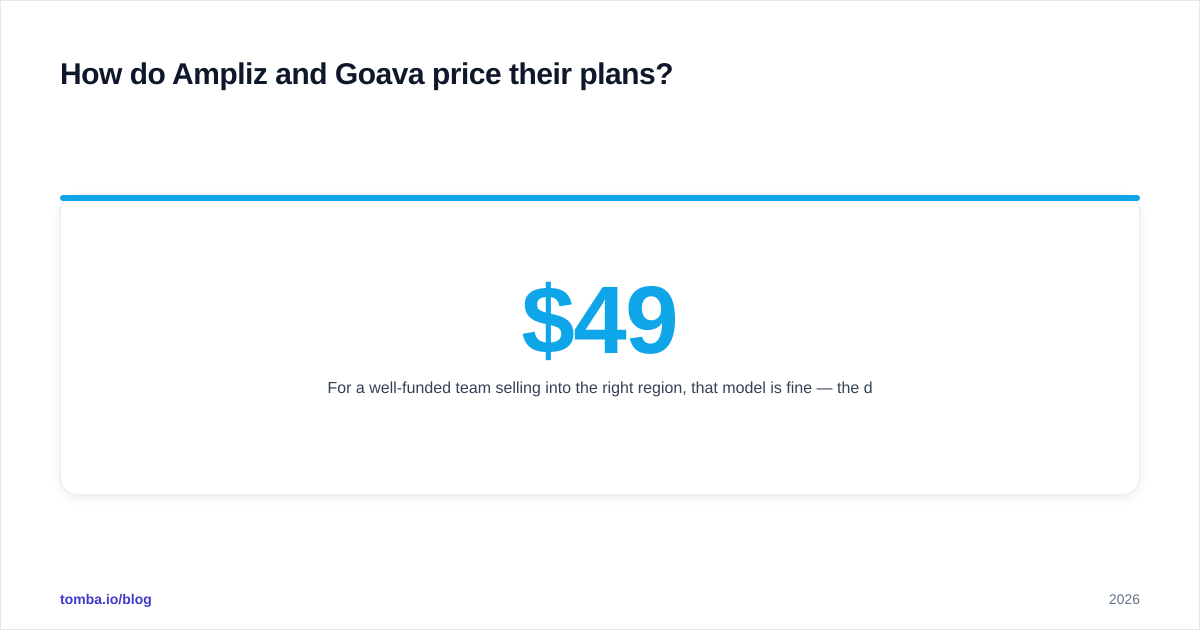
For a well-funded team selling into the right region, that model is fine — the data pays for itself. For a startup or a solo founder testing a market, the lack of a transparent entry price is friction. This is where a tool with published, predictable pricing changes the math. For comparison, Tomba's pricing starts free (25 searches/month), with paid plans at $49, $99, and $249/month — no sales call required to see the number.
Where does each tool fit in a real GTM stack?#
Sales intelligence platforms are one layer of a go-to-market motion, not the whole thing. Here is how each slots in.
Ampliz fits the "vertical specialist" stack. A healthcare SaaS or medical-device company uses Ampliz as the account and contact source, layers intent data on top, and pushes segments into a sequencer. Because healthcare buying committees are large and specialized, the value is in finding the right specialty and title — exactly Ampliz's strength.
Goava fits the "regional account-based" stack. A Nordic company uses Goava's AI recommendations to build a target list, enriches its CRM with registry-grade firmographics, and triggers outreach on buying signals. The tight CRM integration means reps barely leave their workflow.
In both cases, the platform answers who and which account — but you still need clean, deliverable contact details to actually reach people. That is the handoff point where teams plug in a dedicated email finder or run a domain search to pull every public address at a target company. Sales intelligence tells you the account is worth pursuing; the finder gets you in the door.
Is there a leaner alternative to both?#
Yes — and it depends on what you actually need the platform to do.
If you stripped your requirement down to its core, many teams discover they do not need a full sales-intelligence suite. They need three things: find the right person's email, verify it's deliverable, and enrich the record. Those three jobs do not require a five-figure annual contract.
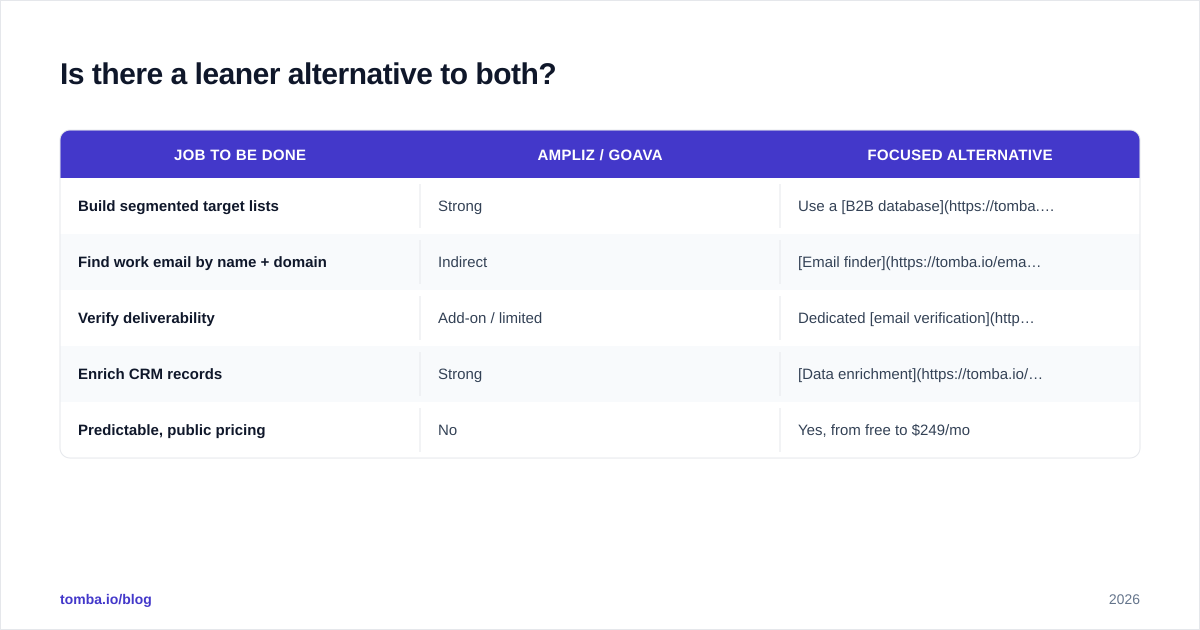
| Job to be done | Ampliz / Goava | Focused alternative |
|---|---|---|
| Build segmented target lists | Strong | Use a B2B database + filters |
| Find work email by name + domain | Indirect | Email finder, instant |
| Verify deliverability | Add-on / limited | Dedicated email verification |
| Enrich CRM records | Strong | Data enrichment API |
| Predictable, public pricing | No | Yes, from free to $249/mo |
The honest framing: Ampliz and Goava earn their cost when their specialized data is the bottleneck — healthcare specialties for Ampliz, Nordic registry depth for Goava. If your bottleneck is simply contact discovery and verification across normal B2B accounts, a focused finder-and-verifier does that job faster and cheaper, and you can always layer a specialist database on later.
You can sanity-check any vendor's reputation on independent review sites like G2 and Capterra before committing — read the reviews filtered by company size and region that match yours, since a five-star rating from enterprise users tells a startup very little.
How should you choose between Ampliz and Goava?#
Run your decision through three questions, in order:
- Where do your buyers live? If the answer is "the Nordics," Goava is the obvious shortlist. If it's "everywhere" or "Asia/North America," Ampliz fits better. This single question resolves most decisions.
- Is healthcare your vertical? If yes, Ampliz's physician and facility database is a category advantage that Goava simply does not address. If no, weigh the platforms on coverage in your specific geography.
- What's actually slowing your reps down? If it's account selection and prioritization, you need the intelligence layer these platforms provide. If it's getting valid contact details into sequences, a finder-plus-verifier solves it for a fraction of the price.
Most teams over-buy at step three. They purchase a heavyweight intelligence platform when their real gap was clean, verified emails — then pay enterprise rates for a problem a $49/month tool already solves. Be honest about which layer is broken before you sign.
For deliverability-sensitive teams, remember that even perfect account data fails if your sends bounce. Pair whichever platform you choose with disciplined list hygiene and protect your email deliverability — the best contact in the world is worthless if it lands in spam.
The bottom line#
Ampliz and Goava are both strong tools that win in different arenas. Ampliz is your pick for global reach and healthcare depth; Goava is your pick for Nordic accuracy and AI-driven lead recommendations. They rarely compete head-to-head because their data footprints barely overlap — your geography and vertical usually make the choice for you.
But before you commit to either custom-quoted contract, separate the job find and verify contacts from the job select and prioritize accounts. If contact discovery is your real gap, start with Tomba's Email Finder — find professional emails by name, domain, or company, verify them in the same workflow, and enrich your records through the API. It's free to start, transparently priced, and slots cleanly alongside Ampliz or Goava if you later decide you need their specialized data too. Test it against your next target list and see how much of your pipeline gap was really just missing emails.
Ready to find emails that actually work?
Join 150,000+ professionals who stopped guessing and started sending. Free credits on signup — no credit card required.
Get the Tomba newsletter
Practical outbound tactics and product updates — once every two weeks.
About the author