Ampliz vs LeadGenius 2026: B2B Data Platforms Compared
Ampliz leans healthcare and APAC intelligence; LeadGenius sells custom human-researched data. Here's which B2B data platform fits your GTM motion in 2026 — and the cheaper third option.
TL;DR
- Ampliz is strongest if you sell into healthcare or the APAC region — it built its reputation on physician, hospital, and Asia-Pacific firmographic data.
- LeadGenius is a managed, human-in-the-loop data service: you describe a hard-to-find audience and researchers build a custom list, often with signals off-the-shelf databases miss.
- Neither is a self-serve, pay-as-you-go tool. Both lean toward annual contracts, sales calls, and minimum commitments — which prices out smaller teams.
- For straightforward email and contact discovery at a transparent price, a self-serve email finder like Tomba covers most of the same ground from a free tier up to $249/mo.
- Pick Ampliz for niche vertical depth, LeadGenius for bespoke account research, and a self-serve tool when you mostly need verified contacts fast.
What are Ampliz and LeadGenius?#
Ampliz and LeadGenius are both B2B data intelligence providers, but they solve the problem from opposite ends. Ampliz sells access to a structured database with a vertical specialty; LeadGenius sells a service that researches data to your exact spec.
Ampliz markets itself as a global B2B data platform with particular depth in healthcare — physicians, hospitals, clinics, NPI-linked records — and in the Asia-Pacific market, where many Western databases thin out. If your ideal customer profile is "cardiologists in tier-2 Indian cities" or "procurement leads at hospitals in Southeast Asia," Ampliz is built for that question.
LeadGenius takes a different route. It blends software with a global team of human researchers who verify and assemble contact and account data on demand. Instead of querying a fixed database, you brief LeadGenius on an audience — including unusual signals like "companies hiring for a VP of Sustainability" or "DTC brands that just switched fulfillment partners" — and they deliver a list. That human layer is the product, and it shows up in both the quality and the price.
The shared idea behind both is data enrichment: feeding your CRM and outbound motion with accurate firmographic, demographic, and contact data so reps aren't guessing. Where they split is delivery model — database vs. managed service — and that distinction drives everything else.
How do Ampliz and LeadGenius compare head to head?#
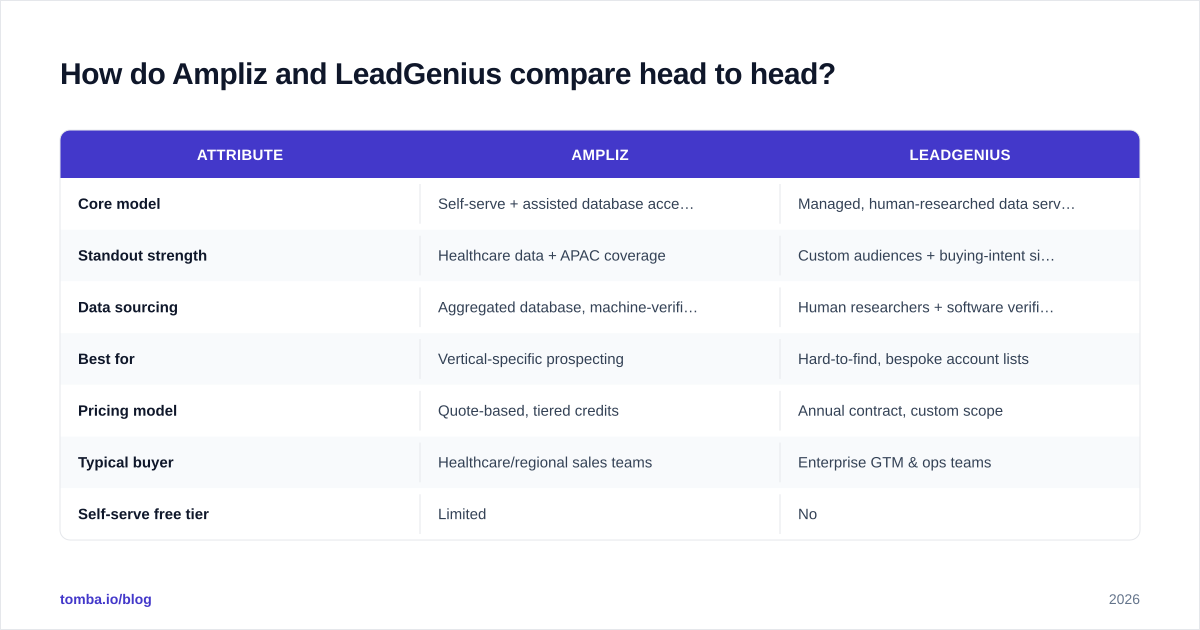
Think of it like buying produce. Ampliz is a specialty grocer with an exceptional fresh-fish counter (healthcare, APAC) and a decent general aisle. LeadGenius is a personal chef who sources exactly the ingredients your recipe calls for — pricier, slower to start, but precise. The table below maps the practical differences.
| Attribute | Ampliz | LeadGenius |
|---|---|---|
| Core model | Self-serve + assisted database access | Managed, human-researched data service |
| Standout strength | Healthcare data + APAC coverage | Custom audiences + buying-intent signals |
| Data sourcing | Aggregated database, machine-verified | Human researchers + software verification |
| Best for | Vertical-specific prospecting | Hard-to-find, bespoke account lists |
| Pricing model | Quote-based, tiered credits | Annual contract, custom scope |
| Typical buyer | Healthcare/regional sales teams | Enterprise GTM & ops teams |
| Self-serve free tier | Limited | No |
| Turnaround | Near-instant on database queries | Days to weeks for custom builds |
| Time-to-value | Fast for in-database records | Slower, but tailored |
The pattern is clear: Ampliz wins when your audience already lives in its database — especially in healthcare or Asia-Pacific. LeadGenius wins when your audience is so specific that no database has it pre-packaged, and you're willing to pay for people to go find it.
Which has better data accuracy and coverage?#
Accuracy depends on whether your targets fall inside each provider's sweet spot — there's no universal winner.
Ampliz's accuracy is highest in its specialty lanes. Healthcare records tied to NPI numbers and hospital affiliations tend to be well-structured because the underlying public and licensed sources are robust. APAC firmographics are a genuine differentiator; many North American–first databases under-represent the region, and Ampliz fills that gap. Outside those lanes — say, mid-market SaaS contacts in the US — its coverage is competitive but no longer uniquely strong.
LeadGenius's accuracy is a function of its human layer. Because researchers verify records against live sources at build time, the data is fresh when delivered, and they can capture nuance an automated crawler misses. The trade-off is scale and speed: a 50,000-row custom build takes time, and you're paying for labor, not just a query.

Whatever the source, treat every list as a starting point, not gospel. Contact data decays at roughly 25–30% per year as people change jobs — a figure widely cited across B2B data research and reflected in HubSpot's database-decay guidance. The practical takeaway: run any purchased or researched list through an email verifier before you send. Even premium data benefits from a verification pass, and it protects your sender reputation from bounces. If you work with catch-all domains common in enterprise, a dedicated catch-all verifier closes the last gap.
How do Ampliz and LeadGenius pricing compare?#
Both are quote-based and lean enterprise — neither publishes a simple self-serve price, and that's the single biggest barrier for small teams.
Ampliz typically sells tiered credit packages negotiated through a sales conversation, with pricing scaling by volume and data type. There are lighter entry points than LeadGenius, but you'll still usually talk to someone before you see a number.
LeadGenius is firmly in the annual-contract, custom-scope category. Because the product includes human research, the floor is higher and engagements are scoped per project or per ongoing program. This is rational for the value delivered — but it means a two-person startup probably can't buy it, and a team that needs data this week can't wait through a procurement cycle.
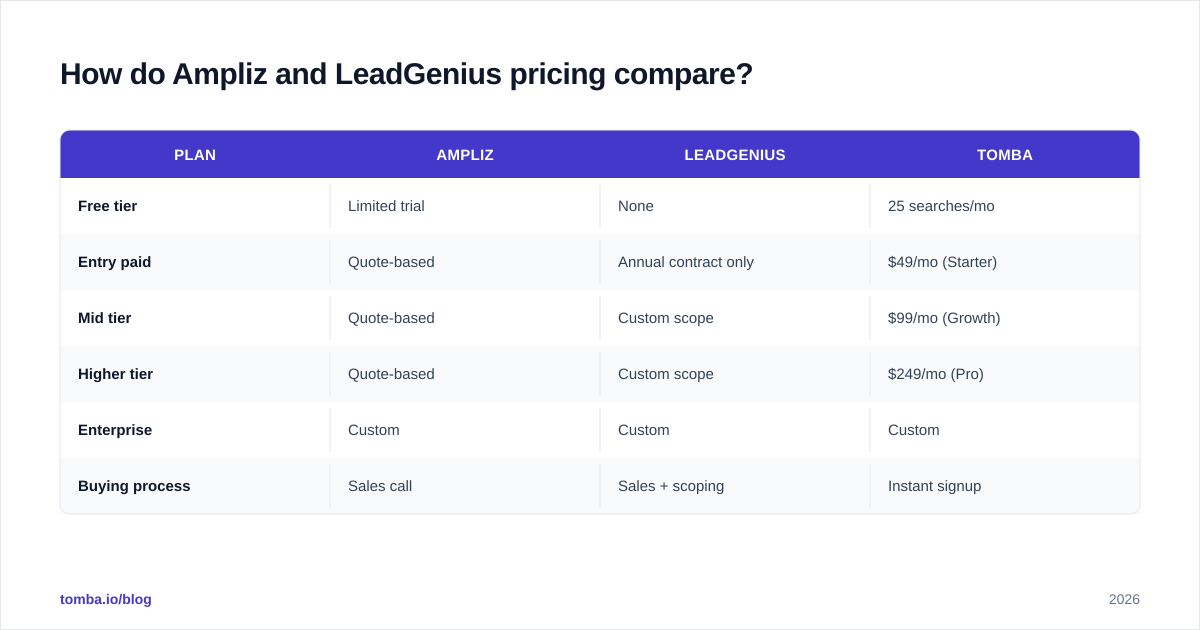
That gap is exactly where self-serve tools live. Here's how the cost structures stack up:
| Plan | Ampliz | LeadGenius | Tomba |
|---|---|---|---|
| Free tier | Limited trial | None | 25 searches/mo |
| Entry paid | Quote-based | Annual contract only | $49/mo (Starter) |
| Mid tier | Quote-based | Custom scope | $99/mo (Growth) |
| Higher tier | Quote-based | Custom scope | $249/mo (Pro) |
| Enterprise | Custom | Custom | Custom |
| Buying process | Sales call | Sales + scoping | Instant signup |
If transparent, month-to-month pricing matters to you, the contrast is stark — you can compare full Tomba pricing without a demo call. For deeper context on how these providers stack up against the broader market, our roundup of Clearbit alternatives covers adjacent data-enrichment options worth shortlisting.
When should you choose Ampliz?#
Choose Ampliz when your ICP is concentrated in healthcare or the Asia-Pacific region, and you want a database you can query rather than a service you brief.
Strong fits for Ampliz:
- Healthcare sales and marketing. Medical device, pharma, health IT, and staffing companies that need physician- and facility-level data with NPI linkage.
- APAC expansion. Teams entering or scaling in India, Southeast Asia, or broader Asia-Pacific markets where other databases are sparse.
- Vertical-first prospecting. When "depth in one niche" beats "breadth across all industries."
- Faster time-to-value than a managed service. In-database queries return quickly, so reps can build lists the same day.
Where Ampliz is a weaker fit: general-purpose US/EU B2B prospecting outside healthcare, and any team that wants fully self-serve, published pricing with no sales touch. You can still pair it with a domain search tool to fill specific company gaps its database doesn't cover.
When should you choose LeadGenius?#
Choose LeadGenius when your target audience is genuinely hard to find and worth paying humans to research — and when you have budget and lead time for a managed engagement.

Strong fits for LeadGenius:
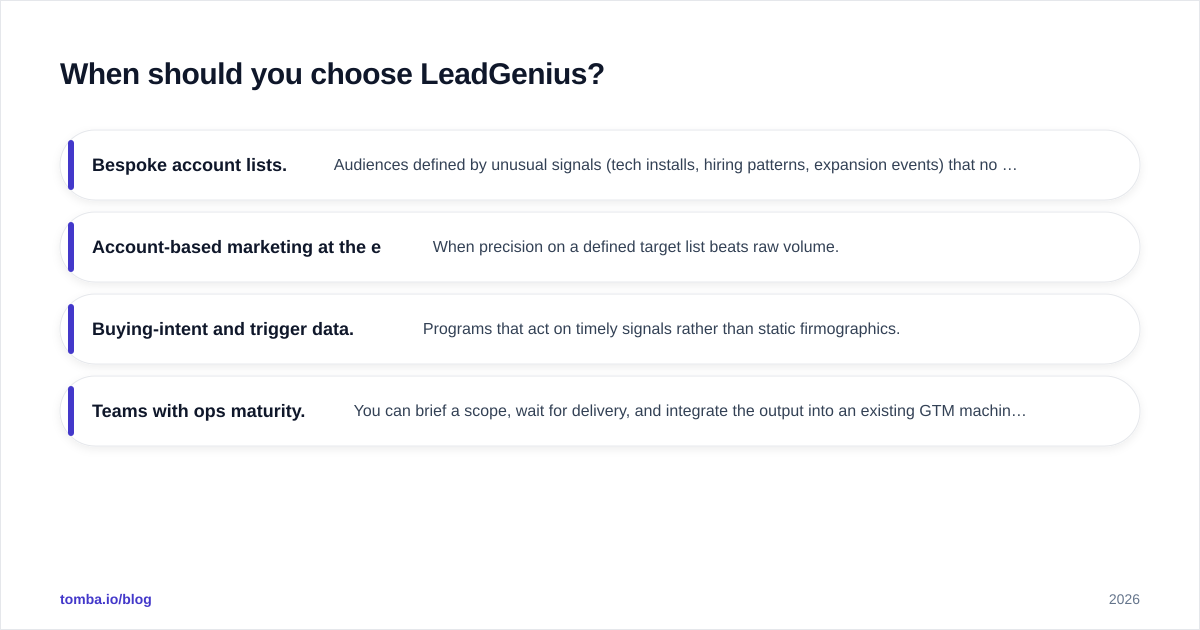
- Bespoke account lists. Audiences defined by unusual signals (tech installs, hiring patterns, expansion events) that no off-the-shelf database packages.
- Account-based marketing at the enterprise level. When precision on a defined target list beats raw volume.
- Buying-intent and trigger data. Programs that act on timely signals rather than static firmographics.
- Teams with ops maturity. You can brief a scope, wait for delivery, and integrate the output into an existing GTM machine.
Where LeadGenius is a weaker fit: small teams, urgent one-off needs, and anyone who simply wants verified emails for a known list of companies. For that last case, a self-serve bulk email finder does the job in minutes at a fraction of the cost — see how teams approach data enrichment without a custom contract.
Is there a simpler, cheaper alternative to both?#
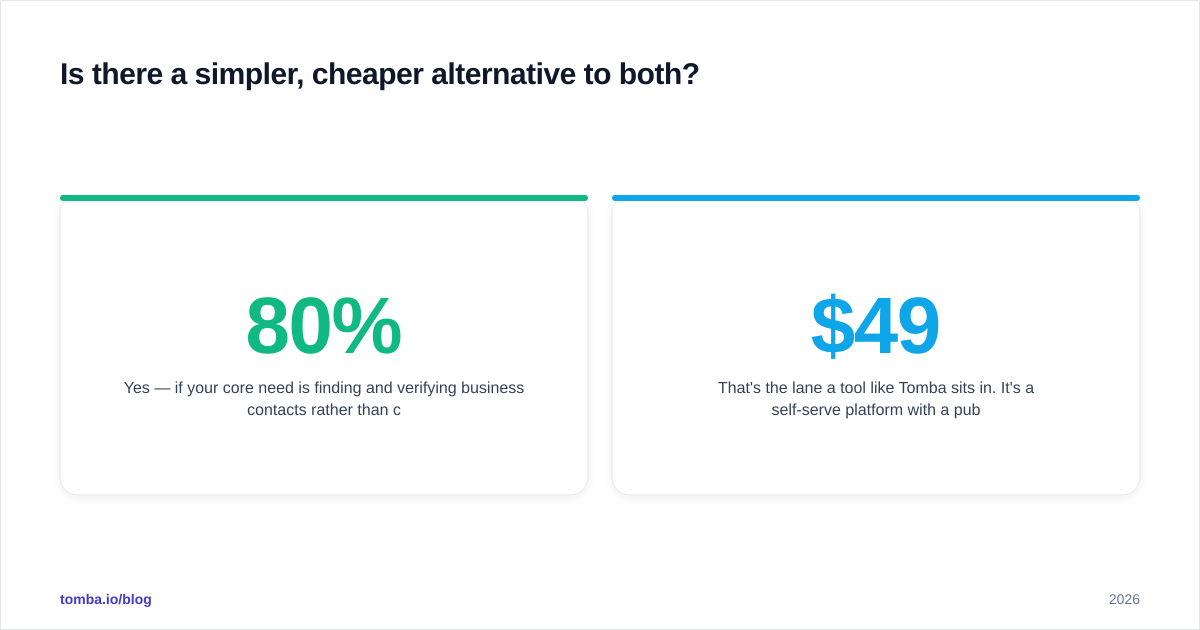
Yes — if your core need is finding and verifying business contacts rather than commissioning custom research, a self-serve email-finding platform covers the 80% case at a transparent price.
Both Ampliz and LeadGenius are excellent at what they specialize in, but both assume a sales conversation and, often, a meaningful annual commitment. Many teams don't need that. They need to: take a list of target companies, find the right people, get verified emails, and start outreach this week.
That's the lane a tool like Tomba sits in. It's a self-serve platform with a published price ladder — free tier at 25 searches/mo, then $49, $99, and $249/mo — and it focuses on the contact-discovery jobs that make up most day-to-day prospecting:
- Email finder — locate professional emails by name and domain, the core find email addresses workflow.
- Domain search — pull known contacts at a target company in one query.
- Email + catch-all verification — clean every list before it touches your sequencer.
- Bulk processing and an email finder API — for scaling and CRM enrichment.
It won't replace LeadGenius for truly bespoke research, and it isn't a healthcare specialist like Ampliz. But for general B2B prospecting, the math and the speed favor self-serve. You can validate quality on the free tier before paying anything — no demo, no minimum, no procurement cycle. For broader market context, third-party review sites like G2's sales intelligence category and Capterra let you sanity-check any vendor against verified user reviews before you commit.
The verdict: Ampliz vs LeadGenius#
There's no single winner — there's a winner for your situation:
- Ampliz if you sell into healthcare or APAC and want a queryable database with vertical depth.
- LeadGenius if you need custom, human-researched audiences and have the budget and timeline for a managed service.
- A self-serve email finder if your real need is verified contacts, fast, at a price you can see before you buy.
Most teams overestimate how exotic their data needs are. Before you sign an annual contract, test whether a transparent, pay-as-you-go tool already solves your problem. Start free with the Tomba Email Finder — run 25 searches, verify the results, and see how much of your prospecting it covers before you ever book a demo. If it does the job, you've saved a procurement cycle and a five-figure commitment. If it doesn't, you'll know exactly which specialist — Ampliz or LeadGenius — to call.
// get started
Find, verify and enrich your first contacts today
Start on the free plan with 25 searches a month, then scale when your team is ready.
Free plan · No credit card required · GDPR & CCPA
// about the author