Ampliz vs Ninjapear 2026: B2B Data & Email Finder Showdown
Ampliz pushes healthcare-grade firmographics; Ninjapear chases cheap, fast email lookups. Here's a no-spin 2026 breakdown of accuracy, pricing, and fit — plus where a leaner tool beats both.
You're comparing Ampliz vs Ninjapear because you need contact data that converts — not a CSV full of guessed addresses that torch your sender reputation. The two tools sit on opposite ends of the B2B data market: one sells depth and segmentation, the other sells speed and a low entry price. This breakdown shows which one fits your motion, and where a focused alternative quietly outperforms both.
TL;DR#
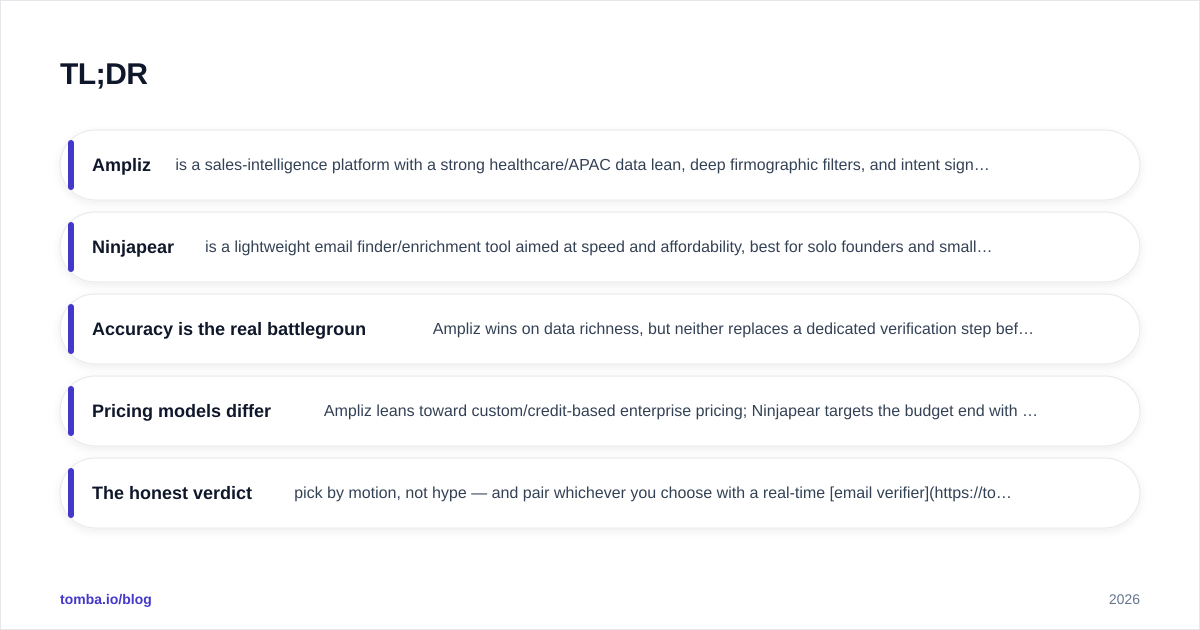
- Ampliz is a sales-intelligence platform with a strong healthcare/APAC data lean, deep firmographic filters, and intent signals — priced and built for teams that need rich segmentation.
- Ninjapear is a lightweight email finder/enrichment tool aimed at speed and affordability, best for solo founders and small outbound teams who want addresses fast.
- Accuracy is the real battleground: Ampliz wins on data richness, but neither replaces a dedicated verification step before you send.
- Pricing models differ: Ampliz leans toward custom/credit-based enterprise pricing; Ninjapear targets the budget end with simpler tiers.
- The honest verdict: pick by motion, not hype — and pair whichever you choose with a real-time email verifier so bounces don't sink your domain.
What is Ampliz?#
Ampliz is a B2B sales-intelligence and data-enrichment platform. Think of it less as a single "find an email" button and more as a database you query: you filter by industry, company size, geography, job title, and technographic or intent signals, then pull contacts that match. Its standout reputation is in healthcare data (the "Ampliz Healthcare Intelligence" angle) and APAC coverage, where many US-centric databases thin out.
For a RevOps or demand-gen team building targeted account lists, that segmentation depth is the draw. You're not just getting an email — you're getting the firmographic context to decide whether the contact is worth a touch at all. If your ICP is narrow and your list-building is account-based, that context matters more than raw record count.
The trade-off is weight. Ampliz is a platform, and platforms come with platform pricing, onboarding, and a learning curve. If all you need is one verified address for a founder you already identified on LinkedIn, you're paying for capability you won't use.
What is Ninjapear?#
Ninjapear is a lightweight email finder and enrichment tool built around speed and a low price point. The pitch is simple: paste a name and domain (or a list), get email addresses back, move on. It targets solo founders, freelancers, agencies, and small sales teams who care about cost-per-lead and want to start sending today, not after a sales call and a procurement cycle.
That focus is a genuine strength for the right buyer. There's little to learn, the entry price is friendly, and for common B2B domains the hit rate on standard email patterns is reasonable. The honest limitation is depth: you get contact data, not the rich segmentation, intent layers, or specialized vertical coverage that a platform like Ampliz is built around. For straightforward prospecting that's fine — for account-based programs that need filtering before outreach, it's thin.

How do Ampliz and Ninjapear compare at a glance?#
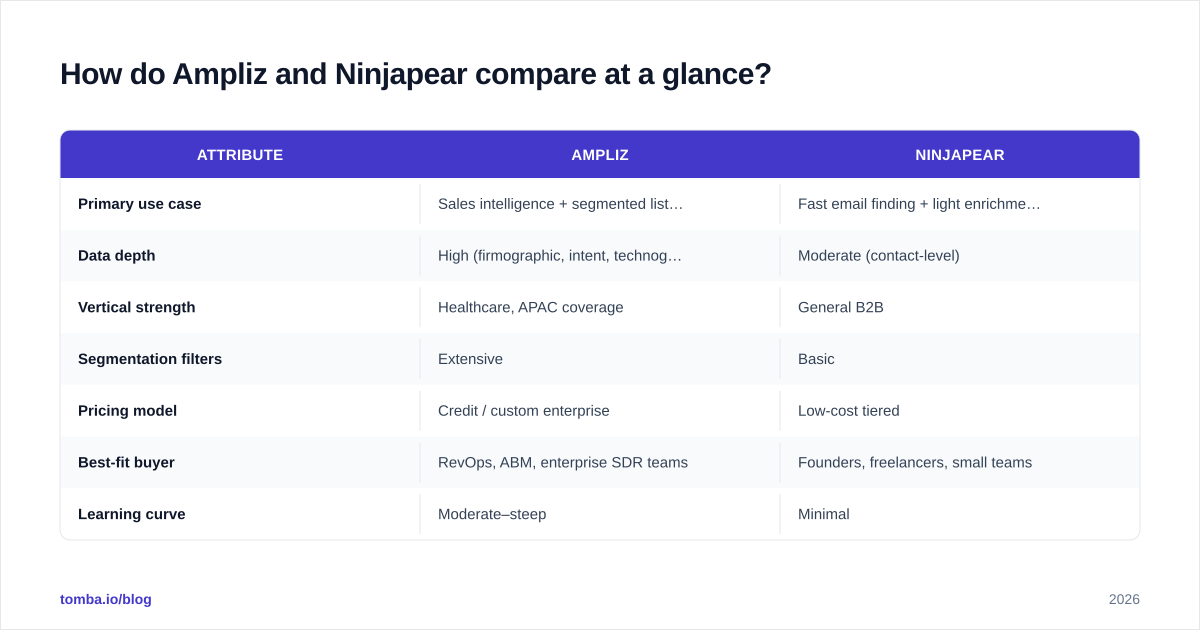
Here's the side-by-side. Treat the data-coverage rows as directional — both vendors update inventory constantly, and your real numbers depend on your ICP and region.
| Attribute | Ampliz | Ninjapear |
|---|---|---|
| Primary use case | Sales intelligence + segmented list building | Fast email finding + light enrichment |
| Data depth | High (firmographic, intent, technographic) | Moderate (contact-level) |
| Vertical strength | Healthcare, APAC coverage | General B2B |
| Segmentation filters | Extensive | Basic |
| Pricing model | Credit / custom enterprise | Low-cost tiered |
| Best-fit buyer | RevOps, ABM, enterprise SDR teams | Founders, freelancers, small teams |
| Learning curve | Moderate–steep | Minimal |
| Built-in verification | Limited | Limited |
The pattern is clear: Ampliz trades simplicity for depth, Ninjapear trades depth for simplicity and price. Neither ships a best-in-class verification engine, which is why your sending workflow needs a third step regardless of which you pick.
Is Ampliz or Ninjapear more accurate?#
Accuracy is where most "vs" posts wave their hands, so let's be precise about what accuracy means. There are two separate questions: (1) does the tool return the right email for the right person, and (2) is that email currently deliverable. Those are different problems, and most data tools — including both of these — are stronger at the first than the second.
Ampliz's larger, segmented dataset generally surfaces better firmographic matches, so you're more likely to be emailing the actual decision-maker rather than a generic inbox. Ninjapear leans on common email-pattern inference, which works well for standard corporate domains but degrades on catch-all domains and smaller companies that don't follow first.last@ conventions.
But here's the part both tools underplay: a database record being "found" is not the same as that mailbox being live. People change jobs, domains get retired, and catch-all servers accept everything and bounce later. That gap is exactly why a separate verification pass — ideally with a catch-all verifier — belongs in your pipeline no matter which finder sourced the address.

If accuracy is your deciding factor, benchmark both on your list, not a vendor's demo. Take 100 known-good contacts in your ICP, run them through each tool, then verify the results. The win rate that matters is verified-deliverable, not "found."
How does pricing compare for Ampliz vs Ninjapear?#
Pricing philosophy follows product philosophy. Ampliz is built for teams and tends toward credit-based or custom enterprise quotes — you talk to sales, you scope volume, you commit. That's normal for a data platform, but it means the true cost isn't a number on a page; it's a function of your seat count and pull volume. Ninjapear sits at the affordable end with simpler self-serve tiers, which is why budget-conscious solo operators gravitate to it.
Because both vendors adjust packaging frequently, confirm current numbers directly on their sites and on review platforms like G2 before you commit. Don't anchor on a screenshot from a blog — including this one.
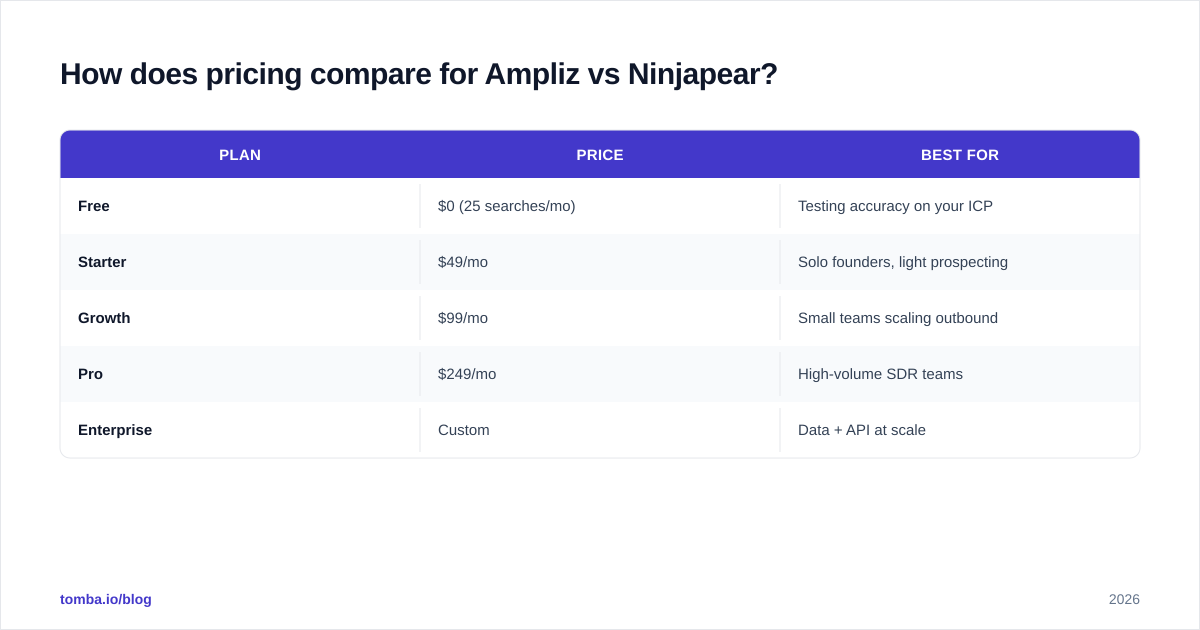
Where does a transparent, published price help? When you're modeling cost-per-verified-lead. For reference, Tomba pricing is public and tiered:
| Plan | Price | Best for |
|---|---|---|
| Free | $0 (25 searches/mo) | Testing accuracy on your ICP |
| Starter | $49/mo | Solo founders, light prospecting |
| Growth | $99/mo | Small teams scaling outbound |
| Pro | $249/mo | High-volume SDR teams |
| Enterprise | Custom | Data + API at scale |
The point isn't that one number beats another — it's that a published, search-and-verify-inclusive price makes cost-per-lead easy to model. With a custom-quote platform, you can't do that math until you're already in a sales conversation.
Which tool is right for your team?#
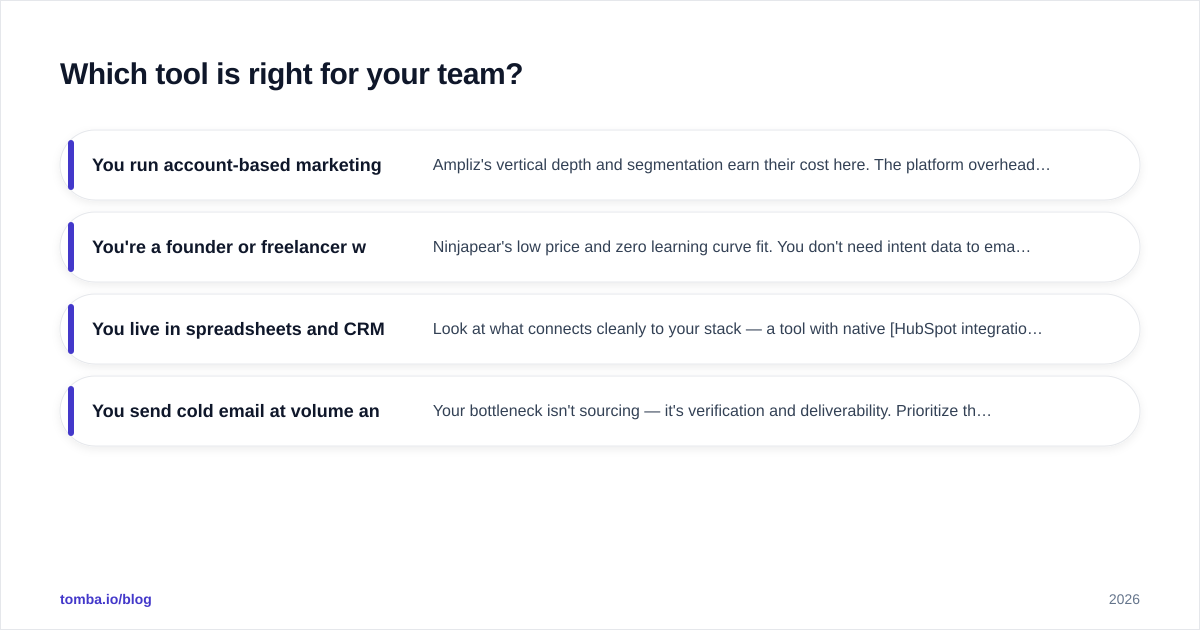
Match the tool to your motion. A few honest scenarios:
- You run account-based marketing into healthcare or APAC. Ampliz's vertical depth and segmentation earn their cost here. The platform overhead pays for itself when targeting precision drives your pipeline.
- You're a founder or freelancer who needs addresses today. Ninjapear's low price and zero learning curve fit. You don't need intent data to email 40 prospects you already researched.
- You live in spreadsheets and CRMs and want enrichment to be invisible. Look at what connects cleanly to your stack — a tool with native HubSpot integration or a Google Sheets add-on saves more hours than a marginally bigger database.
- You send cold email at volume and bounce rate keeps you up at night. Your bottleneck isn't sourcing — it's verification and deliverability. Prioritize the tool with the strongest real-time validation, then protect your domain with proper warmup and sender reputation hygiene.

What do Ampliz and Ninjapear miss?#
Both tools solve sourcing. Neither fully solves the workflow around sourcing, and that's where deals are actually won or lost.
First, verification at send time. A record found last quarter may be dead today. If your finder doesn't validate in real time, you need a step that does — otherwise you learn about bad data from your bounce report, after the damage to your domain reputation is done.
Second, catch-all domains. A huge share of B2B domains accept all mail and reveal nothing at the SMTP layer. Tools that simply "find a pattern" hand you addresses that look valid and silently fail. Dedicated catch-all handling is the difference between a 2% and a 12% bounce rate.
Third, coverage gaps outside the core strength. Ampliz is excellent in healthcare/APAC but you'll find thinner records elsewhere; Ninjapear is fine on standard domains but struggles with non-standard formats and smaller orgs. No single database is complete, which is why many teams run a primary finder plus a fallback.
This is the practical case for a finder with verification built into the same pipeline. Tomba's email finder pairs domain-based discovery with verification and catch-all checks in one flow, plus an email finder API when you need to enrich at scale inside your own systems. It's not about Tomba "winning" a feature war — it's that the find-then-verify gap is real, and closing it where you source is simpler than bolting on a second vendor.
How should you actually choose between Ampliz and Ninjapear?#
Run a three-step bake-off instead of trusting any comparison table — including this one:
- Define a 100-contact test set inside your real ICP, with known-good emails you can check against.
- Run the set through each tool, recording match rate, format correctness, and how each handles catch-all domains.
- Verify every returned address through an independent verifier and measure verified-deliverable rate — the only number that predicts bounce rate.
Whichever tool wins on verified-deliverable rate for your segment is your answer. For some teams that'll be Ampliz's depth; for others, Ninjapear's price-to-value; for plenty, a leaner find-and-verify tool that does both jobs in one place. Cross-check vendor claims against independent reviews on Capterra before signing anything.
The bottom line#
Ampliz and Ninjapear aren't really competitors so much as answers to different questions. Ampliz answers "how do I build precise, segmented lists in healthcare and APAC?" Ninjapear answers "how do I get B2B emails cheaply and fast?" Pick based on which question is actually yours — and remember that neither fully closes the verification gap that determines your bounce rate.
If your priority is finding the right address and knowing it'll land before you hit send, start with the free tier of the Tomba Email Finder. Test it on the same 100-contact set you use for Ampliz and Ninjapear, verify the results, and let the verified-deliverable rate make the decision for you. That's the only benchmark that protects your pipeline — and your domain.
// get started
Find, verify and enrich your first contacts today
Start on the free plan with 25 searches a month, then scale when your team is ready.
Free plan · No credit card required · GDPR & CCPA
// about the author