Ampliz vs Nymeria 2026: Which B2B Contact Data Tool Wins?
Ampliz leans into healthcare and APAC firmographics; Nymeria leans into LinkedIn-sourced emails and phones. Here's the honest 2026 breakdown on pricing, accuracy, coverage, and which one fits your pipeline.
Choosing between Ampliz and Nymeria usually comes down to one question: do you need niche firmographic depth (especially healthcare and APAC), or do you need broad, LinkedIn-sourced contact data at a low per-credit cost? Both tools find business emails and phone numbers, but they were built for different buyers, and pretending they're interchangeable is how teams overpay for data they never use.
This is a neutral, hands-on comparison. We'll look at pricing, data accuracy, coverage, integrations, and the workflows each tool actually fits — plus where a dedicated verification layer matters regardless of which platform you pick.
TL;DR: Ampliz vs Nymeria at a glance#
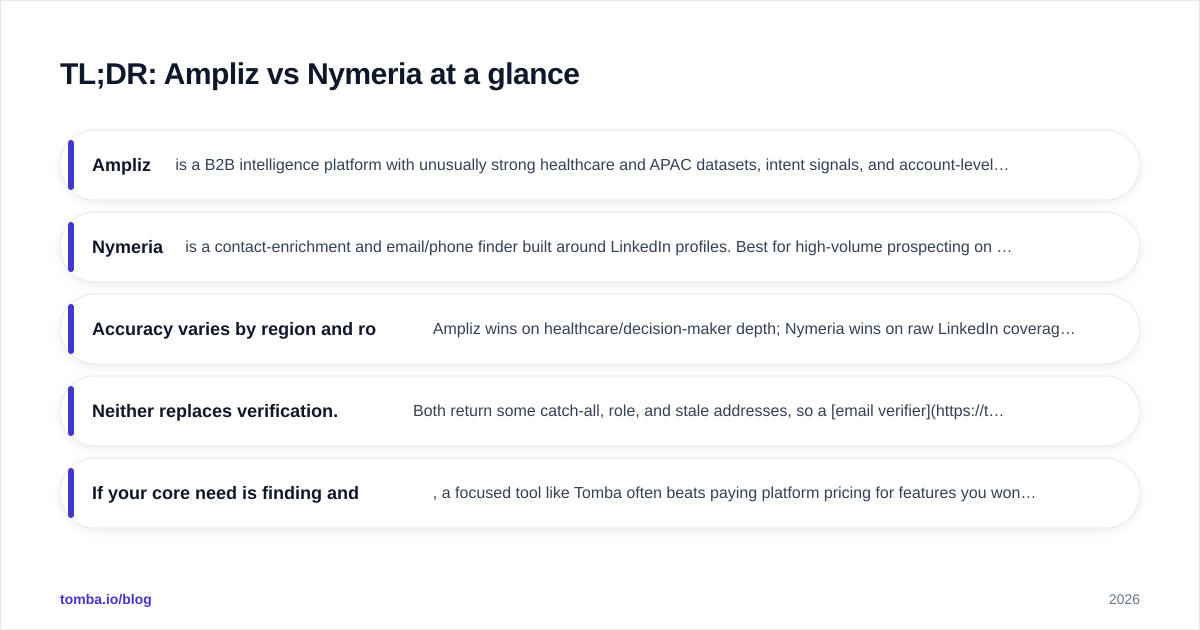
- Ampliz is a B2B intelligence platform with unusually strong healthcare and APAC datasets, intent signals, and account-level firmographics. Best for ABM and vertical-specific outbound.
- Nymeria is a contact-enrichment and email/phone finder built around LinkedIn profiles. Best for high-volume prospecting on a budget, with a generous free tier and cheap bulk credits.
- Accuracy varies by region and role. Ampliz wins on healthcare/decision-maker depth; Nymeria wins on raw LinkedIn coverage and price-per-lead.
- Neither replaces verification. Both return some catch-all, role, and stale addresses, so a email verifier step protects your sender reputation either way.
- If your core need is finding and verifying business emails, a focused tool like Tomba often beats paying platform pricing for features you won't touch.
What is Ampliz?#
Ampliz is a B2B sales-intelligence platform. Instead of being purely an email lookup, it sells access to a contact and company database enriched with firmographics, technographics, and intent data. Its standout angle is healthcare data — physicians, hospitals, clinics, NPI-linked records — plus deep coverage of the APAC region, where many US-centric databases thin out.
You typically use Ampliz to build target-account lists (by industry, revenue, headcount, location, tech stack), then pull verified contacts for the decision-makers inside those accounts. It positions itself against account-based marketing platforms more than against simple email finders.
The trade-off: it's a platform, with platform pricing and a sales-led buying process. You're paying for the data depth and segmentation, not just an email address.
What is Nymeria?#
Nymeria is a contact-enrichment tool built around professional profiles — most visibly LinkedIn. Install the browser extension, visit a profile, and Nymeria surfaces likely work and personal emails plus phone numbers. It also offers bulk enrichment and an API for pushing profile URLs or partial records in and getting contact data back.
Its reputation is volume and price. Nymeria leans into a low cost-per-credit model and a free monthly allotment, which makes it popular with founders, recruiters, and solo SDRs who prospect straight off LinkedIn and don't need account-level intelligence.
The trade-off runs the other way from Ampliz: you get broad people-data coverage, but far less firmographic, intent, or vertical-specific depth.
How do Ampliz and Nymeria compare on features and pricing?#
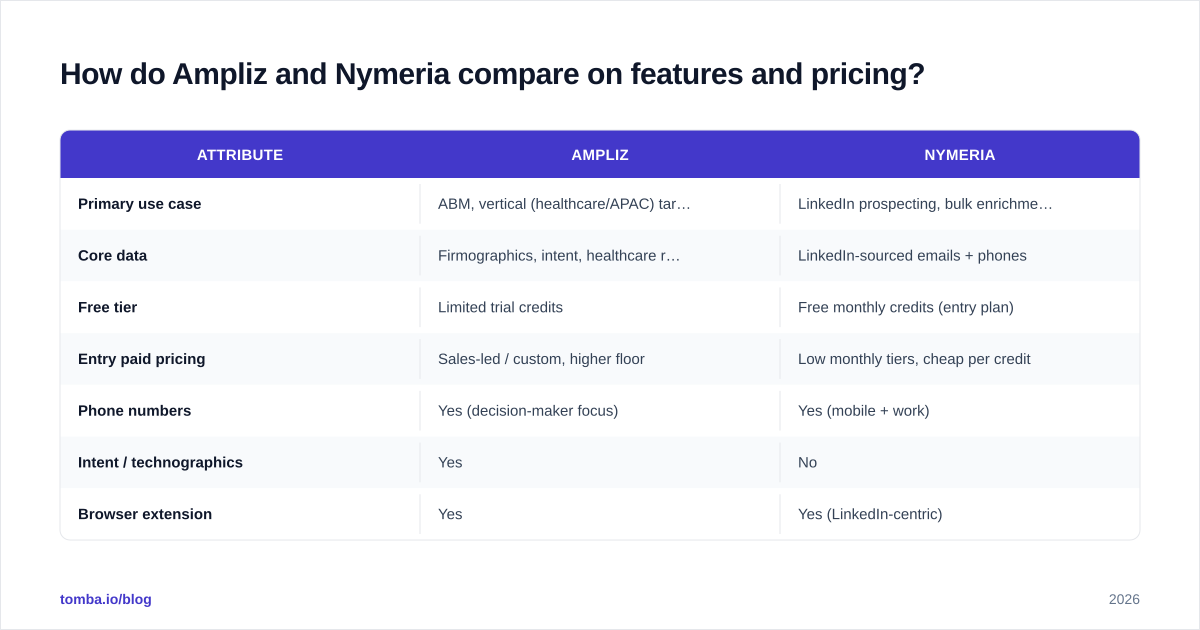
The fastest way to see the split is side by side. Pricing below reflects publicly listed tiers and common plan structures as of 2026; always confirm current numbers on each vendor's site, since data tools change pricing often.
| Attribute | Ampliz | Nymeria |
|---|---|---|
| Primary use case | ABM, vertical (healthcare/APAC) targeting | LinkedIn prospecting, bulk enrichment |
| Core data | Firmographics, intent, healthcare records | LinkedIn-sourced emails + phones |
| Free tier | Limited trial credits | Free monthly credits (entry plan) |
| Entry paid pricing | Sales-led / custom, higher floor | Low monthly tiers, cheap per credit |
| Phone numbers | Yes (decision-maker focus) | Yes (mobile + work) |
| Intent / technographics | Yes | No |
| Browser extension | Yes | Yes (LinkedIn-centric) |
| API access | Yes | Yes |
| Best fit | Mid-market/enterprise verticals | SMB, recruiters, solo SDRs |
Read this as two different shopping carts. Ampliz buyers are paying for segmentation and depth: "show me every cardiology decision-maker at hospitals over 500 beds in Southeast Asia." Nymeria buyers are paying for reach per dollar: "I have 4,000 LinkedIn profiles, get me emails cheaply."

Which has better data accuracy?#
Accuracy depends entirely on who you're searching for and where.
Ampliz tends to win where it specializes. For healthcare roles and APAC contacts, its records are often more complete and better-segmented than generalist databases, and decision-maker emails skew accurate because the dataset is curated for those verticals. Outside its strengths — say, a US SaaS marketing manager — it's competitive but no longer exceptional.
Nymeria wins on coverage breadth. Because it's tied to LinkedIn-style profiles, it surfaces a contact for almost anyone with a professional presence. The catch is that breadth includes more guesses: pattern-derived addresses, personal emails, and catch-all domains that look valid but bounce. That's normal for any LinkedIn-sourced finder, not a Nymeria-specific flaw.
The honest takeaway: no contact database is "verified" enough to skip a verification step. Email providers reject on bounce rate, not on which vendor you bought the list from. Running results through a catch-all verifier and an SMTP-level check catches the addresses that will quietly torch your deliverability.

If accuracy is your top priority, judge any tool the same way: bounce rate on a real send, not the marketing claim. Pull 100 contacts, verify them, then send to a seed list and measure. Vendors quote 95%+ accuracy; your own test is the only number that matters. (For how source data quality is built, see where the data comes from.)
Which one fits your workflow?#
Match the tool to the motion, not the other way around.
Pick Ampliz if:
- You sell into healthcare, life sciences, or APAC markets.
- You run account-based marketing and need firmographic + intent filters.
- You build target-account lists first, then pull contacts.
- You have budget for a platform and a team to use the segmentation.
Pick Nymeria if:
- You prospect directly off LinkedIn, profile by profile.
- You're a recruiter, founder, or small team optimizing cost-per-lead.
- You need a free tier and predictable cheap credits.
- You don't need intent data or deep firmographics.
Consider a focused finder if:
- Your real job is "find and verify business emails by domain or name," not buy a database.
- You want predictable per-search pricing without a sales call.
- You need a clean bulk email finder and verifier in one place.
This is where many teams over-buy. If you don't use intent signals or healthcare segmentation, you're paying Ampliz pricing for nothing. And if you need real firmographics, Nymeria's cheap credits won't get you there. Be honest about which problem you actually have.
How do integrations and the API compare?#
Both tools expose a browser extension and an API, but they're aimed differently.
Nymeria's extension is built for the LinkedIn surface — you work inside a profile or search and enrich from there. Its API and bulk uploads suit a "I have a list of profile URLs" job. Ampliz's tooling is built around list-building and account research, so the extension and platform reward you for filtering and segmenting before you ever pull a contact.
For either, the integration question that matters is: can you push verified contacts into your CRM and sequence them without manual CSV gymnastics? Check native connectors to your stack (Salesforce, HubSpot, Pipedrive) and whether the API rate limits fit your volume. If you live in spreadsheets, a tool with a strong Google Sheets add-on or Tomba API can remove a lot of copy-paste regardless of which database you start from.
What about cost at real volume?#
Sticker price misleads. Calculate cost per usable, verified contact, not cost per credit.
A cheap credit that returns a catch-all you can't safely email isn't cheap — it's a bounce risk you paid for. Nymeria's low per-credit pricing looks unbeatable until you subtract the unverifiable share. Ampliz's higher floor looks expensive until you factor in the segmentation that stops you from emailing the wrong 2,000 people.
A simple way to compare:
| Cost factor | What to measure |
|---|---|
| List price | Per-credit or per-search rate |
| Hit rate | % of searches that return any email |
| Verifiable rate | % that pass independent verification |
| Usable cost | List price ÷ verifiable rate |
| Wasted-send cost | Deliverability hit from bad sends |
Run that math on a 100-lead sample from each tool before committing to an annual contract. The "expensive" tool sometimes wins on usable cost; the "cheap" one sometimes loses it on bounces.
Where does Tomba fit against both?#
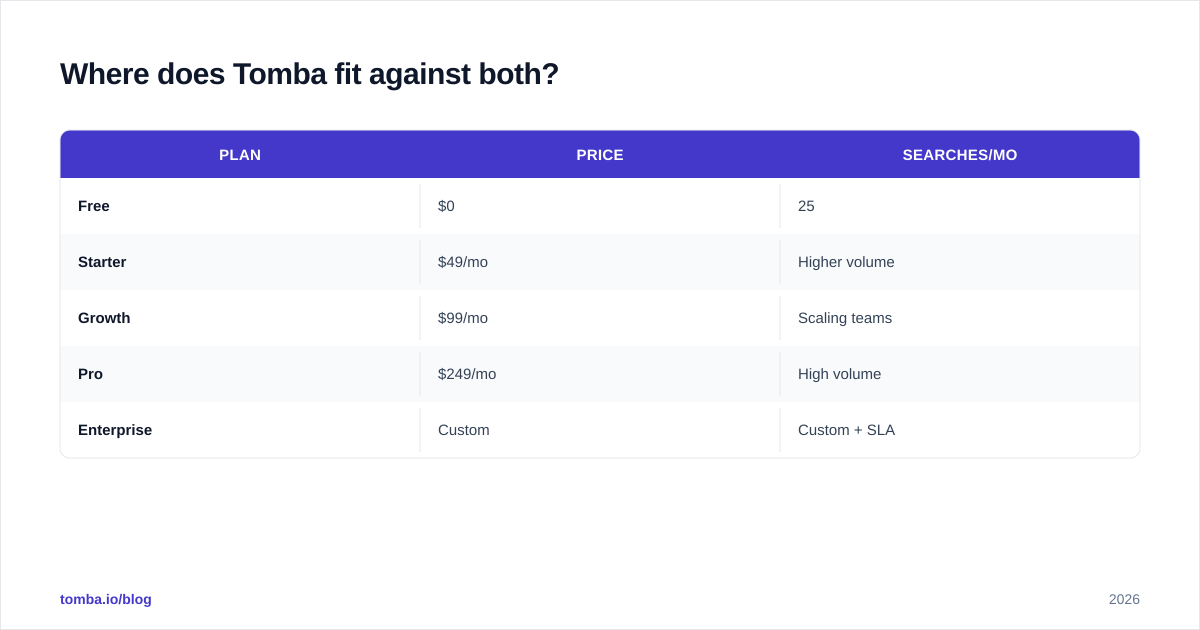
Tomba isn't a healthcare ABM platform like Ampliz, and it isn't a LinkedIn-credit play like Nymeria. It's a focused email finder and verifier for teams whose actual job is getting accurate business emails — by domain, by name, or in bulk — and confirming they're safe to send.
| Plan | Price | Searches/mo |
|---|---|---|
| Free | $0 | 25 |
| Starter | $49/mo | Higher volume |
| Growth | $99/mo | Scaling teams |
| Pro | $249/mo | High volume |
| Enterprise | Custom | Custom + SLA |
You can see full Tomba pricing for credit details. The point of comparison isn't "Tomba beats both at everything" — it doesn't carry Ampliz's healthcare depth or Nymeria's LinkedIn-native flow. It's that if your core need is find email, verify email, push to CRM, paying for a platform's extra surface area is often wasted spend.

For prospecting at the domain level, domain search returns every public email pattern for a company, and the email finder resolves a specific person from a name plus company. Both feed verification automatically, so what lands in your sequence is what survives a bounce check.
How should you decide?#
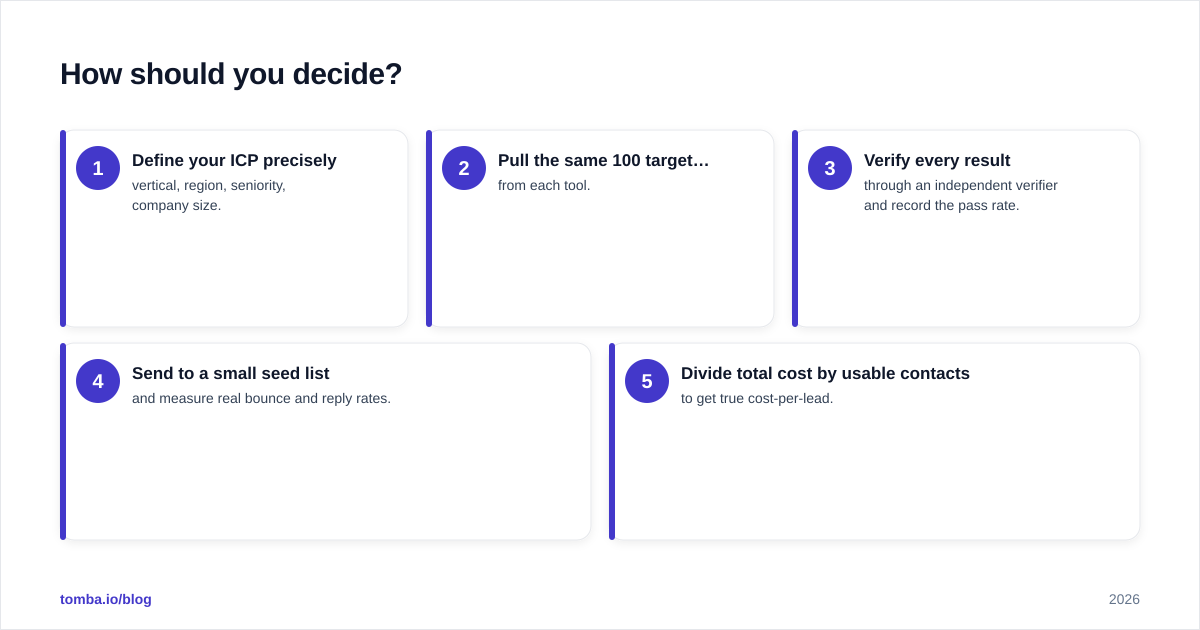
Run a structured trial instead of trusting any comparison post, including this one.
- Define your ICP precisely — vertical, region, seniority, company size.
- Pull the same 100 target contacts from each tool.
- Verify every result through an independent verifier and record the pass rate.
- Send to a small seed list and measure real bounce and reply rates.
- Divide total cost by usable contacts to get true cost-per-lead.
Whichever tool wins your test, wins. Most teams discover the answer isn't "the best tool" but "the best tool for our segment" — and that the verification step mattered more than the source. You can sanity-check vendor claims against third-party reviews on G2 and each vendor's own docs (Ampliz, Nymeria) before you sign anything.
The bottom line#
Ampliz vs Nymeria is a depth-versus-breadth decision. Choose Ampliz when your edge is vertical and account-level intelligence, especially in healthcare and APAC. Choose Nymeria when your edge is cheap, high-volume LinkedIn prospecting and you can absorb a verification pass. Choose neither if your real job is simply finding and verifying business emails at predictable cost — that's a narrower problem with a narrower, cheaper answer.
Whatever you pick, don't skip verification. The platform that gave you the address won't take the blame when it bounces — your domain reputation will.
Ready to test accuracy for yourself? Start free with the Tomba Email Finder — 25 searches a month, no sales call — and run the same 100-lead trial you'd run on Ampliz or Nymeria. Find emails by name or domain, verify them in the same workflow, and compare the only number that matters: how many actually land. If focused, verified contact data is what you're really after, you'll know within one test batch.
// get started
Find, verify and enrich your first contacts today
Start on the free plan with 25 searches a month, then scale when your team is ready.
Free plan · No credit card required · GDPR & CCPA
Get the Tomba newsletter
Product and data updates
// about the author