Ampliz vs Power Almanac: B2B Data Compared (2026 Guide)
Ampliz targets global B2B and healthcare intelligence; Power Almanac owns U.S. local-government contacts. Here's which data provider fits your pipeline in 2026 — and how to verify whatever you buy.
Choosing a B2B data provider usually comes down to one question: does the vendor actually cover the people you need to reach? Ampliz vs Power Almanac is a useful matchup precisely because the two tools answer that question in opposite ways. One sells broad global business and healthcare intelligence; the other sells a single, deep, U.S.-only dataset that almost nobody else maintains well.
This guide breaks down coverage, accuracy, pricing, and fit so you can pick the right one — and shows where a verification layer matters no matter which you buy.
TL;DR#
- Ampliz is a global B2B and healthcare data platform: company firmographics, contact emails/phones, technographics, and a heavy lean toward U.S. healthcare (physicians, hospitals, decision-makers).
- Power Almanac is a niche specialist: contact data for elected officials and staff across U.S. local governments — cities, counties, townships, and special districts.
- They rarely compete head-to-head. If you sell to healthcare or general B2B, look at Ampliz. If you sell to municipalities (GovTech, public-sector vendors, civic outreach), Power Almanac has data others lack.
- Both ship records that decay fast. Plan to run lists through an email verifier before any send.
- Neither is a great "find one person's email right now" tool — that job belongs to an email finder.
What is Ampliz?#
Ampliz is a B2B sales-intelligence and data-enrichment platform. Its pitch is breadth: company-level firmographics, contact records with business emails and direct dials, technographic signals, and intent data, all queryable by industry, geography, title, and company size. Its most differentiated asset is healthcare data — a large database of physicians, providers, hospital decision-makers, and HCP (healthcare professional) attributes like specialty and NPI-adjacent metadata.
In practice, teams use Ampliz two ways. The first is list building: filter by criteria, export a targeted contact list, push it into your CRM or sequencer. The second is enrichment: feed it a thin record (a name and company) and get back title, email, phone, and firmographics. You can read more about that pattern in our overview of data enrichment.
Ampliz publishes its positioning at ampliz.com, and you'll find verified user reviews on G2 if you want unfiltered sentiment before committing.
What is Power Almanac?#
Power Almanac is the opposite of broad. It maintains one thing extremely well: a directory of U.S. local-government officials and staff — mayors, council members, city managers, clerks, public-works directors, finance officers, and similar roles — across tens of thousands of municipalities, counties, townships, and special districts.
This is data that general B2B providers handle badly. Local-government contacts don't sit in standard corporate databases, titles vary wildly between a 2,000-person village and a major county, and turnover after elections is constant. Power Almanac's value is that it tracks this messy, fragmented landscape and re-verifies it on a schedule, exposing it as a filterable list you download as CSV. Their site is poweralmanac.com.
If your buyers are public-sector — GovTech SaaS, infrastructure and engineering services, public-safety vendors, grant-funded outreach — this niche depth is the entire reason the tool exists.
Ampliz vs Power Almanac: how do they compare?#
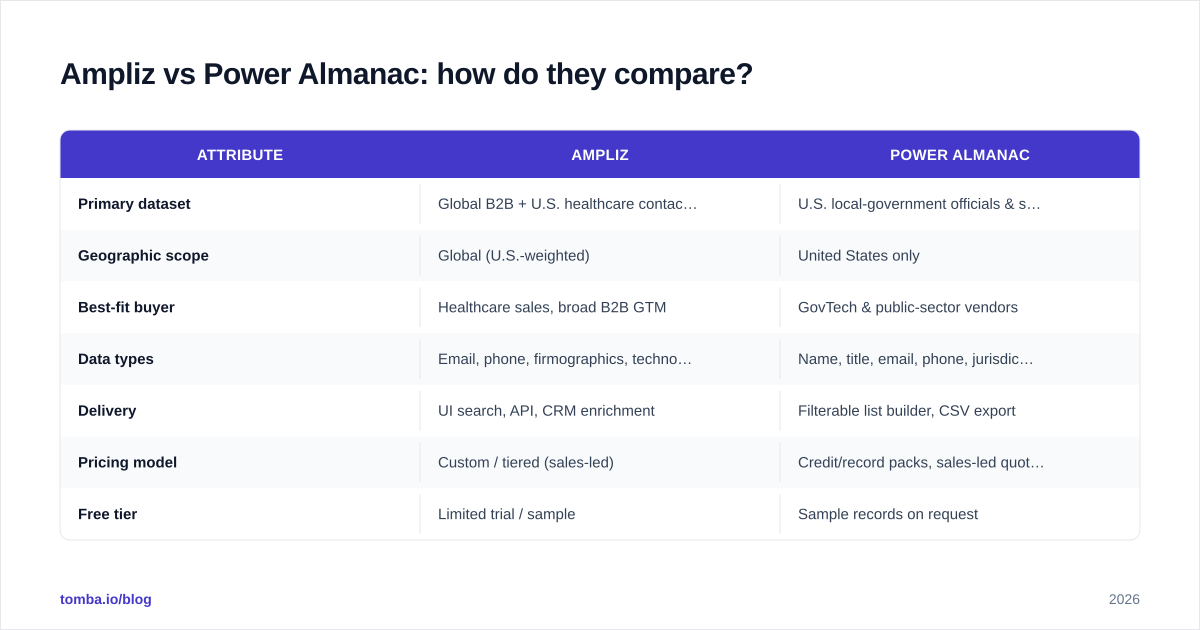
Here's the side-by-side. Treat record counts and prices as directional — both vendors gate exact figures behind sales conversations and change them over time.
| Attribute | Ampliz | Power Almanac |
|---|---|---|
| Primary dataset | Global B2B + U.S. healthcare contacts | U.S. local-government officials & staff |
| Geographic scope | Global (U.S.-weighted) | United States only |
| Best-fit buyer | Healthcare sales, broad B2B GTM | GovTech & public-sector vendors |
| Data types | Email, phone, firmographics, technographics, intent | Name, title, email, phone, jurisdiction, population |
| Delivery | UI search, API, CRM enrichment | Filterable list builder, CSV export |
| Pricing model | Custom / tiered (sales-led) | Credit/record packs, sales-led quotes |
| Free tier | Limited trial / sample | Sample records on request |
| Niche depth | Strong in healthcare | Unmatched in local government |
| Email verification | Some built-in, varies | Re-verified on a cycle, still age out |
The headline: these tools sit in different lanes. The real decision isn't "which is better" — it's "which dataset contains my buyers." Power Almanac wins decisively for municipal targeting; Ampliz wins for nearly everything else, especially healthcare.

Which one is more accurate?#
Accuracy depends on the segment, not the brand. Power Almanac's narrow focus lets it re-verify local-government records on a regular cadence, which is genuinely hard to replicate — but elections and reorganizations mean a chunk of any government list is stale within months. Ampliz covers far more ground, and broad coverage almost always trades against freshness: the more contacts a provider claims, the higher the share that has churned since last verification.
No B2B data vendor ships 100% deliverable contacts. Industry bounce rates on purchased lists routinely run into the double digits. That's not a knock on either tool specifically — it's physics. People change jobs, companies rebrand, mailboxes get decommissioned.
The practical fix is the same regardless of vendor: verify before you send. Run every exported list through verification to catch dead and risky addresses, and check ambiguous domains with a catch-all verifier so you don't torch your sender reputation on undeliverable mail. If you're buying in volume, do it in one pass with bulk verify rather than discovering the bounces in your sequencer.
How does pricing compare?#
Both vendors are sales-led, so you won't find clean public price tables. Here's the shape of each:
- Ampliz prices by access tier and credit/record volume, with healthcare datasets and API access typically commanding higher tiers. Expect a custom quote scaled to seats and export volume.
- Power Almanac sells record/credit packs — you pay for the contacts you download, with pricing that gets more efficient at higher volumes. Because the dataset is narrow, total spend is usually lower than a broad-platform contract.
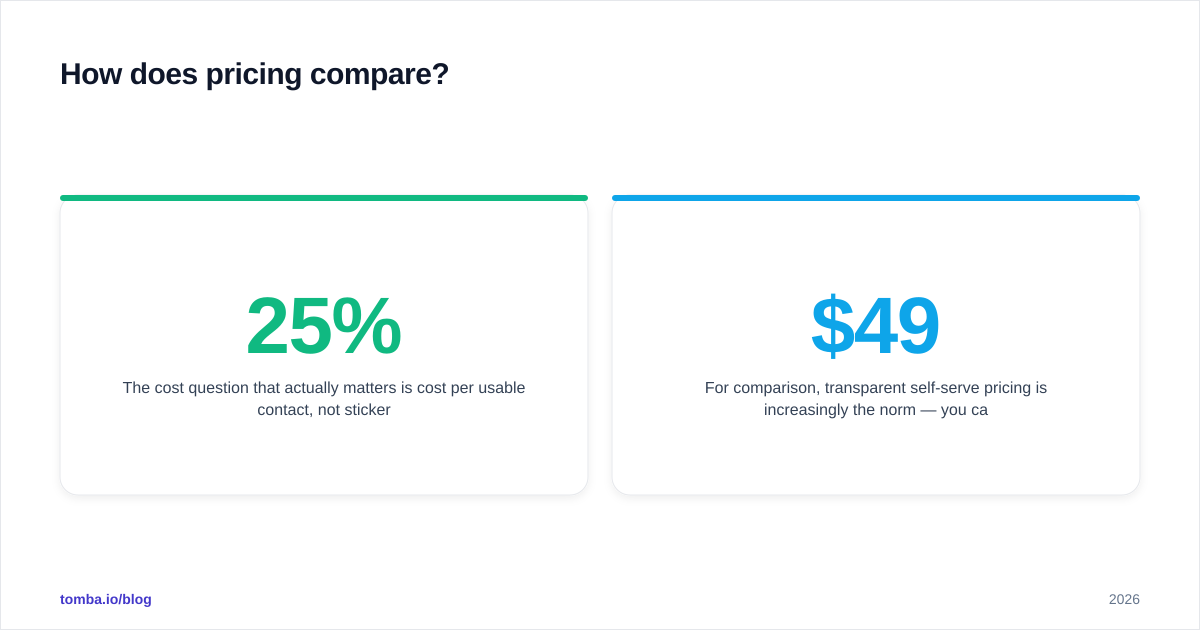
The cost question that actually matters is cost per usable contact, not sticker price. A cheaper list with a 25% bounce rate can cost more in deliverability damage than a pricier, cleaner one. Always factor verification into your true per-lead cost.
For comparison, transparent self-serve pricing is increasingly the norm — you can see a published example on the Tomba pricing page (Free tier with 25 searches/month, Starter at $49/mo, Growth at $99/mo, Pro at $249/mo, and custom Enterprise). When evaluating Ampliz or Power Almanac, ask each rep for the same breakdown: price per record, refund/replacement policy for bad data, and verification guarantees.
What are the pros and cons of each?#
Ampliz — strengths
- Deep U.S. healthcare/HCP data that's hard to source elsewhere
- Broad firmographics, technographics, and intent for general B2B
- API and CRM enrichment for programmatic workflows
Ampliz — weaknesses
- Breadth invites staleness; verify exports
- Pricing opacity makes budgeting harder
- Healthcare strength doesn't help if you sell to other verticals
Power Almanac — strengths
- Best-in-class U.S. local-government coverage
- Re-verified on a cycle for a notoriously volatile segment
- Simple list-builder UX, predictable record-based cost
Power Almanac — weaknesses
- Single use case — useless outside public-sector targeting
- U.S.-only
- Election-driven churn still ages records between refreshes
When should you use a dedicated email finder instead?#
Neither tool is built for the most common day-to-day task: "I have this one person and this one company — get me their email now." Bulk data platforms are list-first. When you're doing targeted, account-based outreach to a named prospect, a real-time lookup is faster and cheaper.
That's where an email finder earns its place in the stack. Need every reachable contact at a target account instead of one name? Domain search returns the contacts and email pattern for a company in one query. Many teams run a hybrid: a bulk provider (Ampliz or Power Almanac) for the addressable-market list, plus a finder for the named, high-value accounts that the database missed or got wrong.
This is also the cleanest way to fill the gaps a niche dataset leaves behind. If Power Almanac doesn't have the new public-works director who took office last month, a finder plus verification gets you there without waiting for the next refresh cycle.
How do you choose between Ampliz and Power Almanac?#
Run your decision through three questions, in order:
- Who are your buyers? If they're U.S. local-government roles, Power Almanac is the obvious starting point — no general platform matches its depth there. If they're healthcare or broad B2B, Ampliz fits. If they're outside the U.S., Power Almanac is off the table entirely.
- List or lookup? Building large addressable-market lists points to a bulk platform. Targeting specific named accounts points to a finder. Most mature teams use both.
- What's your verification plan? Whatever you buy, budget for cleaning. The vendor's "verified" label is a starting point, not a guarantee — confirm deliverability yourself before the first send.
A simple rule of thumb: pick the provider whose core dataset overlaps most with your ICP, then layer verification and real-time finding on top. The data you buy is a snapshot; your job is to keep it current.
The bottom line#
Ampliz vs Power Almanac isn't really a fight — it's a fork in the road. Ampliz is the broad, healthcare-strong B2B platform; Power Almanac is the specialist that owns U.S. local-government contacts. Match the dataset to your buyers and the choice usually makes itself. What stays constant either way is the need to verify and to fill gaps with on-demand lookups, because every purchased list starts decaying the day you download it.
Want to pressure-test the data you already have, or grab the contacts a bulk provider missed? Start with the Tomba Email Finder — find professional emails by name, company, or domain, verify them before you send, and stop paying for bounces. Pair it with bulk verification and you'll turn whichever provider you choose into a cleaner, higher-converting pipeline.
// get started
Find, verify and enrich your first contacts today
Start on the free plan with 25 searches a month, then scale when your team is ready.
Free plan · No credit card required · GDPR & CCPA
// about the author