Ampliz vs SalesIntel 2026: Which B2B Data Tool Wins?
Ampliz leans healthcare and APAC; SalesIntel leans human-verified US firmographics. Here's a side-by-side breakdown of coverage, accuracy, pricing, and the cheaper way to fill the gaps.
Choosing a B2B data provider usually comes down to one question: do you trust the records enough to put your reps' time behind them? Ampliz and SalesIntel both promise accurate contact and company data, but they solve for different buyers. This breakdown shows where each one wins, where each one leaks budget, and how to plug the gaps without overpaying.
TL;DR — Ampliz vs SalesIntel at a glance#
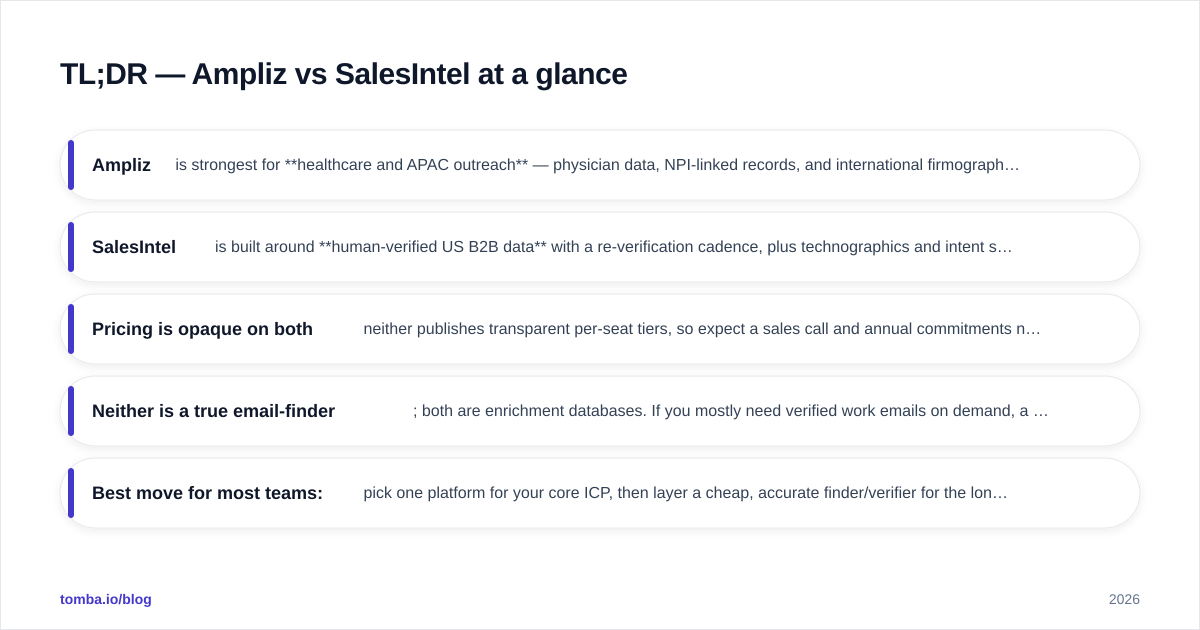
- Ampliz is strongest for healthcare and APAC outreach — physician data, NPI-linked records, and international firmographics that most US-centric tools miss.
- SalesIntel is built around human-verified US B2B data with a re-verification cadence, plus technographics and intent signals through a Bombora partnership.
- Pricing is opaque on both — neither publishes transparent per-seat tiers, so expect a sales call and annual commitments north of four figures.
- Neither is a true email-finder; both are enrichment databases. If you mostly need verified work emails on demand, a focused tool like the Tomba Email Finder costs a fraction.
- Best move for most teams: pick one platform for your core ICP, then layer a cheap, accurate finder/verifier for the long tail and net-new prospecting.
What is Ampliz?#
Ampliz is a B2B data intelligence platform that started with a strong tilt toward healthcare data and APAC markets. Its flagship use case is helping medtech, pharma, and health-IT teams reach physicians, hospital administrators, and clinical decision-makers — segments that generic US databases cover poorly.
Beyond healthcare, Ampliz offers standard B2B firmographics: company size, revenue, industry, and contact details. Its differentiator is geographic breadth. If your pipeline runs through India, Southeast Asia, the Middle East, or Australia, Ampliz typically returns more usable records than tools optimized for North America.
The trade-off: outside its core verticals, accuracy and depth can feel thinner. You're buying Ampliz for who it knows — clinicians and APAC accounts — not for the broadest US technographic graph.
What is SalesIntel?#
SalesIntel positions itself around one promise: human-verified data. Rather than relying only on automated scraping, SalesIntel layers a research team that re-verifies contacts on a rolling cadence (the company markets a roughly 90-day re-verification cycle). The pitch is simple — fewer bounces, fewer dead numbers, more conversations.
SalesIntel concentrates on the US B2B market and bundles three things most enrichment buyers want together:
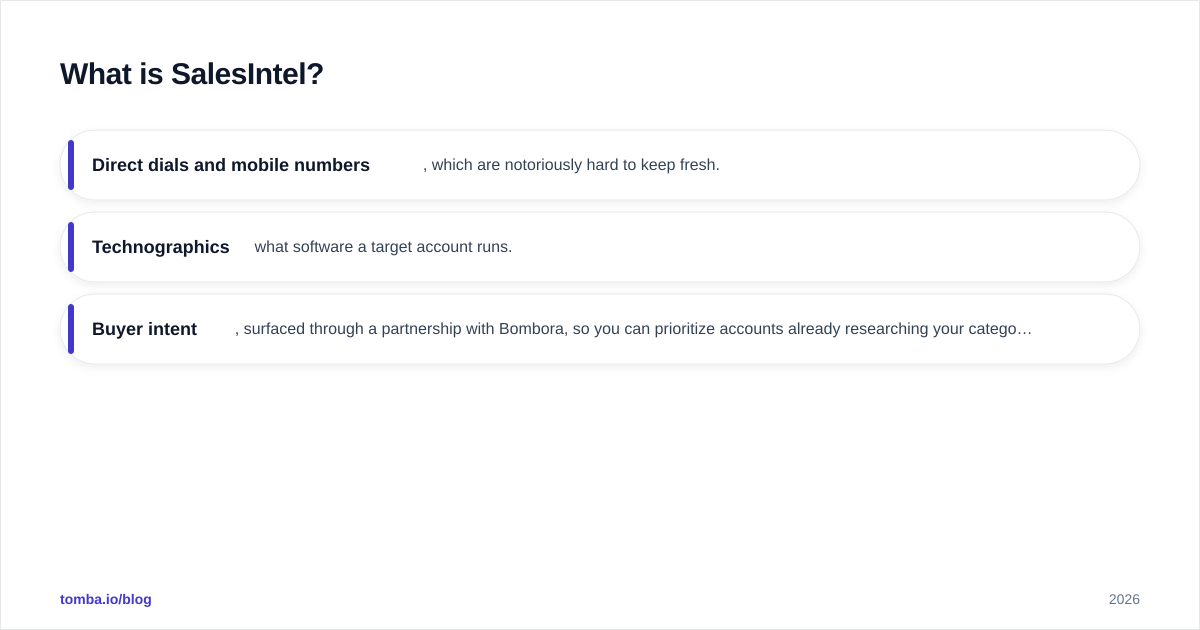
- Direct dials and mobile numbers, which are notoriously hard to keep fresh.
- Technographics — what software a target account runs.
- Buyer intent, surfaced through a partnership with Bombora, so you can prioritize accounts already researching your category.
If your motion is US-based outbound where phone connect rates and account prioritization matter, SalesIntel's verification story is the headline feature. You can read more about how third parties rate it on G2.
Ampliz vs SalesIntel: how do they compare head-to-head?#
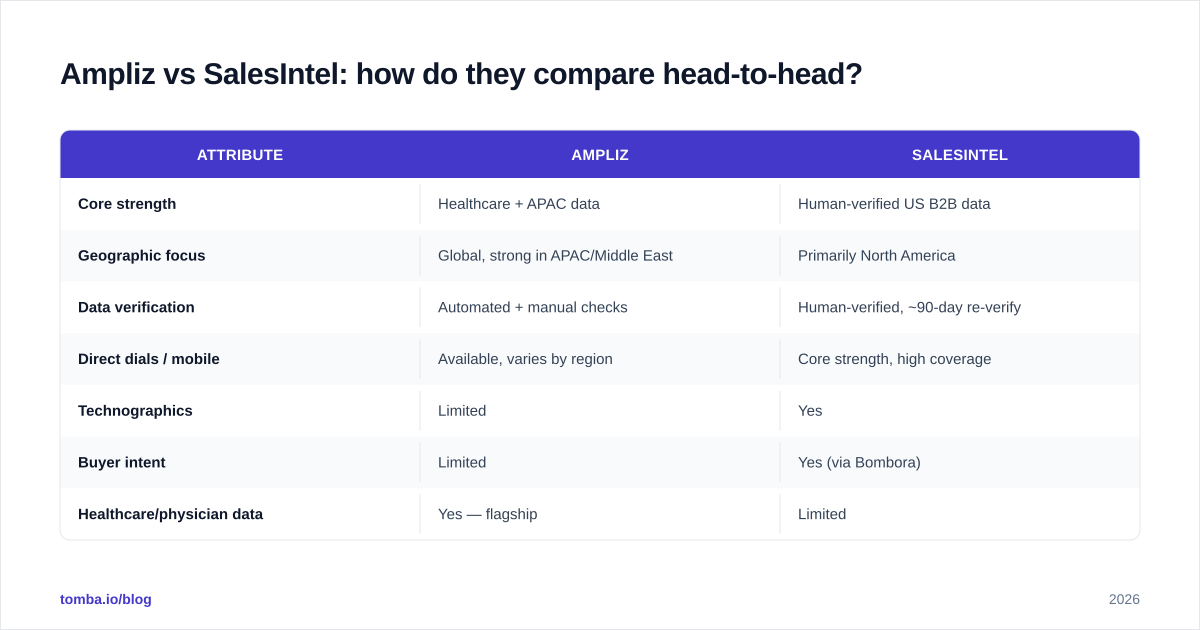
Here's the side-by-side most buyers actually want. Treat the figures as directional — both vendors negotiate, and exact numbers shift by contract.
| Attribute | Ampliz | SalesIntel |
|---|---|---|
| Core strength | Healthcare + APAC data | Human-verified US B2B data |
| Geographic focus | Global, strong in APAC/Middle East | Primarily North America |
| Data verification | Automated + manual checks | Human-verified, ~90-day re-verify |
| Direct dials / mobile | Available, varies by region | Core strength, high coverage |
| Technographics | Limited | Yes |
| Buyer intent | Limited | Yes (via Bombora) |
| Healthcare/physician data | Yes — flagship | Limited |
| Pricing transparency | Custom quote, no public tiers | Custom quote, no public tiers |
| Best for | Medtech, pharma, APAC GTM | US outbound + ABM teams |
| Free trial | Limited/sample on request | Limited/sample on request |
The pattern is clear: these tools rarely compete for the same buyer. Ampliz wins on vertical and geographic specialization; SalesIntel wins on US data freshness, dials, and intent. The wrong question is "which is better?" The right one is "which matches my ICP?"
Which has more accurate data?#
Accuracy depends on where you're searching, not just how the vendor verifies.
SalesIntel's human-verification model gives it an edge on US contacts and phone numbers, the data type that decays fastest. People change jobs, direct lines get reassigned, and an automated crawl from six months ago won't catch it. A research team re-checking records on a cycle is a real moat for phone-heavy outbound.
Ampliz wins accuracy where it's specialized. For physician and APAC records, its data is often cleaner than SalesIntel's simply because SalesIntel doesn't prioritize those segments. NPI-linked healthcare data and regional firmographics are hard to fake with generic scraping.
The honest caveat for both: no database is current forever. Even human-verified records age between cycles, and catch-all domains can mask whether an email actually exists. That's why most disciplined teams run a final-mile check before sending — push exports through an email verifier or a catch-all verifier so a stale record doesn't torch your sender reputation. Treating a vendor's "verified" badge as gospel is how good domains end up on blocklists.

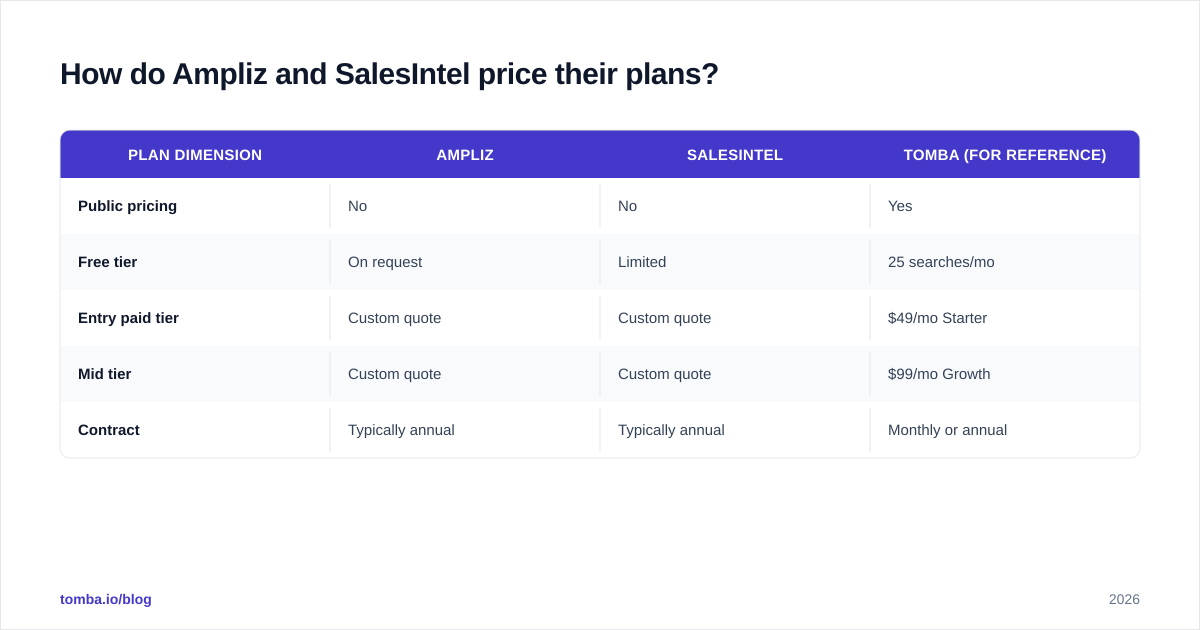
How do Ampliz and SalesIntel price their plans?#
Neither vendor publishes clean, self-serve pricing — and that's the single biggest friction point for both. Expect:
- A mandatory sales call before you see a number.
- Annual contracts rather than month-to-month.
- Credit- or seat-based tiers that scale with export volume and team size.
- Add-ons for intent data, technographics, or premium support that inflate the sticker price.
For small teams or anyone testing a new segment, this opacity is a problem. You can't run a quick experiment when step one is a procurement conversation and a yearly commitment. Compare that with transparent, published pricing — for example, Tomba's pricing lists a free tier and flat monthly plans you can start without talking to anyone.
| Plan dimension | Ampliz | SalesIntel | Tomba (for reference) |
|---|---|---|---|
| Public pricing | No | No | Yes |
| Free tier | On request | Limited | 25 searches/mo |
| Entry paid tier | Custom quote | Custom quote | $49/mo Starter |
| Mid tier | Custom quote | Custom quote | $99/mo Growth |
| Contract | Typically annual | Typically annual | Monthly or annual |
The takeaway isn't that Ampliz or SalesIntel are overpriced — for the right enterprise buyer they earn the spend. It's that you can't price-shop them quickly, and that pushes a lot of mid-market teams toward more transparent stacks.
Who should choose Ampliz?#
Pick Ampliz if:
- You sell into healthcare. Medtech, pharma, diagnostics, and health-IT teams get physician and provider data that general databases simply don't carry.
- APAC or the Middle East is core to your pipeline. Ampliz's regional coverage beats most US-first tools.
- Your ICP is geographically specific and you'd rather have depth in two regions than shallow global coverage.
Skip Ampliz if your motion is US-heavy technographic ABM — you'll be paying for strengths you won't use.
Who should choose SalesIntel?#
Pick SalesIntel if:
- Phone is central to your outbound. Direct dials and mobile numbers are its strongest asset, and human verification keeps connect rates up.
- You run account-based marketing in the US and want technographics plus Bombora intent in one place to prioritize in-market accounts.
- Bounce rates have burned you before and you'll pay a premium for re-verified records.
Skip SalesIntel if you need deep healthcare data or significant non-US coverage — that's not where its research team focuses.
What's the gap both tools leave open?#
Here's what neither platform does well: fast, affordable, net-new email finding for the long tail.
Both are databases. You search what they already have. But real prospecting constantly runs into people not in the database — a founder at a 12-person startup, a niche role at a company outside their core coverage, an APAC contact missing from SalesIntel or a US SaaS lead thin in Ampliz. When the record isn't there, an enrichment database returns nothing, and you're stuck guessing the email format.
That's the wedge for a dedicated finder. Instead of guessing first.last@ and praying, you can:
- Run a domain search to pull every known address pattern at a target company.
- Find a specific person's verified work email by name and domain.
- Bulk verify an exported list before it ever touches your sequencer.

This is also where cost compounds. Paying enterprise database rates to look up a handful of long-tail contacts is wasteful. A focused finder with a free tier and a $49/mo entry plan handles the overflow at a fraction of the per-contact cost — and you keep the big-database contract for the segments it's actually good at.
Ampliz vs SalesIntel: the verdict#
There's no universal winner, because they're built for different buyers:
- Choose Ampliz for healthcare and APAC-first GTM.
- Choose SalesIntel for US outbound and ABM where verified dials and intent drive the number.
- Choose neither as your only tool. Both leave net-new, long-tail prospecting underserved, and both lock you into opaque annual contracts.
The smartest 2026 stack is usually one specialized database plus one transparent, accurate finder/verifier for everything the database misses. You get depth where it matters and flexibility everywhere else — without doubling your data spend. For a broader view of how human-verified vendors stack up, B2B review hubs like Capterra are a useful neutral starting point.
Fill the gaps Ampliz and SalesIntel leave behind#
If you've landed on Ampliz or SalesIntel for your core ICP, don't pay enterprise rates for the long tail too. Use the Tomba Email Finder to pull verified professional emails by name, company, or domain — with a free tier to start, transparent flat pricing from $49/mo, and built-in verification so records are clean before they hit your sequencer. Keep your big-database contract for what it does best, and let a focused finder handle the net-new prospecting those platforms can't. Start free, test it against your own list, and only scale what actually converts.
// get started
Find, verify and enrich your first contacts today
Start on the free plan with 25 searches a month, then scale when your team is ready.
Free plan · No credit card required · GDPR & CCPA
// about the author