Ampliz vs Seamless.AI 2026: Which B2B Data Tool Wins?
Ampliz vs Seamless.AI compared on data accuracy, coverage, pricing, and use cases — plus where a focused email finder beats both for cold outreach in 2026.
The Ampliz vs Seamlessai choice comes down to one question. Do you need deep, vertical-specific contact data, or a broad AI engine that builds lists fast? They look alike on a feature grid. But they solve different problems. And both share a flaw that quietly wrecks cold outreach: unverified emails.
TL;DR — Ampliz vs Seamlessai in 30 seconds#
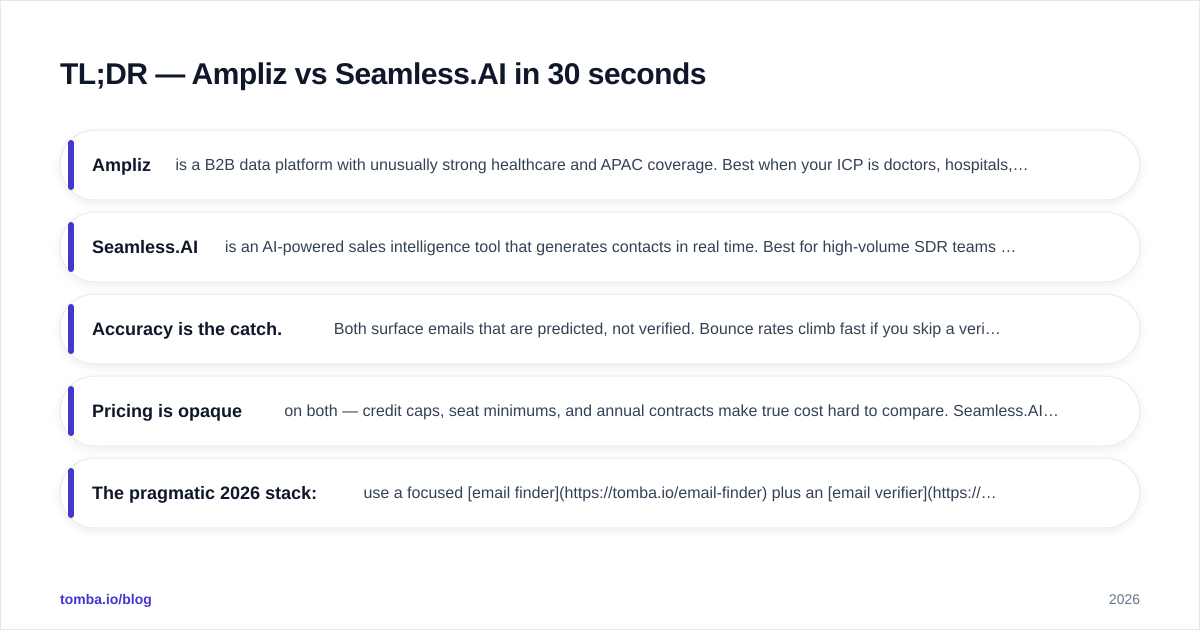
- Ampliz is a B2B data platform with unusually strong healthcare and APAC coverage. Best when your ICP is doctors, hospitals, or niche regional accounts.
- Seamless.AI is an AI-powered sales intelligence tool that generates contacts in real time. Best for high-volume SDR teams that want speed and a built-in Chrome extension.
- Accuracy is the catch. Both surface emails that are predicted, not verified. Bounce rates climb fast if you skip a verification step.
- Pricing is opaque on both. Credit caps, seat minimums, and annual contracts make true cost hard to compare. Seamless.AI in particular pushes annual deals.
- The pragmatic 2026 stack: use a focused email finder plus an email verifier for outbound. Reserve heavyweight platforms for accounts that genuinely need firmographic depth.
What is Ampliz?#
Ampliz is a B2B data and intelligence platform built around contextual intelligence. It blends firmographic, technographic, and contact data, then enriches it with industry signals. Its standout is the healthcare database: physician NPI numbers, specialties, hospital affiliations, and decision-maker contacts that generic providers rarely carry.
It also leans into APAC and global coverage. That makes it a common pick for teams selling outside the North American data sets most tools over-index on. You can search by company, build account lists, and enrich existing records through the platform or its API.
The trade-off comes outside its strong verticals. There, coverage thins out. And like most large databases, it ships email addresses that are pattern-derived rather than checked at send time.
What is Seamless.AI?#
Seamless.AI is a real-time sales intelligence engine. Instead of serving records from a static database, it claims to search the web live to assemble contact details. Emails, direct dials, and company data arrive the moment you request them. That "AI builds your list" pitch is the whole product identity.
Its strengths are speed and workflow. You get a solid Chrome extension, LinkedIn integration, list-building automation, and CRM pushes to tools like Salesforce and HubSpot. SDRs like that they can go from a LinkedIn profile to a contact record in seconds.
The well-documented weakness is data quality variance. Because results are generated on the fly, accuracy swings hard by industry and seniority. Public reviews on G2 repeatedly flag bounced emails and credits burned on bad records. You can read more peer feedback on its Capterra listing too.
Ampliz vs Seamlessai: the head-to-head table#
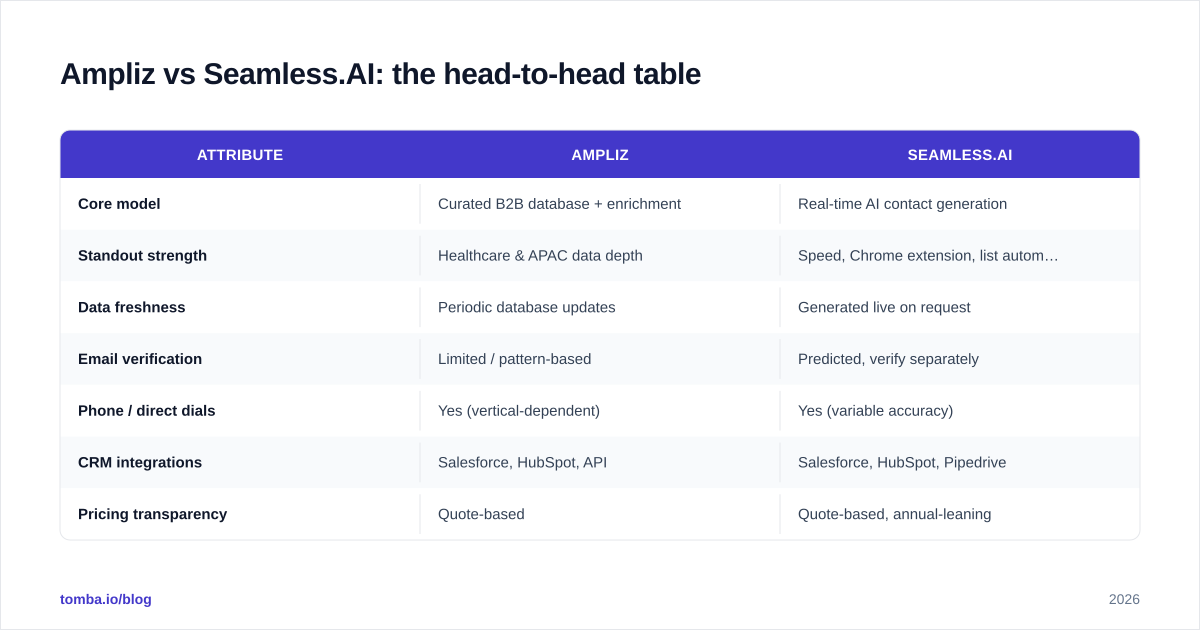
| Attribute | Ampliz | Seamless.AI |
|---|---|---|
| Core model | Curated B2B database + enrichment | Real-time AI contact generation |
| Standout strength | Healthcare & APAC data depth | Speed, Chrome extension, list automation |
| Data freshness | Periodic database updates | Generated live on request |
| Email verification | Limited / pattern-based | Predicted, verify separately |
| Phone / direct dials | Yes (vertical-dependent) | Yes (variable accuracy) |
| CRM integrations | Salesforce, HubSpot, API | Salesforce, HubSpot, Pipedrive |
| Pricing transparency | Quote-based | Quote-based, annual-leaning |
| Best fit | Niche-vertical & global ABM | High-volume SDR prospecting |
| Free option | Limited free credits | Limited free trial |
Which has better data accuracy?#
Neither is "verified by default" — and that is the single most important fact for cold email. Ampliz wins on accuracy inside its core verticals. Its healthcare and regional records are curated, not scraped en masse. Seamless.AI wins on freshness and breadth because it generates contacts on demand. But that freshness is also its liability. A real-time guess about an email pattern is still a guess.
Here is the mechanism that bites teams. Both tools infer addresses from known company patterns, such as first.last@ or flast@. When the pattern is right, you get a deliverable email. When it is wrong, you get a bounce. The same happens if the person left or the domain uses a catch-all. Send enough bounces and mailbox providers throttle your sender reputation. That depresses inbox placement for every campaign, not just the bad list.

That is why accuracy benchmarks matter more than raw record counts. A provider claiming 500M contacts is meaningless if 25% bounce. The fix is the same whichever platform you pick. Run every address through a real email verifier before it touches a sequence. Then check whether the domain is a catch-all with a catch-all verifier, so you know which "valid" results are actually unconfirmable.
How do Ampliz and Seamless.AI price their plans?#
Both hide pricing behind a sales call, which makes apples-to-apples comparison frustrating. Generally:
- Ampliz sells tiered packages keyed to credits and modules, such as healthcare data as an add-on. Expect a quote-based annual structure.
- Seamless.AI publishes a free tier but funnels serious usage into annual contracts with per-seat pricing and credit caps. Several reviewers note aggressive renewal terms and credits that expire.
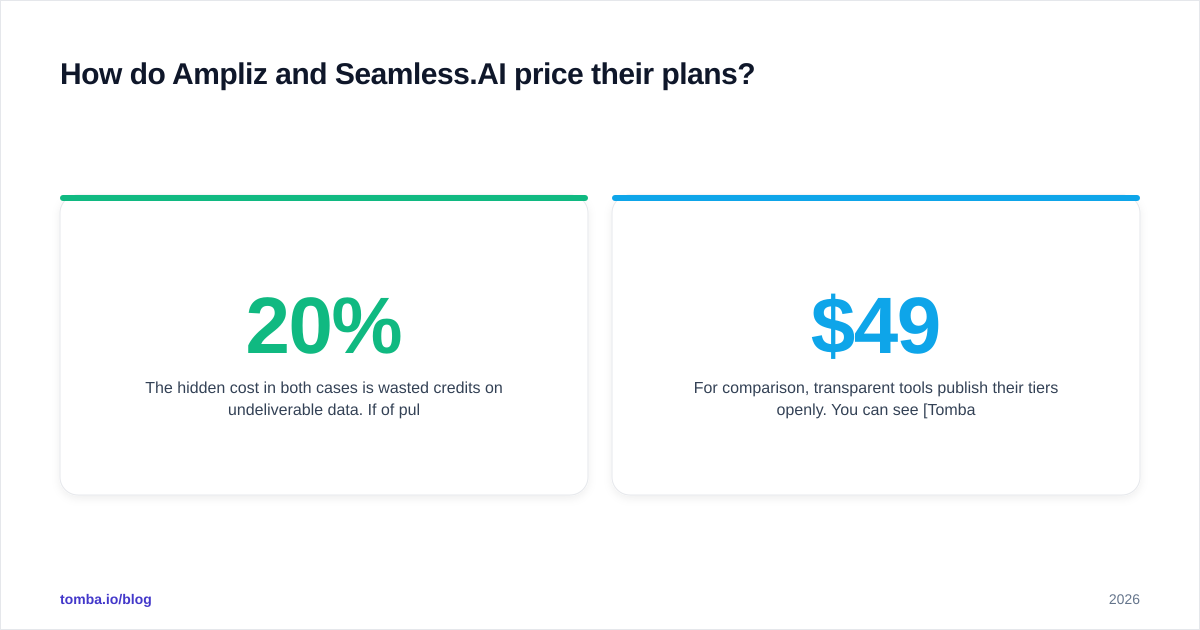
The hidden cost in both cases is wasted credits on undeliverable data. If 20% of pulled contacts bounce, you are paying a 20% tax on every plan. That is the number to model before signing, not the sticker price.
For comparison, transparent tools publish their tiers openly. You can see Tomba pricing without a demo: a free tier with 25 searches/month, Starter at $49/mo, Growth at $99/mo, and Pro at $249/mo. The point is not that cheaper is always better. It is that you should be able to do the math before a sales rep does it for you.

Which tool fits your use case?#
Pick Ampliz if:
- Your ICP is healthcare — physicians, payers, hospital administrators.
- You sell into APAC or other regions where U.S.-centric databases fall short.
- You run account-based motions that need firmographic and technographic depth, not just an email.
Pick Seamless.AI if:
- You have a high-volume SDR team that lives in LinkedIn and a Chrome extension.
- Speed of list-building matters more than per-record precision.
- You already have a verification + warmup process to catch the bounces.
Pick a focused email finder if:
- Your real bottleneck is deliverable contact data for outreach, not enterprise firmographics.
- You want predictable, transparent pricing.
- You need verification baked into the same workflow rather than bolted on.
This last category is where a lot of teams overspend. They buy a heavyweight intelligence platform to solve what is, day to day, an email-and-phone problem. If most of your pipeline comes from cold outreach, a domain search plus verification may give you more reliable results than either platform's full suite.
What does the comparison look like across the wider market?#
Ampliz and Seamless.AI do not exist in a vacuum. The B2B data space includes Apollo, ZoomInfo, Lusha, RocketReach, and Cognism. Each has different accuracy, coverage, and price trade-offs. Where a tool sits on that map matters more than its marketing.

If you are evaluating Seamless.AI specifically, read independent breakdowns and the vendor's own Seamless.AI site side by side. Then test a sample list of your ICP rather than trusting aggregate accuracy claims. A 50-contact test against your real target accounts tells you more than any benchmark chart. Teams comparing options often start with a Seamless.AI alternative shortlist to pressure-test pricing and accuracy before committing to an annual contract.
The same caution applies to enrichment. Say your goal is to fill gaps in an existing CRM. A dedicated data enrichment flow that you control is often cleaner than paying for a platform's full data graph. You append verified emails and phones to records you already own, instead of buying a graph you will use 10% of.
How should you verify data from either tool?#
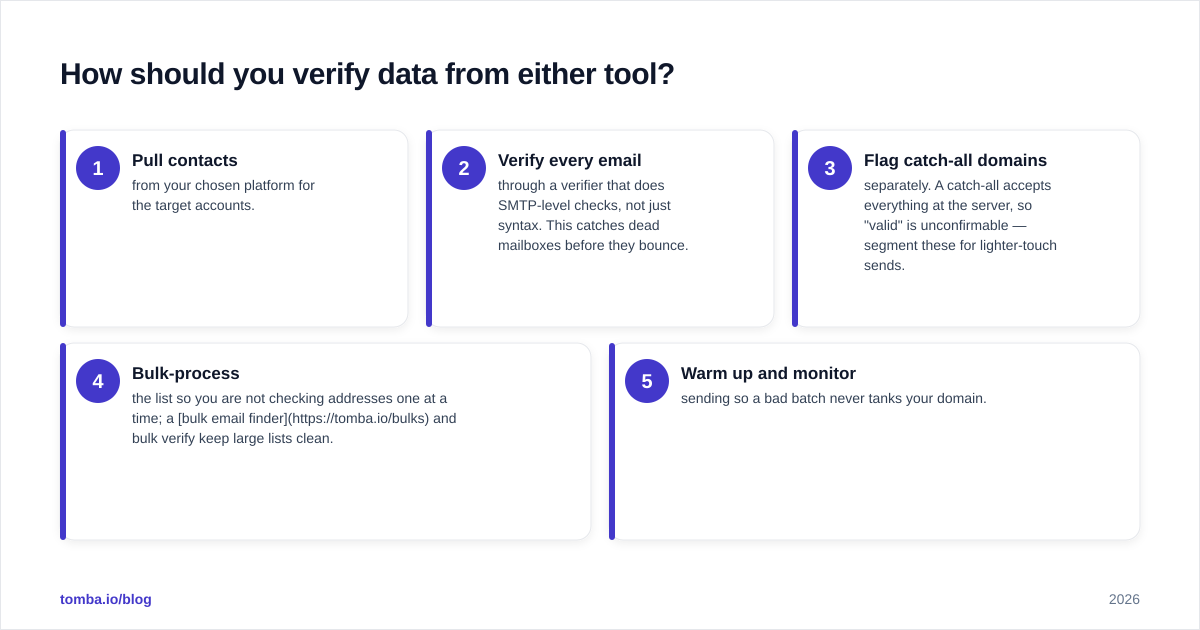
Treat any contact data — Ampliz, Seamless.AI, or otherwise — as unverified until proven. A reliable pipeline looks like this:
- Pull contacts from your chosen platform for the target accounts.
- Verify every email through a verifier that does SMTP-level checks, not just syntax. This catches dead mailboxes before they bounce.
- Flag catch-all domains separately. A catch-all accepts everything at the server, so "valid" is unconfirmable. Segment these for lighter-touch sends.
- Bulk-process the list so you are not checking addresses one at a time. A bulk email finder and bulk verify keep large lists clean.
- Warm up and monitor sending so a bad batch never tanks your domain.
This is the step both Ampliz and Seamless.AI under-emphasize. It is also the difference between a 2% bounce rate and a 20% one. Verification is not optional hygiene. It is what protects the deliverability you are paying these tools to enable.
Frequently asked questions#
Is Ampliz better than Seamless.AI? For healthcare and APAC targeting, yes — its curated vertical data is hard to beat. For broad, fast SDR list-building in North America, Seamless.AI's real-time engine and extension are more convenient. Neither is universally "better"; it depends on your ICP.
Is Seamless.AI data accurate? It is fresh but variable. Because contacts are generated live, accuracy swings by industry and seniority, and reviewers commonly report bounces. Always verify before sending.
Do I still need an email verifier if I use these tools? Yes. Both deliver predicted addresses. Running them through a verifier before outreach is the single highest-ROI step for protecting deliverability.
What is a cheaper alternative to both? A focused email finder with transparent pricing and built-in verification covers the outreach use case at a fraction of the cost. Heavyweight platforms make sense only when you genuinely need their firmographic depth.
The bottom line#
The Ampliz vs Seamlessai verdict is simple: they are good at different things. Ampliz wins on vertical and global data depth. Seamless.AI wins on speed and volume. But both share the same blind spot. The emails they hand you are predictions, and predictions bounce. If your day-to-day need is deliverable contacts for outbound, you do not need to overpay for an enterprise data graph to solve it.
Start with accurate, verified contact data and build out from there. The Tomba Email Finder finds professional emails by domain, name, or company. Verification is built into the same workflow, and you can read the pricing without a sales call — a free tier to test it, then $49/mo when you scale. Run your next list through it, verify before you send, and let the heavyweight platforms earn their keep only on the accounts that truly need them.
Ready to find emails that actually work?
Join 150,000+ professionals who stopped guessing and started sending. Free credits on signup — no credit card required.
Get the Tomba newsletter
Practical outbound tactics and product updates — once every two weeks.
About the author