Ampliz vs SignalHire 2026: Which B2B Data Tool Wins?
Ampliz and SignalHire both promise accurate B2B contacts, but they win at different jobs. Here's a side-by-side breakdown of data, pricing, and accuracy for 2026.
TL;DR
- Ampliz is a B2B data platform with a strong healthcare/APAC intelligence angle — best when you need firmographic depth and account-level segmentation, especially in medical verticals.
- SignalHire is a contact-finder built around a browser extension and recruiting workflows — best for pulling emails and phone numbers off LinkedIn one profile at a time.
- They overlap on "find me a contact," but the underlying jobs are different: Ampliz leans list building and enrichment, SignalHire leans point-and-click sourcing.
- Pricing models differ sharply: SignalHire sells credits per contact, Ampliz quotes custom packages around datasets — budget predictability favors credit transparency.
- If your real need is high-accuracy email discovery and verification at a flat, public price, a focused tool like Tomba often beats both on cost-per-valid-email.
What are Ampliz and SignalHire?#
Short answer: both are B2B contact and data tools, but they were built for different buyers.
Ampliz positions itself as a B2B data intelligence platform. Think of it less like a single-purpose lookup tool and more like a data warehouse you query — company firmographics, contact records, intent signals, and a notable specialization in healthcare and APAC markets. Sales and marketing teams use it to build segmented lists and enrich existing records with attributes like company size, technologies, and decision-maker roles. You can see their positioning on the Ampliz homepage.
SignalHire is a contact-finding tool that lives mostly in your browser. Its core motion is the Chrome extension: open a LinkedIn profile, click the extension, and SignalHire reveals the person's email and phone number. It also bundles a lightweight ATS and bulk search, which is why recruiters gravitate to it. The SignalHire site frames it around "find candidates and decision-makers."
Here's the analogy. Ampliz is a wholesale supplier — you tell it the category and quantity, and it hands you a pallet of records to work through. SignalHire is the corner store — you walk in, point at the one thing you want, and walk out with it. Both sell contacts. The experience and the unit economics are not the same.
How do Ampliz and SignalHire compare head to head?#
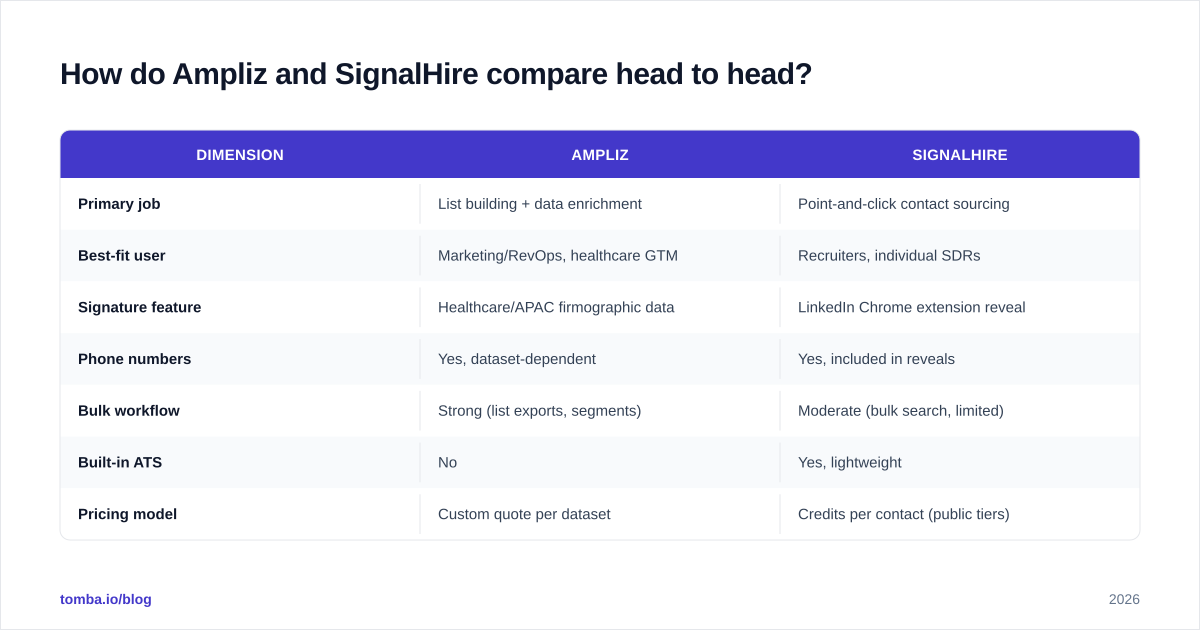
The fastest way to see the gap is attribute by attribute. The table below maps the dimensions that actually change a buying decision.
| Dimension | Ampliz | SignalHire |
|---|---|---|
| Primary job | List building + data enrichment | Point-and-click contact sourcing |
| Best-fit user | Marketing/RevOps, healthcare GTM | Recruiters, individual SDRs |
| Signature feature | Healthcare/APAC firmographic data | LinkedIn Chrome extension reveal |
| Phone numbers | Yes, dataset-dependent | Yes, included in reveals |
| Bulk workflow | Strong (list exports, segments) | Moderate (bulk search, limited) |
| Built-in ATS | No | Yes, lightweight |
| Pricing model | Custom quote per dataset | Credits per contact (public tiers) |
| Free option | Limited trial/credits | Free plan with 5 credits/mo |
| Data transparency | Low (quote-gated) | Medium (credits visible) |
| API access | Yes | Yes |
The pattern is consistent. Ampliz rewards teams that think in segments and accounts. SignalHire rewards individuals who think in profiles and reveals. Neither is wrong — they just price and package for different motions.
)
One caveat on the table: vendor-published numbers age fast, and "database size" claims are notoriously inflated across this category. Treat any "700M contacts" headline as marketing until you test recall on your own ICP. Run the same 50 target accounts through each tool and count valid, deliverable emails — that's the only number that matters.
Which tool has better data accuracy?#
Accuracy is where the marketing gloss meets reality, and it's the question that should drive the decision.
The honest answer: accuracy depends on your segment, not the logo. Ampliz tends to perform well where it specializes — healthcare roles, APAC firmographics, account-level attributes. Push it into, say, North American SaaS mid-market and the edge narrows. SignalHire's accuracy is tied to LinkedIn freshness; because reveals are often triggered off live profiles, the email it returns can be current, but coverage drops for people with thin or stale profiles.

Two mechanics drive most of the accuracy gap between any contact tools:
- Catch-all handling. Many B2B domains accept every address at the server, so a tool can report "valid" when the mailbox doesn't exist. Tools that don't separate catch-all from confirmed-valid inflate their accuracy. If a vendor won't tell you how it handles catch-alls, assume it counts them as hits. This is exactly why a dedicated catch-all verifier matters before you load a list into a sequencer.
- Verification at the point of export. A record found six months ago and never re-checked is a guess. The tools that protect deliverability re-verify at export time. If you're moving lists between systems, run them through an independent email verifier rather than trusting the source tool's stamp.
Practical test protocol: take 100 known-good contacts (people you've actually emailed and gotten replies from), strip the emails, and ask each tool to rediscover them. Measure (a) how many it finds and (b) how many match. Do the same for 100 cold targets and send to a seed inbox to measure bounce rate. That gives you recall and precision numbers no sales rep can spin.
How does pricing compare for Ampliz vs SignalHire?#
Pricing is the cleanest differentiator, because the two companies chose opposite philosophies.
SignalHire publishes credit-based tiers. One credit roughly equals one revealed contact (email + phone). Plans scale by monthly credit volume, and a free plan offers a small monthly allotment so you can test before paying. This is predictable: you know your cost-per-contact going in.
Ampliz is quote-gated. You talk to sales, describe your data needs, and get a custom package — often priced around dataset access and seats rather than per-contact. That can be efficient at volume for a focused vertical, but it removes price transparency and makes apples-to-apples comparison hard until you're already in a sales cycle.
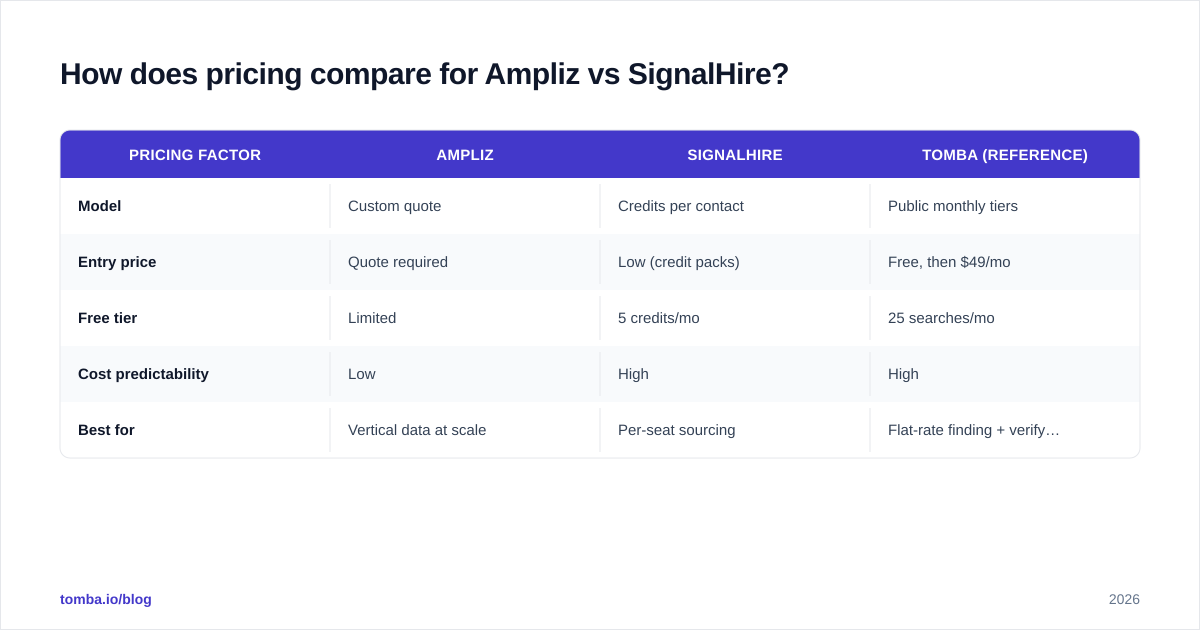
| Pricing factor | Ampliz | SignalHire | Tomba (reference) |
|---|---|---|---|
| Model | Custom quote | Credits per contact | Public monthly tiers |
| Entry price | Quote required | Low (credit packs) | Free, then $49/mo |
| Free tier | Limited | 5 credits/mo | 25 searches/mo |
| Cost predictability | Low | High | High |
| Best for | Vertical data at scale | Per-seat sourcing | Flat-rate finding + verifying |
For comparison, Tomba pricing is fully public: a free tier with 25 searches/month, Starter at $49/mo, Growth at $99/mo, and Pro at $249/mo, with Enterprise custom. The point isn't that one is universally cheaper — it's that a public, flat tier lets you forecast cost-per-valid-email before you commit, which quote-gated models don't.
A budgeting tip: don't compare sticker prices, compare cost per valid, deliverable email. A "cheap" credit that returns a catch-all you can't safely send to costs you more than a slightly pricier credit that returns a confirmed mailbox — because the bounce damages your sender reputation and suppresses every future send.
)
Which should you choose for your use case?#
Match the tool to the job, not the hype. Here's the decision framework.
Choose Ampliz if:
- You sell into healthcare or APAC markets and need vertical firmographic depth.
- Your motion is account-based — you build segments, enrich CRM records, and feed marketing campaigns rather than picking off individuals.
- You have budget for a custom data contract and value depth in a niche over breadth.
- You're a RevOps or marketing-ops function standardizing on one data enrichment source.
Choose SignalHire if:
- You're a recruiter sourcing candidates from LinkedIn and want emails plus phones in one click.
- You work profile by profile and value the browser extension over bulk list building.
- You want a lightweight ATS bundled in so you don't pay for a separate system.
- You need predictable per-contact pricing and a free plan to start.
Consider a focused finder + verifier stack if:
- Your core need is email discovery at scale with public, flat pricing.
- You care most about deliverability and want catch-all separation and verification baked in.
- You want to layer in phone numbers and enrichment without a six-figure data contract.
The third path matters because "Ampliz vs SignalHire" is often a false binary. Many teams don't need a vertical data warehouse or a recruiter-flavored extension — they need clean, verified emails for outbound, and they need to forecast the cost. That's a different tool category.
You can sanity-check any vendor's coverage against independent reviews on G2 before you commit; user-reported bounce rates and support quality tell you more than a feature grid.
What are the main pros and cons?#
A quick balance sheet, because every tool trades something.
Ampliz — pros: deep healthcare/APAC data, strong account-level attributes, good for segmented list building, API available. Cons: quote-gated pricing kills transparency, weaker outside its specialty verticals, overkill for individual reps.
SignalHire — pros: fast LinkedIn reveal, phone numbers included, bundled ATS, transparent credit pricing, free plan. Cons: coverage tied to LinkedIn freshness, bulk workflow is limited, accuracy varies for thin profiles, credits burn fast at volume.
The shared blind spot: neither is primarily a verification engine. If you're running cold outbound, you still want an independent verification pass before send. Loading unverified contacts straight into a sequencer is the fastest way to torch a domain. Pair whichever tool you pick with proper email verification and, ideally, a domain search step to confirm the company's real email pattern before you trust any single record.

How do these tools fit into a real outbound workflow?#
Tools don't work in isolation — they sit inside a sequence. Here's where each fits.
A typical outbound flow runs: define ICP → find accounts → find contacts → verify → enrich → sequence → track replies. Ampliz slots in at "find accounts" and "enrich," because its strength is breadth of firmographic data per segment. SignalHire slots in at "find contacts," because its reveal model is per-person. Neither owns "verify," which is the step that protects your response rate by keeping bounces near zero.
For recruiters, the flow collapses: SignalHire's bundled ATS means find → store → contact happens in one place, which is genuinely convenient if hiring is your whole job. For sellers, the flow is more distributed, and that's where a flat-rate finder plus verifier often replaces the "find contacts" + "verify" steps more cheaply than either platform alone.
The meta-lesson: audit your workflow before you audit the tools. If three of your seven steps are already covered by your CRM and sequencer, you may only be buying one or two steps — and paying platform prices for them is waste.
The bottom line#
Ampliz and SignalHire are both legitimate, but they answer different questions. Ampliz answers "give me deep, segmented data for my vertical." SignalHire answers "let me grab this specific person's contact info right now." Pick based on whether your motion is list-first or profile-first, and price it on cost per valid email, not sticker price or database-size claims.
If your real job is finding and verifying business emails at a predictable, public price — without a custom data contract or a recruiter-shaped ATS you won't use — start with the Tomba Email Finder. It finds professional emails by name, company, or domain, separates catch-alls from confirmed mailboxes, and prices transparently from a free 25-search tier up through flat monthly plans. Run your 50-account test against it the same day you test Ampliz and SignalHire, and let the bounce rate decide.
// get started
Find, verify and enrich your first contacts today
Start on the free plan with 25 searches a month, then scale when your team is ready.
Free plan · No credit card required · GDPR & CCPA
// about the author