Ampliz vs Smarte: B2B Data Platform Comparison 2026
Choosing between Ampliz and Smarte? We break down data accuracy, coverage, healthcare and APAC reach, pricing, and APIs so you can pick the right B2B data platform in 2026 — and where a focused email finder fits in.
TL;DR
- Ampliz is strongest for healthcare/life-sciences contacts and APAC coverage, with a workflow built around list-building and intelligence.
- Smarte (SMARTe) leans into global B2B contact and account data with a focus on GDPR/CCPA-compliant mobile numbers and direct dials for outbound teams.
- Neither tool is a pure email finder — both bundle firmographics, intent signals, and enrichment, which means higher price floors and longer onboarding.
- Pricing for both is quote-based, so budget predictability is weaker than transparent per-seat tools.
- If your real need is finding and verifying work emails accurately at a known price, a focused tool like Tomba Email Finder usually beats a heavyweight data suite on cost-per-valid-contact.
What are Ampliz and Smarte?#
Both Ampliz and Smarte sell the same promise from different angles: give your sales and marketing teams accurate contact data so reps stop wasting time on dead emails and wrong numbers.
Think of them as two grocery stores stocking the same aisles. Ampliz built its reputation on healthcare and life-sciences data — physicians, hospital decision-makers, NPI-linked records — and on Asia-Pacific coverage that many US-centric vendors lack. Smarte (branded SMARTe) positions itself as a global B2B data platform for revenue teams, emphasizing GDPR/CCPA-compliant mobile numbers, direct dials, and a browser extension that pulls contacts while you prospect on LinkedIn or a company site.
Neither is a single-purpose email finder. They are B2B data and intelligence suites: contact records sit next to firmographics, technographics, and (in Smarte's case) buying-intent signals. That bundling matters for both price and fit, which we'll get into below.
If you only skim one section, make it the pricing and accuracy comparison — that's where the two diverge most.
How do Ampliz and Smarte compare at a glance?#
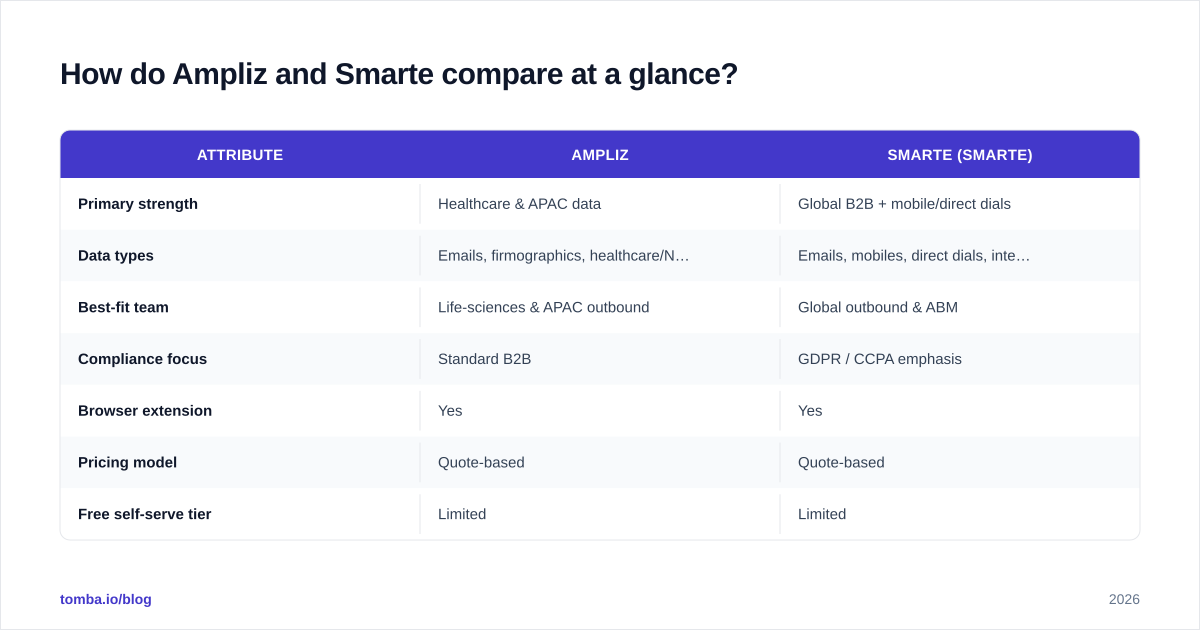
Here's the head-to-head before we unpack each dimension.
| Attribute | Ampliz | Smarte (SMARTe) |
|---|---|---|
| Primary strength | Healthcare & APAC data | Global B2B + mobile/direct dials |
| Data types | Emails, firmographics, healthcare/NPI | Emails, mobiles, direct dials, intent |
| Best-fit team | Life-sciences & APAC outbound | Global outbound & ABM |
| Compliance focus | Standard B2B | GDPR / CCPA emphasis |
| Browser extension | Yes | Yes |
| Pricing model | Quote-based | Quote-based |
| Free self-serve tier | Limited | Limited |
| Verification | Built-in checks | Built-in checks |
| API access | Yes (plan-dependent) | Yes (plan-dependent) |
The pattern is clear: these tools overlap heavily on the "what" (B2B contacts) and differ on the "who" and "where" — Ampliz for specialized verticals and Asia-Pacific, Smarte for broad global reach with phone-heavy outbound.

Which has better data accuracy and coverage?#
Accuracy is the only metric that matters once a list lands in your sequencer. A 100,000-record database is worthless if a third of the emails bounce and torch your sender reputation.
Both vendors claim high accuracy, but the honest answer is that accuracy is regional and vertical-specific, not a single global number. Use this framework when you evaluate either one.
- Ampliz tends to win where it specializes. If you sell to hospital systems, clinics, or life-sciences companies — especially across India, Singapore, Australia, and the wider APAC region — its records are deeper and fresher than a generalist database. Outside those niches, coverage thins out.
- Smarte spreads wider. Its strength is global B2B breadth with a heavy investment in mobile numbers and direct dials, which is why callers and multi-channel outbound teams gravitate to it. Email accuracy is solid but not categorically better than the field.
The catch with any large database is the catch-all problem: domains that accept every address at the server level, so a standard SMTP check can't confirm whether a specific mailbox exists. Both platforms will hand you catch-all records that look valid but aren't. This is exactly why a dedicated email verifier and a catch-all verifier belong in your stack regardless of which database you buy — they re-confirm deliverability at send time instead of trusting a record that was scraped months ago.
If you want to understand how a vendor sources and refreshes records before you commit, ask them the same questions Tomba answers publicly on its data sources page: where does the data come from, how often is it re-verified, and what's the documented bounce rate?
How does pricing compare for Ampliz vs Smarte?#
Neither Ampliz nor Smarte publishes transparent self-serve pricing — both run on quote-based, sales-gated plans. That's standard for the data-suite category, but it has real consequences:
- You can't estimate cost-per-valid-contact before a sales call.
- Annual commitments are common, so you're locked in before you've stress-tested data quality.
- Credit definitions vary (a "credit" may unlock a full record, an email only, or a phone number), which makes apples-to-apples comparison hard.
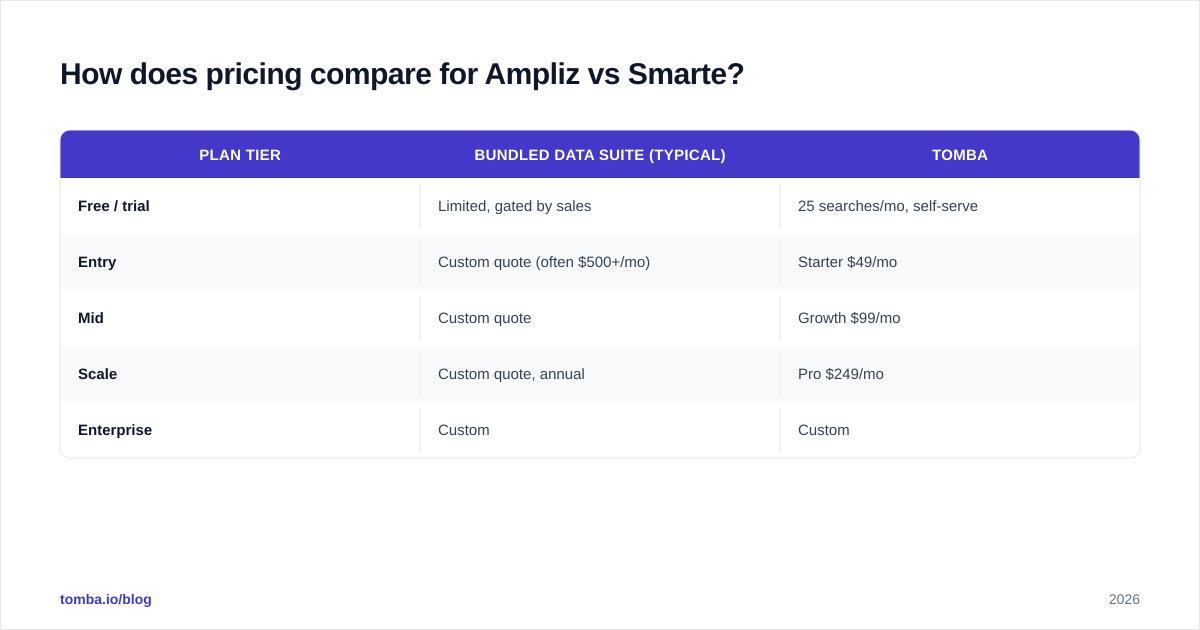
Compare that to transparent per-seat or per-credit tools. For reference, here's how a focused email-finding stack prices against the bundled-suite model.
| Plan tier | Bundled data suite (typical) | Tomba |
|---|---|---|
| Free / trial | Limited, gated by sales | 25 searches/mo, self-serve |
| Entry | Custom quote (often $500+/mo) | Starter $49/mo |
| Mid | Custom quote | Growth $99/mo |
| Scale | Custom quote, annual | Pro $249/mo |
| Enterprise | Custom | Custom |
You can see the full breakdown on the Tomba pricing page. The point isn't that Ampliz or Smarte are overpriced — it's that you're paying for a bundle (intent data, technographics, account intelligence). If you genuinely use all of it, the bundle can be worth it. If you mostly need accurate emails to fill a sequence, you're subsidizing features you'll never open.
Which is better for outbound and prospecting workflows?#
The right answer depends on your motion.
Choose Ampliz if:
- You sell into healthcare, pharma, medical devices, or life sciences.
- Your territory is Asia-Pacific or you need strong India/APAC coverage.
- You build targeted lists by specialty, NPI, or institution type.
Choose Smarte if:
- You run global outbound and need broad firmographic reach.
- Phone is a primary channel — its direct-dial and mobile coverage is the headline feature.
- Compliance (GDPR/CCPA) is a board-level concern and you want documented consent handling.
Choose a focused email finder if:
- Email is your main channel and you want predictable cost-per-contact.
- You'd rather verify deliverability yourself than trust a stale database record.
- You need bulk email finding and data enrichment without an annual enterprise contract.
There's also a hybrid play that a lot of teams miss: use a data suite for account selection and intent, then run the actual contacts through a finder-and-verifier before they hit your sequencer. You get the suite's targeting and a finder's deliverability discipline — without betting your sender reputation on records you can't audit.
What do reviews say about Ampliz and Smarte?#
Third-party review sites are the closest thing to an unbiased read, since both vendors gate their own benchmarks. Patterns worth noting from G2 and similar directories:
- Ampliz reviewers consistently praise vertical depth (healthcare) and responsive support, while critiques cluster around coverage gaps outside its core regions and verticals.
- Smarte reviewers highlight mobile/direct-dial quality and the prospecting extension, with the usual data-suite complaints: occasional stale records and pricing opacity.
Treat any single star rating with skepticism. A 4.4 average tells you nothing about whether the data is accurate for your ICP. The only honest test is a sample list: ask each vendor for 100 records matching your exact target profile, then run them through an independent email verifier and count the valid, deliverable mailboxes. Whichever vendor delivers more verified contacts per dollar wins — for you, specifically.
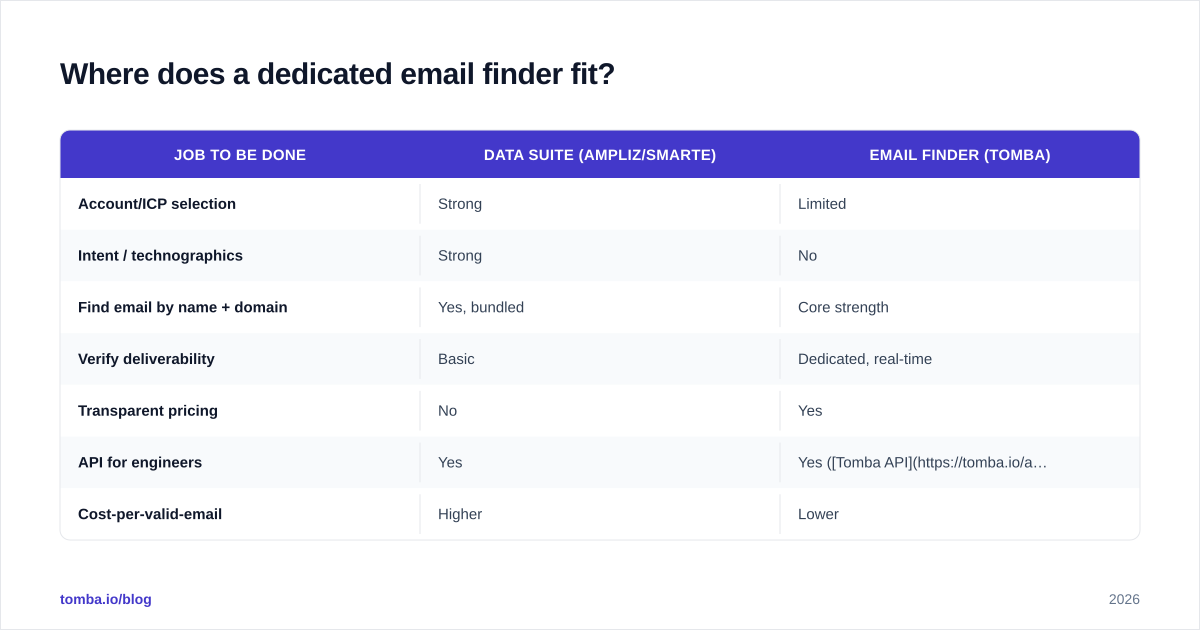
Where does a dedicated email finder fit?#
A data suite and an email finder solve overlapping but distinct problems. Here's how to think about the seam between them.
| Job to be done | Data suite (Ampliz/Smarte) | Email finder (Tomba) |
|---|---|---|
| Account/ICP selection | Strong | Limited |
| Intent / technographics | Strong | No |
| Find email by name + domain | Yes, bundled | Core strength |
| Verify deliverability | Basic | Dedicated, real-time |
| Transparent pricing | No | Yes |
| API for engineers | Yes | Yes (Tomba API) |
| Cost-per-valid-email | Higher | Lower |
If your bottleneck is "I know the companies and people I want, I just need their valid work emails," a suite is overkill. Point a finder at a domain with domain search, pull the named contact with the email finder, verify it, and you're done — at a fraction of the per-record cost and with no annual lock-in.
If your bottleneck is "I don't even know which accounts to target yet," a suite earns its price by narrowing the field with firmographics and intent. The two are complements more often than competitors.
Frequently asked questions#
Is Ampliz or Smarte better for healthcare leads? Ampliz, in most cases. Its healthcare and life-sciences dataset — including NPI-linked physician records — is its founding specialty and remains deeper than Smarte's generalist coverage for that vertical.
Is Smarte better for phone outreach? Generally yes. Smarte invests heavily in mobile numbers and direct dials with a GDPR/CCPA-compliant posture, which makes it a stronger fit for call-led and multi-channel teams.
Do either of them replace an email verifier? No. Both run basic checks, but neither replaces a dedicated, real-time email verification step at send time — especially for catch-all domains where database records can't be trusted.
Can I see pricing without a sales call? Rarely. Both are quote-based. If transparent pricing matters, compare against published tiers like Tomba pricing before you commit to an annual contract.
What's the cheapest way to test data quality? Request a 100-record sample matching your ICP from each vendor, verify it independently, and compare valid-contact yield per dollar. Real deliverability beats any marketing accuracy claim.
The bottom line#
Ampliz and Smarte are both credible B2B data platforms, and the "winner" depends entirely on your motion. Pick Ampliz for healthcare and APAC depth. Pick Smarte for global reach and phone-heavy outbound. But be honest about what you're buying: a bundled, quote-gated suite whose extra modules only pay off if you actually use them.
If email is your channel and you want accurate work emails at a price you can see before you commit, skip the suite tax. Start free with Tomba Email Finder — 25 searches a month, no sales call — find contacts by name, company, or domain, verify them in the same workflow, and only scale up when the numbers prove out. You can always layer a data suite on top later for account selection; you can't un-burn a sender reputation built on records you never verified.
// get started
Find, verify and enrich your first contacts today
Start on the free plan with 25 searches a month, then scale when your team is ready.
Free plan · No credit card required · GDPR & CCPA
// about the author